Feed 44
Crashing the Party of Lincoln on Feed 44

C4SS Feed 44 presents Joel Schlosberg‘s “Crashing the Party of Lincoln” read by Christopher B. King and edited by Nick Ford.

A closer look at the party’s history instead corroborates Kevin Carson’s assessment that from its inception, “the Republican Party is the direct heir to a long line of Hamiltonians, all seeking to use state power to promote the interests of the plutocracy and the wealthiest and most powerful business people at the expense of working people.”

Richardson writes that the GOP was formed “in opposition to the wealthy slaveholders,” implying an opposition to a wealthy elite per se. But the party always aimed merely to replace the slaveowners’ economic elite with its own Hamiltonian industrial elite. The Civil War was the fountainhead of the alliance between the military and a politically connected elite that Eisenhower called the “military-industrial complex.”

Feed 44:

Bitcoin tips welcome:

  • 1N1pF6fLKAGg4nH7XuqYQbKYXNxCnHBWLB
Commentary
Brazilian Secessionism: Sao Paulo Against the Northeast

After the reelection of Workers’ Party Dilma Rousseff, we see the same pattern that has repeated itself since 2006: Several manifestations, many of them offensive or xenophobic, from people in the Southeast and South of Brazil, especially in Sao Paulo, against people from the poorer Northeast, who voted massively in favor of the incumbent.

And since the presidential election was decided on a very slight margin, and considering too that the Sao Paulo electorate cast their votes mostly for opposition candidate Aecio Neves, secessionist voices have gained a little more momentum.

However, Sao Paulo secessionism is not tied specifically to the 12 years that the Workers’ Party has been in power. It is an older idea, upheld for various reasons and pretexts, from the Northeast migration to the taxes from Sao Paulo that are redistributed to other Brazilian states. Despite being one of the richest states in the nation, the argument goes that Sao Paulo is being held back by being part of Brazil.

There is, though, a far lesser known secessionist movement: the Independent Northeast Movement, which stands in sharp contrast to the arguments offered by their Sao Paulo counterparts. In the article “Neocolonialismo Interno Brasileiro e a Questao Nordestina” (“Brazilian Internal Neocolonialism and the Northeast Issue”), Jacques Ribemboim shows that the economical exploitation of Sao Paulo is a myth. Ribemboim argues that the logic of Brazilian federation is the logic of internal neocolonialism:

“In the current scenario, the Southeast imports labor and raw materials under depressed prices (cheaper) and export to the Northeast manufactured products under high and protected prices. That way, the Northeasterner is compelled to pay more for an automobile or any other consumption item in the internal market as opposed to a free choice in the world market. In other words, she pays an additional labor value to the Paulista to prop up the Sao Paulo industry.”

This Northeastern dependence on the Southeast has occurred because of a historical process in which the central government, in its developmentalist hysteria, has come to protect the existing national industry against any kind of competition. The economy is closed off to the benefit of an industry that has been elected to represent the whole country of Brazil, even though it is actually concentrated mostly in a small swath of the Southeast. The national manufacturing has always been mainly Sao Paulo manufacturing.

It would make sense, for instance, that the Amazonian states should engage in trade with the Andean countries, given their geographical proximity, but that is not possible because according to Brasilia, the Mercosur is sacred.

Thus, the Northeast and the Amazon have been harmed by subsidies in favor of Sao Paulo. These poorer regions have had to buy more expensive products to finance the supposed public good of national development which, in fact, amounts to corporate welfare to the Southeast industry.

Sao Paulo secessionism sweeps under the rug subsidies and protectionism that Northeast secessionism denounces.

Translated by Erick Vasconcelos.

Translations of this article:

Portuguese, Stateless Embassies
Surpresa: A guerra às drogas não tem nada a ver com drogas

Na manhã do dia 6 de novembro, a polícia federal dos EUA, o FBI, comemorou a derrubada do site Silk Road 2.0 e a prisão de seu suposto operador Blake Benthall.

Ao fazer isso, o FBI demonstrou novamente que a guerra às drogas nada tem a ver com aquilo que seus propagandistas afirmam. Se a criminalização das drogas é uma questão de segurança ou saúde pública — relacionada à luta contra o crime ou para evitar overdoses —, fechar o Silk Road é uma das coisas mais estúpidas que os agentes do governo podem fazer. O Silk Road era um mercado seguro e anônimo no qual compradores e vendedores podiam negociar sem o risco de violência associado ao comércio nas ruas. E o sistema de reputação dos vendedores fazia com que as drogas vendidas no Silk Road fossem muito mais puras e seguras que aquelas disponíveis nas ruas.

Mas há tanto dinheiro para ser ganho nesse mercado e os cartéis lutam para controlá-lo exatamente porque se trata de um produto ilegal. É isso o que acontece quando são criminalizadas coisas que as pessoas desejam comprar. São criados mercados negros com preços muito mais altos que quadrilhas lutam para controlar. A proibição do álcool nos anos 1920 nos EUA criou a cultura gângster no país que nos acompanha desde então. Quando a lei seca foi repelida, o crime organizado migrou para outros mercados ilegais. Quanto mais atividades mais consensuais e não-violentas são tornadas ilegais, maior a porção da economia que será transformada em mercados negros que quadrilhas brigarão para controlar.

Por outro lado, os lucros dos cartéis mexicanos diminuíram desde a legalização ou descriminalização da maconha em vários estados americanos. Me pergunto por quê.

Talvez a maior piada é a alegação de que o combate às drogas pretende diminuir seu consumo. É claro que muitas pessoas envolvidas na repressão a entorpecentes realmente acreditem nisso, mas a mão esquerda não sabe o que faz a direita. O comércio de narcóticos é uma enorme fonte de dinheiro para as quadrilhas criminosas que o controlam, mas adivinhe? A comunidade de inteligência dos EUA é uma das maiores gangues de tráficos de drogas do mundo e o comércio global de drogas é uma ótima maneira de financiar aquelas coisas mais repugnantes que o Congresso não pode aprovar abertamente. Há 20 anos o jornalista Gary Webb revelou a colaboração da administração Reagan com os cartéis de tráfico de drogas no marketing da cocaína dentro dos Estados Unidos para levantar fundos para os Contras, esquadrões da morte de direita da Nicarágua — uma revelação que fez com que a inteligência e a mídia mainstream dos EUA o manipulasse e o levasse ao suicídio.

Agora ouvimos que os EUA estão “perdendo a guerra às drogas no Afeganistão”. Naturalmente — é uma guerra especificamente projetada para ser perdida. Foi fácil derrubar o Talibã em 2001 porque ele realmente tentou acabar com o cultivo de ópio, com relativo sucesso. Isso não foi bem aceito pelo povo afegão, que tradicionalmente ganha muito dinheiro com o cultivo da papoula. A Aliança do Norte — que os EUA transformaram em governo nacional do Afeganistão —, porém, era bastante amigável ao cultivo da papoula em seu território. Quando o Talibã foi derrubado, o cultivo do ópio e da heroína continuou em seu nível normal. Colocar os EUA a cargo da “guerra às drogas” no Afeganistão é como colocar Al Capone no controle da proibição do álcool.

Além disso, “vencer” a guerra as drogas significaria acabar com ela. E quem nos departamentos policiais dos EUA quer perder essa fonte de bilhões de dólares em financiamento federal, equipamento militar, apoio da SWAT e extensos poderes de vigilância e apreensão? Trata-se de uma guerra perene, da mesma forma que a tal “guerra ao terror”.

O estado sempre estimula pânicos morais e “guerras” contra uma ou outra coisa. Assim, a população permanece amedrontada e mais disposta a dar poderes para ele. Não acredite em suas mentiras.

Traduzido por Erick Vasconcelos.

Feature Articles
Detroit, Disaster Capitalism and the Enclosure of the Water Commons

The “privatization” of local government functions under the state-appointed emergency manager in Detroit is lionized by a lot of right-leaning libertarians as an example of “free market reform.” But it’s a lot more accurate to treat it as flat-out looting — what Naomi Klein calls “disaster capitalism.”

The so-called “privatization” of government assets, as it’s carried out under “actually-existing free market reform,” is really just the latest example of a phenomenon as old as history: the enclosure of commons by state-connected rentiers. As Michael Hudson stated, in an interview on Thomas Piketty’s Capital:

…let’s look at Forbes’ list of the richest people in Russia, China, the Ukraine or the post-Soviet economies. I can guarantee you that they didn’t make this wealth by saving up income, they didn’t earn a higher income; they stole the property by fraud and internal bribery, the same way that the great fortunes were made in the United States. The History of Really Great American Fortunes by Gustavus Myers shows how the railroad land grants made fortunes by bribing congressmen and by privatising the land. The great fortunes are made by privatising natural resources, land and the public domain, and since 1980, when the concentration of wealth and income have really taken off, as Piketty shows, this is the age of privatisation, of Margaret Thatcher, of Ronald Reagan, and Boris Yeltsin in Russia.

But this goes back way further than Thatcher and Reagan, or even the Gilded Age railroad barons. As Henry George noted, most of the political conflict within the Roman Republic took the form of the patrician classes “privatizing” (enclosing) lands in the public domain, and land-poor and landless peasants periodically rising up to demand land reform.

And the same basic pattern applies to all kinds of public service “privatization,” under the kind of “free market reform” that’s carried out by neoliberal vultures feeding on one prostrate country or another.

The typical “privatization cycle” occurs as follows:

First, a basic infrastructure is created at taxpayer expense, either funded directly by taxpayer revenues or by bonds that will be repaid by the taxpayers. When it’s a country outside the US — especially a Third World country — foreign aid or World Bank loans may also help fund the project.

The infrastructure’s main purpose is usually to provide below-cost water or electric utilities, transportation, etc., to big business interests. In the Third World, that means foreign aid and World Bank loans to build the local power, water and transportation infrastructure needed to make Western capital investments (like offshored production) profitable. In California, the whole corporate agribusiness sector depends on massively subsidized water from government-funded dams. And as we will see below, large-scale business and industrial water consumers in Detroit have received preferential treatment like forbearance on tens of thousands of dollars in past-due water bills, while ordinary household ratepayers in poor neighborhoods are treated without mercy.

Second, Disaster Capitalists (to use Naomi Klein’s term) seize on opportunities presented by US-sponsored coups (like Pinochet and Yeltsin), economic meltdowns (the European periphery and Detroit) and military regime change (the US invasion of Iraq) to coerce governments into selling off that debt-financed infrastructure to global capital. And the Disaster Capitalist toolkit includes using such debt (either to bondholders or to foreign lenders), and fiscal insolvency from debt, in exactly the same way as debt peonage or debt to a company store — to blackmail government entities into “privatizing” their infrastructure to “private” (but politically connected) corporations or to domestic kleptocrats. The purchase price is a sweetheart deal, pennies on the dollar, because of the purchasing corporations’ insider ties to the political authorities selling off the goods.

Third, governments frequently spend more in capital investments to make the “privatized” infrastructure salable than they realize from the sale of it.

Fourth, the first item on the agenda of the corporation acquiring the newly “privatized” infrastructure is typically asset-stripping — jacking up rates, using the revenues as a cash cow, and simultaneously starving it of needed maintenance expenditures. The asset-stripping frequently yields more in returns, in a short time, than the company paid for the infrastructure.

And fifth — as Nicholas Hildyard pointed out in “The Myth of the Minimalist State: Free Market Ambiguities” (Corner House Briefing 05, March 1998) — far from operating as a “free market” actor, the newly “privatized” utility or other infrastructure usually operates within a web of state subsidies and protections that more or less guarantee it a profit.

Yet the practical outcome of these policies has not, in most cases, been to diminish either the state’s institutional power or its spending. Instead, it has redirected them elsewhere. It has also strengthened the power of many Northern nations to intervene in the economic affairs of other countries, notably the indebted countries of the South, the emerging economies of the former Soviet Union, and the weaker industrialised partners of trade blocs such as the European Union….

Far from doing away with state bureaucracy, free market [sic] policies have in fact reorganised it. While the privatisation of state industries and assets has certainly cut down the direct involvement of the state in the production and distribution of many goods and services, the process has been accompanied by new state regulations, subsidies and institutions aimed at introducing and entrenching a “favourable environment” for the newly-privatised industries.

The state has actually played a central role in implementing free market [sic] policies and, moreover, has a continued “intimate and ubiquitous” involvement in regulating the minutiae of the market economy — a direct consequence of the hand-in-glove relationship that free market [sic] governments have fostered between “adjusted” state institutions and market interests….

As an example of how so-called “privatized” state services continue to operate within a state-enforced web of protections, consider the “privatization” of pensions in Chile under Pinochet. The defined-contribution plans (of the sort lionized by the neoliberal Right as an alternative both to older-style corporate defined-benefit pension plans and payroll tax-funded government entitlement programs) were administered by a small number of state-licensed pension funds (a cartel, in other words), with very limited price competition and almost identical high management fees.

As George Monbiot said, “Ours is a toll-booth economy, unchallenged by any major party, in which companies which have captured essential public services – water, energy, trains – charge extraordinary fees we have no choice but to pay.”

What’s happening in Detroit these days follows exactly the same pattern of state-facilitated corporate looting. Detroit is very much an example of “disaster capitalism” in the same tradition as Pinochet’s Chile, Yeltsin’s Russia and Iraq under the Coalition Provisional Authority. Just as the puppet regime administered by Paul Bremer in war-prostrated Iraq sold off the Iraqi economy (via his “100 Orders” to Dick Cheney’s dirtbag friends, the state-appointed “Emergency Manager” in Detroit is overseeing the looting of a public resource commons developed at taxpayer expense.

The motto of Disaster Capitalism is “if it ain’t broke, break it” — so that transnational capital can seize on the opportunity to move in on a defenseless society and strip the carcass. In the case of Detroit, what “broke” the city and left it open to corporate looting was the collapse of the auto industry. The Detroit automobile industry, represented by the Big Three legacy automakers since WWII, resulted from two intersecting forms corporate-state collusion that defined the twentieth century American economy: the car culture and suburban sprawl, and a mass-production industrial model based on waste production and planned obsolescence. Both of these reached terminal crisis in recent years, and the mutually reinforcing wave trough left Detroit as a hollowed out shell, with severely downsized industry and population, burdened with publicly funded infrastructures that had been scaled to serve corporate needs during the peak years of the auto industry.

Just as in New Orleans after Katrina, the Disaster Capitalists are seizing on the opportunity presented by mass black exodus to ethnically cleanse, bulldoze and gentrify entire neighborhoods and sell off publicly-financed infrastructures to predatory corporate strip shop operations.

Homrich, which took over management of Detroit’s municipal water system, took on a $5.6 million contract and promised to shut off water to up to 150,000 households by the end of summer 2014.

A major part of [Emergency Manager Orr’s] decision was to hire a company that was only capable of shutting off households. By their own admission, Homrich had neither the expertise nor the inclination to go after large corporate debtors. Orr chose to attack thousands of residents rather than going after a small number of corporate and commercial accounts. These accounts owe nearly half of the total outstanding bills. Had Orr gone after 40 companies he would have brought in nearly all the outstanding corporate debt. Instead Orr approved a $5.7 million contract for two years to shut off residents. He has yet to account to anyone about these decision. 

The company’s slogan is “water purification, delivery and disposal are not free,” but the question of how much of its price is actually oligopoly markup, management salaries and other additions to the actual cost of providing service isn’t even on the table. And the actual cost of purifying water is imposed on the system mainly by industrial users, not ordinary household consumers.

The fact [water] so often now needs “cleansing” is not primarily because ordinary people have polluted it. The fact the average Detroit bill is nearly twice the national average is not the fault of neighborhood folk who remain in the city. The fact its assessment has been increased 119 percent over the last decade and 8.7 percent over recent months is not due to mismanagement in the average household. The fact over $500 million in bonds raised for infrastructure improvements have been siphoned off to banks making record profits over recent years is not due to decisions made by citizens. The fact Detroit Future City articulates a plan, long in the making, to “triage” some city neighborhoods for re-design in the image of the suburb and that a decade of foreclosures and now “ethnic cleansing by water shutoff” may well serve such plans rather nicely, is not a vision hatched on inner city porches.  The fact Kevin Orr and the governor are likely eager to clear bad debt from the DWSD books to entice a private investor to buy the system to turn a profit — research shows rates are likely to increase three-fold when privatization takes over — is not a motive much explored in media coverage of the moment. But none of this comes up for discussion, when DWSD announces the increased shutoffs and Homrich begins turning the keys.  Instead, the racist certainty poor people of color are “free-loading with their bills” and “showering for three hours every day”…  instantly take over the mainstream mind like a national demon returning home to its most familiar haunt.

Orr has also hired Veolia, one of the world’s largest corporate owners of “privatized” water systems, to advise him on “how to find cost savings” in sewer and water service. And meanwhile Orr is taking corporate bids to “privatize” Detroit’s water. It’s a safe guess that Veolia, which has already looted municipal systems throughout the Great Lakes region in Ontario and the American Midwest, is a prime candidate to take over.

There’s no getting around the fact that the groundwater, natural bodies of water and other reservoirs are themselves commons, and there’s a huge body of capital infrastructure for making this water usable that was financed by local taxpayers or ratepayers. And from this it follows that the act of “privatizing” this socially created commons in which members of the local community have an ownership stake, to rack-renting private water companies, is nothing but an expropriation of their property rights followed up by extortion.

A commons, rightfully speaking, cannot be divided up into individual shares or its property otherwise alienated except by the assent of the whole, by whatever bylaws govern it. To take the example of the mir, or communally controlled open field system in the Russian village, the Stolypin “reforms” and the forced collectivization in the Soviet era were equally impermissible violations of village stakeholders’ collective ownership rights. Although under the customs of most medieval open field systems it was possible to legitimately spin off one family’s aliquot share of the open fields as a “close,” under Stolypin this was imposed wholesale by central government fiat, taking away land that was the common property of the village without village assent. And under the Soviet collectivization program, village boundaries were ignored altogether, the open fields of multiple villages amalgamated together, and village governance rights nullified in favor of state-appointed managers.

In the case of modern water systems, the problem is that the function of commons governance, the rightful province of the ratepayers themselves who communally developed the water system and consumed its output, was usurped by the local government. And we all know who states actually serve — as evidence by the very fact of corporate “privatization” itself.

The results of water “privatization” are generally pretty bad. They just create a new layer of parasites that either siphon off the resources that previously went to maintaining the system, or charge ratepayers in excess of the cost of providing the service.

According to Colin Ward, the late anarchist historian in the UK (“Water and the Gift Relationship”), when village wells and pumps were set up 150 years or more ago, against a background of recurring cholera and other water-borne epidemics, local communities appreciated the significance of clean, abundant water as a common endeavor. And in living memory, when water systems were still a common resource under local control, communities typically responded to conservation measures in a public-spirited manner in times of drought. That ended, first with the nationalization of water control for England and Wales in 1974 under ten regional boards, and then with the sale of the water industry to private corporations in 1989. Subsequently rising water rates and rampant disconnections resulted in a tenfold increase in hepatitis and dysentery. At the same time, thanks to the public’s adversarial perception of water suppliers as a capitalist corporation and of water as a mere commodity, local communities responded with scorn to conservation measures.

In Detroit, according to Halima Cassells, water cutoffs have led — just as in the UK — to the spread of disease, foreclosures and the removal of children from their families.

Kostas Nikolaou, of the European Water Movement, writes: “The results of the private management of water, which is applied worldwide, are now known: degradation of water quality, increased water loss, deterioration of infrastructure and increasing prices.”

The public-private partnership is the usual form of privatization which opened the new field for business profits through the exploitation of the natural resource of water, although it belongs to everyone as a commons, and the labor embodied in the management of water supply and sanitation (processing, quality control, distribution, etc.) and finally, the appropriation of surplus value produced by workers. Further profits arising from the maintenance of infrastructure, implementation of technical projects etc, realized by the same or other companies. The price of water paid by citizens determined by the profits of companies and is well above the actual cost of receiving, processing and transporting water from source to tap.

The policy of privatization of water management is not accidental, but an integral part of the attempted privatization of strategic sectors of the society, economy and environment (as well as energy, natural resources, food, waste management, etc.) within the dominant neoliberalism as the contemporary expression of capitalism. This neoliberal privatization policy in conjunction with the – without historical precedent – aggressive policy of financial capital is an unprecedented attack of the smallest and richest percentage of society against the vast majority of the population and leads to a huge transfer of wealth from workers and small and medium classes to the hands of few, deepening further the current crisis (born and exacerbated because of social inequality) and pushing the system to more extreme disorder.

The policy of “privatization,” far from being a “free market reform,” is corporatist to its core. This is revealed, among other things, by the differential treatment of household and corporate ratepayers. In Detroit individual households in arrears are being disconnected — but not businesses. As Cassells notes, some businesses — despite being in arrears by thousands of dollars — are not being threatened with shutoff. Defenders of the shutoffs say some people would rather keep getting cable than pay their water bills. But they don’t mention that

there are corporations who would rather make money on cable broadcasts of their events than pay their water bills — such as Joe Louis Arena (home of the Red Wings) or Ford Field (home of the Lions) who owe respectively $80,000 and $55,000. And who at the time of the national broadcast were not facing shutoff. When white-owned corporations don’t pay, there is no mention of the fact and no rebuke. But if poor people of color struggle with bills, then all manner of stereotype and indignant excoriation come rolling to the surface. What may be true of a few cases gets readily cast across entire communities as the rationale for shutting down core city neighborhoods almost en masse. The racist disparagement could not be more evident.

And in even more egregious cases, private water utilities allow corporate malefactors like Nestle’s Poland Springs bottled water operation to deplete local water systems of artificially cheap water.

The fact that cutoffs are focused entirely on occupied homes, while water gushes from broken pipes in thousands of abandoned properties that haven’t been cut off, suggests that the real motivation is ethnic cleansing (along the lines of post-Katrina New Orleans) rather than actual cost-cutting.

All so-called “free market reform” and “privatization” that’s undertaken as a matter of state policy, in collusion with the corporations that stand to benefit from it, will inevitably result in corruption and political capitalism. As Noam Chomsky argued

Concentrated private power strongly resists exposure to market forces, unless it’s confident it can win in the competition. That goes back centuries…. Protectionist devices, such as those of NAFTA and the WTO, are only a fraction of the means by which the wealthy and powerful protect themselves from market forces. In fact, the core of the “new economy” is based on the principle that cost and risk should be socialized, and profit privatized (often after decades in the dynamic state sector).

The term “lemon socialism” was coined to describe the nationalization of industries that were losing money, but were still vital infrastructures or sources of primary inputs for corporate capitalism as a whole. Such “socialism” usually took the unprofitable industries off private capital’s hands for a lot more than it would have fetched on the securities markets, or gave the former rentier owners of the industries a new guaranteed income from interest on taxpayer-financed bonds.

Conversely, most of what passes for “privatization” and “market reform” in the political mainstream is really just “lemon privatization”: liquidating statist policies after corporate interests have squeezed all the benefit out of them. Instead of the capitalist state taking over a necessary function on behalf of big business because corporations no longer find it profitable to operate on their own nickel, the capitalist state is ceasing to perform a function that no longer serves the interests of big business. The legacy beneficiaries of all that statism decide it’s finally safe to change the rules and compete with the non-beneficiaries on a “level playing field.”

That’s pretty much what was involved in the British adoption of “free trade” in the nineteenth century: after they’d built a global commercial empire through mercantilism, forcibly unified world commerce in British bottoms, suppressed foreign textile trade, committed holocausts in Ireland and India, and exported enclosures to half the world, they decided it was time for the lion and the lamb to compete under a single law. “OK, no more government intervention, starting…. NOW!”

“Privatization” and “market liberalization” policies lobbied for by Halliburton, or by billionaires like the Koch Brothers and their ilk will always — always — result in corporate collusion and welfare for the rich.

What would a real free market reform look like?

The only rightful ownership of a common resource, developed at the expense of the community, is commons governance. To quote Nikolaou again:

So what is the answer? Once the water belongs to everyone, since it is a commons, a social good, a human right, then it must be social ownership and management. That is, they are real owners and managers all citizens with direct democracy, with equality, with social solidarity, without profit, without taxes. How can this be done?

Neo-mutualist anarchist Larry Gambone, in some writings no longer online, some years ago proposed “mutualization” of public services as an alternative to both state ownership and corporate “privatization.” That is, they should be transformed into stakeholder cooperatives governed by some mixture of representatives from those working in the public services and their consumers. So (for example) a public utility, instead of being sold to a corporation, should be turned into a cooperative jointly owned and managed by some combination of utility employees and ratepayers.

The same theme runs through much of the work of English anarchist Colin Ward. In Ward’s schema of recent British welfare history, there was originally a self-organized working class safety net of friendly societies, mutuals, lodges, cooperative insurance, building societies, and the like (described at length by Pyotr Kropotkin in Mutual Aid and E.P. Thompson in Making of the English Working Class). This welfare state was usually cooperatively owned and administered by its working class clientele themselves, and was frequently organized under the auspices of trade unions. Both the Fabian model of state socialism at the turn of the 20th century and the post-WWII Labour government were ideologically hostile to such forms of organization, and nationalized all such functions into central authorities administered by “properly qualified professionals.” And then three decades later, these centralized national authorities in turn were “privatized” to capitalist corporations under Thatcher. Despite the fake populist rhetoric of the Right, the managerialists running large corporations were as hostile as state bureaucrats to any form of genuine self-organization by ordinary people.

Ward proposed a return to the working class’s self-organized and self-managed social safety net in healthcare, education and other fields as an alternative to both state socialist and capitalist managerialism.

Mutualization was also promoted, after a fashion, by American libertarian Murray Rothbard. In “Confiscation and the Homestead Principle” (Libertarian Forum, June 15, 1969) he argued that, since state titles to property were invalid, state property like public utilities should be treated as unowned, and immediately become (via homesteading) the property of those currently using it. That would mean state industry to the workers, collective farms to the villagers, and public services reorganized as consumer cooperatives.

More recently, the Foundation for Peer-to-Peer Alternatives and other advocates of commons-based production have proposed organizing public services, as a commons, on a p2p or stakeholder cooperative basis.

The New Economic Foundation (NEF) has hence recently argued that public services should be delivered democratically and with the help of other not-for-profit community and civil society groups….

The first [step] is co-production among experts and citizens who are recipients of a service, in order to combine their knowledge.

Then there is participatory democracy, that allows service users more control over decisions, over public spending (through participaroty budgeting) and even over political decisions (an example is Iceland, who recently tried to “crowdsource” its new constitution).

One more measure to shift power is the reformation of public agencies so that they resemble the model of cooperative governance structures, by granting less hierarchical working cultures that ensure more autonomy and trust to their staff….

In short, “privatization,” as it is advocated by billionaires like the Koch brothers and their pet think tanks, is nothing but theft. The only genuine property rights in this scenario are the communal rights of the public who developed the resource commons. And this genuine property right is subject to constant expropriation and looting, in recent years, by the very neoliberal elites who talk the most about “free markets” and “property rights.”


Commentary
Belem: The Siege, the Drug War and the Police State

The night of November 4th in Belem, capital of Brazil’s Para state, was terrorizing. After the death of Corporal Figueiredo, from the Tactical Ops (Rotam) of the Military Police of the State of Para, at 7:30 PM, there was a violent retaliation, killing nine people, according to the official numbers, six of whom were undoubtedly executed. The victims appeared concurrent to the Rotam operation intended to arrest those responsible for the death of Corporal Figueiredo. Despite the official number of deaths, most people believe many more were killed during the night.

Rumors, audios, and videos were widely shared though WhatsApp and Facebook while the executions happened, showing what was happening on the outskirts of Belem. There was an unofficial curfew in several places on the periphery, given the expectation that there would be a violent retaliation to the death of the policeman and that the death squads that was wreaking havoc (presumably made up of military policemen) did not intend to take any prisoners. This group supposedly was covered by the official Rotam operation and they intended to kill any suspects.

It is important to highlight here that the deaths did not occur due to gunfights or resisting arrest. They were outright murders. The state government itself recognizes in an official statement that they were homicides, even though it does not conclude that the Military Police took part in them. Luiz Fernandes, Secretary of Public Security of Para, also admits that investigators are working on the hypothesis that death squads were acting there.

However, the sequence of events cannot be understood unless we comprehend their context: The local drug war dynamics.

In Belem, 66% of the population live in irregular buildings, favelas (slums) or the like, which, first, sprouted up near the center of the city (such as neighborhoods Guama, Jurunas, and Terra Firme — the last one being the stage of the murders) and, more recently, in the suburbs. They are very dense areas, with very little space between houses, allowing for the settlement of a large number of migrants from the state’s countryside and from the neighboring state Maranhao.

These areas, however, not unlike many others in Brazil, are marked by precarious access to basic utilities, like sewage disposal, and poor protection of the dwellers’ property rights (despite expropriations and evictions being uncommon in Belem). Moreover, as a result of drug prohibition, they end up under the rule of violent dealers.

Some time ago, it became known that the drug warlords were financing the militias. According to a report from the beginning of the year about the actions of militias in Guama and Terra Firme, these groups were formed by criminals and policemen (generally who are no longer formally affiliated with the Police) for the protection of drug dealers against other dealers and the police. They also regularly extort the local population. According to a Terra Firme dweller, who was quoted on the above report:

They ask people for money and kill whoever gets in their way. It is criminals killing criminals, but there are several honest citizens who are victims as well. When they are bothered by someone, they create a situation for a crime to happen.

The group which acts in the Guama neighborhood, made up mainly by retired police officers, is supposedly involved in the murder of young people, those “who walk around the streets at the wrong time, thieves and drug users,” as a local put it. Out of fear, silence prevails.

The story also tells that the police usually work on the hypothesis that these are hired gunmen, who are paid to enforce debts or murder the borrowers, denying the existence of militias and death squads that are financed by stolen money from the local populations. The events of the 4th seem to have changed that perception, since the government itself has admitted that death squads have been involved.

The general fear after the death of Corporal Figueiredo illustrates how real police, militia, and drug violence is in these areas. This fear has, for the first time, reached the richer areas of Belem, areas unfamiliar with the day to day uneasiness that the poor suffer through. Like never before, the night of November 4th made people, from very different social backgrounds, share the same fear.

Therefore, the murders were not a simple “isolated case,” but a perennial reality for the poor people of Belem, many of whom know or are related to someone who was murdered, were evicted from their homes by drug dealers, or just generally avoid staying out late (always!), afraid of what might happen to them.

These people, who suffer in every imaginable way, are denied the most basic and elementary way to reduce violent crime in Brazil: the end of the war on drugs. There is no reason, at all, that Brazilian cities should top the rankings for “most murders” in the world besides the failure of prohibition. Many cities are even more dangerous than Belem, but the causes of violence are similar. Most murders in Belem and elsewhere are related to drug feuds.

One of the main libertarian causes is the end of this abhorrent policy that takes away individual rights, puts behind bars many thousands of peaceful people and kills more than any substance addiction.

People who live in poor areas (and in other places, naturally) are sold the idea that only more repression will be able to solve the problem of public security. The drug user is the scapegoat and their frequent summary executions by the police are often welcomed.

Due legal process seems to be a burden to the police in Brazil, and its very existence seems to provide them with an even broader license to kill. We lose sight of the deep connections between the police, drug dealers and militias. The poor are the ones most exposed to the resulting police state, and the naive faith in the police as a guardian of order can only worsen their condition.

Belem shows vividly the monstrosity that the war on drugs is and its consequences to the urban dynamics in poor areas, marked by violence everywhere.

The main cause of all these deaths is not the lack of police repression or more executions, but the state itself and its criminalizing impetus, that enriches warlords and makes peripheral communities ever more vulnerable.

Translated by Erick Vasconcelos.

Portuguese, Stateless Embassies
O caminho libertário para o igualitarismo

Um estudo recente feito nos Estados Unidos pelo Bureau de Pesquisas Econômicas, de Emmanuel Saez e Gabriel Zucman, mostrou que o “0,1% de famílias [americanas] mais ricas possuem mais ou menos a mesma parcela da riqueza que os 90% mais pobres“. Além disso, o estudo mostra que a “recuperação” que continuamos a ouvir falar ainda não alcançou a classe média nos EUA, tendo beneficiado somente aqueles no topo da pirâmide.

Como uma parcela muito pequena da população detém uma riqueza tão grande, analistas políticos e acadêmicos apontam os dedos uns para os outros e inventam soluções. Previsivelmente, o livre mercado é culpado pela ampliação das desigualdades de riqueza e renda. Expoentes da desregulamentação e da liberação dos mercados, os libertários normalmente são acusados de viverem em um mundo de fantasia em que os problemas da desigualdade não existem.

Nós, libertários, fazemos isso a nós mesmo. Quando o assunto surge, muitos de nós ficamos desconfortáveis e defensivamente insistimos que a desigualdade não é de fato um problema, que devemos analisar os padrões médios de vida e outras medições. “O capitalismo é ótimo para os pobres — eu juro!” Os libertários devem aceitar o fato de que a desigualdade é de fato um grande problema.

Mas não precisamos considerar a desigualdade como uma fraqueza em nossos argumentos em favor da liberdade econômica ou como uma questão na qual simplesmente não podemos vencer. As relações econômicas atuais não são resultado da liberdade de trocas ou de relações de propriedade legítimas. Os libertários na verdade estão em posição melhor do que se supõe. A liberdade e a igualdade se complementam e se reforçam, e esta resulta naturalmente daquela.

Anarquistas individualistas como Lysander Spooner consideravam que “os extremos em riqueza e em pobreza” resultavam de “legislações positivas”, que colocavam leis arbitrárias no lugar de leis naturais e “estabeleciam monopólios e privilégios”. No capitalismo, alegava Spooner, os donos do capital tinham poderes especiais na economia — poder que nada tinha a ver com a liberdade de produção, comércio e concorrência. Holisticamente, a intervenção estatal redunda em benefícios aos ricos e politicamente conectados, as elites econômicas com acesso especial àqueles que escrevem e implementam as regras a que estamos sujeitos.

Essas intervenções não são perfeitas e certamente o sistema de capitalismo monopolístico vigente no país possui leves proteções aos trabalhadores, consumidores e pobres. Essas medidas, porém, não comprometem o propósito fundamental da intervenção estatal: desapropriar os proprietários verdadeiros e deixar a maioria à mercê de seus empregadores. O propósito histórico da intervenção estatal, em suma, é a luta de classes permanente, o uso do poder estatal para isolar uma aristocracia econômica.

A esquerda política está certa a respeito da desigualdade, mesmo que esteja errada a respeito da liberdade, dos direitos individuais e dos mercados. Os anarquistas de mercado lutam em favor tanto da liberdade quanto da igualdade, defendendo uma sociedade sem estado na qual a lei máxima é a igualdade de liberdade e autoridade.

A concorrência aberta e genuína é uma força de dissolução e dispersão. Os libertários devem parar de inventar desculpas para as gritantes desigualdades atuais, como se tivéssemos chegado neste ponto através de um regime laissez faire e de soberania do indivíduo.

Traduzido por Erick Vasconcelos.

Feed 44
Fairness and Possession on Feed 44

C4SS Feed 44 presents “Fairness and Possession” from the book Markets Not Capitalism, written by Gary Chartier, read by Stephanie Murphy and edited by Nick Ford.

C4SS trustee and senior fellow Gary Chartier is a Professor of Law and Business Ethics, and Associate Dean of the School of Business, at La Sierra University. He is the author of Economic Justice and Natural Law (Cambridge University Press 2009), The Analogy of Love (Imprint Academic 20007), The Conscience of an Anarchist and Anarchy and Legal Order (Cambridge 2012), as well as articles in journals including the Oxford Journal of Legal Studies, Legal Theory, Religious Studies, and the Journal of Social Philosophy. He holds a PhD from the University of Cambridge and a JD from the University of California at Los Angeles.

Feed 44:

Bitcoin tips welcome:

  • 1N1pF6fLKAGg4nH7XuqYQbKYXNxCnHBWLB
Commentary
Wild, Wonderful and Free

Don Blankenship, longtime Chief Executive Officer of coal giant Massey Energy, was indicted November 13 on charges that he consistently violated federal mine safety rules at the company’s Upper Big Branch Mine until an April 2010 explosion that killed 29 of 31 miners.

The Charleston, West Virginia Gazette reports that a federal grand jury charges Blankenship with “conspiring to cause willful violations of ventilation requirements and coal-dust control rules — meant to prevent deadly mine blasts — during a 15-month period prior to the worst coal-mining disaster in a generation.” The allegations come with a maximum prison sentence of 31 years.

I take no joy in the prospect of another dehumanizing incarceration, but regret that a coal baron held so much power in the first place.

Before industry came to the mountains a unique form of common governance existed. Communities obtained subsistence from the surrounding old growth forest. Everyone understood not to claim more than necessary from the commons. This governance naturally produced the maximum sustainable yield of resources. Locals labored, bartered and brought goods to market together.

As European expansion claimed the new world, land became the ultimate commodity and all eyes were fixed on the pristine forests of Appalachia. Enclosure movements commenced as a cash economy developed in the region for the first time. By the early 19th century violent confrontations ruined native populations. The mass slaughter of indigenous people culminated in the Trail of Tears, eradicating tribes from Appalachian governance.

Decades later, in post-Civil War America, mountain settlers were coaxed into selling mineral rights to would-be industry barons. Broad form deeds were developed to acquire local lands. Mineral rights were obtained for less than a dollar an acre as mountaineers maintained surface rights. Clauses in these deeds, however, allowed industrialists to take over the land at the company’s discretion for resource extraction — even if such acquisition would surprise grandchildren decades later. Locals were forced off of their property to line the pockets of absentee capitalists, often by rights that had been sold generations before. By the end of the Industrial Revolution coal reigned as king.

Industry came to own a vast amount of property in the Central and Southern Appalachians, affording barons incredible power over mountain communities. Company towns popped up near mining operations. Workers lived in company barracks, were paid in company scrip and were required to purchase goods at the company store. Mono-economies developed across the coalfields that still persist today.

Working conditions were incredibly hazardous for miners. Explosions, shaft collapse, Black Lung and Silicosis ran rampant in coal communities, as did poverty. Company scrip kept workers incredibly poor as billions of dollars were  extracted from the region. Worker organization was rather difficult in these company-owned communities, but rebellion and unionization did take place. Unionization failed to liberate labor, however, as class struggle fell to capital. The coal towns acted as an exploitative system of power, impacting every aspect of the lives of miners and their families. Powerlessness produced quiescence.

With the news of Blankenship’s indictment, we are reminded of this historical context and confronted with the realization that not much has changed to this day. Appalachian communities experience some of the worst poverty in the United States. Miner safety is set aside for the sake of capital. Vast ecosystems are destroyed as mountaintop removal blasts its way across the landscape. Broad form deeds, after the boom of strip mining in the 1970s, claimed family hollers throughout the 1980s and 90s. The regulatory state, charged with oversight, continually turns a blind eye to industry violations and worker injuries so coal mines can stay in operation, as recently reported by NPR.

But, for what it is worth, I am an optimist. Restorative justice and regeneration is coming to the coalfields. A beautiful anarchism awaits Appalachia.

Coal has established deep cultural roots in the region and will no doubt remain a market mainstay for some time to come. But coal will no longer reign. Deserved competition will significantly reduce its role. Pristine mountain ecosystems will reclaim prominence in emerging economic orders. Beneficial ecosystem services, far too important for the cash nexus, will reclaim their rightful place in the market. Holistic medicine, decentralized food production, eco-tourism, alternative energy markets and trade cooperatives are just a few examples of market forces that will empower mountain people to reclaim the commons. As opposed to capital, individuals will own the means of production, hold agency over their labor and signal the market.

There are no words to describe the complexity that will follow. Such a liberty can only be imagined by the people of this incredibly diverse, ancient terrain. Appalachia will be wild, wonderful and free.

Stigmergy - C4SS Blog, Weekly Libertarian Leftist Review
The Weekly Libertarian Leftist And Chess Review 56

Sheldon Richman discusses Jon Stewart.

Glenn Greenwald discusses how many Muslim countries the U.S. has bombed since 1980.

Wendy McElroy discuses Robert LeFevre.

George H. Smith discusses David Hume on justice.

Justin Raimondo discusses the midterm elections and militarism.

Doug Bandow discusses the GOP taking of the Senate and war.

John Philpot discusses Palestine, Syria, and Iraq.

Uri Avnery discusses ISIS and Israel.

Jason Leopold discusses the Senate report on CIA interrogation.

Anthony D. Romero discusses a Gitmo cover up court.

Patrick Cockburn discusses life under ISIS.

Jeffrey A. Tucker discusses democracy and the unelected part of government.

Peter Van Buren discusses Iraq War 3.0

Laurence M. Vance discusses Veteran’s Day.

Sheldon Richman discusses Uber.

Ivan Eland discusses the strategy being used to battle ISIS.

Dan Glazebrook discusses the lessons of Libya.

Joseph Salerno discusses war making and class conflict.

Wendy McElroy discusses war propaganda and court journalists.

Jacob G. Hornberger discusses interventionism in Iraq.

Robert Parry discusses the neocon plan for more war.

Steve Breyman discusses Obama and the convention against torture.

Judith Bello discusses drone warfare.

Richard M. Ebeling dicusses Gordon Tullock.

Uri Avnery discusses the police shooting of an Arab.

Christopher Brauchli discusses deja vu in foreign policy.

Justin Raimondo discusses Iraq.

Linn Washington Jr. discusses Nixon’s war on pot.

Feed 44
How Libertarians Should — And Should Not — Approach Millennials on Feed 44

C4SS Feed 44 presents Kevin Carson‘s “How Libertarians Should — And Should Not — Approach Millennials” read by James Tuttle and edited by Nick Ford.

Millennials are used to networked collaboration. In the workplace they view such collaboration with their peers as the way to get things done, and see traditional corporate managerial hierarchies as a form of damage to be routed around. The same ethos is reflected in the political models that have emerged in recent years — the Arab Spring, M15, Syntagma, Occupy — all reflect this.

Millennials favor horizontal, prefigurative politics over older models of working within the system for good reason. In the economic realm, they took out student loans and got good grades — followed all the rules for advancement under the old “meritocratic” system — and wound up working part-time for temp agencies (if at all) after moving back in with their parents. In the political realm, enthusiastic 20-somethings turned out in record numbers to vote for Obama. And Obama, elected with the most left-sounding rhetoric, and the largest electoral and Congressional majorities in a generation, turned out to be every bit as much of a tool of the banks and the warfare and surveillance state as Bush had been.

As a result, Millennials have low levels of faith in old-style vertical hierarchies like the corporation or the state to mediate their vision of the good life. Instead, they see direct collaboration with each other to create the kind of life and counter-institutions they want, here and now, as the way to realize their ideals.

Feed 44:

Bitcoin tips welcome:

  • 1N1pF6fLKAGg4nH7XuqYQbKYXNxCnHBWLB
Feed 44
From Whence do Property Titles Arise? on Feed 44

C4SS Feed 44 presents “From Whence do Property Titles Arise?” from the book Markets Not Capitalism, written by William Gillis, read by Stephanie Murphy and edited by Nick Ford.

Forgive the digression to my 90s Nickelodeon childhood, but in illustration I am reminded of an episode of Angry Beavers in which the brothers suddenly discover that they each have a musk pouch capable of marking items with a colored personal stench that repels everyone but themselves. This quickly sets off a war of personal claim until the entire world is divvied up with one stench or the other, each brother more and more completely obsessed with the tally until they can think of nothing else.

This is perhaps the most classic criticism of capitalism — one of simple psychology — and yet it seems to be a critique market theorists are incapable of parsing. To many an anti-capitalist the problem with the capitalist framework is its inherent bent towards materialism, ultimately to the point of treating human beings as objects. But this is incomprehensible for Libertarians because they see respect for property titles as entirely stemming from a respect for personal agency. In practical, everyday terms respect for another person’s agency often comes down to a respect for the inviolability of their body. Do not shoot them, do not rape them, do not torture them. Because humans are tool using creatures like hermit crabs there is often no clear line between our biomass and our possessions (we use clothes instead of fur, retain dead mass excreted as hair follicles, etc.), and so a respect for another’s person seems to extend in some ways to a respect for things that they use. Begin to talk of Rights and these associations must be drawn more absolutely. And sure enough we already have a common sense proscription often enforced in absolutist terms that matches this intuition; do not steal.

Yet the anti-capitalists are clearly on to something. Even setting aside the evolutionary cognitive biases of homo sapiens, we as individuals have limited processing. We can’t think everything at the same time. If some of the thought processes necessary to succeed and flourish under in a given system run out of control and take up more and more space, others — like those behind why we adopted that system in the first place — will get pushed to the periphery.

Feed 44:

Bitcoin tips welcome:

  • 1N1pF6fLKAGg4nH7XuqYQbKYXNxCnHBWLB
Stigmergy - C4SS Blog
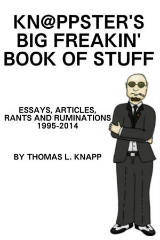
New Book by Tom Knapp

KN@PPSTER's Big Freakin' Book of StuffHey, everyone … if you follow C4SS more than casually, you’ve probably noticed that I work here (Senior Fellow, Senior News Analyst, English Media Coordinator). You may or may not know that I’ve been an Internet political writer for about 20 years, starting in 1995. Yeah, it’s really been that long. And it having been that long seems like a good point at which to publish a collection. Not a “best of” collection, exactly, but a sampling of material starting in during my “libertarian, but one of those conservative-constitutionalist leaning types” and ending here at “fire-breathing left market anarchist.” Just the stuff I found interesting and thought worth sharing.

KN@PPSTER’s Big Freakin’ Book of Stuff weighs in at about 400 pages in trade paperback format. You can download it 100% completely free in PDF format by doing a “right-click/save as” on this here linky-looking text. If you decide you like it enough to pay a little something for it, that’s great … and I’d prefer you send that money to the Center for a Stateless Society.

If you’d like it in EPUB or MOBI formats, it’s available for $1.99 from FastPencil. The dead tree paperback version is also from FastPencil and priced at $13.99. Just click on the cover graphic over there on your right to order.

Feed 44
The Black Hole of the American Injustice System on Feed 44

C4SS Feed 44 presents David S. D’Amato‘s “The Black Hole of the American Injustice System” read by Christopher B. King and edited by Nick Ford.

And while consumers pay top dollar for the prisoners’ expensive wares — and companies like Colorado Corrections Industries rake in millions — the prisoners themselves often make as little as 60 cents per day. David Fathi, director of the ACLU’s National Prison Project, says that prison labor operates in a “legal black hole” where basic legal protections such as minimum wage are conspicuously unavailable.

That hopeless black hole has swallowed nearly 2.5 million individual Americans, destroying lives and dreams, tearing families asunder and leaving them in financial ruin. As is now a well-known and shameful fact, the United States incarcerates a higher percentage of its populace than any other government on earth. No country sanctioning such a practice can maintain that it is “free” in any but the most ironic, mocking sense.

Feed 44:

Bitcoin tips welcome:

  • 1N1pF6fLKAGg4nH7XuqYQbKYXNxCnHBWLB
Portuguese, Stateless Embassies
Como a União Soviética venceu a Guerra Fria

Ao escrever esta coluna, pessoas em todo o mundo celebram — com entusiasmo devido — a queda da Cortina de Ferro 25 anos atrás. Durante a Guerra Hispano-Americana, o sociólogo William Graham Sumner fez um discurso sobre “A conquista dos Estados Unidos pela Espanha”, em que argumentava que, apesar de ter perdido a guerra no campo de batalha, a Espanha havia triunfado porque, durante a guerra, os Estados Unidos se transformaram numa potência imperialista como a própria Espanha era. Os paralelos com o fim da Cortina de Ferro e do comunismo soviético devem ser óbvios.

Embora a abertura pós-soviética no Bloco Oriental tenha sido deformada e pervertida pelo “capitalismo do desastre” neoliberal, pelo cercamento corporativo das antigas economias estatais e pela incorporação desses países no sistema corporativo global, os eventos de 1989 a 1991 ainda assim foram uma grande vitória para os povos do bloco soviético. Para o resto do mundo, nem tanto.

Com todo o autoritarismo e a violência internos do sistema de poder soviético dentro da URSS e de seus satélites do Pacto de Varsóvia — e de fato era um sistema extremamente violento —, em se tratando de suas agressões militares e subversões externas, ele era uma sombra dos Estados Unidos e do bloco americano. Como afirmou Noam Chomsky certa vez, a Guerra Fria — de forma aproximada — era basicamente uma Guerra da URSS contra seus satélites e dos EUA contra o Terceiro Mundo.

Havia também uma dinâmica direta das superpotências em funcionamento, mas era uma pressão comparativamente pequena. Em linhas gerais, a ordem pós-guerra — com a integração do FMI e do Banco Mundial às economias nacionais sob o controle do capitalismo corporativo americano e com a operação as forças armadas americanas (com o selo de aprovação do Conselho de Segurança da ONU) para impedir a saída do domínio corporativo global — funcionava exatamente como previsto pelos planejadores americanos a partir de 1944, como se a URSS nem existisse.

A União Soviética às vezes se aventurava para fora de seu bloco, quando podia financiar um movimento de liberação nacional a riscos relativamente baixos para si, aumentando os custos imperais dos Estados Unidos. E mesmo a improvável possibilidade de confronto militar direto com uma superpotência nuclear provavelmente dissuadia algumas ações marginais dos EUA (como uma invasão do Irã ou a introdução de tropas terrestres na Guerra Árabe-Israelense de 1973).

Porém, no cômputo geral, a URSS era apenas uma lacuna — um espaço rotulado como “Aqui estão os comunistas” — no mapa da Pax Americana neoliberal. Fora desse sistema encapsulado de dominação regional, os Estados Unidos agiam como o maior e mais agressivo poder imperial da história humana, invadindo diretamente ou subvertendo e derrubando mais governos do que qualquer outro império anterior. O Livro Negro do Comunismo é de fato um registro sangrento. Contudo, o Livro Negro do Imperialismo Americano incluiria as milhões de mortes da Indochina após os EUA assumirem o papel que antes cabia à França, a manutenção da aristocracia rural no poder em Saigon, as centenas de milhares de mortes (em estimativas conservadoras) perpetradas por Suharto após o golpe patrocinado pelos EUA na Indonésia e os números ainda maiores de Mobutu depois do assassinato de Lumumba no Congo, as incontáveis mortes no ataque genocida da Indonésia no Timor Leste, as centenas de milhares ou milhões de pessoas mortas por esquadrões da morte na América Central desde a derrubada de Arbenz, as vítimas torturadas por ditadores militares no Brasil, no Chile e os outros países sul-americanos varridos pela Operação Condor e os milhões de famintos e refugiados do Iraque desde 1990.

A queda da URSS resultou num domínio americano totalmente sem competição e sem limite no último quarto de século. Durante esse tempo, não apenas o sistema de poder apoiado pelos Estados Unidos se consolidou e cresceu em seu autoritarismo, mas o autoritarismo doméstico dos EUA também disparou.

Talvez ainda mais importante do que a escala e a agressividade do império americano, em comparação ao soviético, seja a natureza da sociedade a que ele serve. Como no caso da União Soviética e de seus aliados, a política externa dos Estados Unidos e de seus maiores aliados serve aos interesses de um sistema doméstico de domínio de classes.

O sistema de poder estatal-corporativo americano, como o antigo estado burocrático socialista soviético, depende do controle da informação. No bloco soviético, isso significava a censura da imprensa e o licenciamento do uso de máquinas de fotocópias para evitar o fluxo livre de informação que pudesse desafiar a versão dos eventos dada pelo regime ou enfraquecer sua legitimidade. No bloco americano, isso é feito através do controle corporativo da replicação e da distribuição de informações para extrair lucro delas.

Em escala global, isso significa que a chamada “propriedade intelectual” é central aos modelos de negócio de todos os setores dominantes da economia corporativa mundial. Alguns de seus setores mais lucrativos — entretenimento e software — dependem da venda direta de informações proprietárias que poderiam ser reproduzidas de maneira virtualmente gratuita. Outros — como medicamentos, eletrônicos, sementes geneticamente modificadas — dependem de patentes sobre designs de produtos ou processos produtivos. Outros ainda — praticamente todas as manufaturas fora dos EUA — dependem do uso de patentes e marcas registradas para transferir a produção para sweatshops do Terceiro Mundo, retendo o monopólio legal sobre o direito único de compra e disposição do produto. Esses setores corporativos globais provavelmente entrariam em colapso sem os direitos draconianos de “propriedade intelectual” exportados pelos EUA na forma de “acordos de livre comércio” (que, naturalmente, nada têm a ver com isso).

Desde a queda da URSS, os EUA agiram agressivamente não apenas para punir aqueles que desafiam sua hegemonia (no Iraque e nos Bálcãs), mas também para criar uma estrutura legal de tratados e estatutos (o NAFTA, a Rodada do Uruguai do GATT, a Lei dos Direitos Autorais do Milênio Digital e os vários “acordos de livre comércio”) que essencialmente integram a maior parte do planeta a seu modelo de capitalismo corporativo.

Internamente, a dependência do controle da informação pelos centros de poder corporativos do significa o uso de esquemas de gestão de direitos digitais para tornar filmes, músicas e softwares não-copiáveis, a proibição legal do desenvolvimento ou da disseminação de técnicas para quebrar esses sistemas e o maior uso de poderes extrajudiciais como a tomada executiva direta de websites sem qualquer acusação ou julgamento com base em alegações de que hospedam conteúdo “pirata”. Joe Biden pessoalmente já supervisionou — na sede da Disney! — uma força-tarefa do Departamento de Justiça dos Estados Unidos para derrubar dezenas de sites em completa violação da quarta e da quinta emenda à constituição americana. Os provedores de internet assumiram o papel de policiar seus clientes no lugar da indústria de filmes e música, chegando a cortar serviços com base em reclamações não-investigadas de infrações a direitos autorais. Os acordos de comércio mundiais mencionados acima têm forçado a implementação em outros países as leis de “propriedade intelectual” severas já em vigor nos EUA.

Enquanto isso, o estado policial dentro dos Estados Unidos — que já saía do controle com a militarização dos esquadrões da SWAT devido à Guerra às Drogas e com a Lei Antiterrorismo de 1996 assinada por Bill Clinton — cresceu assustadoramente após o 11 de setembro de 2001. As revistas em aeroportos empreendidas pela TSA (Administração de Transporte e Segurança) e por subcontratados, a vigilância ilegal de comunicações por telefone e internet pela NSA (Agência de Segurança Nacional) com a cooperação de provedores de internet e redes sociais, além da combinação da militarização policial com a supressão militaresca de protestos como o Occupy e Ferguson, criaram um complexo industrial de segurança que já vale dezenas de bilhões de dólares, operado por um establishment policial que age quase totalmente fora da lei.

Assim, o capitalismo corporativo ocidental e a economia global legalmente integrada a ele (com o suporte em última instância das forças armadas dos EUA) é uma Cortina de Direitos Autorais.

Claro, a “propriedade intelectual” não é a única forma de autoritarismo que mantém o poder das corporações. Outro propósito central da política externa americana é manter o controle neocolonial das terras e dos recursos naturais em todo o Terceiro Mundo por corporações transnacionais. O capital ocidental, em aliança com as elites domésticas, perpetua o roubo original dos recursos naturais por impérios coloniais europeus. Desde os impérios espanhol e inglês no Novo Mundo até Warren Hastings em Bengala, esses impérios cercaram as terras e despejaram milhões de camponeses, transformando suas antigas posses em culturas comerciais. Eles roubaram os depósitos minerais e os exploraram com trabalho escravo. Os herdeiros desse saque — as corporações transnacionais de mineração e petróleo, juntamente com a aristocracia rural e as empresas globais do agronegócio — continuam a roubar centenas de bilhões de dólares em riqueza do Sul. E dependem do exército dos EUA e da CIA para intervir quando as pessoas desses países tentam tomar de volta o que é legitimamente seu.

Entre a Guerra às Drogas e a Guerra ao Terror (que efetivamente são guerras contra a quarta, quinta e sexta emendas à constituição americana) e a expansão atual de seus poderes de polícia e vigilância para uma Guerra Contra a Pirataria, os EUA estabeleceram um brutal sistema de gulags, colocando atrás das grades uma porcentagem maior de sua população que qualquer outro país a não ser a Coreia do Norte.

O que talvez seja mais irônico é que a economia corporativa americana tem desafiado o antigo sistema soviético em uma área que era seu orgulho e alegria — o planejamento central e a ossificação burocrática. Desde a ascensão de uma economia corporativa estável um século atrás, quando grandes setores foram dominados por poucas firmas oligopolistas, a grande corporação americana tem sido uma burocracia centralmente planejada da mesma forma que os antigos ministérios industriais soviéticos. Elas ignoram ou punem as pessoas que possuem o conhecimento imediato da situação, interferem arbitrariamente em seu julgamento, alocam irracionalmente bilhões de dólares em investimento de capital e usam um sistema interno de preços tão divorciado da realidade quanto o da Gosplan. E desde a revolução neoliberal e o crescimento do capitalismo cowboy dos anos 1980, as corporações foram tomadas por uma oligarquia de MBAs virtualmente indistinguível da nomenklatura soviética. São capazes de sobreviver apesar de sua absurda ineficiência e corrupção pelo mesmo motivo por que a economia planejada soviética conseguiu por tanto tempo: porque existem em um sistema de poder estatal maior que os protege da concorrência externa.

Assim, no lugar do mundo de 25 anos atrás, em que uma péssima superpotência global limitava parcialmente uma péssima superpotência regional que impunha o sistema de poder de sua oligarquia burocrática e planejamento central sobre uma porção da Eurásia, nós temos atualmente uma única e ainda pior superpotência global que impõe seu capitalismo financeiro monopolista sobre todo o planeta. No lugar de uma Cortina de Ferro na Europa e a Península Coreana vigiada com arame farpado e torres com metralhadoras, temos um império global com uma Cortina de Direitos Autorais, vigiada por drones e navios porta-aviões. A URSS morreu. Vida longa à URSS.

Mas eu não posso parar por aqui. O novo sistema de poder é tão inevitável e sustentável que aquele que entrou em colapso 25 anos atrás. Ele é ainda mais incapaz que o regime soviético de controlar informações. Os soviéticos aprenderam que trancafiar fotocopiadores não podia parar a circulação da literatura Samizdat, mas seus esforços foram um sucesso retumbante em comparação a como seus sucessores americanos se saíram contra The Pirate Bay, Chelsea Manning, Wikileaks, Anonymous e Edward Snowden. As tecnologias de policiamento de que a “propriedade intelectual” depende estão sendo — e já foram — rapidamente minadas pelas tecnologias libertárias de circunvenção. Tecnologias de antiacesso para limitar a projeção do poder militar americano estão muito mais baratas e têm um ciclo de inovação muito mais rápido que as tecnologias americanas de agressão militar. Os dias deste império, como do anterior, estão contados.

Feature Articles, The Sheldon Richman Collection
Free-Market Socialism

Libertarians are individualists. But since individualist has many senses, that statement isn’t terribly informative.

Does it mean that libertarians are social nonconformists on principle? Not at all. Some few libertarians may aspire to be, but most would see that as undesirable because it would obstruct their most important objectives. Lots of libertarian men have no problem wearing a jacket and tie, or shoes, socks, and a shirt, on occasions when that attire is generally expected.

Virtually all libertarians observe the common customs of their societies, just as they conform to language conventions if for no other reason than they wish to be understood. I don’t know a libertarian who would regard this as tyranny. In fact, as one’s appreciation of the libertarian philosophy deepens, so does one’s understanding of the crucial behavior-shaping role played by the evolution of customs and rules—the true law—that have nothing whatever to do with the state. Indeed, these help form our very idea of society.

Libertarians are individualists in other respects, however. They are methodological individualists, which means that when they think about social and economic processes, they begin with the fact that only individuals act. That’s shorthand for: only individuals have preferences, values, intentions, purposes, aspirations, expectations, and a raft of other related things. In truth these words don’t actually refer to things we have, but rather to things we do. Strictly speaking, we don’t have preferences; we prefer. We don’t have values; we value. We don’t have purposes; we act purposively. And so on. I’m reminded here of Thomas Szasz’s statement that mind isn’t essentially a noun but a verb. (It follows that one cannot lose it.) A favorite book of mine on this and related matters is Gilbert Ryle’s The Concept of Mind.

From here, it’s a short step to the principle that the unit of morality is the individual person. Morality concerns what individuals should and should not do, and what sort of life is proper for human beings. Interpersonal morality addresses, among other things, when the use of force is permissible (if ever), and this leads into the ideas of rights, entitlements, and enforceable obligations, also attributes of individuals.

None of this disparages the importance of groups, ranging in size from two persons to great societies. But it does implicitly remind us that the dynamics of groups cannot be understood without first understanding their components. It is certainly reasonable to talk about a college class doing things. But misunderstanding will plague anyone who fails to realize that class here simply indicates a group of individuals in a certain relationship with one another, with a professor, with a particular institution, and with society at large. When we say, “The class left the room,” we don’t mean that some blob flowed through the door, but rather that the individuals who count as members of the class left the room.

That’s an easy case which no one is apt to misunderstand. But other statements shroud, perhaps intentionally, basic methodological and moral individualism. When the news media attribute preferences and actions to “the United States” or “the U.S. government,” clarity would be served by keeping in mind that specific individuals with interests, preferences, and the rest — individuals whose legitimate claim to act on our behalf may be dubious — perform the actions. Collective nouns are unproblematic as long as we remember what we are talking about.

Nothing about libertarianism commits its adherents to what critics call “atomistic individualism.” That would be a curious descriptor for people who love the ideas of trade and the division of labor, even among perfect strangers at great distances. That’s why I long ago proposed an alternative: molecular individualism. Libertarians agree with the ancient Greek philosophers who emphasized the fundamental social nature of human beings. Baked into this concept is the idea that persons inescapably are reason- and language-using beings. An atomistic individual would be less than fully human because fundamental potentialities would be left unactualized, owing to the absence of contact with other reason- and language-using beings. Our ability to think beyond the most primitive level depends on language, which is by nature social.

The progressives’ caricature of the libertarian as a rugged, self-sufficient, antisocial off-the-grid inhabitant of a mountain shack — a Ted Kaczynski sans the letter bombs — is ludicrous.

Libertarians, to the extent that they grasp the fundamentals of their philosophy, care about social dynamics, which accounts for their fascination with economics, especially the Austrian school.

I don’t mean to downplay anything I’ve just said when I point out that, in an important sense, the social whole is greater than the sum of its parts. Economies are not machines; they are people exchanging things. We are the economy the statists wish to control. Yet our continuing interaction spontaneously generates — in a bottom-up way — a vast and complex order of interrelated institutions that no individual or group could possibly grasp in any detail, much less design.

The mundane price system is a perfect if unappreciated example. Prices are critical to our well-being because they enable us to plan our day-to-day lives. They do so by providing signals to us not only as consumers but also as producers. Prices guide our decisions about what to produce for exchange, how much to produce, and by what means. The resulting profits and losses reveal successes and failures at serving consumers. Without prices we’d fly blind, as Ludwig von Mises famously showed in his demolition of central economic planning. This is the upshot of the famous socialist-calculation debate.

Mises had other interesting things to say about the market process that go toward debunking the progressives’ critique of libertarianism as hyperindividualist. For example, we meaningfully if metaphorically speak of the freed market’s channeling resources from those who serve consumers poorly to those with the potential to do a better job at it. This is no reification of the economy, which in itself has no purposes — only people have purposes. An analysis of this channeling would refer to consumers’ decisions to buy or abstain from buying goods offered on the market.

But no individual decided to put, say, the bookseller Borders, out of business. In an important sense, we did it collectively, but not at a mass meeting with people giving speeches and voting on whether the principals of Borders should keep control of the company’s assets. Rather, the demise of Borders and the transfer of its assets to others were the outcome of many individual decisions, most of which were not consciously coordinated. It’s just that enough people had preferences inconsistent with the company’s business plan. So the people who ran Borders were out, however much they objected.

Think about it: When the marketplace is really free and competitive (rather than constricted by the state to protect privileged interests), it is we collectively who decide who controls the means of production. We don’t do this in the legal sense, for example, by literally expropriating the assets of some people and transferring them to others. Yet that’s the effect of free competition and individual liberty.

In other words, the freed market would give traditional leftists what they say they want: a society in which free, voluntary, and peaceful cooperation ultimately controls the means of production for the good of all people.

What well-wisher of humanity could ask for anything more?

Commentary
The Libertarian Road to Egalitarianism

A recent National Bureau of Economic Research study by Emmanuel Saez and Gabriel Zucman finds that “the top 0.1% of [American] families now own roughly the same share of wealth as the bottom 90%.” Furthermore, the study shows that the “recovery” we keep hearing about hasn’t reached the middle class, with only those atop the economic pyramid seeing its benefits.

With a narrow sliver of the populace hoarding so much of the country’s wealth, policy wonks and academics busy themselves pointing fingers and proffering solutions. Predictably, free markets come under fire as the source of widening inequalities of wealth and income. As exponents of deregulation and free markets, libertarians frequently find ourselves charged with living in a fantasy world, tuning out problems of inequality.

We libertarians do it to ourselves: When the subject inevitably comes up, too many of us become palpably uneasy, defensively insisting that inequality just isn’t a problem, that what we ought to look at is standard of living or some other metric. “Capitalism is great for the poor — we swear it!” Libertarians must accept the cold fact that inequality is a very big problem indeed.

But we needn’t regard inequality as a weak point in our arguments for economic freedom, or as an issue on which we simply cannot win. Existing economic relations are not the product of freedom of exchange or legitimate private property. Libertarians actually hold the high ground on the inequality issue. Liberty and equality in fact complement and reinforce one another, the former naturally resulting in the latter.

Individualist anarchists like Lysander Spooner held that “extremes in both wealth and poverty” resulted from “positive legislation,” substituting arbitrary laws for natural laws and “establish[ing] monopolies and privileges.” In capitalism, Spooner argued, the owners of capital receive special power in the economy — power having nothing to do with simple freedom of production, exchange, and competition. Considered holistically, state intervention redounds to the benefit of the rich and politically connected, economic elites with special access to those who write and implement the rules we are all forced to live by.

These interventions are not perfect, and certainly the country’s system of monopoly capitalism is overlaid with a veneer of measures ostensibly intended to protect workers, consumers, and the poor. But no such measure ever compromises the fundamental purpose of state intervention — to dispossess rightful owners, putting the multitudes at the mercy of employers. The historical purpose of the state, in short, is permanent class war, the use of state power to insulate a socioeconomic nobility.

The political left is thus quite right about inequality, even while tending to be quite wrong about freedom, individual rights, and markets. Market anarchists favor both freedom and equality, espousing a stateless society in which the ultimate law is equality of freedom and authority.

Genuine open competition is a dissolving and dispersive force. Libertarians should stop making apologies for today’s staggering inequalities as if we arrived at this place via laissez faire and sovereignty of the individual.

Portuguese, Stateless Embassies
Separatismos: paulista e nordestino

Após a reeleição de Dilma Rousseff, testemunhamos novamente o padrão que se repete desde 2006: manifestações ofensivas, muitas delas xenofóbicas, de pessoas no eixo Sudeste-Sul, especialmente São Paulo, contra os nordestinos, que votaram maciçamente em favor da candidata do PT.

Como as eleições deste ano foram decididas por uma pequena margem de votos em favor de Dilma e o eleitorado paulista votou maciçamente no candidato Aécio, o separatismo paulista ganhou mais vozes.

O separatismo paulista não é um fenômeno vinculado aos 12 anos que o PT ocupa na presidência. Trata-se de uma ideia mais antiga, defendida sob uma série de motivos e pretextos, desde a migração nordestina até a receita tributária gerada em São Paulo ser redistribuída para outros estados brasileiros. Apesar de ser um dos estados mais industrializados e ricos da federação, o fundo comum entre essas justificativas é que São Paulo está prejudicada por fazer parte do Brasil.

Já o separatismo nordestino é menos conhecido. O Movimento Nordeste Independente contrapõe-se às justificativas dadas pelo separatismo paulista. No artigo “Neocolonialismo Interno Brasileiro e a Questão Nordestina”, Jacques Ribemboim mostra que o argumento de São Paulo ser prejudicado economicamente por estar ligada ao Brasil é insustentável. Ribemboim sustenta que a federação brasileira está estruturada sob a lógica do neocolonialismo interno:

“Na atual conjuntura, o Sudeste importa mão-de-obra e matérias-primas a preços comprimidos (baratos) e exporta para o Nordeste manufaturas a preços altos e protegidos. Deste modo, um nordestino é obrigado a pagar mais por um automóvel ou um item qualquer de consumo, em comparação a uma escolha livre no mercado mundial. Em outras palavras, entrega horas adicionais de seu trabalho ao paulista, para que este possa proteger a indústria de São Paulo.”

Esta situação de dependência do nordeste em relação ao sudeste ocorreu por um processo histórico onde o governo central, em sua histeria desenvolvimentista, passou a proteger a “indústria nacional” contra a concorrência estrangeira. A economia foi fechada em prol de uma indústria que, de nacional, só tinha o fato de ser localizada no Brasil, não de ser distribuída ao longo do território brasileiro. A indústria “nacional” sempre foi, principalmente, a indústria paulista.

Essa discrepância entre o desenvolvimento econômico de diferentes regiões do Brasil pode ser atribuída à política intervencionista e desenvolvimentista do governo central, que privilegiou a indústria paulista, e ao que Benjamin Tucker denominava de monopólio das tarifas, “que consiste em incentivar a produção a altos preços e sob condições desfavoráveis com a cobrança de impostos sobre aqueles que produzem a preços baixos e sob condições favoráveis”.

Atualmente, por exemplo, faria sentido que os estados da Amazônia estivessem em livre comércio com os países do Pacto Andino, dada a proximidade geográfica, mas isso não é possível, porque, para Brasília, o Mercosul é sagrado.

Portanto, o Nordeste e a Amazônia foram prejudicados pelas medidas protecionistas em favor da indústria paulista. Essas regiões mais pobres tiveram que comprar produtos mais caros para financiar o suposto “bem comum do desenvolvimento nacional” que, em suma, significa o bem da indústria paulista protegida da livre concorrência internacional.

O separatismo paulista joga para baixo do tapete os subsídios e o protecionismo do estado central que o separatismo nordestino denuncia.

Feed 44
Jeff Madrick’s Misplaced Criticism of Free Trade on Feed 44

C4SS Feed 44 presents Kevin Carson‘s “Jeff Madrick’s Misplaced Criticism of Free Trade” read by Christopher B. King and edited by Nick Ford.

The centerpiece of the neoliberal agenda is not “free trade” — that is, voluntary exchange of goods and services in which all parties operate on their own nickel and nobody has access to coercive power to set the rules in their favor — but the age-old ruling class agenda of “privatization” (enclosure) of the commons as a source of rents. The increased volume of international trade under the neoliberal policy regime results from direct state subsidies to long-distance trade and state intervention to reduce the transaction costs of trade — in both cases socializing the operating costs of transnational corporations.

Feed 44:

Bitcoin tips welcome:

  • 1N1pF6fLKAGg4nH7XuqYQbKYXNxCnHBWLB
Commentary
Reclaiming the Public

A new study by Duke University scholars Troy H. Campbell and Aaron C. Kay (“Solution Aversion: On the Relation Between Ideology and Motivated Disbelief,” Journal of Personality and Social Psychology) suggests that politics is the root of all social ills.

The research finds that people evaluate issues based on the desirability of policy implications. If said implications are undesirable people tend to deny a problem even exists. The study uses the subject of climate change as a specific example. Most discourse regarding climate simply asks after the role of the nation, or state, in addressing global change — to carbon tax, or not to carbon tax is the question. The Washington Post‘s Chris Mooney connects the dots and notes: “Conservatives don’t hate climate science. They hate the left’s climate solutions.”

This is interesting fodder for the libertarian. Beyond the subject of climate change, this study holds large implications for the entire state apparatus.

The scholarly definition of the state is: “A human community that successfully claims the monopoly of the legitimate use of physical force within a given territory.” State officials, ideology intact, make sweeping policy decisions for entire nations. After each election, parties gain or lose majority influence, but the problem of centralized governance always remains. It is impossible for a few elected officials to form desirable policy representing the whole public, even if they want to. Successful governance and state are ever at odds.

This cannot be more evident today. The United States Congress enjoys a miserable 14% approval rating and after recent mid-term elections the same miserable party affiliates are crafting policy to govern each and every one of us. It is time for polycentric, common governance.

Common governance awards all members of a given community equal rights — power is equally distributed. There is no coercive body delegating policy. Common governance is rooted in liberty, not enclosed by a monopoly of force and violence.

For the libertarian this approach to governance is ideal. We do not view freedom in the abstract — we hold it is critical to unleash the creative, innovative potential of human society. Consistent libertarians seek a stateless society. Beltway political circles dismiss the proposal as utopian and incompatible with modern civilization. These objections are easily refuted, however. We are inclined to decentralize. The emergence of democracy, for example, exhibits this societal trait.

Today it is of increasing importance to dismantle illegitimate forms of authority and spread power to as many individuals as possible. Systems of power and domination contribute to apathy and quiescence. This hinders the populace and denies us the ability to craft our own unique existence. We are too busy denying problems exist to fully engage and participate in democratic decision-making.

The beauty of common governance is its decentralized nature. The commons are built and sustained by individuals — empowering the commons, by default, empowers all individuals. A society operating under the principles of liberty necessarily rejects the concentration of authority and coercive claims to power. Such an order thus champions individual labor, place connections and civic participation in the political economy. Individual achievement exists not despite of, but due to liberty.

Decentralization is a requirement of successful governance. Concentrated power is unnatural. It holds a monopoly over decision-making. Concentrated power lacks competition, innovation and progress — it is static. Common governance, on the other hand, is dynamic. The commons allow all stakeholders to craft and emulate policy, creating desirable options for all participants. Thus, the commons can overcome barriers to meaningful social change as discussed in the Duke study.

Let us end the state monopoly on governance and reclaim the public.

Feature Articles
Lies, Damn Lies and Statistics

Remember that stupid “We Are the 53%” campaign? Were you hoping you’d seen the last of it? Sorry to disappoint you, but it’s back. This time it’s being resurrected in an even more monstrous form by Stephan Kinsella — a libertarian attorney who, when not writing stuff like this, is actually one of the most incisive critics of “intellectual property” around.

Kinsella has had a love-hate relationship with left-libertarianism for some time now. And evidently one of the things about us that sticks in his craw — especially those of us at Center for a Stateless Society and Alliance of the Libertarian Left — is our predominant view of the rich as a parasitic class who derive most of their wealth from state intervention in the economy rather than productive activity. To counter this view of things, he cites a passage from a five-year-old US News article (Rick Newman, “How the Government is Swallowing the Economy,” Nov. 9, 2009):

Economist Gary Shilling has calculated that 58 percent of the population is dependent on the government for “major parts of their income,” including teachers, soldiers, bureaucrats, and other government employees; welfare and Social Security recipients; government pensioners; public housing beneficiaries; and people who work for government contractors. By 2018, Shilling estimates, an astounding 67 percent of Americans could be dependent on the government for their livelihood.

This means, Kinsella argues on his Facebook page, that the bottom 58% (or the extrapolated 67%) of the population are “parasites” who live off the wealth produced by some other segment of the population. Never mind that Shilling never actually specified the actual income levels of members of that 58% who get money from the government, so Kinsella has no reason for jumping to the conclusion that it’s the bottom 58% in income; we’ll just stipulate for the sake of argument that it really is the bottom 58%.

In the course of this diatribe Kinsella conflates, blurs or ignores so many distinctions that the result is a big hot mess. The original “53% vs. 47%” slogan, originally created by Erick Erickson of RedState.org in 2011 as a counter-meme to Occupy Wall Street’s “We are the 99%” and then inadvertently revived by Mitt Romney during his presidential campaign, conflated payment of taxes with economic productivity (I wrote about it here, here and here).

Kinsella, somewhat similarly, conflates the receipt of direct government spending as any portion of one’s income with being a net productive drain on society, and living entirely on the production of those who don’t receive direct monetary aid from the government. To emphasize the point, he telescopes the entire bottom 58% (or 67%) from Shilling’s statistics into a category of “lowlifes” living on “WIC cheese.” Further down in the comments below his original post he explicitly states that “[t]he dregs clearly do not produce [the wealth],” and that “the bottom 2/3 produce nothing.”

But treating either the payment of taxes or receipt of government money as a proxy for where one stands on the Producer-Parasite spectrum is ridiculous. Commenter Kirsten Tynan points out the sheer absurdity of asserting that the bottom two-thirds of society literally produce nothing and live entirely on the output of the rest:

I’m still trying to understand if by “the bottom 2/3” produces nothing, we mean that people like timber workers, truck drivers, miners, construction workers, warehouse employees, electronics assemblers, etc. could just disappear and the world would go on pretty much as normal. If all of those people suddenly disappeared, how would an Apple or Microsoft campus get built? How would its products get built? How would they get delivered? But they should if the bottom 2/3 really produces nothing, right?

It would be amusing indeed to see how a Galt’s Gulch society would organize all the logging, truck driving, mining, construction, etc., without that parasitic 67% holding back the geniuses on Wall Street and in the C-suites. The assertion that the 67% “produce nothing” is as pig-brained stupid as the claim three years ago that the 47% “pay no taxes.” As I wrote back then, the poor pay lots of taxes — they just take the form of payments to nominally private monopolists.

…[D]on’t be fooled by the fact that some of us aren’t paying any income taxes. We pay lots of taxes — to rich takers who live off our largesse. The portion of your rent or mortgage that results from the enormous tracts of vacant and unimproved land held out of use through artificial property rights is a tax to the landlord. The 95% of the price of drugs under patent, or Bill Gates’s software, is a tax you pay to the owners of “intellectual property” monopolies. So is the portion of the price you pay for manufactured goods, over and above actual materials and labor, that results from embedded rents on patents and enormous brand-name markups on (for example) Nike sneakers over and above the few bucks a pair the sweatshops contract to make them for. So is the estimated 20% oligopoly price markup for industries where a few corporations control half or more of output.

The great bulk of state-enabled parasitism takes the form, not of checks paid directly out of the US Treasury, but of nominally “private” transactions: paychecks to that 67% of timber workers, truck drivers, miners, construction workers, warehouse employees and electronics assemblers that amount to less than the value they produce, or checks from customer for inflated prices far above the actual cost of providing the goods and services they’re purchasing, that result from corporations, landlords, etc. being put into a privileged monopoly position by the state. Most of the taxes that most of us pay aren’t in the form of checks made out to the IRS. They’re made out to nominally private businesses that are actually branches of the state.

And as C4SS Fellow Erick Vasconcelos mentioned:

In Soviet Russia, over 95% of citizens depended on the government for most of their income. I suppose they were just a bunch of parasites exploiting the hardworking Randian heroes in the Politburo.

But what we’ve discussed so far isn’t the only example of sloppy thinking in Kinsella’s post. Take another look at the composition of that “bottom 67%” in Kinsella’s US News quote:  …”teachers, soldiers, bureaucrats, and other government employees; welfare and Social Security recipients; government pensioners; public housing beneficiaries; and people who work for government contractors…”

Let’s break that down. First of all, welfare recipients are the category that at first glance looks most like a prima facie case of parasitically living off government largesse funded by others. But as above, it’s conflating the payment of taxes to the nominal state and the receipt of nominally public funds with the real degree of exploitation or parasitism.  I have repeatedly argued, in column after column at C4SS, that most of the upper class’s extraction of wealth from society comes not from direct government transfer payments, but from corporations’ and landlords’ “private” gouging of the public in their roles of worker, consumer and tenant. The privileged classes transfer wealth upward from the producing classes to themselves, through “private” taxation in the form of state-enabled monopoly rents, with a front-end loader. When the resulting polarization of wealth becomes too economically and politically destabilizing, the state transfers a tiny fraction of it back downwards with a teaspoon to the most destitute of the exploited, to increase aggregate demand somewhat and keep outright homelessness and starvation from reaching sufficient levels to bring the system down.

Programs like welfare and food stamps — which by themselves are a small minority of total human services spending — amount to the capitalists using their state to clean up a problem they themselves created, acting through their state, in the first place. By Kinsella’s standard, it’s “parasitism” when government buys crutches for people, even though it worked in tandem with business to break their legs in the first place — and then adds insult to injury by subsidizing the crutch industry in the process.

Second, including Social Security — which may well constitute a majority of total government payments to the “67%” — is especially disingenuous, because Social Security is an entitlement funded entirely by payroll taxes on the recipients’ own wage income over their working lifetime.

What’s more, under the terms of Reagan’s Social Security “reform,” the revenue from the payroll tax increase was used over a period of about twenty years to offset the lost revenue from tax cuts for the rich. And nothing remained of the actual increased payroll tax payments but a stack of government bonds in the “trust fund.” That means that, over a twenty year period — in the name of “keeping Social Security solvent” — a major part of the tax burden was shifted directly from the super-rich to payroll taxes on working people.

Third, a good many of the categories in that list are taxpayer-funded positive externalities to big business.These are all examples of the phenomenon James O’Connor described in The Fiscal Crisis of the State, of big business remaining artificially profitable only because it can externalize a growing share of its operating costs and inputs on the taxpayer. The state is being driven to larger deficits and a growing debt precisely because it takes an ever-increasing amount of direct and indirect subsidies to keep corporate capitalism profitable.

The main function of teachers is to impart the skills and attitudes that will transform their budding human raw material into useful, compliant “human resources” for their employers. The first state public school systems were created in the mid-19th century when factories needed workers who would show up on time, obey orders, and line up to eat and piss at the sound of a bell. The public educationist literature from the turn of the 20th century is full of explicit statements that the public schoolsl exist to fit children into their niche in the social hierarchy. If you don’t believe it, look at the role of Bill and Melinda Gates and other billionaires in promoting charter schools, Core Curriculum and the like.

Soldiers? Whose interests do you think are served by the wars they fight in? Remember the old Vietnam-era joke about General Mills, General Electric and General Motors? Have you noticed that every country defeated by the US gets a new government that rubber-stamps the latest so-called “Free Trade Agreement,” starts taking orders from the World Bank and IMF, and auctions off its economy to global corporations? How much of US security policy is dedicated to maintaining US access to the Persian Gulf and Caspian Sea oil basins, keeping the sea lanes open for oil tankers, and otherwise guaranteeing “clean, safe and abundant energy” to the American corporate economy?

And of course the government contractors building all those subsidized highways that make giant corporations with large market areas artificially profitable against smaller, more efficient producers serving local markets, or promote urban sprawl and real estate interests at the expense of poor people whose neighborhoods were destroyed by freeways.

Stephan Kinsella should be fully aware of what my positions, and those of other libertarian leftists, actually are. I suspect he is fully aware that we believe looting and exploitation by the rich takes the form of monopoly rents and other forms of nominally private exchange, and not direct government transfer of revenue from poor to rich. No doubt he disagrees with that. If so, he should argue against our actual position — not disingenuously pretend that some idiotic statistic about the “67%” is a response to what we actually believe.

Anarchy and Democracy
Fighting Fascism
Markets Not Capitalism
The Anatomy of Escape
Organization Theory