Commentary
The State as Stay Puft Marshmallow Man

I’m usually pretty optimistic about the day after tomorrow — I’ve been dismissed more than once as a techno-utopian — but sometimes when I get depressed by NSA surveillance, drones, and the corporate state’s manufactured aura of inevitability, I need a story to cheer me up. Here it is: A Canadian artist copyrighted his land as a work of art to thwart construction of the Northern Gateway Pipeline across it (Stephen Keefe, “This Canadian Artist Halted Pipeline Development by Copyrighting His Land as a Work of Art,” Vice, November 6).

Think about it: “Intellectual property” is the single most important state-enforced monopoly at the core of corporate capitalism. It’s the keystone of every one of those so-called “Free Trade Agreements” that industry reps draft in secret and parliaments ratify without ever letting their members read the “classified” text. And here’s a guy using it to sabotage a pipeline, which exemplifies the other major structural component of state capitalism: Massive state subsidies and land theft to promote energy and other extractive industries. He’s using state capitalism to fight state capitalism. I’m still laughing.

Sometimes the capitalist state’s internal rules and procedures, created to serve an economic ruling class, in specific cases wind up sabotaging the very interests they were created to serve. Much like the Catholic doctrine of concupiscence (the “war within my members” St. Paul wrote about), the legal framework and administrative machinery created to maintain capitalism takes on a life and internal logic of their own. Or if you’re more familiar with Ghostbusters, when the destructor assumes a form it’s limited by all the weaknesses the laws of its own nature impose on that form.

Authoritarian hierarchies will die because they’re built on conflict of interest. They can’t trust their subordinates with discretion to use their own judgment or situational knowledge, so they create standard operating procedures, “best practices” and Weberian work rules that degrade everybody’s effectiveness. In order to limit the discretion of subordinates to harm the system, they must limit their discretion to use their own knowledge most effectively. The system doesn’t know what the system knows; the whole is less than the sum of its parts.

At the same time, as Vinay Gupta once argued (“The Authoritarian Cause Will Be Defeated By Its Own Cognitive Dissonance,” P2P Blog, January 17, 2012), the same kind of internal concupiscence, or what psychologists call “cognitive dissonance,” means that subordinates carrying out the system’s dirty work cannot be trusted with full awareness of the real nature of what they’re doing and the purposes they serve. And many of those who suspect the nature of the system suppress their knowledge for their own peace of mind, as a defense mechanism that enables them to keep doing their jobs. Aside from a handful of sociopaths who can serve the system knowing its true nature, the morale of the system’s enforcers depends on their buying in to its legitimizing myths. Noam Chomsky somewhere quoted a letter home from a Japanese field-grade officer involved in the Manchurian counter-insurgency, who saw his mission — much like his American counterparts in Vietnam 25 years later — as defending civilization and economic progress from the scourge of communism.

The networked resistance, on the other hand, is made up of people who fully understand the nature of the system they’re fighting and that of the system they’re trying to supplant it with. And a stigmergic network’s actions consist entirely of the actions of its members, based on their own situational knowledge and skills. So it gets entirely inside what strategist John Boyd called the OODA loop (Observe, Orient, Decide, Act) of hierarchies. It reacts to situations, iterates new policies, assesses the results — lather, rinse repeat — many times faster than the enemy hierarchy can react to it.

We fight a system whose very nature is defined by exploitation, extraction and conflict of interest, which can therefore only function by deceiving its component members, threatening them with force, or impeding their use of their own full knowledge and judgement. We, on the other hand, fight to supplant it with a system based on reciprocity, solidarity and self-determination, and on the willing and fully informed participation of everyone involved. Who will win? It’s no contest.

Feed 44
No Justice from the Prison State on Feed 44

C4SS Feed 44 presents Cory Massimino‘s “No Justice from the Prison State” read by Christopher B. King and edited by Nick Ford.

As prison system inspectors visited Franklin Correctional Institution they discovered an incident from three years prior in which an inmate, 27-year-old Randall Jordan-Aparo, begged officer Rollin Suttle Austin, to take him to the hospital because of a blood disorder and the officer ordered him “gassed.” Jordan-Aparo died that night.

The inspectors rightfully found that the fiasco constituted “sadistic, retaliatory” behavior by the guards, but they allege that when they brought their findings to Florida Department of Corrections Inspector General Jeffrey Beasley, he told them he would “have their asses” if they didn’t back off. The involved officers remain on staff, although the U.S Department of Justice is investigating the situation.

That makes me feel so much better…

Feed 44:

Bitcoin tips welcome:

  • 1N1pF6fLKAGg4nH7XuqYQbKYXNxCnHBWLB
Feed 44
There is No Hope/The Anarchist as Lover on Feed 44

C4SS Feed 44 presents Ryan Calhoun‘s “There is No Hope/The Anarchist as Lover” read by Trevor Hultner and edited by Nick Ford.
Music: Despair and Triumph, Danse Morialta, and Reawakening, by Kevin MacLeod. incompetech.com

“The war culture is all-enveloping and there is no end. The American resolve against war does not exist beyond an Internet fad, entirely obliterated with effective propaganda and fear-mongering. We are a nation of dunces, suckers, cads, cowards and killers. The world will bear most of the consequences for our idiocy. The people of the Middle East are not so easily led on. They know that war is all there is. They live with drones dotting their skies and murderers posing as peacekeepers occupying their streets. They know there is no hope, no expectation that America will ever do the right thing. Their children will die. Their parents will die. Their homes will be turned to ash and they will only grieve for a moment, because to wish any of it hadn’t happened is to embrace cartoon fantasy.”

“We hate too often. There is no shortage of things to hate for an anarchist, but we must never allow our hate to become a defining feature of our individual insurrections and revolutionary rhetoric. Hate can help us identify the enemy, but it can never destroy them. Hate will not empty the prisons, it will not burn down the corporate office space, it will not melt down the machinery of the military-industrial complex. If we are filled with hate, we will only accomplish the destruction of our current system for another system of walls. Because what is oppression but hatred for freedom? It is raw fear, terror and misery which ensnare us all in some way. It is the true fuel of military conquest, racism, xenophobia, sexism. Without hate, systems have no way of imposing themselves on us.”

Feed 44:

Bitcoin tips welcome:

  • 1N1pF6fLKAGg4nH7XuqYQbKYXNxCnHBWLB
Feature Articles
How the Soviet Union Won the Cold War

I don’t know when this column will see print, but as I write it people all over the world are celebrating — with rightful enthusiasm — the fall of the Iron Curtain 25 years ago. During the Spanish-American War, William Graham Sumner gave a speech on “The Conquest of the United States by Spain,” in which he argued that despite having lost on the battlefield, Spain had actually triumphed because in the course of fighting that war the United States had remade itself as an imperialistic power in Spain’s image. The parallels to the fall of the Iron Curtain and Communism should be obvious.

Although the post-Soviet thaw in former Eastern Bloc countries was warped and perverted by neoliberal “disaster capitalism,” by the corporate enclosure of the former state economies, and by the incorporation of those countries into the global corporate system, the events of 1989-91 were still on the whole a great victory for the people of the Soviet Bloc. For the rest of the world, not so much.

However bloody and authoritarian the Soviet system of power was within the USSR and its Warsaw Pact satellites — and it was very much so — when it came to external military aggression and subversion it was entirely in the shadow of the United States and the American bloc. As Noam Chomsky once said, the Cold War — as a first approximation — amounted to a war by the USSR against its satellites and by the US against the Third World.

There was also a direct superpower dynamic at work, but it was comparatively weak. The general outlines of the post-war order — the IMF and World Bank integrating national economies under the control of American corporate capital, and the US armed forces (under UN Security Council figleaf) operating as enforcer against any national defection from global corporate rule — functioned exactly as they had been designed to in US planning circles from 1944 on, as if the USSR had never existed.

The Soviet Union did indeed sometimes act as a spoiler outside its bloc, when it could aid a national liberation movement at relatively low risk to itself and increase the costs of Empire to the United States. And even the outside possibility of direct military confrontation with a nuclear superpower probably deterred some American actions on the margin (like an invasion of Iran or the introduction of ground troops in the 1973 Arab-Israeli War).

But on the whole the USSR was only a lacuna or blank space — labelled “Here Be Commies” — on the map of the neoliberal Pax Americana. Outside that encapsulated regional system of domination, America acted as the largest and most aggressive imperial power in human history, directly invading or subverting and overthrowing more governments than any empire that came before it. The “Black Book of Communism” is a bloody track record indeed. But the Black Book of American Imperialism would include the millions of deaths inflicted on Indochina after the US took over France’s role maintaining a landed oligarchy in power in Saigon, the hundreds of thousands (conservative estimate) killed by Suharto after the US-sponsored coup in Indonesia and the much larger death toll from Mobutu after the assassination of Lumumba, the countless deaths in Indonesia’s genocidal assault on East Timor, the hundreds of thousands or millions killed by Central American death squads since the overthrow of Arbenz, the victims tortured by military dictators in Brazil, Chile, and the other South American countries swept by Operation Condor, and the millions starved or bombed to death in Iraq since 1990.

The fall of the USSR as even a partial counterweight resulted in totally unrivalled and unchecked US domination in the quarter century since. In that time, not only has the US-backed global system of power consolidated and increased in authoritarianism, but American domestic authoritarianism has ratcheted upwards with it.

But even more important than the scale and aggressiveness of the American empire, compared to the Soviet one, is the nature of the society it serves. As with the Soviet Union and its satellites, the foreign policy of the US and its major allies serves the interests of a domestic system of class power.

The American corporate-state system of power, like the old Soviet bureaucratic state socialist, hinges on the control of information. In the Soviet bloc, this meant censoring the press and licensing the use of photocopiers to prevent the free flow of information that would challenge the regime’s framing of events or undermine its claims to legitimacy. In the American bloc, this means corporate control of the replication and distribution of information in order to extract profit from it.

Globally, this means that so-called “intellectual property” is central to the profit models of all the dominant sectors of the world corporate economy. Some of the most profitable sectors — entertainment and software — depend on the direct sale of proprietary information that could reproduced virtually free of charge. Others — drugs, electronics, genetically modified seeds — depend on patents on product designs or production processes. Others — virtually all offshored manufacturing — depends on the use of patents and trademarks to offshore actual production to Third World sweatshops while retaining a legal monopoly on the sole right to purchase and dispose of the product. These global corporate sectors would probably collapse without the draconian “intellectual property” standards being exported by the US in the form of “Free Trade Agreements” (which are obviously nothing of the kind).

Since the fall of the USSR the United States has acted aggressively not only to punish challenges to its status as hegemon (in Iraq and the Balkans), but has created a legal framework of treaties and statutes (NAFTA, the Uruguay Round of GATT, the Digital Millennium Copyright Act, and assorted “Free Trade Agreements” that essentially integrate most of the planet into its model of corporate capitalism).

Domestically, corporate power’s central reliance on information control has meant the use of DRM to make movies, music, and software uncopyable, the legal prohibition of developing or disseminating techniques for breaking DRM, and the increased use of lawless, extrajudicial powers like direct executive seizure of websites without charge or trial based on allegations of hosting “pirated” content. Joe Biden personally supervised — from Disney Headquarters! — a Justice Department task force that took down dozens of such websites in violation, in total violation of the Fourth and Fifth Amendments. Internet Service Providers have assumed the role of policing their own paying customers on behalf of the movie and music industry, discontinuing service based on uninvestigated complaints of infringement. The global trade agreements mentioned above are pushing worldwide adoption of the US’s harsh new “intellectual property” law.

Meanwhile, the domestic security state in the US — already mushrooming out of control with Drug War-related militarization of SWAT teams and Clinton’s 1996 Counter-Terrorism law — grew by further leaps and bounds after 9/11. The TSA airport screening infrastructure and its industrial contractors, NSA’s illegal telephone and Internet surveillance and the ISPs and social networks that cooperate with it, and the intersection with increasing police militarization with military-style suppression of protests like Occupy and Ferguson, have coalesced into a Security-Industrial Complex worth tens of billions of dollars and a law enforcement establishment operating almost totally outside the bounds of law.

So Western-style corporate capitalism, and the global economy legally integrated into it (with the ultimate backing of the US armed forces), amounts to a DRM Curtain.

Of course IP isn’t the only form of state authoritarianism involved in maintaining corporate rule. Another central purpose of US foreign policy is to uphold neocolonial control of land and natural resources throughout the Third World by transnational corporations. Western capital, in alliance with domestic ruling elites, perpetuates the original theft of those resources by European colonial empires. Going back to the Spanish and English in the New World and Warren Hastings in Bengal, these empires enclosed land and evicted peasants by the millions, converting their former holdings to cash crop agriculture. They seized mineral deposits and worked them with slave labor. The heirs to this robbery — the transnational mining and oil corporations, and native landed oligarchies in collusion with global agribusiness companies — continue to loot hundreds of billions of dollars in wealth from the Global South. And they rely on the US military and CIA to intervene when the people of those countries try to take back what is rightfully theirs (as with the overthrow of Arbenz in Guatemala).

Between the Drug War and the War on Terror (which are really a war on the Fourth, Fifth and Sixth amendments), and the current expansion of their enforcement and surveillance into the War on IP Piracy, the US has a brutal gulag system with a larger share of its population imprisoned than any other country except North Korea.

Perhaps most ironic, the American corporate economy is even challenging the old Soviet system in the one area that was its pride and joy — central planning and bureaucratic ossification. Since the rise of a stable corporate economy a century ago, with major manufacturing industries dominated by a handful of oligopoly firms, the large American corporation has been a centrally planned bureaucracy much like the old Soviet industrial ministries. They ignore or punish the people on the spot with actual knowledge of the situation, recklessly interfere with their judgement by diktat, irrationally misallocate billions in capital investment, and use an internal transfer pricing system about as divorced from reality as that of Gosplan. And since the neoliberal revolution and the rise of Cowboy Capitalism in the 80s, corporations have been taken over internally by a self-perpetuating oligarchy of self-dealing MBAs virtually indistinguishable from the Soviet nomenklatura. They are able to survive despite their gross inefficiency and corruption for the same reason the Soviet planned economy did for so long: they exist within a larger, statist system of power that protects them from outside competition.

So in place of the world of 25 years ago, with a really bad global superpower partially constrained by a really bad regional superpower enforcing centrally planned bureaucratic oligarchy on a portion of the Eurasian landmass, what we have today is a single, unconstrained really horrible global superpower enforcing centrally planned monopoly finance capitalism on the entire planet. In the place of an Iron Curtain across central Europe and the Korean peninsula policed by barbed wire and machine gun towers, we have a global Empire with a DRM Curtain policed by drones and carrier groups. The USSR is dead. Long live the USSR.

But I can’t leave it at that. This new system of power is no more inevitable, or even sustainable, than the one that collapsed twenty-five years ago. It does an even poorer job, in actual practice, of controlling information than the Soviet regime did. The Soviets learned that locking up photocopiers couldn’t stop the circulation of Samizdat literature, but their efforts to do so were a resounding success compared to how their American successors have fared against The Pirate Bay, Chelsea Manning, Wikileaks, Anonymous and Edward Snowden. The enforcement technologies that “intellectual property” depends on are being — have been — rapidly undermined by libertarian technologies of circumvention. Area denial technologies for challenging American military power projection are many times cheaper, and have an innovation cycle far more rapid, than American technologies for military aggression. The days of this Evil Empire, like the earlier one, are numbered.


Commentary
But Who Will Build the Roads? (Maritime Edition)

China just announced a regional infrastructure plan to promote the integration of Asian markets under Chinese leadership — sparking predictably hypocritical outrage from the United States (“China’s Pouring $40 Billion Into a New ‘Silk Road,'” The Blaze, November 9). Chinese President Xi unveiled the Silk Road Fund to leaders of Bangladesh, Cambodia, Laos, Mongolia, Myanmar, Pakistan and Tajikistan as they prepared for a summit on Asian-Pacific affairs. The announcement follows the creation of a $50 billion bank last month by China and twenty other governments to finance regional infrastructure.

According to unnamed US officials, Silk Road is an unnecessary duplication of existing World Bank efforts. The subtext, of course, is that the World Bank and other Bretton Woods institutions, along with Western foreign aid programs, were created to integrate the world economy under the control of Western capital (primarily that of the US and its trilateral junior partners in Western Europe and Japan). China, as a rising regional power and the second largest economy in the world, challenges the hegemony of global economic governance institutions created to serve American interests — much as the rising power of imperial Germany a hundred years ago challenged Britain’s unrivaled naval and colonial domination.

The hypocrisy comes in when you consider the sheer scale of US government global infrastructure financing since World War II, and its pretense that the goal of this financing is service to the neutral interests of some “international community.”

Some people (especially liberals) frame state-funded infrastructure as a neutral good that benefits everyone. It is no such thing. Depending on its scale, structure, and degree of overlap between its funders and its beneficiaries, it benefits some economic actors at the expense of others like any other state-funded input. One stereotypical question we anarchists like to attribute to liberals — usually delivered in a whiny, quavering voice — is “but who will build the roooaaads?”

In fact, despite the lionization of “infrastructure” as “progressive,” every major, centralized, nationally funded infrastructure project in American history has had politically organized business interests as its main constituency, serving primarily to subsidize their business models. In early US history it was mainly the Federalists and Whigs, parties of the national commercial interests, who promoted federally-funded “internal improvements.” The massively subsidized national railroad system, with its high-capacity central trunk lines and reliable schedule, gave rise to a nationwide wholesale and retail ecosystem, which in turn enabled giant industrial corporations to produce on a continental scale. Like the railroad system, the federally subsidized civil aviation and Interstate Highway systems made large nationwide corporations artificially competitive against local producers by enabling them to externalize increased distribution costs onto the taxpayer.

Some right-leaning libertarians whose hearts bleed for corporate interests adopt a pose of ignorance, echoing liberal arguments that “the roads benefit anyone who wants to use them,” or disingenuously twisting left-libertarian arguments that subsidized roads benefit some business interests at everyone else’s expense as a condemnation of large corporations for “driving on public roads.”

Some use similar chicanery on a global scale, asking how libertarians could object on principled grounds to obviously “neutral” activities like the US Navy keeping world sea lanes open for commerce. This is just a larger-scale libertarian equivalent of “but who will build the roooaaads?” For an answer we need only consult Adam Smith, who argued that public infrastructure should be financed by its beneficiaries: That public bridges be financed by tolls based on the weight of vehicles passing over them, and that navies be financed based on the value of merchant cargo shipped under their protection.

The single largest component of US “defense” spending is the US Navy, due to the enormous capital outlays embodied in its ships. And the main purpose of all those carrier groups in the Indian Ocean and western Pacific is to keep maritime choke points open and suppress piracy. Absent a state with the ability to tax society at large for the benefit of particular economic interests, merchant shipping (including oil tankers) would necessarily bear the full cost of this policing activity, adding significantly (to say the least) to shipping costs.

It’s hard to deny — unless one is economically illiterate — that this is a massively distorting subsidy, or that the provision of maritime protection on free market principles would result in a powerful shift of incentives toward supply chain relocalization and energy conservation.

Stigmergy - C4SS Blog, Weekly Libertarian Leftist Review
The Weekly Libertarian Leftist And Chess Review 55

Lucy Steigerwald discusses how Federal agencies do whatever they want.

Steve Horowitz discusses income inequality and cronyism.

Alex Kane discusses the use of the word terrorism.

Sheldon Richman discusses the prohibition and regulation of intoxicating liquors.

Nathan Goodman discusses how fear helps the expansion of state power.

Thomas L. Knapp discusses voting or not voting and complaining.

Jacob G. Hornberger discusses separation of economy and state.

Ismael Hossein-Zadeh discusses ISIS as useful enemy.

Gary Leupp discusses the continued presence of the neocons.

John Feffer discusses a rebellion in the ranks of NATO.

Uri Avnery discusses Netanyahu

Gabriele vom Bruck discusses the Houthi advance on Yemen’s capital.

Ron Jacobs discusses the media and the paranoid state.

Christopher Brauchli discusses Blackwater.

John Stanton discusses fascism American style.

John Grant discusses Thomas Friedman.

Cesar Chelala discusses bringing peace and books to Colombia.

George H. Smith discusses David Hume.

J. Arthur Bloom discusses how the Koch Brothers are more anti-war than The Center for American Progress.

Wendy McElroy discusses Ebola and free markets.

Sandy Ikeda discusses the power of no.

Kelly Vlahos discusses COIN doctrine and John Nagl.

Eric Margolis discusses the 4th British defeat in Afghanistan.

Ryan McMaken discusses the corporatist Olympics.

Patrick Cockburn discusses the Libyan aftermath.

Michael S. Rozeff discusses the War on Terror.

David Swanson discusses electoral choices.

Richard M. Ebeling discusses Bejnamin Constant.

Books and Reviews
The Communism of Everyday Life

David Graeber. Debt: The First 5000 Years (Brooklyn and London: Melville House, 2011).

David Graeber, as we already saw to be the case with Elinor Ostrom, is characterized above all by a faith in human creativity and agency, and an unwillingness to let a priori theoretical formulations either preempt his perceptions of the particularity and “is-ness” of history, or to interfere with the ability of ordinary, face-to-face groupings of people on the spot to develop workable arrangements — whatever they may be — among themselves. Graeber is one of those anarchist (or anarchist-ish) thinkers who, despite possibly identifying with a particular hyphenated variant of anarchism, have an affection for the variety and particularity of self-organized, human-scale institutions that goes beyond ideological label. These people, likewise, see the relationships between individual human beings in ways that can’t be reduced to simple abstractions like the cash nexus or doctrinaire socialism. I selected James Scott and Elinor Ostrom for C4SS research papers based on this quality, and I read Debt in the course of researching a similar paper on Graeber’s thought. I expect to continue with papers on Pyotr Kropotkin and Colin Ward who, despite identifying as libertarian communists, cannot be reduced to any ideological pigeonhole based on that label.

It strikes me, also, that Graeber’s view of the particularity and historical situatedness of human experience precludes abstracting human social relations into artificially separated spheres like “economic man” functioning purely in the cash nexus. One of his criticisms of modern economics, as a discipline, is that

for there even to be a discipline called “economics,” a discipline that concerns itself first and foremost with how individuals see the most advantageous arrangement for the exchange of shoes for potatoes, or cloth for spears, it must assume that the exchange of such goods need have nothing to do with war, passion, adventure, mystery, sex, or death. Economics assumes a division between different spheres of human behavior that, among people like the Gunwinngu and the Nambikwara, simply does not exist…. This in turn allows us to assume that life is neatly divided between the marketplace, where we do our shopping, and the “sphere of consumption,” where we concern ourselves with music, feasts, and seduction.

In fact, as we shall see below, this separate sphere of atomized cash nexus exchange has never existed in any human society except where it was artificially created by the state. The common pattern throughout human history, including communities where significant elements of exchange existed, was for production, exchange and consumption to be embedded in a context of social relationships, religion, love and family life. If anything, the common denominator throughout human history — even in our society, despite the capitalist state’s attempt either to destroy it or harness it as an auxiliary of the cash nexus — has been what Graeber calls “the communism of everyday life.” Every society in human history has been a foundation built out of this everyday communism of family, household, self-provisioning, gifting and sharing among friends and neighbors, etc., with a scaffolding of market exchange and hierarchies erected on top of it.

For Graeber, this kind of communism is the basis of everyday life in most societies, just as many anarchists like to point out that most of our lives are characterized by anarchy. He means the same thing by it as the classic definition conveyed: “from each according to their abilities, to each according to their needs.” Without this universal kind of communism, based on voluntary association and self-organization, what we refer to as “capitalist” or “state socialist” societies simply could not sustain themselves. To a large extent, the cash nexus and hierarchical institutions are parasitic on this basic stratum of communism in which human life and culture are reproduced.

In fact, “communism” is not some magical utopia, and neither does it have anything to do with ownership of the means of production. It is something that exists right now–that exists, to some degree, in any human society, although there has never been one in which everything has been organized in that way, and it would be difficult to imagine how there could be. All of us act like communists a good deal of the time…. “Communist society” … could never exist. But all social systems, even social systems like capitalism, have been built on top of a bedrock of actually-existing communism.

Whenever we look at the nuts and bolts of “who has access to what sorts of things and under what sorts of conditions” — even among two or a few people — and see sharing, “we can say we are in the presence of a sort of communism.” The domain of communism extends further in “less impersonal” communities, like medieval villages, where it is commonly accepted that anyone with enough of the basic necessities of life to spare will share some with a neighbor in distress. Graeber recounts the story of a Danish traveller in Greenland who, encountering a successful Inuit hunter generously sharing his walrus kill with the less fortunate, thanked him for his own portion. The hunter was outraged.

“up in our country we are human!” said the hunter. “And since we are human we help each other. We don’t like to hear anybody say thanks for that. What I get today you may get tomorrow.”

(This form of communism, let’s note, was the main form of “social insurance” against old age, sickness or incapacitation, back in the days when the normal unit of human society was a hunter-gatherer group. A strong, skilled hunter who shared his kill with those in need of food was insuring himself against want if his own fortune changed.)

Even within formally capitalist or state socialist hierarchies — corporations, state-owned factories, etc. — hierarchies often unofficially rely on the informal communism of those at the bottom rung working together to solve problems that are opaque to the idiots at the top (when not actually caused by them). And society — the communities actually on the spot — reverts to this baseline communism after a major disaster, with people stepping in to contribute their labor or risk their lives in the same extraordinary — yet ordinary — ways that Kropotkin described in Mutual Aid.

Further, when we look at specific human ventures in local self-organization in their particularity, and not through the prism of ideological abstractions, it strikes me that local, face-to-face arrangements — whatever mixture of market exchange, gifting and sharing, or autarky they partake of — are largely irrelevant to critiques like Mises’ socialist calculation problem or the anti-market socialist fear that any form of market exchange will, through the process of winners and losers, lead to a capitalist system based on absentee ownership and exploited wage labor. Human experience, quite simply, is too big for such theories to adequately describe.

Graeber’s account of the origins and history of money is liable to upset a lot of Austrian goldbugs and hard money folks. But it strikes me as pretty much unassailable on historical grounds — especially given the ahistoricity of most mainstream economic treatments of the origins of money. The conventional account, stated in Smith’s The Wealth of Nations and repeated in a thousand introductions to economics since then, is that people in “primitive” societies start out by bartering necessities with one another; confronted with the problem of “double coincidence of wants,” these societies first address the problem by stockpiling especially widely desired commodities to use as media of exchange, proceed to adopting rare precious metals as the primary medium of exchange, and finally issue specific quantities of previous metals denominated in monetary values. From there, societies go on to issuing credit against stockpiled wealth.

This account, as Graeber shows, turns out to be as much of a legitimizing nursery tale as the “original accumulation of capital” and the “Social Contract.”

Schumpeter, in his History of Economic Analysis, distinguished between what he called “money theories of credit” and “credit theories of money.” The former, of which the conventional account of the emergence of specie money from barter is an example, views the medium of exchange and denominator of value functions of money as a secondary outgrowth of their primary quality as a store of value. And credit is something issued against a store of past value, accumulated from “deferred consumption.”

Graeber’s history of money and debt falls decisively into the later category, as a credit theory of money. First, he said, there’s no example in history of barter emerging as the first basis for exchange in a community of people who know one another. Barter has always been a marginal phenomenon (“it’s almost never employed… between fellow villagers. Ordinarily it takes place between strangers, even enemies.”). Barter is a mode of exchange mainly for one-off transactions between people who you will never see again, who do not exist in any common social context. (And, Graeber argues throughout this book, currency exchange on the cash nexus is the dominant practice mainly in societies where individuals have been stripped of common social context by states, and turned into atomized individuals.) Barter has nowhere ever spontaneously evolved into the adoption of specie coinage a regular medium of exchange for ordinary, daily economic transactions.

The first money used for market exchange within communities, rather, has universally been credit. These credit-money systems, emerging wherever communities engaged in internal market exchanged, have typically evolved from the “communism of everyday life.” At the most basic level, this might take the form of one person in a village hinting to the shoemaker that her shoes are getting worn out, shortly thereafter getting the spontaneous “gift” of a pair of shoes, and later taking the opportunity to reciprocate the gift when the shoemaker needs something she can provide — or, just as likely, filling a need for someone else to whom the shoemaker owes a favor. No “double coincidence of needs” ever arises. At a more refined level, this kind of system might evolve into virtual money, with everybody running ongoing tabs with the butcher, baker and candle-stick maker, and keeping account of a tab for whatever nature of goods and services they provide for their members. Periodically members of the community settle up whatever differences are left after all the debits and credits have cancelled each other out. So money was actually primarily a unit of measurement, and accounting systems appeared long before commodity-based currencies (in other words, just the reverse of the orthodox model). For example, Graeber’s illustration of an English village.

Since everyone was involved in selling something…, just about everyone was both creditor and debtor; most family income took the form of promises from other families; everyone knew and kept count of what their neighbors owed one another; and every six months or year or so, communities would hold a general public “reckoning,” canceling debts out against each other in a great circle, with only those differences then remaining when all was done being settled by use of coin or goods.

This sounds, as a matter of fact, a lot like the mutual credit-clearing systems of Thomas Greco and E.C. Riegel. It’s also, in its most primitive form, a lot like the system of “obs” in Eric Frank Russell’s “And Then There Were None.”

Money was no more ever “invented” than music or mathematics or jewelry; What we call “money” isn’t a “thing” at all; it’s a way of comparing things mathematically, as proportions…. As such it is probably as old as human thought.

Barter sometimes appears in cash nexus societies where the central state collapses and the money supply dries up, but it’s more common for a credit-money system to emerge that uses the old currency denominations as a unit of account without any actual circulating currency.

(This is hardly the place for a discussion of currency in its own right, but this historical analysis seems to back up my own view of viable post-state money systems. It strikes me that store-of-value currencies, like specie and Bitcoin, are suitable mainly for anonymous, one-off transactions in situations where trust is low. Bitcoin displays all the perverse tendencies of other currencies that have been regarded as investment assets in their own right: it is deflationary, and commerce tends to dry up for want of sufficient liquidity as the medium of exchange is hoarded and concentrated in a few hands in anticipation that it will appreciate in value. The ideal currency for producers of goods and providers of service within a local community economy is a credit system like Greco’s or Riegels, in which the medium of exchange is created by the act of exchange itself in the same way that inches are “created” by the act of measuring and cutting lumber.)

Some use of specie currency occurred, even when credit-money predominated; it was used mainly for long-distance transactions between people who didn’t know each other, where trust was low.

But it has been the primary basis of exchange in ordinary situations only when states have imposed it on human society. The organization of economies around specie coinage as a medium of exchange, Graeber writes, has been closely associated historically with war and slavery. There have been two broad historical eras dominated by this complex of warfare, coinage, slavery and debt. The first was during the military empires of the Axial Age, which emerged in the mid-first millennium BCE from a sort of Dark Age interregnum after the fall of the second millennium empires, and persisted until the fall of Rome in the first millennium CE. The second was the modern era, in which European nation-states forcibly subdued and enslaved most of the world and laid the foundations of modern global capitalism. In both periods states first used coinage to pay professional armies and administrative officials in granaries and prisons, and the soldiers and state functionaries spent their pay; the states used their mercenaries to engage in foreign conquest and loot precious metals from other countries, and used war captives as slaves to mine more precious metals; and in turn, states monetized their domestic economies by requiring the use of the money as legal tender for all payments due the state. As the need for money led to rising levels of personal indebtedness, the ultimate outcome was debt slavery.

In the Axial period, patriarchy was also greatly intensified by the rise of the money economy. Traditionally “bride prices” and dowries were emphatically understood not to be an actual purchase of a woman as a commodity, because the husband was unable to sell her or otherwise dispose of her as he saw fit. If it purchased anything, it was the favor of her family — or rather, established a personal relationship between families. Before the rise of the cash nexus, however authoritarian societies might be, human beings themselves were not seen as ordinary tradeable commodities with a cash price. Even slaves were members of households, governed by the web of custom. But with the appearance of growing debt burdens, enforceable by the state, women and children took on a cash value as commodities in the market for the first time. The salability of wives and children for debt, or the selling of oneself into slavery, was the source of the understanding of the paterfamilias in Roman law as the absolute owner of the household, with powers of disposal up to and including life or death just as he had over his cattle. The cult of female purity was also greatly intensified in this era, as women became commodities who could be sold into sex slavery to pay off debt. Patriarchal morality and the cult of virginity, with the father passing his daughter “intact” to her husband, emerged as a backlash fueled by resentment against this state of affairs. In a society where women could be forced into sex slavery, and economically distressed husbands and fathers saw themselves increasingly powerless to prevent it, a man’s personal sense of honor became bound up with the idea that his wive and daughters were beyond even the hint of ever having sexual relations for money or outside the bounds of marriage.

Although the cash economy was associated with conquest and slavery in the Axial period, it advanced to an entirely different order of magnitude, on a global scale, in the modern era. The rise of economies organized around the cash nexus led, in Europe itself, to serfdom and enclosure, as feudal landlords gradually transformed into agrarian capitalists and sought to produce wool for the market and maximize their extraction of surplus labor to obtain money for the outside commodity economy. So, contrary to the received version of history, the emergence of modern economies did not usher in an era of prosperity for a previously destitute populace. If anything, before the rise of large-scale cash nexus economics feudalism was decaying into something very like de facto peasant ownership of the land, with increasingly nominal rents fixed by custom and a peasant standard of living the laboring classes weren’t to attain again for two or three centuries. The influx of precious metals from the New World led to crushing price inflation for the working classes, and almost universal expropriation of peasant land starting with enclosure of open fields for sheep pasturage and ending with the Parliamentary Enclosure of common pasture and waste. In short, capitalism in the modern era was founded on robbery and impoverishment.

In the colonial areas outside Europe, first the Spanish reduced the native population of the New World to slavery or debt peonage, and then as they exterminated the population of Hispaniola and the rest of the Caribbean and found native labor inadequate, an intercontinental market emerged in African chattel slaves. The indirect effects of this on Africa were even more devastating than the direct ones. Some slavery existed in Africa, but it occurred on a limited scale and was embedded in a customary economy. It is only in cash economies that slavery translates human beings fully into commodities with a market price. And once the European slave traders came into regular contact with the coastal areas of Africa and expressed their willingness to pay cash for human beings, the resulting corruption and chaos quickly spread deep inland. People feared to travel alone outside their villages, and entire villages abandoned their homes and moved into the forest to escape slaving raids. In settled areas, communities came under the domination of increasingly authoritarian and economically exploitative governance arrangements, justified in the name of protecting them against enslavement from outside.

Graeber also distinguishes between “credit,” in the sense of members of a community keeping running accounts or open tabs with one another, and large-scale debt as a tool of social control. The latter, usually associated with some form of debt peonage or debt slavery (whether formal or in the virtual sense of our time), is possible only in money economies with the power of creditors backed up by police and prisons. In communities where exchange is based on self-organized credit without a coercive state, the primary basis for one’s personal credit is simply reputation — and in stable communities where people know one another, it works quite well.

According to Graeber, although modern ideological paradigms distinguish between “the market” and “the state,” in fact “the market” — in the sense of an atomized cash nexus society organized around circulating currency — has never existed without being imposed by the state. In this sense, “market” and “state” have been intimately intertwined since the beginning of society.

This is not to say, however, that Graeber necessarily equates the market as such to the cash nexus or to capitalism. In fact one of the best things about his analysis is the distinction he makes between the free market and capitalism. Although “we’re used to assuming that capitalism and markets are the same thing… in many ways they could equally well be conceived as opposites.” Markets — in the sense of exchange using credit accounting systems — to exchange surplus crops for necessities, and the like. Capitalism, on the other hand,

is first and foremost the art of using money to get more money…. Normally, the easiest way to do this is by establishing some kind of formal or de facto monopoly. For this reason, capitalists, whether merchant princes, financiers, or industrialists, invariably try to ally themselves with political authorities to limit the freedom of the market, so as to make it easier for them to do so.

Graeber points out that, “under genuine free market conditions,” without exogenous state enforcement machinery funded at general taxpayer expense, “loans at interest will become effectively impossible to collect.” The repayment of loans and honoring of contracts will be enforced mostly by reputational mechanisms, within communities characterized by ongoing relations between people who know one another, or within merchant guilds enforcing law merchant — in both cases, situations where a reputation for not honoring contracts could be devastating to one’s livelihood.

This kind of free market persisted for some time in local communities, to the extent it was not suppressed by the state, even when the society as a whole was governed by the cash nexus. Mutual credit persisted as the primary basis of exchange in English villages, for example, into the seventeenth century.

…[W]e’re used to blaming the rise of capitalism on something vaguely called “the market”–the breakup of older systems of mutual aid and solidarity, and the creation of a world of cold calculation, where everything had its price. Really, English villagers appear to have seen no contradiction between the two. On the one hand they believed strongly in the collective stewardship of fields, streams, and forests, and the need to help neighbors in difficulty. On the other hand, markets were seen as kind of attenuated version of the same principle, since they were entirely founded on trust.

Some lending at interest still took place within this social framework, but it was fairly marginal and comparatively non-usurious, with enforcement mainly by reputation: “lending was an appropriate vocation… for widows with no other source of income, or as a way for neighbors to share in the profits from some minor commercial venture.” (This last sounds a lot, in fact, like recent models of crowd-funding local projects in the alternative economy with micro-credit).

In this world, trust was everything. Most money literally was trust, since most credit arrangements were handshake deals. When people used the word “credit,” they referred above all to a reputation for honesty and integrity; …but also, reputation for generosity, decency, and good-natured sociability, were at least as important considerations when deciding whether to make a loan as were assessments of net income.

Cash was used mainly for dealings with strangers outside the village, or to pay tribute to the landlord and the state. In the larger economy, it was mainly used either by government functionaries and landlords, or by the violent criminal underworld — from the perspective of village society, pretty much two versions of the same thing. The majority of people residing in villages “tried to avoid entanglement in the legal system just as much as they tried to avoid the affairs of soldiers and criminals….”

This world carried with it a social ethos in which the market was embedded in a larger nexus of solidarity and mutuality.

For most English villagers, the real font and focus of social and moral life was not so much the church as the local ale-house — and community was embodied above all in the conviviality of popular festivals like Christmas or May Day, with everything that such celebrations entailed; the sharing of pleasures, the communion of the senses, all the physical embodiment of what was called “good neighborhood.” Society was rooted above all in the amity of friends and kin, and it found expression in all those forms of ordinary communism (helping neighbors with chores, providing milk or cheese for old widows) that were seen to flow from it. Markets were not seen as contradicting this ethos of mutual aid. It was… an extension of mutual aid — and for much the same reason: because it operated entirely through trust and credit.

The ideology of the state, and the state-imposed cash nexus, on the other hand, was just the opposite. In this ideology, the natural state of human beings was atomized and isolated, stripped of all social ties and contexts, in a Hobbesian “war of all against all.” Hobbes’ Leviathan was “an extended attack on the very idea that society is built on any sort of prior ties of communal solidarity.” Humans, rather than naturally convivial and empathic beings, were debased creatures who would destroy each other unless, out of sheer calculation of their self-interest, they submitted to a state which would prevent them from doing so.

So Smith’s view of human society — an anonymous cash nexus united around the tendency to “truck and barter,” and motivated by the self-interest rather than the benevolence of the butcher, brewer and baker — as something that had arisen autonomously and needed no state to maintain, was utterly false. It was, in fact, a creation of the state. And far from being something a state was required to prevent, Hobbes’ “state of nature,” with its violence and rapacity, was something created by the state.

But that’s the past. What of the future? Graeber notes that the historical pattern is for the decay of military empires and their cash nexus economies to be succeeded by eras of credit-money, like those that prevailed in the Middle Ages. Nixon’s decoupling of the dollar from gold in 1971, and the terminal crisis tendencies of finance capitalism we’ve seen in recent years, he writes, suggest that we’re entering another such era. But history occurs in spirals, not identical cycles. It rhymes, it doesn’t repeat. So the pattern isn’t identical every time. And in the forty years since Nixon’s action, Graeber points out, it appears that the power of finance capital and Empire has, if anything, been consolidated. Neoliberalism, the Washington Consensus, the financialization of the economy and political power of banks, the military supremacy of the one remaining superpower post-1989 — all have increased the power over the world astronomically.

And yet, Graeber reminds us, forty years is almost nothing in historical terms. He suggests, based on the collapse of 2008 and America’s recent military defeats, that this is the last gasp of a dying system. Argentina defaulted on its debt, the multilateral financial authorities renegotiated Third World debt on terms quite beneficial to the latter, and Washington’s political and military presence in South America — the first major foreign province of its empire — has collapsed like a house of cards. The boom-bust cycle that culminated in the Depression and was temporarily suspended by WWII and the New Deal consensus is back in full force — and it has teeth. Neoliberal capitalism, and the military power that enforces it on the world, is becoming unsustainable. The state’s foreign and domestic military apparatus — its “Shock and Awe” abroad, and fully militarized NYPD and OPD riot cops fighting pitched battles against Occupy demonstrators — was created because the ruling elite senses its impending doom, and is afraid.

Ultimately, Graeber predicts, as we move into the post-capitalist era, we will return to horizontally organized credit money, and empires and vast standing armies will decay or collapse. We will return to a more humanly tolerable basis for arranging society.

…but we have no idea how long it will take, or what, if it does, it would really look like.

At the time he was finishing up this book, the Arab Spring, M15 and Syntagma were perhaps already underway — perhaps not. But Occupy, in which he was to become so heavily involved, wasn’t even on the radar. So perhaps our picture of the successor society is coming just a little more into focus. But in my opinion, the building blocks are already there. They include the p2p model of organizing information production, open-source software design, and file-sharing — the foremost contemporary examples of the communism and conviviality Graeber celebrates. They include open-source hardware hackers, creating radically cheapened, small-scale production tools that destroy the basic material rationale of most wage labor. They include the growing development of local economic infrastructures based on small shops using such machinery, neighborhood food systems based on Permaculture and vacant lot and rooftop gardening, and local currency systems.

In Argentina in 2002, after the economic collapse, there was a vast upsurge of this economic model — of local credit systems, factory occupations, neighborhood assemblies, a resurgence of the landless movement, and the like. And following the global economic collapse that happened since, we see the adoption of similarly horizontal counter-economies in countries like Greece on a similar scale. As economic stagnation, permanent unemployment and underemployment become the norm, we will see a continued shift to this economic model. And the American superpower, suffering one humiliating defeat after another and plagued by cheap and increasingly effective area denial technologies in areas where it was once confident in its ability to project its power, will become hollowed out and retreat the same way Rome did 1500 years ago.

If we look at things in another few decades, I think, I think we will see a world in which surviving states, corporations and other hierarchical institutions are much weaker and much smaller, the major portion of social life will be coordinated by self-organized, horizontal institutions like local markets, p2p networks and social commons, and average people have a degree of control over the circumstances of their daily lives unprecedented since the hunter-gather era or the pre-state agrarian village.

Graeber’s book, and the view of human nature presented in it, is a tribute to the fact that — in the words of the Inuit hunter’s declaration — we are human; and because we are human we help each other. We have done this since our hunter-gather origins, long before the rise of states, and states — despite their pretensions of the contrary — have acted largely to suppress this human tendency or subvert it, in the interest of making us easier for one parasitic ruling class after another to exploit.


Distro of the Libertarian Left
Support C4SS with Lucinda Cisler’s “Abortion Law Repeal, Sort Of”

C4SS has teamed up with the Distro of the Libertarian Left. The Distro produces and distribute zines and booklets on anarchism, market anarchist theory, counter-economics, and other movements for liberation. For every copy of Lucinda Cisler’s “Abortion Law Repeal, Sort Of” that you purchase through the Distro, C4SS will receive a percentage. Support C4SS with Lucinda Cisler’s “Abortion Law Repeal, Sort Of“.

abort

$1.00 for the first copy. $0.60 for every additional copy.

“Abortion Law Repeal (sort of)” first appeared in the incredibly influential Women’s Liberation Movement anthology, Notes from the Second Year (May 1970), and then was reprinted, in condensed form, in the New Left movement magazine Ramparts (August 1970). It was later anthologized, in an even more condensed form, in DEAR SISTERS: Dispatches from the Wo­men’s Liberation Movement (2000). This text is based on the version that appears in Notes from the Second Year.

“One of the few things that everyone in the women’s movement seems to agree on is that we have to get rid of the abortion laws and make sure that any woman who wants an abortion can get one. We all recognize how basic this demand is. . . But just because it sounds so simple and obvious and is such a great point of unity, a lot of us haven’t really looked below the surface of the abortion fight and seen how complicated it may be to get what we want.

“In our disgust with the extreme oppression women experience under the present abortion laws, many of us are understandably tempted to accept insulting token changes that we would angrily shout down if they were offered to us in any other field of the struggle for women’s liberation. . . . These restrictions insult women in the same way the present ‘preservation-of-life’ laws do: they assume that we must be in a state of tutelage and cannot assume responsibility for our own acts. . . . There are many reasons why a woman might seek a late abortion. . . whatever her reasons, she belongs to herself and not to the state.

“All women are oppressed by the present abortion laws, by old-style ‘reforms,’ and by seductive new fake repeal bills and court decisions. But the possibility of fake repeal–if it becomes reality—is the most dangerous. It can buy off most middle class women and make them believe things have really changed, while it leaves poor women to suffer and keeps us all saddled with abortion laws for years to come. It is up to feminists to make the strongest and most precise demands. . . We will not accept insults and call them ‘steps in the right direction.’ . . .”

Lucinda Cisler is a libertarian feminist activist, and a leading force in the early years of the Women’s Liberation Movement. She was a member of New York Radical Women, NYC-NOW, East Coast Chair of NOW’s National Abortion Committee, and a founding member of New Yorkers for Abortion Law Repeal (NYALR), the National Association to Repeal Abortion Laws (NARAL), and the Association of Libertarian Feminists (ALF). She compiled and circulated a “legendary” movement biblio­graphy of works about women. The editors of Notes from the Second Year wrote that she “is the foremost expert on abortion in the feminist movement. For years she has fought tirelessly (and without pay) for women’s right to control their own bodies. She is also important in the movement for her excellent and comprehensive bibliography.”

Feed 44
If it Yelps, Let it Go on Feed 44

C4SS Feed 44 presents Nick Ford‘s “If it Yelps, Let it Go” read by Christopher B. King and edited by Nick Ford.

While Yelp is largely powered by user-created content, the users themselves don’t own or help run Yelp. Instead a board of directors and a CEO do. Sure, the terms and conditions say that the user-generated content belongs to the user, but Yelp can remove it at any time for any (or no) reason. Yelp can use the information however it wants, and by posting there you agree to that use. Moreover, Yelp is the platform. You don’t own the space, you’re merely accessing it to spread information … but Yelp has the ultimate control.

With all of that power, money and discretion at their fingertips over a massive project, abuse is more than likely to follow.

Feed 44:

Bitcoin tips welcome:

  • 1N1pF6fLKAGg4nH7XuqYQbKYXNxCnHBWLB
Feature Articles
Jon Stewart, Jester for the Warfare State

Professional fools are an ingrained aspect of our image of the medieval royal court system. Fools, more commonly known as jesters, were permitted to be asses for the amusement of heads of governments. While professional and respectful conduct was expected of most members of the court, the Fool existed to give an image of laxness. The king would not want people to think him an overly serious figure. Of course, the jester too had restraints. Many fools found their end after a misplaced joke on the wrong aristocrat.

The function of Jon Stewart in the eyes of many young people is to satirize the court, to make light of those in power and their media lapdogs. For awhile, this comfortable narrative of his position might have approached truth. However, Jon Stewart has yet again let this maverick pose slip. In a CNN interview covering the results of the American midterm elections, Stewart was asked if he voted, to which he responded, “I just moved. I don’t know even where my thing is.” Later, on The Daily Show, Stewart took out time to grovel at the feet of America’s greatest sacrament. Especially given the poor outcome for Stewart’s side, he thought that joking about not voting was nothing to joke about. He reasserted the importance of voting and apologized for being “flip” about such a serious matter.

First, I’d like to address the unimportance of Stewart’s choice to vote. Like him, I live in New York, though certainly a more red area of upstate NY. Even living around the few Republican lifeforms that inhabit NY, it is patently absurd to think Stewart could have somehow swayed the election away from the Democrats. New York, like Texas, is never flipping to the other side of the Color War. Moreover, the decision of one individual in deciding the results of any election is the great myth which fuels participation in this representative democracy. He and voters like him think far too much of themselves. They believe the story, told to them by the electoral system, that their vote does indeed matter. In all likelihood it does not.

Second, it is the job of the comedian to be flip. Stewart’s apology displays a subservience undue to a funny man post-Lenny Bruce. Stewart claims to be a devoted fan of George Carlin, and no doubt he is, like all comedians. George Carlin is a man who delivered one of the most blistering, debilitating rants against America’s democracy in his special “Back In Town”. He attacks the public’s obedience and inability to produce better results, then sees fit to end his rant and his special with a line about the superiority of masturbation to participation in the system. Stewart is of course his own man with his own opinions, but does he think Carlin was somehow being flip and disrespectful? Was Carlin responsible for the Republicans retaining the Congress in the 96 elections?

The difference between Carlin and Stewart is that Carlin was not beholden, he kept nothing as sacrosanct and by the time of his death had at one point offended the sensibilities of every demographic on the planet. He railed against the entire American political system and he did not apologize. Carlin is a comedian. Jon Stewart is a Fool. Stewart will go on with an air of being the rebel, the outsider until it might possibly impose a negative image on the establishment. Voting is no laughing matter for the politicians Stewart regularly entertains on his show. It is their livelihood. Most of their careers will be spent telling people to vote, rather than helping them. If Stewart wants to remain in with this crowd, he must respect the careers these professional hype men have made for themselves — even if he’s smart enough to see past it. It’s why he had to apologize this week. It’s why he had to beg for forgiveness for disrespecting Harry Truman, one of the great American mass murderers of the 20th century. Liberals can challenge actions like the dropping of the nuclear bomb until they realize that America IS the nuclear bomb, that the stars and stripes they pray to are kept above the rest of the world by mass violence. Then they will march in the streets next to the Republicans they claim to fear so much.

Is it any surprise then, that Stewart has also come out in support of a draft? Bemoaning declining youth involvement in their nation’s best interests, Stewart proposes, “There should be a draft where every young person has to do one year of something — military, public works — something so that we all feel invested in the same game, because that’s the part that we’ve lost.” This is a man who at least claims to have opposed America’s Iraq War, who criticized the Bush administration for its reckless foreign policy. This was all a veneer. Stewart really wants young people, otherwise known as his audience, to obey the orders of the nation state.

Stewart is a Fool. He will apologize to the King and his Court for disrespecting their most holy of political processes and go back to smashing pies in people’s faces as if that makes him different. He is in reality an integral part of the mechanism which maintains the legitimacy of the warfare state. His opinions differ in only boring, trivial minutia from your average Neocon. He must apologize because he realizes he doesn’t just mock the system but himself. He will never have to apologize for his comments on the draft. He will never have to apologize for his worship of Harry Truman. Frankly, as a fan of comedy and honesty, I wouldn’t want him to. Stewart has his beliefs and I want him to be open about them. I want to know who the warmongers are and who the fools are. I know now, like I never knew before, that he is a jester for murderers. Analysis of his comedy above that level is an insult to Carlin and to every revolutionary mind that made American comedy more than just a late night TV gag.

The Sheldon Richman Collection
The Political Sterility of Jon Stewart

Political satire has a long and honorable history: Aristophanes, William Shakespeare, Jonathan Swift; W.S. Gilbert; George Orwell; Tom Lehrer, David Frost, and That Was the Week That Was; George Carlin; Spitting Image, Yes, Minister; the Smothers Brothers; the early Saturday Night Live, Dave Barry, The Onion, South Park, Family Guy, and so many more. Unfortunately, while it would be a slight exaggeration to say that political satire is dead in America, it’s been on the critical list for some time. That’s too bad. We need it more than ever.

Throughout history, satirists have risked their liberty and even their lives using humor to engage in deep commentary about the reigning political system and its exalted political figures—they’re called leaders, though surely better terms are rulers and misleaders. But no satirist risks his life or liberty in America today, which makes the scarcity of good satire so puzzling. Is it fear that keeps it safely limited? Or is it simply that so few people today can see the fundamental flaws in the American political system, which trashes liberty in so many ways?

You tell me.

By now most people who pay attention to these things know that The Daily Show’s host, Jon Stewart, who is probably regarded as America’s premier political satirist, felt it necessary to recant after apparently uttering a heresy according to America’s civic religion: democracy.

In an election-day interview on CNN, Christiane Amanpour asked Stewart if he had voted. He said, “No”—to which Amanpour reacted with (or perhaps feigned) amazement, “No?!”

Stewart continued, “I just moved. I don’t even know where my thing is now.”

That night on his own show, Stewart, after assuring his audience that he has known where “his thing” is since age 13, acknowledged that his answer created “a bit of a story.” So he felt compelled to say,

To set the record straight, I did vote today.… I was being flip, and it kind of took off. I shouldn’t have been flip about that.… It sent a message that I didn’t think voting was important or that I didn’t think it was a big issue. And I do, and I did vote. I was being flip, and I shouldn’t have done that. That was stupid. So, I apologize.

Where to begin?

First off, how did his flip answer create “a bit of a story”? He’s a comedian for heaven’s sake! Several nights a week he makes fun of politicians and government bungling! He does flip for a living! Who got upset with his reply, aside from U.S. Secretary of War Amanpour? Whether one believed Stewart’s answer or not, how in the world was it the stuff of public controversy? Does no one have a sense of humor? Must he say “just kidding” after every sentence?

Maybe one reason political satire is so scarce is that Americans don’t get it. Paul Fussell, who wrote excellent books on how war degrades culture, said that World War II killed Americans’ sense of irony. (See his Wartime.) We have here good evidence for Fussell’s claim.

But even allowing for the irony-impairment of American culture, did Stewart really feel he had to apologize? Did he think he’d lose his audience if he became known as one who is “flip” about the holy rite of voting? I realize that ratings are a matter of life and death, but come on. I doubt that his career was in jeopardy. He might have even picked up a few viewers.

My son, Ben Richman, a fine rock guitarist who also has a keen eye for politics, had a different take on Facebook:

I don’t think he was giving into public pressure, either. I think he genuinely felt that joking about it was wrong. At the end of the day, Stewart loves the system.

I’m inclined to agree. Stewart can be funny when he pokes fun at politicians for their gaffes and indiscretions, and occasionally he ventures into a minefield. (He’s done some surprisingly good stuff on Israel.) But if you watch closely, you’ll see that he doesn’t plunge the dagger in too deep. He is a man of the system, a progressive, of course. Thus, he believes government is good, the more active the better. He rarely gets down to fundamentals, and on the rare occasion when he does, he quickly retreats.

Remember when in 2009 he called President Harry Truman a “war criminal” for the atomic bombings of Hiroshima and Nagasaki, which killed or maimed nearly 200,000 Japanese civilians? Now, actually that statement was neither satirical nor ironic. It was the unvarnished truth. Truman’s victims threatened no one, and the war was essentially over. Yet those civilians were subjected to the most ghastly of fates. Some were vaporized on the spot, literally leaving only their shadows behind. And don’t forget that Truman dropped the second bomb three days later. He considered dropping a third, but decided he didn’t want to kill any more children. Reading about what the victims’ experienced will turn your stomach, if you have a scintilla of decency in you.

But, nevertheless, Stewart recanted a couple of days later. On his program he said,

The other night … I may have mentioned during the discussion we were having that Harry Truman was a war criminal. And right after saying it, I thought to myself that was dumb. And it was dumb. Stupid in fact. So I shouldn’t have said that, and I did. So I say right now, no, I don’t believe that to be the case. The atomic bomb, a very complicated decision in the context of a horrific war, and I walk that back because it was in my estimation a stupid thing to say.… Sorry.

Stewart did not bother to explain why the statement was “stupid” (he also called his voting remark stupid) or why Truman’s decision was “complicated”; that’s what every Truman apologist says. But we know what Stewart meant. In America’s civic religion, it is heresy to talk about an American war as though it was a massive series of crimes committed by “our” misleaders. You must not say that. Actually, that’s not it. You must not think that. Two and two is five. Never forget it.

Yes, it is permissible to say the war in Vietnam (never WWII, however) was a blunder, a colossal mistake. But don’t say it was mass murder and a humongous criminal operation. Don’t say the perpetrators should be brought to justice. Noam Chomsky did that and was thenceforth barred from publications that had regularly published him. It is a rare mainstream publication that would let you say that Bush 43, Cheney, Rumsfeld, Powell, Rice, Tenet, Petraeus, McChrystal, et al. should be hauled before the International Criminal Court to stand trial for their wars of aggression against the people of Iraq and Afghanistan. Has Nuremberg been erased from the history books? (Since writing this, I’ve been reminded of Stewart’s obsequiousness before court historians like Doris Kearns Goodwin.)

Getting back to Stewart and voting: his remark was actually pretty lame. All he said was that he couldn’t vote because he didn’t know where the polls were in his new location. He didn’t say he was happy about it. He could have said,

Did I vote? Of course I voted! Would I pass up a critical opportunity to add my one single drop of water to the vast ocean? Why, every vote counts! Had I stayed home, the whole country—heck, the whole world—might be different. You must be crazy to think I’d let that happen.

That would have been satire. But it also would have struck too deep at America’s civic religion, which holds that trudging faithfully to the polls every few years is the be-all and end-all of freedom. (That voting majorities by nature must violate the rights of voting minorities and nonvoters is curiously overlooked.)

What I wouldn’t give to see Americans react to Emma Goldman saying on television, “If voting changed anything, they’d make it illegal.” No doubt she’d be burned at the stake.

Excuse me, but I grew up watching George Carlin. So call me spoiled. Jon Stewart is to George Carlin what Joe Scarborough is to H.L. Mencken.

Here’s how Carlin handled politics:

I don’t vote. On Election Day, I stay home. I firmly believe that if you vote, you have no right to complain. Now, some people like to twist that around. They say, “If you don’t vote, you have no right to complain,” but where’s the logic in that? If you vote, and you elect dishonest, incompetent politicians, and they get into office and screw everything up, you are responsible for what they have done. You voted them in. You caused the problem. You have no right to complain. I, on the other hand, who did not vote—who did not even leave the house on Election Day—am in no way responsible for what these politicians have done and have every right to complain about the mess that you created.

George, we need you.

Distro of the Libertarian Left
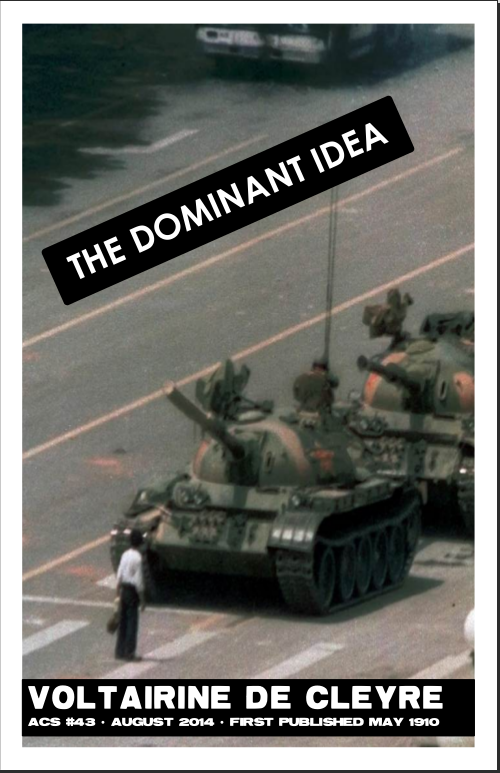
Support C4SS with Voltairine de Cleyre’s “The Dominant Idea”

C4SS has teamed up with the Distro of the Libertarian Left. The Distro produces and distribute zines and booklets on anarchism, market anarchist theory, counter-economics, and other movements for liberation. For every copy of Voltairine de Cleyre‘s “The Dominant Idea” that you purchase through the Distro, C4SS will receive a percentage. Support C4SS with Voltairine de Cleyre‘s “The Dominant Idea“.

domi

$1.50 for the first copy. $0.75 for every additional copy.

“The Dominant Idea” first appeared as a serialized article in Alexander Berkman and Emma Goldman’s influential anarchist magazine, Mother Earth, with the first instalment in May 1910. Soon after, the Mother Earth Publishing Association printed a booklet edition of the article, which they sold through their catalogue from 1910 onward.

“Regnant ideas, everywhere! Did you ever see a dead vine bloom? I have seen it. Last summer I trained some morn­ing-glory vines up over a second story balcony; and every day they blew and curled in the wind, their white, purple-dashed faces wink­ing at the sun, radiant with climbing life. Then all at once some mis­chance hap­pened, some cut worm or some mis­chiev­ous child tore one vine off below. The sappy stem wilt­ed and began to wither; in a day it was dead, — all but the top which still clung longingly to its sup­port, with bright head lifted. But the next night there was a storm, a heavy, driving storm, with beat­ing rain and blind­ing lightning. I rose to watch the flashes, and lo! the won­der of the world! In the black­ness of the mid-night, in the fury of wind and rain, the dead vine had flower­ed. Five white, moon-faced blossoms blew gaily round the skel­e­ton vine, shining back triumphant at the red lightning. I gazed at them in dumb wonder. Dear, dead vine, whose will had been so strong to bloom, that in the hour of its sudden cut-off from the feed­ing earth, it sent the last sap to its blos­soms; and, not waiting for the morn­ing, brought them forth in storm and flash, as white night- glories, which should have been the child­ren of the sun. Over death and decay the Dominant Idea smiled: the vine was in the world to bloom, to bear white trumpet blossoms dash­ed with purple; and it held its will beyond death.

“I think this unqualified determinism of the material is a great, lamentable error in our modern progressive move­ment; the absolute sway of Matter is quite as mischievous an error as the unrelated nature of Mind; in its direct action upon personal con­duct, it has the more ill effect of the two. What we need is a true appraise­ment of the power and rôle of the Idea. Against the accept­ed form­u­l­a of modern Materialism, ‘Men are what circum­stances make them,’ I set the opposing declaration, ‘Circumstances are what men make them’; and I contend that both these things are true, up to the point where the combating powers are equalized, or one is overthrown….”

Voltairine de Cleyre (1866-1912) was a popular Anarchist and feminist writer, speaker and activist. Her contemporary and friend Emma Goldman called her “the most gifted and brilliant anarch­ist woman America ever produced.” She published articles in Liberty, Twentieth Century, Free Society and Mother Earth, and worked closely with libertarian com­mun­ists, market anarch­ists, and mutualists within the Phila­delphia social an­arch­ist move­ment, but refused to commit herself to economic blueprints, adopting a pluralistic view of economic arrangements in any future free society.

Feed 44
End the Fed: The Economics of Liberty on Feed 44

C4SS Feed 44 presents Grant A. Mincy‘s “End the Fed: The Economics of Liberty” read by Christopher B. King and edited by Nick Ford.

Thanks to Carmen Segarra, however, we now have some keen insight to the inner operations of the Federal Reserve System.

Segarra was recently employed at the New York Fed as a bank examiner, charged with ensuring the bank followed internal regulations and conducting “oversight” of the economic powerhouse. During her tenure, Segarra grew suspicious the Fed was rather lenient with powerful, well-connected investment banks — notably Goldman Sachs (a key player in the 2008 financial crisis). To document her concerns she recorded 46 hours of private meetings and conversations. Her recordings reveal the Fed is, in fact, rather cozy with the financial institutions it’s supposed to regulate.

With evidence in hand, Segarra voiced her objections.

She was soon fired.

Feed 44:

Bitcoin tips welcome:

  • 1N1pF6fLKAGg4nH7XuqYQbKYXNxCnHBWLB
Portuguese, Stateless Embassies
Belém: O cercamento da periferia e o estado policial

Na madrugada do dia 4 para o dia 5 de novembro, Belém foi dormir aterrorizada.

Após a execução do cabo Figueiredo, da Ronda Ostensiva Tática Metropolitana (Rotam) da Polícia Militar do Estado do Pará, às 19h30 do dia 4, uma retaliação seguiu-se, com 9 mortes confirmadas no total segundo a divulgação oficial, 6 das quais com indícios incontroversos de execução, ocorrendo concomitantemente à operação da Rotam para prender os responsáveis pela execução do cabo da PM. Apesar da contagem oficial, muitas pessoas acreditam que o número de mortos tenha sido maior, dada a noite de perseguição.

Boatos, áudios e vídeos se espalhavam enquanto as execuções aconteciam por meio do WhatsApp e do Facebook, mostrando o que se passava na periferia da capital paraense, nos bairros Guamá, Terra Firme, Jurunas e Canudos, especialmente.

Neles, houve um toque de recolher extraoficial, dada a expectativa de que haveria retaliações contra suspeitos e que o objetivo desse grupo de extermínio (presumivelmente composto por policiais militares) era o de “não fazer prisioneiros”. O grupo clandestino atuaria acobertado sob o pretexto da operação oficial da Rotam e seu objetivo era o de executar os suspeitos.

É importante que se esclareça que as mortes não decorreram de tiroteios ou de resistência à prisão. Foram execuções. O próprio governo do estado reconhece, em nota oficial, que foram homicídios, embora não conclua que houve participação de policiais militares. O secretário de Segurança Pública do Pará, Luiz Fernandes, reconhece também que as investigações trabalham com a hipótese da atuação de grupos de extermínio.

Porém, a sequência de acontecimentos não pode ser entendida a menos que se compreenda seu contexto: a dinâmica do combate às drogas local.

Em Belém, 66% da população mora em construções irregulares, favelas ou afins, que, primeiro, aglomeraram-se nas proximidades do centro (como ocorre em bairros como Guamá e Jurunas, e mesmo da Terra Firme, palco dos homicídios) e, mais recentemente, em bairros mais distantes. São áreas de grande adensamento, com pouco espaçamento entre as residências, mas que possibilitaram à cidade absorver um grande contingente de migrantes do interior do estado e do Maranhão, estado vizinho, inclusive para residência próximo ao centro onde estão grande parte dos empregos.

Entretanto, como em outras regiões brasileiras, são áreas marcadas pelo acesso precário a serviços públicos básicos, como saneamento básico, e pela débil proteção do direito à propriedade (embora não sejam comuns desapropriações ou remoções em Belém). Além disso, como resultado da proibição do comércio de drogas, acabam sob o domínio de criminosos do tráfico de drogas.

Há algum tempo, sabe-se que os chefes do tráfico de drogas financiam milícias. Segundo reportagem do início do ano, sobre a atuação de milícias nos bairros do Guamá e da Terra Firme, esses grupos são formados por criminosos e policiais (geralmente já fora dos quadros funcionais da corporação), para proteção de traficantes contra outros traficantes e a polícia, mas também para extorquir a população. Como relata um morador da Terra Firme à reportagem:

“Eles pedem dinheiro para as pessoas e matam quem estiver no seu caminho. É própria criminalidade matando a criminalidade, mas há também pessoas de bem que são vítimas. Quando eles estão incomodados com alguma pessoa, criam uma circunstância para que o crime aconteça”

Já o grupo que atua no Guamá, formado principalmente por policiais reformados, estaria envolvido no assassinato de jovens, de “quem anda pela rua fora de hora, quem rouba e usa drogas”, como afirma um morador. Por medo, a lei do silêncio prevalece.

A reportagem também mostra que a polícia costuma trabalhar com a hipótese de pistoleiros contratados para acertos de contas ou para executar quem está em dívida, negando a existência de milícias e de grupos de extermínio que é sustentada pela população que mora nesses bairros. Os eventos da última terça parecem ter mudado isso, já que o secretário de Segurança Pública reconheceu a possibilidade do envolvimento de um grupo de extermínio.

O temor generalizado da população após a morte do cabo da PM na terça ilustra o quão real é para os moradores desses bairros o medo da ação das milícias e de policiais dentro destas ou acobertando estas, tanto como dos traficantes de drogas. Medo que, pela primeira vez, atingiu muitos dos moradores de áreas nobres em Belém, que não vivem o cotidiano de apreensão vivenciado pelos habitantes da periferia. Como nunca, aquela madrugada em Belém fez moradores de bairros em condições tão diferentes compartilharem do mesmo medo, da polícia, do tráfico e das milícias.

Portanto, as execuções de terça para quarta não foram um simples caso isolado de retaliação, mas sim uma realidade perene vivida por moradores da periferia de Belém, muitos dos quais conhecem alguém que foi executado ou tiveram um parente assassinado, alguns que foram expulsos de suas casas pelos traficantes, outros que evitam sair de casa a certas horas da noite (não só na última terça!) por medo do que poderá acontecer consigo e com os seus.

A essa população, que sofre de tantos lados, desde os traficantes até a abordagem de policias, é negada a mais básica e elementar forma de reduzir a criminalidade violenta no Brasil e seu financiamento: o fim da guerra às drogas. Não existe nenhum motivo para que cidades brasileiras encontrem-se no topo do ranking de cidades com maior número de homicídios do mundo que não seja essa política fracassada de proibição das drogas. Muitas cidades são mais perigosas que Belém, que está em 343º no ranking de cidades com maior número de homicídios no Brasil (a capital do Pará tem 45,6 homicídios por 100.000 habitantes), mas as causas são similares entre essas cidades. A maioria desses homicídios em Belém e nas outras cidades estão relacionados ao tráfico de drogas.

Uma das bandeiras libertárias mais importantes é o fim dessa política que cerceia os direitos civis, coloca atrás das grades pessoas pacíficas e mata mais que o vício pelo usuário, ao conferir uma fonte rápida de financiamento aos criminosos que passam a controlar este mercado.

Vende-se às pessoas que moram nesses bairros (bem como aos moradores de outros bairros mais privilegiados de Belém) a ideia de que apenas mais repressão será capaz de resolver o problema da segurança pública. Ao usuário de drogas cabe o papel de bode expiatório e frequentemente se sugere que a execução sumária de criminosos pela polícia é bem-vinda.

Mas negar o direito ao devido processo legal e legitimar ainda mais a licença para matar que os policiais já possuem, através do auto de resistência, apenas intensifica as violações de direitos humanos que diárias no Brasil. Perde-se de vista a conexão de policiais com traficantes e milícias. São os mais pobres que ficam à mercê do estado policial e a fé ingênua na polícia como guardiã da ordem só piora sua condição.

Assim, o caso de Belém escancara a monstruosidade que é a guerra às drogas brasileira e as consequências destas nas dinâmicas urbanas das periferias, marcadas pela onipresença da violência.

A principal causa de todas essas mortes não é a falta de mais repressão policial ou de mais execuções em relação às que já existem tanto da parte dos traficantes quanto de policiais, mas sim o próprio estado em sua sanha criminalizante, o que enriquece criminosos e aumenta a vulnerabilidade das comunidades que perdem a capacidade de organizar sua própria segurança.

The Sheldon Richman Collection
Election 2014: The Good News and Bad

The 2014 midterm election delivered both good news and bad. The good news is that the losers lost. The bad news is that the winners won.

Journalist Mike Barnicle says he’s never seen an election in which the people feel so distant from the government. I wish his diagnosis were right, but I suspect it is not. True, voter turnout likely set no records for a midterm, but this doesn’t indicate alienation as much as disgust with the particular cast of incumbents. Who wouldn’t be disgusted?

Despite what the voters may think, however, this isn’t really about personality and character. It’s about the limits of human nature. No one is qualified to govern us, considering how “govern” is defined today. The national, state, and local governments attempt to manage all aspects of our lives. In various ways, they undertake to “get the economy moving” and keep it “humming.” On top of that, the national government maintains a global empire in the service of which the national-security apparatus presumes to manage foreign societies.

Even if doing these things were morally proper—which it assuredly is not—it would be beyond the capability of human beings. No person or group could possibly possess the knowledge that would be required to manage a society—this one or one in a foreign land. Any “leader” who presents himself as fit for that job is a poser. No one is qualified to do what politicians today aspire to do.

That goes for Republicans as well as Democrats. Republicans talk about shrinking government, but don’t believe it. They certainly have no intention of shrinking the American empire, much less dismantling it. Quite the contrary. And while they talk about freeing the economy, that usually means removing restrictions on privileged economic interests without also eliminating the privileges. Republicans give the free market a bad name, because too often their policies amount to unabashed corporatism. But, then, the Democrats are no different. Both parties have a vested interest in the essential status quo, whatever their differences at the margin.

The election season is when we most often hear hosannas to democracy. Every public figure, including supposedly hardboiled news people, urges us to vote. “Every vote counts,” they say.

Balderdash.

As the late Gordon Tullock explains, “It’s more likely that you’ll get killed driving to the polling booth, than it is that your vote will change the outcome of the election.” Think about the elections you voted in. Not one would have turned out differently had you done something else that day.

Since no one vote is decisive, most people have no incentive to invest time and money acquiring the knowledge necessary to act responsibly on election day. (The responsible thing could be to stay home.) Government at all levels imposes burdens on our economic activities—the so-called economy is just people and their pursuits. How many voters study economics so they can competently judge what candidates promise to do? And how many study moral philosophy to better decide whether existing and promised policies are moral or immoral? The great American social critic H.L. Mencken said, “Every election is a sort of advance auction sale of stolen goods.” How would we decide if he is right or wrong?

To really become an informed voter, you would have to do nothing but study these and other subjects. But since your one vote won’t be decisive, why would you take time away from your family, friends, work, and voluntary community activities, where your choices are decisive?

You wouldn’t, and you don’t.

Moreover, the costs and benefits associated with electing the candidates you vote for are dispersed among the multitude, so even if your choice wins, your share is minuscule.

Thus your vote has virtually no personal material consequences and no influence on the outcome. So remaining ignorant and voting your biases and feelings turns out to be the rational thing to do.

In other words, voting rewards irresponsibility. That’s just one problem with democracy.

In the end, democratic representation—the opiate of the masses—is just a way to stop us from complaining. The people in Washington aren’t our representatives. They are our rulers.

But fear not. The alternative isn’t dictatorship. It’s individual freedom, responsibility, contract, and voluntary mutual aid.

Commentary
Surprise: The Drug War Isn’t About Drugs

On the morning of November 6 the US Federal Bureau of Investigation trumpeted its takedown of the Silk Road 2.0 website and the arrest of  alleged operator Blake Benthall.

In so doing the FBI demonstrated, once again, that the War on Drugs has nothing to do with anything its propagandists claim it’s about. If drug criminalization is a public safety issue — about fighting violent crime and gangs, or preventing overdoses and poisoning — shutting down Silk Road is one of the dumbest things the feds can do. Silk Road was a secure, anonymous marketplace in which buyers and sellers could do business without the risk of violence associated with street trade. And the seller reputational system meant that drugs sold on Silk Road were far purer and safer than their street counterparts.

This is true of all the other selling points for the Drug War. Hillary Clinton, in possibly one of the stupidest remarks ever uttered by a human being, says legalizing narcotics is a bad idea “because there’s too much money in it” — referring, presumably, to the lucrative drug trade and the cartels fighting over it.

But there’s so much money in it, and the cartels fight to control it, only because it’s illegal. That’s what happens when you criminalize stuff people want to buy: You create black markets with much higher prices, which organized crime gangs fight to control. Alcohol prohibition created the gangster culture of the 1920s. It’s been with us ever since. When Prohibition was repealed, organized crime just shifted to fighting over other illegal markets. The more consensual, non-violent activities are made illegal, the larger the portion of the economy that’s turned into black markets for gangs to fight over.

In related news, the Mexican drug cartels are reportedly making less money since the legalization or decriminalization of pot in several American states. I wonder why.

Perhaps the biggest joke is that the War on Drugs is fought to reduce drug use. No doubt many people involved in the domestic enforcement side of the Drug War actually believe this, but the left hand doesn’t know what the right hand’s doing. The narcotics trade is an enormous source of money for the criminal gangs that control it, and guess what? The US intelligence community is one of the biggest criminal drug gangs in the world, and the global drug trade is a great way for it to raise money to do morally repugnant stuff it can’t get openly funded by Congress. It’s been twenty years since journalist Gary Webb revealed the Reagan cabinet’s collusion with drug cartels in marketing cocaine inside the United States, to raise money for the right-wing Contra death squads in Nicaragua — a revelation he was gaslighted and driven to suicide for by the US intelligence community and mainstream press.

Now we hear that the US is “losing the drug war in Afghanistan.” Well, obviously — it’s a war that’s designed to be lost. The Taliban were so easy to overthrown in the fall of 2001 because they really did try to stamp out opium poppy cultivation, and with a fair degree of success. This didn’t sit well with the Afghan populace, which traditionally makes a lot of money growing poppies. But the Northern Alliance — which the United States turned into the national government of Afghanistan — was quite friendly to poppy cultivation in its territory. When the Taliban was overthrown, poppy and heroin cultivation resumed normal levels. Putting the US in charge of a “war on drugs in Afghanistan” is like putting Al Capone in charge of alcohol prohibition.

Besides, actually “winning” the drug war would mean ending it. And who in US domestic law enforcement wants to cut off the source of billions in federal aid and military equipment, militarized SWAT teams and unprecedented surveillance and civil forfeiture powers? This is a war meant to go on forever, just like the so-called War on Terror.

The state always encourages moral panic and “wars” on one thing or another in order to keep us afraid, so we’ll give it more power over our lives. Don’t believe its lies.

Translations of this article:

Distro of the Libertarian Left
Support C4SS with Lysander Spooner’s “Natural Law”

C4SS has teamed up with the Distro of the Libertarian Left. The Distro produces and distribute zines and booklets on anarchism, market anarchist theory, counter-economics, and other movements for liberation. For every copy of Lysander Spooner‘s “Natural Law” that you purchase through the Distro, C4SS will receive a percentage. Support C4SS with Lysander Spooner‘s “Natural Law“.

natlaw

$1.50 for the first copy. $0.75 for every additional copy.

“Natural Law, or: The Science of Justice” is Part One of an incomplete treatise by Lysander Spooner (Part Two was never published). It was first published in 1882 as a book by A. Williams & Co.

“The science of mine and thine — the science of justice — is the science of all human rights; of all a man’s rights of person and property; of all his rights to life, liberty, and the pursuit of happiness. It is the science which alone can tell any man what he can, and cannot, do; what he can, and cannot, have; what he can, and cannot, say, without infringing the rights of any other person. It is the science of peace; and the only science of peace; since it is the science which alone can tell us on what con­d­i­t­ions mankind can live in peace, or ought to live in peace, with each other. . . If there be in nature such a principle as just­ice, nothing can be added to, or taken from, its supreme auth­or­ity by all the legis­lation of which the entire human race united are capable. And all the attempts of the human race, or of any porti­on of it, to add to, or take from, the supreme authority of jus­t­i­ce, in any case whatever, is of no more obligation upon any single human being than is the idle wind.”

“What is legislation? It is an assumption by one man, or body of men, of absolute, irresponsible dominion over all other men whom they call subject to their power. It is the assumption of a right to subject all other men to their will and their service. It is the assumption of a right to abolish outright all the natural rights, all the natural liberty of all other men; to make all other men their slaves; to arbitrarily dictate to all other men what they may, and may not, do; what they may, and may not, have; what they may, and may not, be. It is, in short, the assumption of a right to banish the principle of human rights, the principle of justice itself, from off the earth, and set up their own personal will, pleasure, and interest in its place. All this, and nothing less, is involved in the very idea that there can be any such thing as human legislation that is obligatory upon those upon whom it is imposed.”

Lysander Spooner (1808-1887) was a labor activist and a radical abolitionist who came out in opposition to the Civil War. (He believed that the slavery should be ended by arming the slaves and supporting their rebellion, rath­er than by means of invading and occupying the South.) After the war, he wrote his most famous series of essays, entitled “NO TREASON,” arguing against the U.S. Consti­t­ut­ion and all forms of non-consensual government. His writ­ing on natural law in the 1880s, for example in the “Letter to Bayard,” “Nat­ur­al Law,” and the “Letter to Grov­er Cleveland,” made him an incredibly influential figure in the emerging individualist Anarchist movement, and he became close friends with the rad­ical individualist writer and editor Benjamin Tucker. Spoon­er’s essays are today widely reprinted and read through­out the liber­tar­ian and anarchist movements, and his work played a major role in the 1960s intellectual revival of individualist an­arch­ism.

Feature Articles
Cancer Therapy and Barriers to Open Biopharma

Science and innovation are chaotic, stochastic processes that cannot be governed and controlled by desk-bound planners and politicians, whatever their intentions. 

Good scientists are by definition anarchists.

–Theo Wallimann, ETH Zurich


Abstract

Although profitable, cancer therapy has failed to live up to the promises of the War on Cancer waged since 1971. Modern chemotherapy can exceed $100,000 annually for patients prescribed patented medications of dubious long-term benefit. R&D costs, thought to justify high prices, are in fact far less than claimed. The present intellectual “property” regime has impelled researchers like Dr. Isaac Yonemoto to seek crowdsourced funding to develop a promising unpatentable molecule as an open-source cancer drug (9DS, 9-deoxysibiromycin). While fully supportive of this effort, we wish to call attention to longstanding Corporation-State erected barriers to entry for disruptive therapies and funding models.

The Palliative Machine: Medical Monopoly under the Corporation-State by Sebastian A. Stern, is strongly recommended as a prerequisite to this article.

Open Source Drug Development – Rescuing 9DS from Oblivion

The Project Marilyn/indysci.org team should be applauded. As of this writing, they have reached their initial $50,000 goal, and finished about $8,000 over, to fund the project.

We won’t analyze their scientific prospects (though we will say that DNA-alkylating agents are passé and targeting cancer-specific metabolism and cell surface markers is the future of chemotherapy), but sincerely hope that progress is made.

However, as with Wikileaks, Bitcoin, or Anonymous, whether this particular project succeeds is secondary. The truly disruptive event is the model, the idea. Many copycats have replicated cryptocurrency, hacktivism and anonymous leaks and, at times, doing it better.

Should indysci.org or Project Marilyn stumble, let that not be evidence of futility, but a clue for the next iteration of the stigmergic model of science funding. The imperative force to fix the medical system is too great for concerned parties to resign.

The cat is out of the bag. 

Corporation-State Barriers Still to be Overcome

By no means is victory inevitable — quite the contrary. There is a veritable Library of Alexandria of preclinical evidence supporting medicines that never come to market. The problem isn’t curing disease in mice; cancer and other diseases are said to have been cured in mice many times over. The problem is higher up: at the level of the FDA and pharma.

How do we reconcile the irrepressible deluge of preclinical findings for promising drugs with the truly devastating paucity of FDA-approved chemical entities? It’s not that mice and men are so different, but the fatal flaw is in the incentive structure of the centralized, corrupt corporate-regulatory nexus.

There are two major problems faced by Project Marilyn et al and those who will follow in their footsteps: If the drug works too well, it might be tabled by the FDA on behalf of pharma. Secondly, pharma may patent a “me-too” drug analogue, establish it as the standard of care and any doctor deviating from their product will be liable for malpractice. Welcome to patent medicine under corporate capitalism, brought to you by humanitarian John D. Rockefeller and his cartelizing Flexner Report of 1911.

Emerging Alternatives to Centralized Medical Decision-making

The People need a way to conduct clinical trials and distribute medicine that routs around the FDA. For example, quantified self and cheap biomarkers would enable patients to upload their data.

Adverse effect reporting can be conducted by a third party regulator like the Environmental Working Group, which already tests cosmetics and water supplies. This way, desperate patients won’t have to wait 7 years for the FDA to approve a drug showing low toxicity (and regardless of efficacy, after all, “First, Do No Harm” said Hippocrates).

Synthetic biology and distributed biosynthetically-engineered microbial factories (yeast, bacteria, algae) could manufacture the drugs. This is how Genentech makes the recombinant insulin peptide or how Evolva SA makes natural products like resveratrol and vanillin — these can be distributed P2P at low marginal cost per unit.

Forget 3D printer chemistry — evolution has crafted enzymes that are far more efficient than any chemist’s reaction, with no expertise required other than some nutrient broth to culture the cells. The remaining puzzle piece is actually designing the (modified) natural product biosynthetic pathways: it’s not always known which enzymes do which reactions and in what order.

The roadmap to open-source data-driven medicine is coming into view, but we should expect resistance from biopharma and the state going forward.

The Cure: Just Around the Corner Since 1971

Everyone should know that most cancer research is largely a fraud and that the major cancer research organizations are derelict in their duties to the people who support them. –Linus Pauling, PhD, winner of both the Nobel Peace Prize and Nobel Prize in Chemistry, link to original document.

Cancer is big business. It is the second leading cause of death in the U.S. (576,961 in 2010, after heart disease) and War on Cancer is worth over $125 Billion annually according to the National Cancer Institute. Biopharma elites consider illness a cash cow rather than a blight to be eradicated. This is illustrated most recently by Memorial Sloan-Kettering Cancer Center whistleblower Ralph Moss, PhD in the documentary “Second Opinion” (2014).

The goal of the industry is to indefinitely “manage” disease — curing it would destroy the market. (Talk about a perverse incentive structure.) Recall how the “defense” industry seeks to initiate armed conflict, Gen. Smedley Butler’s “war is a racket” and Gen. President Eisenhower’s military-industrial complex.

The prime directive of any individual or institution is self-preservation (and corporations seek indefinite expansion at all externalized costs).

The economic idea behind this suppression is akin to reverse planned-obsolescence: call it planned-permanence, a form of retarding progress in order to extract economic rents.

The same dynamic prevails with new energy, transport, finance, and less violent forms of governance. (Government-imposed invention secrecy is on the rise, and applies especially to high efficiency energy systems).

The legal magic that keeps disruptive technology under-wraps is called intellectual “property.” (See “Against Intellectual Monopoly” PDF by Boldrin and Levine 2008).

There are many examples of government-pharma suppression of disruptive therapy (a few are discussed in The Palliative Machine: Medical Monopoly under the Corporation-State).

Regardless of whether any one of them works: shouldn’t free individuals be allowed to chose their own therapy, especially when the standard of “care” has failed them? Shouldn’t the same logic apply to the consumption of any chemical? Or any behavior that doesn’t violate the negative rights of others?

For those skeptical that the politburo would conspire to conceal any medically relevant information: Never forget that, for half a century, Big Tobacco and the State successfully convinced doctors and the public that cigarettes were not harmful. (The film “Thank You For Smoking” (2005), executive producer Elon Musk, is a witty modern take on tobacco lobbying).

Today, we recognize cigarettes as the world’s leading cause of preventable death.

Next we’ll be hearing about how sugar and non-ionizing electromagnetic radiation (cell phones, wi-fi) cause cancer, or some such quackery that threatens profits. There is little financial incentive to uncover the causes of illness, because discovering hexavalent chromium 6 (see Erin Brockovich and PG&E) in the water supply doesn’t make money for shareholders (and that the development of cancer does generate new business).

Furthermore, many plant-derived natural products (like curcumenoids, compounds found in turmeric) show high efficacy against cancer with low toxicity (in addition to a litany of other benefits, including augmenting adult neurogenesis). Natural products don’t interest pharma because they cannot be patented without modification. Furthermore, most modern disease, including cancer, arises due to improper diet, lifestyle and the scourge of biological aging.

Creative Accounting and Overstated R&D Costs by Big Pharma

It is simply no longer possible to believe much of the clinical research that is published, or to rely on the judgment of trusted physicians or authoritative medical guidelines. I take no pleasure in this conclusion, which I reached slowly and reluctantly over my two decades as an editor of The New England Journal of Medicine. –Marcia Angell, M.D.

Pharma attempts to justify its exorbitant drug prices by claiming high R&D and regulatory costs. This is a huge lie: Pharma spends double on marketing than R&Dhalf the price tag is an estimate of the profits a drug company might have made, over the course of bringing a product to market, if it had, instead, invested its capital elsewhere; and they include the cost of failed research on other drug candidates (which simply reflects the inefficiency and bloat of a cartelized industry). GAAP accounting is not a great concern for pharma’s PR department.

Take the example of the canonical 21st century wonderdrug: imatinib (Gleevec). It allegedly works well for highly specific mutations (targeting the tyrosine kinase fusion protein Brc-Abl, a.k.a. the Philadelphia chromosome of chronic myelogenous leukemia), but pharma extorts over $100,000 per year for the treatment, despite protests like the recent letter in Blood (the leading hematology journal) from dozens of the physicians who actually ran the clinical trials for Novartis in the first place. The more advanced “me too” iterations of imatinib cost even more.

Nearly all research is funded by taxation via the NIH. It costed Novartis relatively little to develop imatinib, but the company knows they can literally extort patients for their lives (and by proxy tax cattle).

Genentech attempted the same tactic with Avastin, declaring that it would charge whatever the market would bear (until being recalled because it was shown to be ineffective — serves Genentech right for stealing the plasmid for recombinant insulin from UC San Francisco, culminating in a $200M settlement in which Genentech admits no wrongdoing).

Pharma claims about $1B costs per drug. This meme is extremely pervasive in medicine, apparently justifying their exorbitant drug prices despite very low marginal costs per unit. (Pharma is historically among the most profitable business sectors). Anyone familiar with the cost of automated drug assays, animal studies and clinical trials must question this astronomical figure. FDA user fees are in the $5-10M range. Where is this money going? The funny thing is, these costs are not itemized, even by studies claiming these inflated numbers.

“The US$802-million figure was based on the research-and-development costs of 68 drugs at 10 companies. The data, however, were not made available to other researchers, and drug-industry watchdogs say this lack of transparency is typical. …[I]t is in the best interests of drug companies — who often lobby governments to loosen price regulations and increase patent protection — to overstate costs.”

“These high estimates are all from industry-supported studies done by industry-supported economists who, as far as I can tell, compete to see who can come up with the higher number.” Donald Light, professor of comparative health care at the University of Medicine and Dentistry of New Jersey and coauthor of an article challenging the validity of the 2003 study (J Health Econ2005;24[5]:1030-3).

…Another criticism of studies that produce numbers in the billion-dollar range is that large portions of those estimates aren’t out-of-pocket expenses. About half of the 10-figure price tag is an estimate of the profits a drug company might have made, over the course of bringing a product to market, if it had instead invested its capital elsewhere. Calculating forgone profits is, according to Light, a reasonable way for a company to determine if it should go ahead with a project. “What is not reasonable,” he says, “is to then take that estimate, which is a calculation of investment, and claim it as a cost against society.”

The cost estimate of successful drug development also includes the cost of research that fails to net new products. Again, this is a common practice. But critics claim the pharmaceutical industry misleads the public by claiming it costs more than a billion dollars to overcome the 1-in-5000 odds of a new chemical compound making it to market. About two-thirds of true research and development costs, Light says, are incurred in phase III trials, where the odds of success are about 3 in 5. Earlier trials are relatively inexpensive, and most compounds don’t even make it to the trial stage. –Collier, R. 2009. “Drug development cost estimate hard to swallow.” CMAJ.

We have had some insight into the expenditures of the companies overall. Lo and behold, pharma spends roughly double on marketing what it does on R&D.

A Minefield of Patents Driving Up The Costs of Basic Research

Although drug development costs are far lower than claimed, biomedical R&D is indeed too expensive. Not because labor is expensive — God knows there is a gross oversupply of grad students and PhDs, fomenting the Postdoc-opalypse. (NIH finding is only $30B annually and funds almost all the medical research in the U.S. Meanwhile, DARPA’s official budget is $90B and the DoD is $600B. The problem is not too many scientists, but not enough funding, and most of it paying rents on instruments and reagents).

Scientists, of course, are not stupid like economists. They know full well that half their grant is being eaten by inflated costs (and academics don’t even bear the full brunt of IP because of the Safe Harbor Clause).

In a survey published in Nature Biotechnology, biologists overwhelmingly felt that IP restricted their progress.

“[B]iologists’ accounts of recent instances of delayed or blocked access to research tools recognize this negative net effect of the proliferation of university IP protection after the Bayh-Dole Act of 1980.” –Lei et al. (2009) Patents versus patenting: implications of intellectual property protection for biological research. Nature Biotechnology.

Invitrogen almost succeeded in patenting the antibody — a fundamental tool in molecular biology. The whole field of antibody-based therapeutics would not exist if everyone had to license the very idea of an antibody — produced by all higher organisms — from Invitrogen. Similarly, 70% of the human genome has patent claims by industry. They charge thousands of dollars to conduct very cheap tests for genetic variants. Scams like these are why the U.S. medical system is the most expensive yet broken medical system in the developed world.

The reason basic research is so expensive is due to IP, which leads to high capital costs, a barrier to entry protecting the cartelized market. Small biopharma companies almost always sell out to a bigger fish — they’re the ones who can afford the next steps to commercialization. Thus, rarely does a drug come to market without big pharma sponsorship.

Case Study on Trusting the Government: The Food and Drug Administration

“The thing that bugs me is that the people think the FDA is protecting them. It isn’t. What the FDA is doing and what the public thinks its doing are as different as day and night.” –Dr. Herbert Ley, former commissioner of the FDA (1968-9).

The current head of the Food Divison of the FDA is Michael R. Taylor, former Vice President of Public Policy for Monsanto. Monsanto is that corporation that is trying to monopolize global seed reserves via genetic modification, sells BT corn, Round-Up (highly toxic glyphosate herbicide poisoning the food and water), aspartame and MSG, and is best known for suing farmers when their GMO pollen fertilizes crops by blowing many miles down the road. Notable alumni include Hillary Clinton and Clarence Thomas. It has been this way since the very beginning, as the FDA began as the Division of Chemistry of the Department of Agriculture at the turn of the 20th century, ushering in the new era of patent medicine (and pushing out unpatentable plant extracts as the dominant form of medicine).

Rest assured, the FDA, just like the SEC, Federal Reserve, EPA, NLRB, FCC, CIA, NSA (and whatever agency put over 100,000 innocent Japanese Americans in concentration camps) have your best interests at heart. They mean well, they really do. It’s just that the executives are revolving-door psychopaths. Salt-of-the-earth types, frankly.

“[A]s a chemist trained to interpret data, it is incomprehensible to me that physicians can ignore the clear evidence that chemotherapy does much, much more harm than good.” –Alan C Nixon, PhD, former president of the American Chemical Society.

“In regard to surgery, no relationship between intensity of surgical treatment and duration of survival has been found in verified malignancies [for breast cancer]. […] Although there is a dearth of untreated cases for statistical comparison with the treated, it is surprising that the death risks of the two groups remain so similar. […]

The evidence for greater survival of treated groups in comparison with untreated is biased by the method of defining the groups. All reported studies pick up cases at the time of origin of the disease and follow them to death or end of the study interval. If persons in the untreated or central group die at any time in the study interval, they are reported as deaths in the control group.

In the treated group, however, deaths which occur before completion of the treatment are rejected from the data, since these patients do not then meet the criteria established by definition of the term “treated.” The longer it takes for completion of the treatment, as in multiple step therapy, for example, the worse the error…. With this effect stripped out, the common malignancies show a remarkably similar rate of demise, whether treated or untreated.

The apparent life expectancy of untreated cases of cancer after such adjustment in the table seems to be greater than that of the treated cases.

–Hardin B. Jones, Ph.D., professor emeritus of medical physics and physiology at the University of California at Berkeley. “A Report on Cancer,” paper delivered to the ACS’s 11th Annual Science Writers Conference, New Orleans, Mar. 7, 1969

Today, there is a revolving door of public policy, lobbying, academia and corporate influence. The FDA was once funded entirely by the federal government (perhaps a time when corporate co-optation was less blatant).

In 1992, George H.W. Bush changed the rules, and the FDA now derives over 40% of revenue from fees charged to pharmaceutical companies. Britain’s version of the FDA derives 70% of revenues from drug companies, thanks to Margaret Thatcher’s earlier reforms in the ’80s. The FDA having a monopoly on regulation is bad enough, and the aforementioned mercantilist conservatives simply required bold-faced bribery.

There are a of myriad methods employed to misrepresent the research. Not all of it is published—only about 40% of research finds its way to a journal. Of those that do, there is a “publication bias,” where studies that find positive results (that the drugs work) are more often published than those that show the drugs don’t work or are toxic.

Another technique is “Salami slicing”—Big Pharma will cite the same data multiple times in numerous studies. There is no profit motive for independently funded research that seeks to take dangerous drugs off the market. Further, independent research is not published in the major journals like The Lancet or NEJM. Finally, standard cooking of the books, or fun with numbers: anyone along the chain of command can, with a keystroke, corrupt the data. Industry-supported research must be taken with colossal, hypertension-inducing grains of salt.

See the documentary “The War on Health” (2012) for more on the FDA.

The Emperor of All Maladies? Cancer as a Discrete, Tractable Metabolic Cellular Dysfunction

Let us end with some good news.

A common refrain in medicine is that cancer is many diseases, each tissue-type of cancer being distinct. As such, they each require a different drug! Fortunately, over 60% of cancerous cells share the same phenotype: a form of fermentation known as aerobic glycolysis, or the Warburg Effect.

Discovered by Nobelist Otto Warburg in the 1920s, this common metabolic feature makes cancer tractable broadly. Cancer cells burn a lot of sugar and without using oxygen, even when oxygen is present. This is why tumors are hotter on thermograms. It is hypothesized that the effect occurs because tumor microenvironments are oxygen-poor because cells form a dense ball into which oxygen cannot diffuse.

The drug 3-bromopyruvate, developed by Peter Pedersen at Johns Hopkins, and others like it under development, take advantage of the Warburg effect as “metabolic poisons.” Whether they see the light of the open market remains to be seen.

A sincere wish for the best of luck to Project Marilyn, but I am more hopeful about medical research elsewhere in the world, further from the reach of the US medical establishment.

Further reading:

The Cancer Industry by Ralph Moss, PhD

“Dying to Have Known” (2006), “The Beautiful Truth” (2008), “Cut, Poison, Burn” (2010); documentaries covering suppressed therapy and the overhyped safety and efficacy of conventional cancer treatment.

This excerpt in UTNE from book “Malignant,” on the cancer industry.

Here is the perspective of a cancer survivor who dug into big pharma corruption.

Bad Pharma by Ben Goldacre.

Feed 44
The Conquest of the United Kingdom by Scotland on Feed 44

C4SS Feed 44 presents Joel Schlosberg‘s “The Conquest of the United Kingdom by Scotland” read by Christopher B. King and edited by Nick Ford.

“Yes” netting 44.7% of the tally undermines a 300-year consensus and the devolution of substantial political power to Scotland is already conceded. Such a near-tie is far more problematic for an existing political system struggling to maintain its legitimacy than for a new one trying to find its feet. And the concerns raised in advance of the referendum persist.

With the burden of proof shifted onto them, the social-contract arguments for existing states were drawn out from the shadows of handwaving and dimly-remembered civics classes.

Feed 44:

Bitcoin tips welcome:

  • 1N1pF6fLKAGg4nH7XuqYQbKYXNxCnHBWLB
Distro of the Libertarian Left
Support C4SS with Kevin Carson’s “Millennial Liberty”

C4SS has teamed up with the Distro of the Libertarian Left. The Distro produces and distribute zines and booklets on anarchism, market anarchist theory, counter-economics, and other movements for liberation. For every copy of Kevin Carson‘s “Millennial Liberty” that you purchase through the Distro, C4SS will receive a percentage. Support C4SS with Kevin Carson‘s “Millennial Liberty“.

mill

$1.00 for the first copy. $0.60 for every additional copy.

This article was originally published as “Five Libertarian Re­forms Millennials Should Be Fighting For” in January 2014, as a Feature for the Center for a Stateless Society (c4ss.org).

“Millennials are disgruntled and it’s no won­der. In 2008 they turned out in record numbers in sup­port of a presidential candidate who used the most leftish sounding rhetoric of any Democratic candidate since Mc­Govern. In­stead he governed as a moderate Repub­lic­an, continuing the Paulson TARP program, bailing out the larg­est ‘too big to fail’ industrial corporation in America, and implementing a national healthcare ‘reform’ proposed by Rich­ard Nixon. In the meantime, twenty-somethings face a situ­ation where half of recent college graduates are un­em­ploy­ed or underemployed. They were the backbone of the Occupy movement, founded on the assumption that repre­s­ent­ative democracy and the political process were worth­less, and the only alternative was to build a new system outside the existing one.

“The reforms I propose below are all free market libertarian reforms, but they’re also essentially soc­ial­ist or anti-capitalist in that they shift wealth from rent­ier classes to the people who actually produce it, break the power of giant corporations, and create a fairer sys­tem with a more egalitarian distribution of wealth. End the credit monopoly. End the land monopoly. End the ‘in­t­el­lect­u­al property’ monopoly. End the minimum wage for plu­tocrats. Cut welfare from the top down. Start by elim­i­n­ating eliminating all the forms of artificial property, artificial scarcity and subsidies that concentrate wealth in a few hands. Let free com­pet­it­ion destroy enor­mous con­cen­trat­ions of wealth and redistribute it downward. . . .”

Kevin A. Carson is a mutualist writer living and working in northwest Arkansas, and the author of several incredibly influ­ential works on contemporary mutualist anarchism, including “The Iron Fist Behind the Invisible Hand,” Studies in Mutualist Political Economy,Organization Theory: A Libertarian Per­spect­ive, The Homebrew Industrial Revolution, and numerous articles and research reports for the Center for a Stateless Society.

Anarchy and Democracy
Fighting Fascism
Markets Not Capitalism
The Anatomy of Escape
Organization Theory