Missing Comma, Stigmergy - C4SS Blog
Missing Comma: “What is Vox? And Why Should Anyone Care?”

This week’s blog topic is derived from a tweet posted by Dave Zirin earlier this week, following new media site and Ezra Klein vessel Vox posting a silly and weightless article about Solange Knowles beating up on Jay Z in an elevator titled, “Who Is Solange? And Why Is She Attacking Jay Z?”

The article doesn’t really answer the second question, as at the time, no one really knew why past rumor and speculation. But past that, the article is really just… uninformative. We’re apparently supposed to care (and/or not… care? What is happening) about the incident at the Met Gala because Solange is Beyonce’s sister, and Bey was recently listed as one of the most influential people by Time Magazine, and then there are memes and reposted photos from TMZ and…

Is this what new media is supposed to look like?

Vox debuted mere weeks ago, on March 30, to limited fanfare; it’s part of the same media group that hosts the fantastic tech site The Verge and video game site Polygon, and its launch was sponsored by General Electric. According to their “About” page, Vox is building their site in public, “listening to your feedback and learning as we grow.” Its mission? “Explain the news.”

So far, they’ve “voxsplained” Common Core (including an article listing all the ways in which Louis C.K. is wrong about it), net neutrality and Benghazi, among other subjects; they’ve also done hard hitting journalism on… otter necrophilia.

So far, color me unimpressed, and a little bit queasy.

When we talk about new media, and celebrity-journalist-centered media specifically, we tend to be optimistic that a given vehicle is going to highlight the good points of a particular writer’s work. With The Intercept, we focus on Glenn Greenwald, Jeremy Scahill and Laura Poitras’s writing on government surveillance. With FiveThirtyEight, we want good political statistics. With Vox, what are we getting? After the first month, it doesn’t seem like a whole lot. Mostly, it just reminds me of the overly-curious personality sphere you have to kill from Portal.

Ezra Klein has gathered together a pretty hefty team of writers to work for him at Vox, including Matthew Yglesias and Zach Beauchamp. But so far, the results have brought a less-interesting Buzzfeed to bear, not a new media franchise blazing new ground. Also, otter necrophilia.

~~~

The first two weeks of May have been very good to us at C4SS Media. The podcast feed (also on iTunes and Stitcher Radio) has been downloaded from over 2000 times since the first recording was posted on May 1. We’ve got more in the works, including a podcast for this blog and some other discussion-oriented shows. In the meantime, you can like Missing Comma’s Facebook page and follow us on Twitter, and don’t forget to do the same for the Center here and here. Thanks for your support!

Life, Love And Liberty, Stigmergy - C4SS Blog
Response To Al Carroll On Libertarianism: Part One

Al Carroll recently penned a piece titled The Moral and Practical Failures of Libertarianism and Small Government Conservatism. This will be a point by point refutation. Let’s begin.

Al writes:

In economics, both orthodox Communism and Libertarianism are equally wrong, callous, and dangerous examples of ideological blindness, a set of principles taken to an extreme that caused many people to die. Both are more alike than either set of fanatics (as both set of true believers are) would want to admit. Both fall back on the same defense of “there has never been a true or pure form”of their system. Both systems clearly failed. Communism only lasted 70 years in the first nation to have it, and killed tens of millions with purely man made famines and extreme repression. Libertarianism and its influence on US conservatism takes the greatest share of blame for extreme economic inequality, the Great Recession, and most financial elite crime waves of the past 30 years.

As usual with many critics, he fails to take account of different brands of libertarianism. He only refers to a seemingly singular “libertarianism”. This will be written from a left-libertarian market anarchist perspective. The cliched “you claim your system has never existed in pure form” is trotted out. Democracy has probably never existed in pure form either, but that doesn’t mean it isn’t viable. There have been particular libertarian policies implemented with some success such as drug decriminalization. It may be true that the full libertarian package has never existed in systematic form, but this doesn’t mean it can’t exist. Liberal democratic societies never did and now do.

It’s partially unfair to pin economic inequality on libertarians, because they have hardly been in charge. Some libertarians will justify inequality, but there is good reason to think that freed markets would produce less inequality. That will be the subject of a future blog post. As for blaming the Great Recession on libertarianism; it’s once again worth pointing out that libertarians aren’t in charge. A detailed examination of why libertarians aren’t to blame for economic recessions or depressions will have to come later though. Libertarians oppose fraud by financial elites or anyone else, so it’s silly to blame us for the crime wave emanating from said people.

The question then becomes, to what degree should there be a mixed system? The slogans of libertarians and many conservatives that “government is the problem” or “regulation doesn’t work” are easily proven wrong, and fairly foolish falsehoods.

Conservative protestations against government are often hypocritical and insincere. It’s also true that these questions require defining what constitutes a problem and by what standard of value doesn’t regulation work. The New Leftist historian, Gabriel Kolko, documented the purpose regulations served in concentrating economic power and resources:

As Gabriel Kolko demonstrates in his masterly The Triumph of Conservatism and in Railroads and Regulation, the dominant trend in the last three decades of the nineteenth century and the first two of the twentieth was not towards increasing centralization, but rather, despite the growing number of mergers and the growth in the overall size of many corporations,

toward growing competition. Competition was unacceptable to many key business and financial leaders, and the merger movement was to a large extent a reflection of voluntary, unsuccessful business efforts to bring irresistible trends under control. … As new competitors sprang up, and as economic power was diffused throughout an expanding nation, it became apparent to many important businessmen that only the national government could [control and stabilize] the economy. … Ironically, contrary to the consensus of historians, it was not the existence of monopoly which caused the federal government to intervene in the economy, but the lack of it.1

He also writes:

This article argues some basic humanitarian principles should be applied to economics and the human and humane spheres or politics, ones so obvious it seems absurd to have to make them explicit:

1. Helping people obviously helps people more than not helping them.

2. Watching out for and preventing or stopping abuse and harm is obviously better than not watching and not stopping abuse and harm, or even refusing to look and denying harm exists.

3. Generosity and selflessness are obviously better than stinginess and selfishness,

4. Democratic control obviously is better than elite control.

There is nothing in these four points that a libertarian could not embrace. There are ways of helping people that don’t require government or state intervention. These approaches are known as mutual aid societies. The prevention and stopping of abuse is compatible with libertarianism, because we believe said action is a justifiable response to rights violations. Some libertarians are egoists, but this is not the only ethical viewpoints that has been adopted. The rational egoist definition of selfishness as elaborated by Ayn Rand is not what you typically refer to as egoism. It pertains to not sacrificing others to yourself or yourself to others. Libertarians have an admittedly uneasy relationship with democracy, but the left-wing market anarchist position is democratic in the sense that it grants everyone an equal right to control their own lives and make decisions affecting them. That’s all for now. Stay tuned for my next blog post on this article!

Commentary
For Acai, Against the State

Like any other Para-born person, I like acai (pronounced “assa-IH,” people) a lot. Every Paraense, regardless of socio-economic status, eats it. It is an undeniablefact of life in Para. If you live in the capital, Belem, that is a constant reminder that we live in the Amazon, just like the herons downtown.

Acai, as it is traditionally made, is so beloved in Para that there is a song with the following verses: “Anyone who went to Para stopped. They ate acai, stayed.”

The acai sold in Para is not the same one that is sold all over Brazil. Its real flavor is found in the pure one prepared here, not in the diluted and mixed recipe sold elsewhere.

Who could threaten the traditional acai, if there is such a demand for it? The state, obviously.

In 2010, a bill was presented about the “Mandatory pasteurization of the acai pulp.”

Its first paragraph laid it out:

“§1 The pulp derived from the fruit of the a aizeiro (Euterpe oleracea) should undergo pasteurization, according to specific regulation, with the objective of preventing the communication of diseases to human beings.”

The commerce of unpasteurized (traditional) acai would be punishable by fines of about $1,000 in the first occurrence, $2,500 and community service in the second and closing of the store in the third.

Chagas disease was the justification for the project. The author defended it on the grounds that eating unpasteurized acai, something that goes on especially in the Amazon, “could become a public health issue of great proportions, [thus] we find it important to mandate the immediate pasteurization of the acaizeiro fruit pulp.” As Lucio Flavio Pinto noted, “it has been so long since acai was adopted by the Paraense,” that the law does not make any sense. Moreover, hygiene measures and quality standards were “already adopted by the sellers anyway.”

The bill was so absurd that its approval would make illegal the “traditional selling points of acai all over Para.” The little joints, “recognizable by their purple sign, add up to over 4,000 only in the Metropolitan Region of Belem.” According to the Fruit and Derivates Industries Union in Para (Sindfrutas), “the activity involves over 100,000 families, only in the region.”

Sindfrutas’s president at the time, Solange Motas, highlighted the unemployment that would result: “Senator Tiao Viana has no idea how many people are going to be left jobless in this region. In Belem’s surroundings only, there are over 4,000 acai joints that we know of, and in the state the number should be over 10,000. They are people who are going to be helpless by this bill. It is a very flawed law, and it shows even in its writing.”

From every angle, it was a stupid proposal. From the drastic meddling with a local tradition to the serious economic problems that would follow to thousands of small vendors, it was an unjust law and completely oblivious to the local reality. Reason prevailed and the bill, fortunately, was rejected.

We should not be satisfied, though. It is just amazing that a federal senator, thousands of miles away from the Para, would have the power (and the nerve) to propose such a bill that would interfere so drastically with a local tradition. It is appalling that the National Congress, in Brasilia, even has the power to pass such a law to alter significantly the life of every Paraense. It is so patently absurd to think that the Paraenses, who have been eating acai for so long, would need Brasilia to keep them from dying from Chagas disease.

Contamination can happen, sure, and safety and health procedures are in order, but there is nothing to justify the ban on unpasteurized acai, nothing can take away the right to choose from the individual.

It is time to take back the right from the government to decide what we can or cannot eat. We have to ban the ability of the government even to conceive of a bill of that nature and the possibility of them meddling so deeply in the Amazonian life. Actually, we should pass a new eternity clause: the inalienable right to eat the açaí we want and the inalienable right to sell it. The right to an açaí without the bitter taste of the state.

Translations for this article:

Distro of the Libertarian Left
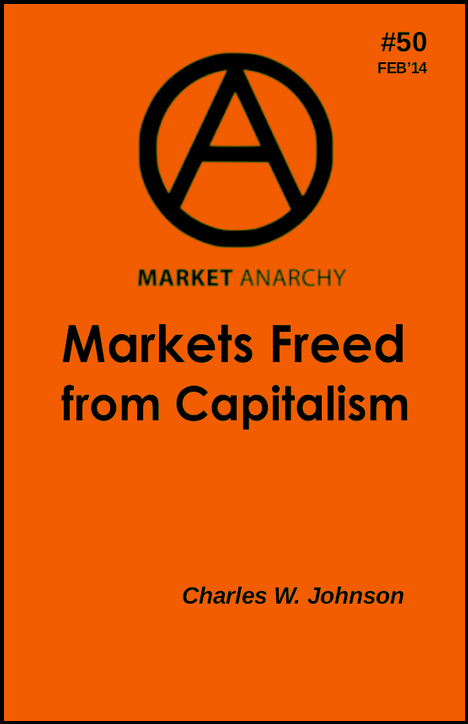
Support C4SS with Charles Johnson’s “Markets Freed from Capitalism”

C4SS has teamed up with the Distro of the Libertarian Left. The Distro produces and distribute zines and booklets on anarchism, market anarchist theory, counter-economics, and other movements for liberation. For every copy of Charles Johnson’s “Markets Freed from Capitalism” that you purchase through the Distro, C4SS will receive a percentage. Support C4SS with Charles Johnson’s “Markets Freed from Capitalism“.

freed

$1.50 for the first copy. $0.75 for every additional copy.

This essay, first appearing as Chapter 4 of Markets Not Capitalism (eds. Charles W. Johnson and Gary Chartier), is an examination of the mechanisms of state capitalism and the monopolistic privileges that sustain it, as well as a close and critical consideration of the nature of the “market form” that left-wing market anarchists defend — looking at markets, on the one hand, in the sense of spaces of free social experimentation; but also, on the other hand, as networks of relationships reduced to the cash nexus. What kind of market relations do “free-market anti-capitalists” defend? In what contexts, and playing what kinds of social roles?

“However often they may be linked in fact, free exchange and the cash nexus are distinguishable in concept. Markets in the first sense (the sum of all voluntary exchanges) include the cash nexus — but also much more than the cash nexus. If a ‘freed market’ is the sum of all voluntary exchanges, then family sharing takes place within a freed market; charity is part of a freed market; gifts are part of a freed market; informal exchange and barter are all part of a freed market. Similarly, while markets-as-free-exchange may include ‘capitalistic’ arrangements — so long as they are consensual — they also encompass far more than that. There is nothing in a freed market that prohibits wage labor, rent, corporate jobs, or corporate insurance. But a freed market also encompasses alternative arrangements —including many that clearly have nothing to do with employer-employee relationships or corporate management, and which fit awkwardly, at best, with any conventional meaning of the term ‘capitalism:’ worker ownership and consumer co-ops are part of the market; grassroots mutual aid as­soc­i­at­ions and community free clinics are part of the market; so are voluntary labor unions, consensual communes, narrower or broader experiments with gift economies, and countless other alternatives to the prevailing corporate-capitaliststatus quo. To focus on the specific act of exchange may even be a bit misleading; it might be more suggestive, and less misleading, to de­scribe a fully freed market, in this sense, as the space of maximal con­sen­su­ally-sustained social experimentation. . . .

“For a principled anti-statist, the growth of ‘markets’ as spaces for consensual social experi­ment­ation is always a liberating development — but these social ex­peri­ments may be mediated by the cash-nexus, or may be mediated by entirely different social relationships, and may look nothing like conventional business or commerce. The growth of ‘markets’ as cash-nexus exchanges, on the other hand, may be liberating or violating, and its value must depend entirely on the context within which it arises — whether those relationships come about through the free interplay of social forces, or through the direct or indirect ripple-effects of government force and coercive creation of rig­ged markets. Forms of interaction that are positive and productive in the context of free exchange easily become instruments of alienation and ex­ploit­ation when coercive government forces them on unwilling participants, or shoves them into areas of our lives where we don’t need or want them. . . .

“When they take place within the context of a system of free exchange, the social relationships based on the cash nexus — producing, buying, and selling at market prices, saving money for future use, investing money in productive enterprises, and the like have all positive, even essential, role in a flourishing free society. I do not intend to argue that these will disappear in a society of equal freedom; but I do intend to argue that they may not look like what you expect them to look like, if your picture of commercial relationships is taken from commerce under the conditions of corporate capitalism. Commerce under capitalism does have many of the exploitative and alienating features that critics on the Left ac­cuse ‘private enterprise’ or ‘market society’ of having. But not because of the enterprise, or because of the market. The problem with commerce under capitalism is capitalism, and without it, both freed-market exchange and cash-nexus commerce will take on a wholly different character. . . .

“The need for a shift to freed-market anti-capitalist ana­lysis is press­ing because — with apologies to Shula­mith Firestone — the political eco­nomy of state capitalism is so deep as to be invisible. Or it may appear to be a super­ficial set of inter­vent­ions, a problem that can be solved by a few legal reforms, or perhaps the elimin­at­ion of bail-outs and the occasional export subsidy, while preserving more or less intact the basic re­cog­niz­able patterns of capit­al­istic business as usual. The free market anti-capit­al­ist holds there is something deeper, and more per­vasive, at stake than the sort of surface level policy debates to which pro-capitalist libertarians too often limit their discussions. A fully freed market means the liberation of vital command posts in the economy, re­claim­ing them from points of state control to nexuses of market and social entre­pren­eurship — trans­form­at­ions from which a market would emerge that would look profoundly different from anything we have now. That so pro­found a change cannot easily fit into trad­it­ion­al categories of thought, e.g. ‘libertarian’ or ‘left-wing,’ ‘laissez-faire,’ or ‘socialist,’ ‘entre­pre­neur­ial’ or ‘anti-capitalist,’ is not because these categories do not apply but be­cause they are not big enough: radically free markets burst through them. If there were another word more all-embracing than revolut­ion­ary, we would use it. . . .”

Charles W. Johnson (b. 1981) is an individualist anarchist writer in Auburn, Alabama. He keeps a blog at radgeek.com. He is a founding member of the Alliance of the Libertarian Left, a card-carrying member of the Industrial Workers of the World, and the author of many works on left-wing market anarchism, the individualist anarchist tradition, and the philosophy and history of left-libertarian views, as well as the co-editor (with Gary Chartier) of Markets Not Capitalism: Individu­al­ist Anarchism against Bosses, Inequality, Corpor­ate Power, and Structural Poverty (Minor Compositions/Autonomedia, 2011).

Italian, Stateless Embassies
Boko Haram e l’Imperativo dell’Autodifesa

In Nigeria, il gruppo islamico radicale Boko Haram ha compiuto una serie di orribili attacchi, culminati nel recente rapimento di 234 ragazze da un collegio della città di Chibok. L’intenzione, secondo le dichiarazioni, sarebbe di venderle come schiave. Il governo nigeriano chiede la loro liberazione, ma secondo notizie avrebbe fatto ben poco se non aspettare che arrivino aiuti dall’estero.

L’offerta di sicurezza è una delle giustificazioni più basilari dell’esistenza dello stato. Si immagina che lo stato protegga la popolazione dai predatori, sia interni che esterni. Ma in Nigeria lo stato non ha la capacità di adempiere questa funzione. E forti dubbi esistono anche riguardo la volontà: secondo notizie poi confermate da Amnesty International l’esercito nigeriano era venuto a conoscenza con quattro ore di anticipo del fatto che una colonna armata di militanti di Boko Haram si stava dirigendo verso Chibok: quattro ore durante le quali l’esercito non ha fatto assolutamente nulla.

Ora, visto che il governo nigeriano non può o non vuole proteggere i nigeriani, forse questi potrebbero prendere esempio dai messicani, che si sono armati per difendere se stessi dall’aggressività sia dei cartelli della droga che dello stato. Ovviamente il governo nigeriano cerca di favorire la dipendenza della popolazione dallo stato vietando il possesso di armi semiautomatiche e fucili di qualunque genere; divieto che, pateticamente, non riesce ad applicare ai gruppi di Boko Haram ma che i custodi del collegio di Chibok disgraziatamente rispettano fin troppo.

L’autodifesa armata contro il terrorismo è uno di quei territori che nel corso del secolo appena iniziato sono stati esplorati ampiamente. Il punto di svolta dell’occupazione americana in Iraq non è stato, come si crede comunemente, un prodotto delle tattiche americane, ma piuttosto il risultato degli sforzi di gruppi armati di autodifesa, organizzati dagli stessi iracheni in barba al loro governo fantoccio. Anche se questi gruppi venivano finanziati dai militari americani, la decisione di agire è nata all’interno delle comunità tribali irachene. L’esempio iracheno, così come quello fornito dalla popolazione dello stato messicano di Michoacán, può costituire un modello efficace di difesa da Boko Haram per il popolo nigeriano.

Cosa possiamo fare noi occidentali per aiutare il popolo nigeriano? La cosa più ovvia è ovviamente illegale: se un americano dona armi ai nigeriani o va a combattere contro Boko Haram finisce in galera per molti anni. Un caso che illustra l’assurdità di queste leggi è quello di Eric Harroun, un veterano americano che è andato in Siria a combattere il governo di Assad. Harroun rischia il carcere per aver aiutato gli stessi ribelli siriani che l’amministrazione Obama sta cercando di aiutare. Date queste leggi, c’è poco che l’occidente possa fare legalmente, se non fare donazioni alle istituzioni di carità nigeriane e fare pressione sul governo nigeriano.

Un consiglio al popolo della Nigeria: Il vostro governo non ha né il potere né la volontà di proteggervi. Gli aiuti da parte dei governi occidentali potrebbero risolvere questa dolorosa crisi nel breve, ma non sono una soluzione di lungo termine. Invece di aspettare che i burocrati di Abuja vengano a salvarvi, prendete misure adesso per proteggere voi stessi e i vostri figli. Armatevi, se potete. Organizzate servizi di vigilanza. E se il vostro governo vi chiede di fermarvi, chiedetegli dove era il quattordici aprile, quando le vostre figlie sono state rapite.

Traduzione di Enrico Sanna.

Feature Articles
Dark Wallet: New Weapons for Old Wars

As some of you may be aware, the Dark Wallet project was released to the public May 1st, 2014. Dark Wallet is developed by UnSystem, an organisation that includes among other great minds, Cody Wilson. Wilson is (in)famous for developing the worlds first 3d printed gunThe Liberator. Dark Wallet is in its alpha stage of development, so it is not advised to use it for anything other than testing purposes.

Dark Wallet is a suite of tools for storing, sending and receiving Bitcoins that seeks to protect and anonymise the use of the crypto-currency. It stands against those who would seek to take the crypto out of crypto-currency.

If you do wish to test it out yourself, you can find it by going to UnSystem’s page and navigating to the github. From there the source code is available to download. If you are using a windows system, download the .zip. If you are on OSX, you can choose either the .zip or the tar.bz. If you are using Linux, you should probably be aware of what archiving programs are on your system and choose accordingly. Once it is downloaded, extract the folder to a known location.

To install the extension to your Chrome Browser, go to Settings > Extensions, then tick the Developer Options box, and then click “load unpacked extension“,  find the folder you have just extracted and hit OK.

You will now have Dark Wallet installed on your browser.

Upon running Dark Wallet for the first time, you are greeted with a clear, simple and flat interface. From here you are prompted to create an account, you can choose to use the Bitcoin Testnet if you wish. This is alpha software, so this is the wise choice. The Testnet is a parallel Bitcoin architecture used for the testing and development of Bitcoin related software. It is designed in such a way that the coins in the system remain worthless.

loginpage

Once your account is created, you are taken to your wallet. From here you can manage and create “pockets,” which are administerable sub-wallet addresses, and check your transaction history. There is a Multisig fund feature, which allows the creation of a wallet that is required to be signed by multiple keys in order to initiate a transaction. This seems especially useful for business and organisations where the person administrating the Bitcoins is not necessarily the owner of the Bitcoins, and due to the irreversible nature of these transactions, accountability is important.

walletmainpage

In the send section are the basic tools to send your Bitcoins to other addresses, with added advanced options such as “CoinJoin” which is a feature that mixes transactions from different users together, making them difficult to track through the blockchain. The public nature of Bitcoin transactions means there is a risk of anonymity being compromised if a malicious party is interested enough.

walletsendpage

There is also an escrow option that is not yet active. Presumably this will allow transactions to be held at an address by a third party arbiter, if a dispute arises between two parties, the arbiter can have final say as to which direction the transaction flows. If implemented properly, this could be an effective decentralised antidote to monolithic institutions such as Paypal and banks in the role of a dispute resolution service. This is a much needed standard, if Bitcoin is to gain mainstream traction.

Other features include a system for keeping contacts, and right now there is a public chat under “lobby”. This is a great feature to have right now, the lobby moves randomly from bouts of nonsense and pointless trolling to answering questions about the software, and people sending and receiving test coins to each other so they can get a sense of how Dark Wallet works. If you can’t get a hold of any Testcoins, numerous “faucets” are available that will send you a reasonable sum of TestCoins to your wallet. Here is one that I, and others have had success with.

While the alpha is not without it’s bugs, the design and features available have great potential to proliferate and become a mainstream Bitcoin wallet. In doing so, it could make Bitcoin unassimilable into the current financial paradigm. This is possibly the greatest potential that Bitcoin can offer. This concept, along with the possible future Dark Market may be an extremely robust and open alternative to the current white market system.

Dark Market is at present a proof of concept not currently in active development, as the UnSystem team wish to focus their current efforts on Dark Wallet. To it put simply, Dark Market is a market platform with the same focus on privacy and anonymity as Dark Wallet. A P2P distributed counter economy, which can not easily be shut down – in Cody Wilson’s words, market “where no one has to be Dread Pirate Roberts”.

While an initial look at Dark Wallet, and the concept Dark Market may seem like they are best suited for selling contraband, there is no reason that this, as a platform, could not eventually become a Grand Bazaar – a new Amazon or eBay free from centralised restriction, utilising cryptography and peer to peer networking to facilitate transactions and resolve disputes.

A parallel grey and black market that seduces the white.

Agorist Market Theory

Right now there is a battle between those who see crypto-currencies as a solid foundation for a modern counter-economy, those who wish to sterilise and recuperate it into the state approved white market and those who simply want to destroy it. This is imperative to them because only the white market can effectively be controlled by the state, only in the white market can taxes be sought on the movement of goods and services and regulation be placed on what we trade. Dark Wallet equips us against this, whether we are self-consciously engaging in the counter-economy or not. As anarchists it is not only ethical, but conducive to our goal to engage and expand the counter-economy – to engage in voluntary exchange without feeding the state. The war between these markets is an old one, and Dark Wallet represents a new weapon in that battle.


Commentary
Climate Change: Epic State Fail

Of all the complex wicked problems facing the biosphere today perhaps the most contentious, and ultimately the most important, is climate change. A new paper in Geophysical Research Letters  from lead author Eric Rignot at NASA’s Jet Propulsion Laboratory adds to the already substantial body of evidence that climate change poses an immediate threat to human civilization. The study notes that due to rising ocean temperatures some glaciers in west Antarctica, in just a matter of decades, will slide into the ocean where they will melt and raise global sea levels by an estimated 1.2 meters.

This study calls for pause and careful reflection. Rising sea level is a particularly dangerous aspect of global change which may eventually produce millions of climate refugees. Eustatic change could displace entire island nations, swallow coastal cities, increase flood damage and reduce the availability of important ecosystem services offered to our societies from coastal wetlands. Following such reflection, the natural question to ask is what exactly is human civilization to do about climate change?

Most discourse over climate change from the body politic simply asks after the role of the nation, or state, in addressing the problem.  There are many problems with this type of debate, not least of which is that actually existing capitalism is incredibly reluctant to change its ideology and abandon practices which perpetuate environmental degradation and social injustice. Take for instance the Obama administration’s National Climate Assessment, which warns that the effects of climate change are “immediate and widespread.” Obama himself touts the new assessment (in a solar paneled Wal-Mart surrounded by socks, gaudy flip-flops and other items produced for mass consumption) by announcing a series of corporate pledges to increase renewable energy use and boost solar generation. In his speech Obama declares: “Together, the commitments we are announcing today prove that there are cost-effective ways to tackle climate change and create jobs at the same time.”

There you have it: “Growth at any cost” economics and the corporate state championed as an answer to the anthropogenic influence on climate change. Obama’s speech was nothing but an endorsement of the status quo. Of course the administration also advocates cuts in greenhouse gas emissions and other regulations to slow anthropogenic change, but this rhetoric serves the sole purpose of green-washing the inherit reluctance of the current political economy to embrace real change.

As seas change there is an emerging necessity for a corresponding sea change in politics — enter the market left.

The market, or libertarian, left, largely endorses the idea that human-kind strives for the free, unhindered unfolding of the individual and social forces of life (to borrow from Rudolf Rocker) — and institutions that contain such development are illegitimate unless democratically (small d) justified. If any authority is illegitimate, which is usually the case, it is to be dismantled and only reestablished, if need be, from the grassroots. Under such a socio-economic order society would be freed from political guardianship, liberating individual labor from concentrated private capital.

The market left simply seeks the true market form — an alliance of liberated individuals based on co-operative, inclined labor and community interests. Such an order can only exist in a massively decentralized society. The market left envisions a society where political boundaries are dissolved thus leaving only natural boundaries — watersheds, landscapes and ecosystems. Here, the individuals relationship to community and the environment will be much more understood. Only in liberty will the body politic be empowered enough to manage a changing global climate.

The answer to the aforementioned climate question is the stateless society.

Commentary
Libertarianism Without Context is Pretext

It is common in Brazil to say, “Text with no context is pretext.” The wordplay conveys a valuable truth: Out of context reasoning can be easily used as pretext for an agenda. To comprehend reality outside of context can serve interests very different from those originally intended.

This should be a wakeup call for the rising Brazilian libertarian movement. The examination of political and social phenomena should never be pulled out of context.

Unfortunately, I have witnessed many instances of “de-contextualized libertarianism,” the application of libertarian principles to a given political issue without due regard to the circumstances. The analysis is scarily vitiated.

An example is the re-integration of Oi’s property, about which I have written. Some libertarians complimented the swift decision by the Justice. This can be seen as, technically, a correct application of the principle that property rights should be upheld. But what is missing? Context.

Thousands of people were deprived their homes by World Cup developments and natives and riverside inhabitants are being expropriated for the building of the Belo Monte dam. The same efficiency displayed by the state to reinstate Oi’s property is what allows its violence against the poor. Oi’s property reinstating, in context, reveals a state that combines the protection of the rich and powerful’s property with systematic aggression against the poor with an impetus to control their access to land.

A second example is the tendency, among some, to criticize Bolsa-Família (a welfare program for the very poor) and its recipients. We should listen to Kevin Carson: Our anger should not be directed towards welfare recipients, because the true parasites are higher up on the social pyramid.

Think about it: The state, by means of countless interventions and laws in the past and present has deprived the poor in Brazil of many opportunities and granted even more privileges (subtly or openly) to the well-connected. Do you really think that the few hundred reais from Bolsa-Família come even close to outbalancing what was taken from the poor in opportunity? They may receive welfare, but they are clearly hurt by the government. It is much better to criticize BNDES (a bank that primarily lends money to the rich on very favorable terms) and the insistence of the government on creating Brazilian transnational corporations.

One last example: Sao Paulo separatism. There exists a historical movement of secession in the Sao Paulo state. Libertarians defend secession, but the one the movement calls for is not libertarian, since they would not recognize the right of its constituent parts to secede as well.

Moreover, some people who argue that Sao Paulo should secede claim that it “supports the rest of the country” by having their taxes seized and spread among the other states in the country. It is impossible to associate libertarianism with that in any way. The Brazilian Amazon and the Northeast have always been hurt by the protectionism in favor of Sao Paulo, poorer people that have always bought more expensive goods to prop up Sao Paulo’s industries and finance a supposed “national development.” It would make sense, nowadays, to have the Amazonian states trade with the Andes countries. That is not possible, though, because Brasilia thinks the Mercosur is sacred.

Something amazing about the American left-libertarian tradition is its ability to turn libertarianism into a powerful tool of contextual political analysis. Albert Jay Nock, for one, used to denounce the usage of “imposter terms” such as laissez faire and individualism to cover the fact that since the very beginning of the modern factory system, there have been systematic interventions in favor of manufacture. In Brazil, in law schools, a convenient “imposter term” is the “liberal state from the 19th century,” a century in which liberals themselves were the opposition.

Hence, the conclusion we can arrive at is that, superficially and out of context, the application of libertarian principles seems to coincide with the interests of the elites, but attention to circumstances reveals that they are in line with the general welfare, especially for the poor. A contextualized libertarianism tends to be some form of left-libertarianism, which promotes individual freedom and social justice at the same time. We will not always agree on the details because the intellectual variety in libertarianism is impressive and positive, but we will be more consistent with the soul of classical liberalism.

Brazil needs a contextualized libertarianism that should be consequently inclusive, liberating and humanitarian. Contextless libertarianism, on the other hand, is but a pretext to those “those selfish and blind interests that set themselves athwart the necessary transformation of a political and economic organization which has ceased to be adapted to societies’ present conditions of existence,” which Gustave de Molinari mentioned in the 19th century.

Translated from Portuguese into English by Erick Vasconcelos.

Distro of the Libertarian Left
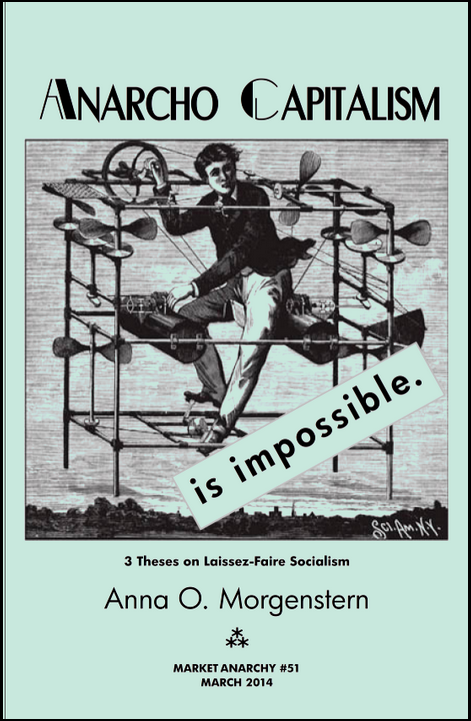
Support C4SS with Anna O. Morgenstern’s “Anarcho-‘Capitalism’ is Impossible”

C4SS has teamed up with the Distro of the Libertarian Left. The Distro produces and distribute zines and booklets on anarchism, market anarchist theory, counter-economics, and other movements for liberation. For every copy of Anna O. Morgenstern‘s “Anarcho-‘Capitalism’ Is Impossible” that you purchase through the Distro, C4SS will receive a percentage. Support C4SS with Anna O. Morgenstern‘s “Anarcho-‘Capitalism’ Is Impossible“.

impossible

$1.50 for the first copy. $0.75 for every additional copy.

“What will happen under anarchy? EVERYTHING.”

This booklet collects three Center for a Stateless Society (C4SS) feature articles by left-libertarian writer Anna O. Morgenstern, examining the rel­ation­ship between anarchism, capitalism and pro-capitalist “libertarian­ism,” including: “Anarcho-Capitalism is Im­pos­s­ible,” “Anarchism & Capitalism: A Revisitation,” and “Market Anarchism vs. Market Statism.”

“Goals sometimes lead people toward certain means, but it is the means that determine results, not the goals. And if the anarcho-capitalists follow anarchist means, the results will be anarchy, not some impossible ‘anarcho-capital­ism.’ . . .

“Anarchy does not mean social utopia, it means a soci­e­t­y where there is no privileged authority. There will still be social evils to be dealt with under anarchy. But anarchy is an important step toward fighting those evils with­out giving birth to all new ones. My take on the impossibility of anarcho-capitalism is simply as follows:

  • Under anarchism, mass accumulation and concentration of cap­it­al is impossible.
  • Without concentration of capital, wage slavery is im­poss­ible.
  • Without wage slavery, there’s nothing most people would re­cog­nize as ‘capitalism.’

“Even assuming an ‘anarcho-capitalist’ property re­g­ime, any­thing recognizable as ‘capitalism’ to any­one else could not exist. In fact the society would look a lot like what ‘an­archo-socialists’ think of as ‘social­ism.’ Not ex­act­ly like it, but much closer than anything they’d imagine as capitalism. . . .”

The essays in this collection first appeared in 2010 and 2014, as Featured Articles at the Center for a Stateless Society, a left-wing market anarchist think tank and media center. They appear here in print for the first time.

Anna O. Morgenstern, a Contributing Writer at the Center for a Stateless Society, has been an anarchist of one stripe or another for almost 30 years. Her intellectual interests include economic history, social psychology and volunt­ary organization theory. She writes frequent com­ment­ar­ies for the Center for a Stateless Society (c4ss.org).

Italian, Stateless Embassies
Barriere all’Ingresso e Finte Scarsità

Da decenni i regolamenti sui taxi sono un esempio da manuale di come le norme governative creino artificialmente barriere, rendite e lavoro salariato. Oltre ad una serie di normative di stampo proibitivo che arrivano a definire anche il colore dei calzini di un tassista, il sistema dei “medaglioni” (come sono chiamate le licenze dei taxi in America, es) limita drammaticamente il numero dei taxi nelle maggiori città creando allo stesso tempo un mercato in cui le licenze vengono date in affitto o vendute (a New York il prezzo varia da qualche centinaio di migliaia a oltre un milione di dollari). Ovviamente questa scarsità imposta ha portato a situazioni di monopolio in cui i medaglioni sono controllati strettamente da mediatori, obbligando gli autisti ad operare in condizioni di lavoro disperate agli ordini di boss capricciosi.

Oggi finalmente questa eterna, dolorosa distorsione sta per dissolversi. Con una complicazione, però: l’edificio sta crollando non tanto per lo sforzo delle organizzazioni di base, ma attraverso il potere di due giganteschi speculatori, Uber e Lyft, che con un proprio capitale politico sono in grado di contrastare gli interessi monopolistici radicati in varie città.

Uber e Lyft non sono santi, e per molti versi anche loro confidano sui privilegi di stato. Le riserve inimmaginabili di capitali speculativi che li proteggono dalle pressioni del lavoro organizzato e della comunità affondano le radici nelle enormi rendite estratte con la proprietà intellettuale e il settore bancario. Questi profitti non esisterebbero senza l’aiuto armato dello stato. Il modello imprenditoriale dei Uber e Lyft, inoltre, prevede che gli utenti – in questo caso i tassisti che vogliono essere indipendenti – siano rinchiusi in “giardini murati” centralizzati online al fine di estrarne la rendita.

A parte ciò, però, il fatto che sfruttino carenze delle normative dei taxi e l’apertura della professione ad autisti indipendenti che non hanno pagato cifre esorbitanti è indubbiamente positivo. Certo, niente garantisce che Uber e Lyft non cercheranno di mettersi d’accordo tra loro per tagliar fuori la concorrenza, così da poter depredare clienti e aspiranti tassisti dalle possibilità limitate, ma le porte della concorrenza, basata su un modello più decentrato e cooperativo, sono state aperte. Le cose stanno finalmente cambiando.

Purtroppo tutto ciò è stato accolto con sdegno dalle fila meno radicali della sinistra.

È comprensibile che i tassisti che si sono già imbarcati in grossi investimenti con le attuali normative siano atterriti all’idea che la professione possa essere aperta agli esterni. La concorrenza farà sicuramente calare le tariffe, e con le regole attuali, con tutto quello che devono pagare tra controlli e norme, molti tassisti riescono a malapena a pareggiare i conti. E anche se riuscissero a liberarsi dalla rete di predatori che attualmente li avvolge per servirsi delle nuove possibilità, vedere che altri entrano nell’attività senza oneri può essere umiliante.

Il tentativo di spacciare le normative dei taxi per garanzia di “professionalità” non è che l’ultimo capitolo nella storia di sindacati conservatori che fanno guerra ad altri lavoratori, invece che ai boss e allo stato, cercando di limitare l’accesso al lavoro con mezzi come le leggi che proibiscono agli immigrati di svolgere certi lavori “per questioni di standard”. È questa mentalità miope che dà la precedenza a chi ha già un lavoro e manda a quel paese tutti gli altri.

Nel tentativo di salvare i posti di lavoro esistenti, la sinistra ingenua finisce per proteggere il lavoro salariato in sé.

Se si vuole una vera soluzione radicale bisogna smettere di aspettare lo stipendio che arriva dall’alto; bisogna smettere di stare attaccati ai datori di lavoro, in attesa che arrivi la rivoluzione nel lontano futuro. Occorre invece generare lavoro per conto proprio. In un mondo in cui la gente ha creatività e capacità, l’insensatezza della disoccupazione e della precarietà di massa sono possibili soltanto se si permette ai guardiani di stabilire chi può fare qualcosa per gli altri. Questo è l’inevitabile effetto perverso delle “normative” della sinistra; quelle che permettono ai parrucchieri di fare lobby per vietare ad una persona di fare le trecce in cambio di denaro se non spende migliaia di dollari per una certificazione.

In un’epoca in cui abbondano guide del consumatore affidabili e largamente diffuse come Yelp, oltre a sistemi di certificazione decentrati, l’urlo disperato degli statalisti, “Occorre una regolamentazione!”, è morto e sepolto. Ciò che impedisce servizi e condizioni di lavoro standard sono le oligarchie. Le barriere all’ingresso e le finte scarsità create in punta di fucile (di poliziotto) non sono amiche della classe lavoratrice, e chi a sinistra le difende è incoerente e reazionario.

Traduzione di Enrico Sanna.

Portuguese, Stateless Embassies
Pelo açaí, contra o governo

Como qualquer outro paraense, gosto muito de açaí. Todo paraense, independente de condição socioeconômica, toma açaí. Este é um fato incontestável da vida no estado do Pará. Se você mora na capital, Belém, também é uma lembrança constante do fato de vivermos na Amazônia, ao lado de outras, como garças em uma praça em pleno centro da cidade.

O açaí, na sua produção tradicional, é tão querido no Pará, que até foi inventada uma música com o seguinte trecho: “Quem foi ao Pará parou. Tomou açaí ficou.”

E o açaí do Pará não é o mesmo que é vendido como energético em outras regiões do país. O seu verdadeiro paladar encontra-se no puro tomado aqui, não no diluído e misturado vendido alhures.

Mas quem poderia ser uma ameaça ao açaí tradicional, se há demanda entre os paraenses para este açaí? Se seu palpite era o estado brasileiro, você acertou.

Em 2010, foi apresentado por um senador um projeto de lei, que, em suas próprias palavras, “Dispõe sobre a obrigatoriedade da pasteurização da polpa do açaí.”

Seu artigo 1º dispunha:

“Art. 1º A polpa oriunda da desintegração do fruto do açaizeiro (Euterpe oleracea) deve ser submetida à pasteurização, conforme regulamentação própria, com fins de prevenção do contágio de doenças transmissíveis aos seres humanos.”

Ainda se previam punições a quem comercializasse o açaí não pasteurizado (leia-se: tradicional): R$ 2.000 na primeira incidência, R$ 5.000 mais prestação de serviços comunitários na segunda incidência, interdição do estabelecimento, na terceira incidência.

A justificativa do projeto era a prevenção da contaminação pela doença de Chagas. O autor do projeto defendia que referida lei era necessária para evitar que as contaminações por ingestão do açaí não-pasteurizado, que ocorrem principalmente na Amazônia, “venham a se tornar um problema de saúde pública de maiores proporções, [por isso] julgamos importante a obrigatoriedade da pasteurização imediata do produto resultante da desintegração do fruto do açaizeiro”. Mas, como bem apontou Lúcio Flávio Pinto, “tanto tempo depois que o açaí faz parte da mesa do paraense”, a proibição não faz nem sentido. Além disso, cuidados de higiene e normas de qualidade foram “providências que os próprios vendedores passaram a adotar.”

O projeto era tão absurdo que sua aprovação tornaria ilegais “os tradicionais pontos de venda de açaí espalhados pelo Pará. Os pequenos pontos, reconhecidos pela famosa placa cor de vinho com o escrito “açaí”, somam cerca de quatro mil apenas na Região Metropolitana de Belém. Segundo estimativa do Sindicato das Indústrias de Frutas e Derivados do Estado (Sindfrutas), a atividade envolve hoje 100 mil famílias, apenas na RMB”.

A presidente do Sindfrutas à época, Solange Motas, destacou o desemprego que seria ocasionado pela medida: “O senador Tião Viana não tem noção do desemprego que essa medida vai ocasionar na região. Só aos arredores de Belém são mais de quatro mil batedores de açaí catalogados, em todo o Estado devem ser mais de dez mil, que ficarão sem condições de sobreviver. É um projeto que quebra diretamente esses produtores. É um projeto totalmente falho, que mostra a falta de conhecimento até no texto”.

Portanto, de todos os ângulos, seja da alteração drástica do gosto de um alimento tradicional, seja do grave prejuízo econômico que representaria para milhares de pequenos vendedores, seria uma lei injusta e alheia à realidade local. Felizmente, o projeto foi rejeitado.

Mas isso não deveria nos deixar satisfeitos. O ponto é que é incrível que um senador federal tenha o poder de apresentar uma lei que pudesse fazer tal alteração nesta tradição regional. É incrível que um Congresso legislativo, instalado em Brasília, tenha o poder de aprovar uma lei que pudesse tão dramaticamente alterar a vida dos paraenses, tanto em uma forma típica de nutrição como em uma opção de trabalho de alta demanda. É incrível que se suponha que os paraenses, consumidores de longa data do açaí não pasteurizado, precisariam de Brasília para não morrerem todos de doença de Chagas.

Contaminações podem ocorrer, e medidas de higienização preventivas são valiosas, mas não há nada que justifique o banimento do açaí não pasteurizado, não há nada que justifique tirar o poder de escolher tomar este tipo de açaí de seu legítimo e verdadeiro dono: o indivíduo, neste caso, geralmente paraense.

Então, está na hora de tomarmos de volta do governo federal o poder de decisão sobre que açaí tomar, que é nosso por direito. Banir, assim, a própria possibilidade de um projeto de lei dessa natureza ser apresentado, a própria possibilidade do estado interferir dessa maneira no cotidiano da Amazônia. Por uma nova cláusula pétrea: o direito inalienável de tomar o açaí que queremos tomar e o direito inalienável de vender esse açaí. O direito ao açaí amazônico sem o paladar azedo do estado.

Feed 44
Let’s Abolish Prisons: Interview with Cory Massimino

Jeffrey Tucker of Liberty.me takes on the tricky topic of prisons and the market solution with Cory Massimino.

Commentary
Occupational Regulations and the Gender Wage Gap

Two researchers at Utah State University have discovered a factor which may be silently impacting the much-discussed, but poorly understood, gender wage gap. Lindsey McBride and Grant Patty examined the gender bias of occupational licensing requirements. What they found is that —  at least at the lower end of the socioeconomic ladder — women are far more likely than men to need to obtain government permission to work.

The researchers focused on jobs in Utah with median yearly earnings below $40,000 (the state’s average) so as to exclude doctors, lawyers, financial professionals, accountants and other specialized professions that are universally licensed. As Economics 21 explains:

The authors then determined the primary gender of those who worked in the thirteen occupations that fell in this category. Their results are clear— in Utah. Approximately 70 percent of the people who needed licenses to work in these professions were women. Of the 13 occupations examined, 9 licensed more women than men and 6 were over 80 percent female. These occupations included dietitians (98 percent female), court reporters (80 percent), cosmetologists (94 percent), and estheticians (96 percent), to name a few.

Similar results can be seen in public interest law firm Institute for Justice’s state-by-state rankings of licensing requirements. The firm regularly fights on behalf of women whose livelihoods are endangered by regulators. For example, even though African hair braiding involves zero dangerous chemicals or implements, Dr. JoAnne Cornwell faced losing her business, Sisterlocks, because she hadn’t spent thousands of dollars and hundreds of hours learning irrelevant, outdated techniques. The truth is Cornwell had developed a new method of braiding which threatened existing businesses. IJ was successful in striking down the arbitrary, cronyist legislation.

According to IJ, the profession with the most onerous licensing requirements out of all the low- and moderate-skill professions is interior design, an overwhelming female field. To design interiors in Nevada, Louisiana, Florida, or the District of Columbia costs $364 and an average of six years of required experience. But it’s hard to understand how ugly rooms threaten public safety.

Right now IJ is fighting for Trisha Eck’s right to allow her customers to use her teeth whitener in her office, though a board of Georgia dentists wants to shut her business down. And in Arizona, Celeste Kelly and IJ are fighting for her right to operate her animal massage business.

There’s abundant evidence that attempts to mandate equal pay can actually hurt women. Legislation always carries with it unintended consequences, no matter how well-intentioned.

The truth is neither side has it right. The left says the gender wage gap results from discrimination. The evidence for this is shaky at best. The right says the gender wage gap can be chalked up to women’s choices. But this doesn’t take into account how government-mandated barriers such as the high cost of child care and occupational licensing laws influence those choices.

Who knows what choices women might make if they were allowed to work without needing permission slips from, essentially, their competitors? There can be no doubt that up-front costs of thousands of dollars and hundreds of hours to even get started in a profession effectively thwarts many women’s career hopes and dreams. By ignoring the problem of women’s underutilization in the work force, or trying to fix it with overbroad, blunt legislation, we miss opportunities to fight to simply government out of the way so women can succeed.

Stigmergy - C4SS Blog, The Weekly Abolitionist
The Weekly Abolitionist: Prison Healthcare and Structural Neglect

Robert Johannes, a 73 year old man, is currently incarcerated in Michigan. His attorney, Daniel E. Manville, contends that inadequate access to dental care has left Johannes missing teeth for extended periods of time and unable to eat. As Michigan Live reported, “The lawsuit claims that Johannes has had several teeth removed, including three bicuspids and two molars, since entering prison and that he requires dentures or partials to be able to chew foods.”

Michael Levy, an inmate at Arizona State Prison, arguably faced even worse neglect from prison healthcare providers. After 15 days of headaches and chest pains, he was only given ibuprofen. Fourteen days later he complained that these symptoms persisted in excruciating ways, and requested an MRI. Officials ignored the request, and he continued to file requests over several months. Eventually, Levy experienced an aneurysm and a stroke. According to Tucson News 4, “Doctors recommended the inmate do aggressive physical therapy, but Levy’s health care provider Corizon stepped in. … Corizon denied his rehab with St. Joseph Hospital and Medical Center in Phoenix ‘due to the cost of rehab.'”

These recent incidents of prison healthcare neglect are not unique. In her book Resistance Behind Bars, Victoria Law describes the case of Michelle Everett, a prisoner in Oregon who repeatedly requested medical care but was ignored. “She was given medical attention only after turning yellow,” Law writes. “After both hepatitis and cirrhosis of the liver were ruled out, she was told that a bile duct was obstructed, but that the prison could do nothing about it.”

For-profit companies often contract with prisons to provide healthcare. Yet their incentives differ substantially from what we would see from healthcare providers in a free market. While these companies are cost-sensitive due to the impact of costs on their profits, their clients are not prisoners, but the state. These contractors have a state-secured monopoly within the prison, so prisoners are not free to seek services from competing firms.  These incentives predictably produce abysmal care. Victoria Law describes two companies that engaged in particularly egregious forms of neglect. One is Prison Health Services (PHS). Writes Law:

A yearlong investigation by the New York Times found that the care provided by PHS was often deficient, flawed, and/or lethal. According to the Times, state investigators scrutinizing ten prisoner deaths came to the same conclusions after finding the same circumstances in each case: to cut expenses, PHS trimmed medical staffs, hired underqualified doctors, had nurses doing tasks beyond their training and withheld prescription drugs. The investigators also found that PHS allowed patient records remain unread and employee misconduct to go unpunished.

Similar neglect has been perpetrated by Correctional Medical Services (CMS). “An investigative article in Harper’s revealed that CMS stymies those seeking treatment for hepatitis C, requiring them to fulfill a long list of conditions, known as ‘the protocol pathway,’ before they can receive any care,” writes Law. This reprehensible behavior is predictable given the incentives prison medical contractors are given.

Problems in prison and jail healthcare are systemic. Prison healthcare services are often understaffed. Moreover, prison is characterized by cruel, austere, and punitive conditions, such as hard and uncomfortable beds and inadequate or unappetizing food rations. The only way to get more bedding or better food is typically a medical exemption, which means that understaffed medical services find themselves swamped with inmates who are simply seeking better accommodations. This makes it harder to detect serious medical issues and respond to them in time.

The mentally ill, the poor, drug users, and sex workers all face increased risks of health problems. Yet our society warehouses members of these groups in institutions where healthcare access is systematically denied. Problems with prison healthcare are not isolated incidents; they’re signs of a structural problem.

Portuguese, Stateless Embassies
Libertários de acordo?

Em Propriedade privada: quando e por quê, Joseph S. Diedrich afirma: “A propriedade privada é, no máximo, um conceito neutro; dadas as condições naturais, ela pode ser tanto boa quanto ruim”. Embora a princípio eu tivesse discordado dessa posição, acredito que após esclarecimentos de Joseph, estou de pleno acordo com ela. Para determinar se o conceito de propriedade é válido, precisamos analisar os fatos externos primeiramente. Esse parece ser o ponto principal que a crítica de Joseph tenta enfatizar para que saibamos quando a propriedade é legítima.

Seria estranho, afinal, após uma construção ética rigorosa, dizer que a propriedade sobre qualquer coisa é legítima. Acho que fiz isso em minha primeira resposta por não ter incluído um trecho sobre a teoria libertária. Isto é, a propriedade sobre bens externos é legítima e é uma extensão da auto-propriedade somente no caso de bens escassos.

Não é possível se apropriar ou adquirir um bem que seja superabundante como o ar. Uma teoria de propriedade adequada deve levar em conta o fato de que existem bens escassos e não-escassos. Eu não poderia afirmar que uma certa “área” do ar seja minha por direito, uma vez que não se trata de algo que seja escasso. Como diz Murray Rothbard em Man, Economy, and State, o ar é, “na maior parte das situações, um bem em abundância ilimitada. Portanto, ele não é empregado como meio escasso para atingir objetivos. (…) O ar, embora indispensável, não é um meio, mas uma condição geral da ação e do bem estar humano”.

O ar e outras coisas superabundantes não são bens no sentido econômico, eles simplesmente existem. Portanto, não são sujeitos à apropriação. Isto é, não podem se tornar propriedade. Suponhamos que vivêssemos na nave Enterprise e tivéssemos acesso a um replicador, uma máquina que criasse o que quiséssemos do nada, a custo zero (além dos poucos segundos que ela levaria para funcionar). No mundo de Jornada nas Estrelas, tudo existe em superabundância (tecnicamente, nem tudo, já que o replicador não é capaz de criar organismos vivos ou matéria negra, mas pode criar qualquer outro bem econômico que conhecemos).

Uma vez que eu usasse o replicador para criar uma deliciosa pizza para o meu almoço e a como, me parece que ela seja por direito minha. Se Warf aparecesse e tentasse tomá-la de mim, acredito que isso seria, efetivamente, um roubo. Em certo sentido, essa pizza é, por direito, minha, já que eu a tornei parte de meu projeto corrente. Contudo, Warf é capaz de usar o replicador e fazer sua própria pizza, ou o que quer que seja que os Klingons comam. Não há conflito, uma vez que os recursos não são escassos (ignore, para os propósitos desta discussão, a escassez ou disponibilidade do próprio replicador).

Esse é exatamente o argumento de Joseph. Sem a existência da escassez de bens, o conflito é impossível e a noção de propriedade perde o sentido. Com isso, ele é capaz de elaborar um argumento contra a propriedade intelectual: “A propriedade privada é, no máximo, um conceito neutro; dadas as condições naturais, ela pode ser tanto boa quanto ruim.” A teoria da propriedade é a seguinte: as pessoas têm direitos a bens externos escassos através de sua transformação pelo trabalho, tornando-os parte de seus projetos. Essa é a parte que se preocupa com a ética normativa.

Devemos analisar com maior profundidade cada situação específica para aplicar esta teoria, utilizando a ética aplicada. Devemos primeiro determinar o que é ou não é escasso no mundo real antes que possamos saber a que os direitos de propriedade se aplicam. Pizzas e revistas em quadrinhos são bens escassos e podem ser transformados em propriedade legítima. O ar e ideias são bens superabundantes que não podem ser adquiridos como propriedade legítima. No mundo de Jornada nas Estrelas, por conta das “condições naturais” (embora o replicador não seja efetivamente natural), a propriedade em bens externos não faz sentido. Em nosso mundo, a propriedade externa é um conceito válido, uma vez que existem bens escassos, mas também há coisas a que ela não se aplica.

Em última análise, acredito que eu e Joseph estejamos em completo acordo nesta questão. Foram apenas necessários alguns esclarecimentos para que eu percebesse. A questão não gira em torno de argumentos consequencialistas ou deontológicos para justificar a propriedade sobre bens externos. A questão é olhar para o mundo real e saber onde existem propriedades válidas. É concebível que exista um mundo em que não existam propriedades válidas: um mundo de superabundância. Um mundo em que eu viva na Enterprise. Contudo, podemos apenas sonhar com esse mundo. A escassez é um fato de nosso mundo. E Joseph e eu concordamos que a propriedade só se aplica a objetos escassos.

Traduzido do inglês para o português por Erick Vasconcelos.

Feature Articles, Mutual Exchange, Private Property: How, When and Why
Libertarians in Agreement?

In “Private Property, When and Why,” Joseph writes, “At best, private property is a neutral concept in itself; based on given natural conditions, it can be either good or bad.” While I disagreed with this position initially, I believe after further clarification, I am actually in full agreement with it. To determine if the concept of property is valid, we must look at the actual facts about the world first. That seems to be the point Joseph is trying to stress in order to figure out when and why property is legitimate.

It would be odd, indeed, to declare, following some rigorous ethical constructivism, that property in anything is legitimate. I fear that is what I did in my first response because I never included a key part of libertarian property theory. That is, external property is only legitimate, only an extension of self-ownership, in the case of scarce goods.

You can’t homestead or acquire a good that is superabundant, such as air. To have a fully fleshed out theory of property, you need to account for the difference between scarce and non-scarce goods. I couldn’t claim a certain “area” of air as being rightfully mine since it is, for all intents and purposes, not scarce. As Rothbard puts it in “Man, Economy, and State,” air is “In most situations in unlimited abundance. It is therefore not a means and is not employed as a means to the fulfillment of ends….Air, then, though indispensable, is not a means, but a general condition of human action and welfare.”

Air, and other things of super abundance, are not goods in the economic sense. They are simply there. Therefore, they aren’t proper subjects of homesteading. That is, they can’t be owned. Suppose that we lived on the Enterprise and had access to the replicator: a machine which creates whatever we want out of thin air, at no cost (besides the few seconds it takes to work). In the world of Star Trek, everything is in super abundance (well, technically not everything since the replicator can’t create living organisms or dark matter, but it can create any economic good we know of).

Now, once I used the replicator to create a delicious pizza for me for lunch, and I am sitting down to eat it, I think it is rightfully mine. If Worf tried to come over and take it, I believe that would be, in effect, stealing. So, in a sense that pizza is rightfully mine since I made it part of my ongoing projects. However, Worf is able to use the replicator and make his own pizza, or whatever Klingons eat. There is no conflict since the resources are not scarce (ignore for the purposes of this discussion the scarcity and/or availability of the replicator itself).

This is exactly Joseph’s point. Without scarcity in goods, conflict over resources is impossible and the notion of external property becomes meaningless. He succinctly uses this point to argue against intellectual property. Let’s go back to the original quote, “At best, private property is a neutral concept in itself; based on given natural conditions, it can be either good or bad.” The theory of property is this: People have claim rights to external, scarce goods by mixing their labor with them and making them part of their ongoing uses. This is the part concerned with normative ethics.

We must delve deeper into each specific situation to apply this theory, to do applied ethics. We must first determine what is or isn’t scarce in the real world before we can see what property applies to. Pizzas and comics are scarce goods that can be legitimate property. Air and ideas are superabundant “goods” that can’t be legitimate property. The world of Star Trek, because of the “natural (the replicator isn’t really natural) conditions,” external property doesn’t really make sense. In our world, external property is a valid concept since there are scarce goods, but there are also things it doesn’t apply to.

Ultimately I believe Joseph and I are in full agreement on this issue. It only took some clarification to realize it. The issue is not consequential vs deontological reasons for external property. The issue is looking at the real world and seeing where valid property exists. It is conceivable that a world exists where they don’t. A world of superabundance. A world where I live on the Enterprise. However, I can only dream of that world. Scarcity, so far, is a fact of our world. Joseph and I agree that property only applies to those scarce objects.

Feed 44
“Libertarian Class Analysis” on C4SS Media

C4SS Media presents ‘s “Libertarian Class Analysis” read by James Tuttle and edited by Nick Ford.

Say the words “class analysis” or “class conflict” and most people will think of Karl Marx. The idea that there are irreconcilable classes, their conflict inherent in the nature of things, is one of the signatures of Marxism. That being the case, people who want nothing to do with Marxism quite naturally want nothing to do with class analysis.

So it ought to be of interest to learn that Marx did not originate class analysis or the idea of class conflict. These things have their roots in radical liberalism, or libertarianism, predating Marx’s writings.

French, Stateless Embassies
Miley Cyrus et la culture libertarienne rénégate

L’artiste la plus célébrée et controversée de l’année est, sans aucun doute, Miley Cyrus. Miley a rapidement et parfaitement transformé son image enfantine des années 2000 à la rebelle corporate. Miley a captivé les audiences avec ce que beaucoup considèrent comme un comportement choquant qui embrasse l’hédonisme et en se moquant des valeurs puritaines. Alors que beaucoup considèrent ses représentations scéniques comme des provocations gratuites, ça marche indéniablement pour attirer l’attention sur elle et transformer son image en quelque chose de nouveau et même de radical. Mais pourquoi est-ce que les libertariens devraient s’intéresser à Miley Cyrus ?

Et bien, parce que le grand public est important, et plus encore, les institutions et constructions culturelles qui persistent sont importantes. Les libertariens ont fait un travail extrêmement bon en développant une théorie de comment une société idéale devrait opérer, alors que dans le même temps ils ne se préoccupent pas de savoir si leurs travaux intéressent ceux qui ne sont pas déjà acquis à la cause. Pourquoi donc est-ce qu’un individu moyen qui a à peine la moindre connaissance en politique ou en philosophie s’intéresserait aux valeurs libertariennes ? La réalité est que de nombreux libertariens sont des iconoclastes rationnels. Nous aimons ne pas être conformes et bousculer l’ordre établi. Nous pensons que l’attaque la plus percutante est un syllogisme ou peut-être la 25ème édition anniversaire de La Grève. Le libertarien ne voit pas de rigueur intellectuelle dans la culture populaire et juge donc inutile toute analyse. Ce rejet a mené le libertarianisme à être vu comme une théorie excentrique destinée aux solitaires et aux introvertis. Si les libertariens veulent accomplir de réels changements dans la société, ils ont besoin de passer moins de temps à débattre théorie et plus de temps à infuser leurs idées dans la culture populaire et soutenir les normes culturelles qui favorisent la liberté. Les normes culturelles sur le sexe, les drogues et toute autre amusement dont certaines personnes ne veulent pas que d’autres personnes en profitent ne valent pas plus que l’opinion de ces personnes elles-mêmes. La loi n’est pas une force divine que l’on ne peut pas braver. C’est une question de reconnaissance sociale. Personne n’ira faire respecter la loi sur les feux rouges à New York, puisque tout le monde les grille. Il serait impossible d’essayer de la faire respecter. Les libertariens doivent arrêter de convaincre les gens de changer leurs valeurs culturelles et doivent commencer à promouvoir celles qui leur sont importantes.

Roderick T. Long et Charles W. Johnson ont abondamment argument sur pourquoi est-ce que les libertariens devraient embrasser les valeurs traditionnelles de gauche, question de cohérence culturelle. Le succès d’une société libertarienne n’est pas seulement d’anéantir l’état, mais d’anéantir toute forme d’oppression. A quoi bon vivre dans une société sans état si les femmes y sont toujours traitées comme des objets ? Où votre couleur détermine votre statut socio-économique ? Les libertariens doivent regarder sérieusement les formes d’oppression qui existent hors de l’état, puisque l’état puise ses pouvoirs dans ces oppressions non gouvernementales. (voir Roderick Long, « Féminisme libertarien : Est-ce que ce mariage peut être sauvé ?«)

Il y a des formes d’oppressions qui ne dépendent tout simplement pas de l’existence de l’appareil d’état. Les lois sont faites des normes que le peuple est prêt à reconnaître et à appliquer. Même les institutions politiques autoritaires par excellence comme l’armée reposent plus sur l’acceptante culturelle, l’obéissance et la docilité que sur les intentions des généraux et des politiciens. Et s’il y avait une guerre et que personne ne venait ? Les institutions politiques donnent la possibilité faire usage d’intimidation, mais personne n’est forcé à devenir militaire. Personne ne vous met un pistolet sur la tempe et vous demande de soutenir les troupes. Si demain chacun arrêtait de croire que chaque soldat est un héros et que chaque guerre est un sacrifice au nom des valeurs américaines, peut-être verrait-on un déclin de cet empire du mal.

Comme Johnson et Long, je pense aussi qu’il est nécessaire d’avoir une conception plus large du libertarianisme. Plus précisément, je pense que les libertariens devraient embrasser ce que j’appelle lelibertinage culturel, par cela je veux dire l’expression de la volonté d’une personne à faire ce qu’elle et elle seule désire. Cela signifie soutenir les actions spontanées des individus, qu’elles soient en accord avec nos propres valeurs ou non. Quand les normes culturelles sont utilisées pour étouffer les préférences personnelles, les libertariens devraient s’indigner.

L’historien Thaddeus Russell a longuement argumenté que pour les libertés que nous considérons comme acquises, de l’indépendance des femmes au week-end, il faut remercier des renégats. Les renégats ne sont pas des hommes politiques. Ils n’ont rien à faire du principe de non-agression (NAP) ou d’une société sans état. Dans certains cas, ils pourraient bien être des personnes très désagréables avec qui vous ne voudriez pas être laissés seuls bien longtemps. Ils ne sont certainement pas les gens disciplinés qui seraient à la tête de sociétés d’aide mutuelle ou de coopératives. Ils pourraient être ces cavaliers seuls dont on a peur. Néanmoins, ces actes qui peuvent nous dégoûter nous ont donné une vision plus large de la liberté individuelle, tant sur le plan politique que culturel.

Mais que diable viennent faire les singeries de Miley Cyrus ? Eh bien, je regarde les actions de Miley de ces derniers temps, que ce soit sur sa sexualité, sa consommation d’ecstasy ou qu’elle ait fumé un joint sur scène face à des millions de spectateurs, moins comme des actes qui visent à choquer, mais comme une forme dedésobéissance culturelle. La désobéissance culturelle, comme la désobéissance civile, implique des actions qui soient culturellement mal vues. Quand Miley rejette son rôle d’idole pour adolescents et commence à se frotter sauvagement contre Robin Thicke avec des ours en peluche sexualisés en arrière plan, elle fait plus qu’attirer l’attention pour son nouvel album, elle se débarrasse de ce que l’on attend d’elle en tant « qu’innocente ». Miley affiche sa sexualité à bon usage, comme quelque chose de fort que chacun peut apprécier comme il l’entend.

Récemment Miley s’est de nouveau engagée dans un acte de désobéissance culturelle en allumant un joint sur scène durant un événement télévisé. Encore une fois, on peut voir ça comme une publicité provocante. Elle n’aurait jamais fait ça si ses avocats ne l’avaient pas approuvé auparavant. Mais c’est un signe qui montre que les normes sur la consommation de drogue sont en train de s’effondrer. La plus grande nouvelle dans la pop ces derniers temps est d’être choqués de la voir prendre de la drogue et, ce faisant, elle fait sa part dans la normalisation de la drogue dans notre culture. Comme j’ai pu écrire auparavant :

« … nous n’arriverons pas au point où la consommation de drogues n’est plus sévèrement réprimandée par la société et par l’état sans avoir des consommateurs de drogues pour participer à une désobéissance civile passive. Ceux qui allument un joint sur leur porche ou dans un parc public ne sont pas seulement en train de planer, ils sapent les normes sociales qui légitiment ces lois. Quand nous soutenons les conservateurs qui font de l’œil aux politiques libertariennes mais mettent de côté ceux que nous voyons comme déviantes, nous soutenons une culture puritaine. Nous oublions nos vraies valeurs, nous soutenons les valeurs qui rendent les lois sur les drogues possibles. »

Considérez cela tout simplement comme une extension de l’application de la pensée agoriste. L’agorisme reconnait que le gouvernement est aussi bon que l’économie qu’il contrôle. La culture libertarienne reconnaît que la culture joue un rôle similaire dans la fondation des lois en vigueur. Les drogues ne sont pas devenues illégales parce que les politiciens l’ont dit, mais à cause des campagnes anxiogènes sur leurs effets et à cause du profil des personnes qui en prennent. Les femmes ne se sont pas réveillées dans un monde d’oppression le lendemain du passage des lois régulant leur corps. Il était déjà accepté dans la culture dominante que les femmes doivent être traitées de la sorte, et ça c’est manifesté dans la loi.

Miley Cyrus peut potentiellement faire avancer les choses, comme d’autres figures de la pop. Vous n’avez pas à adorer leur musique ou la façon dont ces gens se vendent. Le fait est que les libertariens devraient adopter une attitude sex-positive et drug-positive afin d’éliminer l’oppression qui est faite sur les minorités sexuelles, les consommateurs de drogues et les dissidents culturels. Considérez qu’il y a plus à l’expression de votre philosophie politique que le NAP. Quand les gens se dressent et déclarent qu’ils sont libres malgré les normes sociales, nous devrions les désigner comme les meilleurs représentants de notre philosophie. Vous devons soutenir les renégats culturels et, plus particulièrement, la culture populaire qui bouscule les mœurs traditionnelles. C’est en mettant en avant les idées libertariennes et même libertines dans la culture populaire que le libertarianisme progressera. La guerre sur la culture (ndt. référence à la guerre sur les drogues aux USA) est réelle et les libertariens doivent commencer à la prendre au sérieux.

Traduction de Miley Cyrus And The Libertarian Renegade Culture de Ryan Calhoun

Stigmergy - C4SS Blog, Weekly Libertarian Leftist Review
The Weekly Libertarian Leftist And Chess Review 29

Steven Reisner discusses a letter to Obama about ending torture once and for all.

Ralph Nader discusses a potential left-right alliance.

Vincent Navarro discusses the Mondragon worker cooperatives in Spain.

James Peron discusses how people who hate gays also hate capitalists in the context of the businesses refusing to discriminate against them.

Qatryk interviews Roderick Long in Poland.

Lucy Steigerwald discusses the death penalty.

Danny Haiphong discusses the left flank of U.S. imperialism and respectability.

Kevin Carson discusses May Day.

Kevin Carson discusses the governmentalist educational establishment and equality.

Stefan Haus discusses the rise of the right in Europe.

Ron Keine discusses why ending the death penalty should be a conservative priority.

Sheldon Richman discusses how the U.S. blew a chance to reconcile with Iran.

Tessie Castillo discusses a Georgia mother who arrested her own daughter for heroin.

Jacob G. Hornberger discusses racism in government programs.

Sheldon Richman discusses the thick and thin libertarian debate.

Travis Wilson discusses why he uses the word voluntarylist rather than anarchist or libertarian.

Ron Jacobs discusses the failure of the U.S. war in Afghanistan.

Mateo Pimentel discusses the U.S. embargo on Cuba.

Justin Raimondo discusses the non-interventionist sentiment among the American populace.

Jacob G. Hornberger discusses the continuing Cold War against Cuba.

Zenon Evans discusses the drug testing of teens at three private high schools by a company with a CEO that is a brother of the principal of SEHS.

Robert Fantina discusses U.S. terrorism against Cuba.

Steve Chapman discusses the secrets and lies of the American drone war.

Conor Friedersdorf discusses the ticking time bomb scenario and torture.

Cathy Reisenwitz discusses how government created the campus rape crisis.

Christopher Westley discusses e-cig manufacturers who support regulation.

David Stockman discusses why the warfare state must be dismantled.

Magnus Carlsen beats Anand before the World Chess Championship.

Magnus Carlsen beats Boris Gelfand.

Feed 44
“Abolishing Capital Punishment is Not Enough” on C4SS Media

C4SS Media presents ‘ “Abolishing Capital Punishment is Not Enough” read by Trevor Hultner and edited by Nick Ford.

When we are disgusted by the unnecessary pain inflicted even on those who’ve inflicted unnecessary pain, we are disgusted with retribution. When we are outraged by the horror of a botched execution, we are outraged by the use of punishment to make an example out of its victims.

It is time to take the final steps on the path we’re already taking.

It is time to abolish the crime of punishment.

Anarchy and Democracy
Fighting Fascism
Markets Not Capitalism
The Anatomy of Escape
Organization Theory