Portuguese, Stateless Embassies
Cercamentos modernos

Recentemente, Rodrigo Mezzomo, no blog do Instituto “Liberal”, defendeu a “remoção” das favelas como necessidade urbanística para o Rio de Janeiro. De acordo com o autor, as favelas são símbolo de “desordem e ilegalidade”, resultado de “invasões e ocupações desordenadas”. Além disso, os moradores das favelas são “cidadãos superiores, que não estão submetidos à ordem constitucional do país, pois não são obrigados a cumprir os mesmos deveres dos demais brasileiros que vivem no asfalto”. Por isso, para ele, “remover é preciso”.

É lamentável que Mezzomo não esteja disposto a chamar o que ele defende daquilo que realmente é: a expropriação violenta dos moradores das suas posses legítimas. As favelas são “irregulares” apenas por uma formalidade jurídica. Apesar de alguns tímidos esforços de legalização fundiária urbana, os favelados ainda são considerados invasores e criminosos por definição, embora tenham se apropriado de terrenos virgens.

Isso deve explicar por que Mezzomo não está tão ansioso para deixar sua casa e ir morar nas favelas, embora os favelados sejam considerados “cidadãos superiores”: a verdade é que os moradores das favelas, longe de serem privilegiados, são considerados cidadãos de segunda classe, indignos de garantias básicas, excluídos de direitos de propriedade, privados de suas liberdades individuais.

Os moradores das favelas convivem com a opressão diária da própria polícia (que não reconhece seus direitos individuais e impõe um estado de sítio permanente sobre a população), com o perigo constante imposto pelos traficantes de drogas (extremamente armados e que utilizam as favelas como trincheiras), com a ameaça constante de expropriação (seja por motivos de “segurança” contra enchentes, por exemplo, ou por motivos urbanísticos), com a insalubridade constante do ambiente (tomado por lixo e esgoto a céu aberto) e com a prestação precária de serviços (em muitos locais, a própria distribuição de água e energia é inexistente). Viver em favelas claramente não é o mar de rosas descrito por Mezzomo. A favela não paga IPTU, mas acho que poucos favelados consideram que a troca seja justa.

É sintomático que Mezzomo tenha mencionado que o bairro da Tijuca tenha se “desvalorizado” no Rio de Janeiro após a ocupação de diversas áreas por favelas. Era uma área “nobre”, que perdeu após a chegada das favelas e, presumivelmente, dos indesejados. O problema é que as favelas, enquanto construções irregulares, não são resultado da liberdade urbanística, mas são a consequência cruel de anos e anos de intervenções violentas nas cidades, de planificações urbanas e da proibição da ocupação de terrenos perfeitamente viáveis para a aquisição.

A tentativa de expropriação dos pobres que moram nas favelas é particularmente criminosa, pois remove os cidadãos dos centros urbanos, onde há oportunidades, e os desloca para a periferia, longe dos olhos e das sensibilidades dos ricos.

Para Mezzomo, as “remoções” são assunto tabu dentro da política do Rio de Janeiro e do Brasil de forma geral. Mentira. As remoções são sancionadas e praticadas como política de estado e aprovadas pela classe média metropolitana. No Rio de Janeiro, mais de 20 mil famílias já foram removidas desde 2009. Estima-se que 250 mil pessoas possam ser despejadas com os preparativos para a Copa, embora não existam dados precisos.

O programa Minha Casa, Minha Vida, do governo federal, inclusive, trabalha diligentemente para enriquecer empreiteiras e despejar os pobres para morar na periferia.

Sei que não vou convencer a classe média nem os ricos com os argumentos acima, então tenho uma proposta que deve agradar a todos: vamos remover os ricos e a classe média dos bairros nobres, colocá-los na periferia e dar aos pobres as antigas casas e apartamentos do Leblon, de Ipanema e Copacabana. Que tal?

Commentary
Reviving the Lodge Model

[Note: This piece was originally written as a letter to the editor of the New York Times in reply to its “Invitation to a Dialogue” on alternative therapies.]

As Dr. Gordon notes, legislation ostensibly aimed at increasing the affordability of health care has had the effects of locking in a status quo of needlessly high levels of costly treatment required to receive any health care and of crowding out self-help and innovations in lower-cost methods. This will be the inevitable result as long as the necessity of subsidizing the capital-intensive, mass-production model of delivery of uniform service by a favored professional elite to passive recipients is assumed necessary to guarantee a modern standard of quality.

Historian David T. Beito notes that the lodge practice system which provided low-cost health care to the members of early twentieth century fraternal societies “opened up rare opportunities for many working-class Americans to compare and experiment and empowered them with the necessary economic clout to break free from the confining view that health care was merely a generic good.” A modernized revival of the lodge model of cooperative, nonprofit provision of basic health care, along the lines of the Ithaca Health Alliance, would avoid the perverse effects of the current mass-industrial model.

Commentary
Police Have Never Guaranteed Order

It’s over. As the evening started on Thursday (May 15), the Military Police of the State of Pernambuco, in Brazil decided to finish a strike that had lasted the whole day. Looting, depredations, disorder and murder all happened during the strike. Stores closed, people went home. “Arrastoes” (“draggings,” where large groups of people set off to plunder) were common, cars were set on fire — perhaps to make sure that the firemen were also on strike (they were).

As I left home here in Pernambuco’s capital, Recife, the prevailing sensation was that nothing had changed. Pernambuco is one of the most violent states in the country, and Recife is the 39th most dangerous city in the world, with 36.82 homicides per 100,000 people. When the police function normally, we are in constant peril. Without them, was it actually more dangerous or had little changed?

What actually changed was people’s perceptions. They thought no one could be punished for crimes anymore. People took the streets and plundered. Big retail stores moved their merchandise and were able to protect themselves, but many small businesses lost everything. The situation seemed to have gotten out of control, but government decided to exercise its monopoly of violence radically and put army tanks on the streets. I imagine they hoped to blast some people who were getting away with stolen TV sets — the World Cup is less than a month away, TVs are valuable right now.

But the perception that there weren’t any police was much stronger than reality: The truth is that Pernambuco never actually has a police force. When it does, it’s seen as a threat, not as protection, by 80% of the population. In our everyday lives, we hardly ever feel protected by the police and nothing had changed in that regard on Thursday. If, on any given day, people decided to do the same they did then, they would be able to and would go unpunished. They just haven’t realized their power yet, but the police are nothing but a small group of people, incapable of dealing with a much larger number of people who are not willing to obey them.

The fact that the police stopped working and everything came crashing down so quickly was supposed to show us how essential the police really are, but the message seems to be the very opposite. In Recife, 1,416 people died in 2013 — almost 4 each day. On the 15th, when anomy and anormality supposedly reigned, there were 7 deaths. The police strike should make stop and think for a moment that, ultimately, the Military Police are an exercise in futility, an institution that survives on stated purpose rather than results.

Order only survives when people believe it will survive; if people believe that it is government’s enforcement branch that keeps order, this order will only subsist while government does. Thus, order is not sustained by force, but by culture — and the same goes for rulers. If people, collectively, stop thinking that the police are needed, there will be order and freedom without looting, depredation or deaths. Power is just a public fiction, something that does exist, but which can disappear with a simple change in public opinion.

Ayn Rand would say that power only exists by the sanction of the victim. La Boétie asks us which power our rulers have, if not those we give them. David Hume concludes that power is sustained by little more than opinion; while Gramsci knows that any order is created and maintained by a cultural system that legitimizes it. And, as Lord Varys puts it, on Game of Thrones, “Power resides where men believe it resides.”

On Thursday, people took the power they always had and used it for evil. And, by the end of the day, they decided to hand it over to the police, that announced the end of their strike — but if the people didn’t want to hand power back over, what could the police do? When cops announce their next strike, maybe the people will realize they don’t really need them and will keep on living normally. Because order exists where people believe it exists.

Portuguese, Stateless Embassies
A ação direta alcança resultados práticos

Na vila de Kalabalge, no estado nigeriano do norte de Borno, o povo reagiu. Enquanto políticos tremiam e ativistas tuitavam, as pessoas de Kalabalge se armaram e combateram seus inimigos, prendendo um comboio do Boko Haram numa emboscada quando iriam sofrer um ataque em sua vila. Pelo menos 41 militantes do Boko Haram foram mortos e dez foram capturados no ataque surpresa a dois caminhões empreendido pelos habitantes do vilarejo. Armados com rifles, facões e arcos, as pessoas de Kalabalge fizeram aquilo que o exército da Nigéria não foi capaz de fazer e se defenderam com sucesso dos milicianos.

Estamos condicionados a pensar em “ativismo” como uma tentativa de fazer com que outras pessoas façam alguma coisa. Pedimos para que políticos e burocratas saiam de sua inércia e ajam de alguma maneira benéfica. Mas o melhor e mais efetivo ativismo é aquele em que assumimos o controle da situação e resolvemos nossos problemas — ou combatemos nossos inimigos — por conta própria. Na província de Michoacán, no México, as pessoas se insurgiram contra o cartel Cavaleiros Templários, expulsando-os com tanta eficiência que o governo mexicano desistiu de tentar suprimir as milícias e agora pretende suborná-las, transformando-as em um braço do estado criminoso. Só podemos esperar que o povo resista a esses avanços.

E agora, na Nigéria, o povo está levantando. Enquanto o resto do mundo responde aos crimes do Boko Haram com hashtags e selfies, o povo de Kalabalge respondeu com balas e facas, assumindo a responsabilidade por suas vidas e famílias. Para se defender, deve-se depender de si mesmo; em cursos de autodefesa, nós aprendemos tanto a confiar na própria força quanto técnicas para derrotar os atacantes. O Boko Haram reagiu da forma que os agressores respondem desde sempre a vítimas fortalecidas — colocaram o rabo entre as pernas e fugiram, deixando seus mortos e feridos para trás como covardes que sempre foram.

Nos Estados Unidos, o centro imperial, nós também precisamos aprender a nos defendermos de agressores em nosso meio, contra as forças do império. As ações não precisam ser diretas, não é necessário o confronto direto — embora aqueles que escolham enfrentar os opressores diretamente mereçam o nosso respeito. No movimento anti-guerras dos últimos 14 anos, ocorreram várias iniciativas de conscientização, de levantamento de fundos e outros eventos importantes, mas o ativismo mais efetivo teve duas formas: o desestímulo ao alistamento militar — conhecido como “contra-recrutamento” — e o estímulo à deserção dos soldados. São iniciativas muito mais desafiadoras do que segurar uma placa numa passeata, porque requerem que nós conheçamos as pessoas que estamos tentando alcançar e que ofereçamos uma alternativa viável ao exército, que é um dos últimos lugares que existem em nossa sociedade em que qualquer pessoa fisicamente apta pode conseguir um emprego com bom salário e benefícios. Mas ambas as ações geram resultados práticos, porque retiram matéria-prima da máquina estatal, forçando os controladores do estado imperial a gastar mais tempo e recursos para encontrar e reter soldados e menos na agressão e no assassinato de pessoas.

Falar numa sala de aula no interior sobre as alternativas ao exército não é tão dramático quanto fazer uma emboscada a caminhões do Boko Haram numa floresta nigeriana no meio da noite, mas ambas as ações compartilham um mesmo aspecto: nenhuma delas requer que imploremos àqueles que detêm o poder por piedade e conforto. Ambas combatem o inimigo diretamente e enfrentam diretamente os mecanismos de opressão e violência. Se vamos ser salvos, precisamos seguir o exemplo de coragem do povo de Kalabalge e tomar nosso destino em nossas próprias mãos.

Traduzido do inglês para o português por Erick Vasconcelos.

Feature Articles
Radicalism as Revolution: A Call for a Fractal Libertarianism

In this recent post at Students for Liberty (SFL), Clark Ruper calls for libertarians to stop fighting between themselves and to band together in the name of spreading freedom. Using the story of Students for a Democratic Society (SDS) as a parallel, he decries going too far down a “rabbit hole” of “reflective thinking.” It is Ruper’s claim that because SDS became too concerned with ideological commitments beyond their central focus, their movement imploded in a mess of intra-group Marxist feuds. From this analysis of SDS’s history Ruper warns libertarians that SFL and libertarianism more generally are risking SDS’s fate. Because of fighting between different groups within libertarianism, (objectivists, left-libertarians, anarcho-capitalists, minarchists, etc.) we risk losing the ability to work toward our common end – freedom.

Ruper’s claims are odd for a libertarian. After all, libertarianism is a system of views specifically orientated toward unique individuals of common or conflicting interests working together peacefully. If there is a danger of ideological debate between libertarians degenerating into useless bickering and a broken movement, then perhaps there’s good reason to reconsider libertarianism as a whole.

Despite this tension, there are compelling parts of Ruper’s article. In discussing topics which informed people care about, it is common for discussion to degenerate into wastes of time like ad hominem attacks or strawmen. In this regard, it is very important that libertarians are vigilant not to let infighting kill the movement. Focusing too much on personal grudges or allowing dialogue to rot into the aforementioned “time waste” just squanders energy and time. However, it is not the case that this means “reflective thinking” need be abandoned by any group in particular, much less the movement as a whole. A movement that does not define itself is powerless when calling for change. It can express disapproval for any number of problems, but without specific or clearly defined tenets, it cannot move. The “movement” stagnates. In this regard, it is useful to distinguish between two types of infighting: discussion and discord. Discussion is the necessary form of internal conversation that transforms a movement into a tradition. Discord is the partisan altercation that leads to the demise of groups like SDS. Both can appear tumultuous and divisive, but where tumult in discussion is passion, tumult in discord is budding enmity, where division in discussion reveals ideological questions to be addressed, division in discord leads to a fracturing of the movement.

Ruper, in all fairness, does say he appreciates libertarians’ intense self-analysis. He seems to just want libertarians to redirect their energies toward spreading broadly libertarian ideas, rather than converting members of the libertarian movement to a different faction therein. He specifically says defining people out of the libertarian movement is unhelpful, as it only splinters those working toward a common cause. He is right to call for caution in how libertarian movements build themselves, but it is impossible to imagine a movement that did not define who was not a supporter. Whether they are libertarians or not, people believe in varying numbers of libertarian principles. Who counts as a libertarian is, therefore, an important questions for groups seeking to push libertarian ideas. For a big tent group like SFL, a more lenient set of criteria (like simply believing in substantially greater individual liberty) might suffice. However, that does not mean that the end of necessary or even useful libertarian self-analysis is this politically expedient inclusion of all those who aim for freedom for whatever reason. Even for SFL, discussion and disagreement about the content of libertarianism (its thin core) and its implications (its thick perimeter) can show those outside the many and varied ways libertarianism can address problems. If someone is a fan of non-interventionism and open borders but not intellectual property abolition, seeing some libertarians defend copyrights and patents can draw them into the movement (hopefully, investigating the internal debate, they will find the evils of IP).

According to the article, SDS fell apart because they passed from being radicals to revolutionaries. By “radicalism” Ruper means getting to the root of problems and pushing for change in their fundamental causes. In his own words about revolution:

Revolutionary thinking goes a step further than radicalism by assuming the entire structure of society or a movement is corrupt and that it has to be torn down and started fresh. It posits that revolutionaries know what is best for all and that they can rationally design something better. In practice, it leads to massive upheaval and destruction, as can be seen from the blood-soaked streets of the French Revolution to the bomb-shattered legacy of Students for a Democratic Society.

His first sentence is accurate. There is no way to have true revolution without complete overhaul. This is why perpetual revolution is the activist’s dream. There can never be complacency, never stagnation, never degradation. The whole of society is in an unending state of flux toward social equilibrium. However, after that, Ruper’s claims are strange, even in the most charitable reading. Anarchists, for example, are revolutionaries in part because a better society cannot be rationally designed (at least not centrally). If revolutionaries don’t know how a better a society could function, even using a form of spontaneous order like Hayek or Proudhon imagine, then radicals certainly don’t either. The necessity of revolution is a conclusion arrived at from the same kind of reasoning “mere” radicals use, not an epistemic block that prevents revolutionaries from seeing the faults they supposedly have due to hubris. The idea that revolution leads to destruction and upheaval is accurate, but this is desirable in its nonviolent form. Assuming Ruper means violent revolution, even that is often desirable. When a people rise up against a tyrant who oppresses them, violence will result but it is still a just struggle.

There is a deeper problem with the radical-revolutionary split Ruper suggests. Today, one cannot be a consistent radical without being a revolutionary. With all the problems endemic to government from public choice issues to rights violations, it is fanciful to believe that anything short of complete overhaul is needed. As all the work at C4SS strives to show, there is no way to see the fundamental causes of the myriad social problems facing humanity today and not call for the abolition of government domination, institutionalized violence and social hierarchy. To be truly radical requires being totally revolutionary. The radical must be an activist, and the activist must pursue the aforementioned dream – perpetual revolution.

To more accurately draw the distinction, Ruper is probably reaching for, a successful movement can pass from advocating radicalism and, consequently today, revolution to advocating violent, isolating fanaticism. When SDS began planning aggressive efforts to change their society, they ceased using the means libertarians accept as justifiable. At the same time, they began to use means that isolate a movement and lock it into the socially unacceptable space of fanaticism. Libertarians, if they are to be consistent, should be radicals and revolutionaries but not fanatics.

So what is a libertarian to do? Ruper asks for a movement devoid of “revolutionary thinking” whose members waste no time infighting. This leaves libertarians with a milquetoast ideology, poorly defined and lacking passionate defenders or rigorous introspectors. This is far from what makes a highly successful movement. However, incivility and isolating extremism can destroy a movement. Fanaticism is a death sentence for any growing ideological minority. It seems that libertarianism needs a movement based on pursuit of common goals, with the varying ideological camps willing to put aside differences until their relevance is immediate, and able to discuss their differences within the larger groups they organize. The libertarian movement needs to become a fractal of nested associations between individuals. The left libertarian market anarchist and the paleolibertarian minarchist both belong in a big tent libertarian organization, but perhaps not at the same table. Together they can push for the ideals of nonviolent social cooperation, but on specific issues of social hierarchy they can take opposite sides. Within the big tent they can discuss the issue, and outside they can spread their ideals independently, but within the big tent no camp should try to push its particular ideals as though it represented the majority.

To implement this vision of activism, every organization needs a statement defining what its members aim to accomplish. For C4SS, it is a leftist vision of anarchy. For SFL (from their website, emphasis added):

Students For Liberty is an organization that supports liberty. SFL does not dictate the foundations upon which individuals justify their belief in liberty. Rather, Students For Liberty embraces the diversity of justifications for liberty and encourages debate and discourse on the differing philosophies that underlie liberty. What Students For Liberty endorses are the principles that comprise liberty:

  • Economic freedom to choose how to provide for one’s life;
  • Social freedom to choose how to live one’s life; and
  • Intellectual and academic freedom.

Ruper has forgotten the mission of the very organization he supports. The call for a libertarianism including many groups, debating their differences and celebrating their likenesses is precisely the ideal SFL represents. In calling for an end to infighting in favor of ideological simplicity and purity, he has, ironically, come back to bite himself. He is pushing for a particular form of libertarianism and advocacy. In his own words:

There has been far too much “we would be better off if” and “this is why we can’t have nice things” rhetoric in the movement. Internal debates are healthy and good. We should study fringe ideas and be critical of our own beliefs, but not to the point where we devolve into tribal elitism over those differences… We need to be radical champions and unifiers, not dividers, of liberty.

To restate, Ruper is claiming to believe we would be better off with fewer “we would be better offs.” It is entirely unclear what a movement looks like without recommendations for the direction to move in, but it is true that “tribal elitism” is unhelpful. This is the crux of the fractal movement model. With each sub-group having a place in the big tent, no one group gets to dictate to the rest, and all get the benefits of working together. This makes perpetual revolution a kind of endless zooming in on the fractal. As the biggest tent achieves its goal, it can disband and the next largest set of groups can continue their work on their relevant differences.

In a sense, this fractal structure is seen in nature. No species is genetically pure, and for good reason. With variation in traits comes the ability to adapt to future, unforeseen problems and leave offspring. Evolution takes advantage of internal differences when they are adaptive or gets rid of them as maladaptive traits are explored. In the same way, social movements can take advantage of variation and internal discussion while discarding ideas as they are found inaccurate or other movements achieve their goals.

Ruper is right to caution against libertarianism going the way of SDS, and he is right to call for a united, championing libertarian movement, but he misdiagnoses the source of SDS’s ills, and is unduly alarmist about libertarianism, and especially SFL. Infighting is a libertarian pastime, and there cannot be a movement without rigorous self-analysis and recommendations about how best to work together. Ruper knows this, or he would not have written his article. What he should have called for is a libertarianism united under the common banner of freedom, with passionate, friendly discussion on the issues therein, and a fractal nesting of smaller, more specialized groups. Libertarianism needs deeper specialization with less incivility, not sterilized homogeneity with self-congratulatory discussion.

Stigmergy - C4SS Blog, Supporter Updates
Volume 1, Issue 2 of THE NEW LEVELLER now online!

newnewnewleveller

“Are you interested in individualist anarchism, or at least so frightened by it that you want to keep an eye on its progress? Are you frustrated by capitalism’s love for central planning and communism’s conservative view of human potential? Do you suspect that abolishing the institution responsible for war, police brutality, and mass incarceration might not be so dangerous after all?

Then The New Leveller is for you!”

The second issue of the Students for a Stateless Society‘s newsletter, The New Leveller is now online.

For a link to a PDF of the entire issue (recommended!), click here.
For links to an HTML version of each individual article, click here.

In this issue:
“Who Is the Government?” asks the question of its title. Rejecting the standard democratic myth that “we are the government,” it focuses its answer on the State’s exploitative nature.
“No Loyalty on May 1st” by Benjamin Blowe examines the lessons left-libertarians should take from May Day. Blowe especially takes issue with the U.S. Government’s attempted co-option of May 1st with what is called “Law Day” (or worse, “Loyalty Day.”)
“Liberty by Design” by Andy Bratton takes a dynamic view of freedom, showing how the negative liberty that anarchy affords is also the best tool for developing a world of greater and greater positive liberty.
“The Planet vs. The State” by Zoe Little outlines both how the Earth is threatened by the governments who lay claim to it, and how it would be better protected by respecting the rights of its inhabitants.
“A General Idea of Revolution” by Gabriel Amadej is a brief manifesto for human liberation. Supporting not only freed markets and a strategy of counter-economics, but also worker autonomy and a strategy of wildcat unionism, Amadej proposes a vision of “agora-syndicalism.”
“Toward an Anarchy of Production, Part II” by Jason Lee Byas is the second part in a series of arguments for why anti-capitalists, leftists, and anarchists ought to support markets. This installment explores the interconnectedness and interdependence of commerce and community.
“The Individualist Anarchist & Work” by Nick Ford draws attention to just how soul-destroying the modern work experience is, and argues that individualist anarchists ought to want more out of life.

Feature Articles
Rothbard’s For a New Liberty

In 1973, nine years before he published his magnum opus in political philosophy, The Ethics of Liberty, Murray Rothbard issued a comprehensive popular presentation of the libertarian philosophy in For a New Liberty: The Libertarian Manifesto, first published by the mainstream publisher Macmillan.

The book is an excellent discussion of libertarian principles and applications, and it is still worth reading today. In rereading the book for the first time in decades, I found the foundational material especially interesting. Indeed, the material in For a New Liberty foreshadows what we find in greater detail in the later Ethics of Liberty.

As we saw in the later book, Rothbard believed that what he called the “nonaggression axiom” had to be derived. Although he used the word axiom, rather than principle or maxim or (as I prefer) obligation, he did not mean that the idea of nonaggression was self-evident, a priori, or self-justifying. Nor did he say that the denial of the axiom results in a contradiction.

As Rothbard wrote, “If the central axiom of the libertarian creed is nonaggression against anyone’s person and property, how is this axiom arrived at?” Clearly, then, he regarded it as a derived principle. Does that mean he was wrong to call it an axiom? Not according to Roderick Long:

Another objection [to the nonaggression axiom] focuses on the term “axiom,” which is sometimes taken to imply that the prohibition of aggression enjoys a special epistemic status analogous to that of the law of non-contradiction, e.g., that it is self-evident, or knowable a priori, or a presupposition of all knowledge, or that it cannot be denied without self-contradiction. While some proponents of the prohibition do indeed claim such a status for it, many do not, and accordingly it is sometimes suggested that “non-aggression principle” or “zero aggression principle” is a more accurate label than “non-aggression axiom.”

On the other hand, there is a broader sense of “axiom” in which a foundational presupposition of a given system of thought counts as an axiom within that system of thought … even if it rests on some deeper justification outside that system; for example, Isaac Newton described his fundamental laws of motion as “axioms” within his deductive system of mechanics, yet regarded them as grounded empirically. In this sense non-aggression might legitimately be regarded as an “axiom” of libertarian rights theory regardless of what one takes its ultimate justification to be.

Rothbard continued his own discussion of the foundation of the nonaggression axiom thusly:

What is [the axiom’s] groundwork or support? Here, libertarians, past and present, have differed considerably. Roughly, there are three broad types of foundation for the libertarian axiom, corresponding to three kinds of ethical philosophy: the emotivist, the utilitarian, and the natural rights viewpoint.

“Emotivists,” he wrote, “assert that they take liberty or nonaggression as their premise purely on subjective, emotional grounds.” He was undoubtedly dissatisfied with that “foundation”:

While their own intense emotion might seem a valid basis for their own political philosophy, this can scarcely serve to convince anyone else. By ultimately taking themselves outside the realm of rational discourse, the emotivists thereby insure the lack of general success of their own cherished doctrine.

He meant that one must give reasons for why we all have a right not to be aggressed against, or why (changing perspective) we owe it to others to abstain from aggression.

He also dismissed utilitarianism as a foundation for libertarianism. While he agreed that freedom produces the good consequences claimed by utilitarians, he found this defense wanting because it is confined to consequences only and has led to a weak espousal of guidelines in political theory, rather than to “an absolute and consistent yardstick.” He might have gone further and argued that strict consequentialism cannot contend with the fact that the various things that contribute to human well-being are discrete and incommensurable (there’s no homogenous thing called well-being) and that interpersonal comparisons of subjective utility are impossible. In other words, the required utilitarian calculus cannot be executed.

That leaves the “natural-rights basis for the libertarian creed,” which Rothbard claimed is the “basis which, in one form or another, has been adopted by most of the libertarians, past and present.”

“Natural rights,” he went on, constitute “the cornerstone of a political philosophy which, in turn, is embedded in a greater structure of ‘natural law.’” From there, Rothbard provided material similar to what he would write later. He described human nature and the nature of the world as requiring that each person

learn about himself and the world, use his mind to select values, learn about cause and effect, and act purposively to maintain and advance his life. Since men can think, feel, evaluate, and act only as individuals, it becomes vitally necessary for each man’s survival and prosperity that he be free to learn, choose, develop his faculties, and act upon his knowledge and values. This is the necessary path of human nature; to interfere with and cripple this process by using violence goes profoundly against what is necessary by man’s nature for his life and prosperity. Violent interference with a man’s learning and choices is therefore profoundly “antihuman”; it violates the natural law of man’s needs.

Rothbard, in For a New Liberty, didn’t address the question of why we should care about human flourishing, though he did so in The Ethics of Liberty. In essence, he responded there that the ultimate good — flourishing — is, so to speak, baked into the very enterprise of doing ethical and political theory, and indeed of all action.

In light of his concern with human flourishing, it is unsurprising that Rothbard would write that “it is evident that individuals always learn from each other, cooperate and interact with each other; and that this, too, is required for man’s survival” and that “the libertarian welcomes the process of voluntary exchange and cooperation between freely acting individuals.” Hence, Rothbard’s interest in the free market, with its division of labor, as a natural habitat for human beings.

It is important to understand that for Rothbard, the very concept aggression (and thereforenonaggression) could not be formed apart from more fundamental considerations. He wrote,

If, for example, we see X seizing a watch in the possession of Y we cannot automatically assume that X is aggressing against Y’s right of property in the watch; for may not X have been the original, “true” owner of the watch who can therefore be said to be repossessing his own legitimate property? In order to decide, we need a theory of justice in property, a theory that will tell us whether X or Y or indeed someone else is the legitimate owner.

To avoid vicious circularity, of course, a theory of justice cannot be formulated in terms of aggression. Rather, its roots lie in the natural law, from which the nonaggression axiom/principle/obligation is also derived.

Rothbard played a larger role than most in shaping the modern libertarian movement. Alas, he’s been gone nearly 20 years, but his work deserves attention today. Anyone eager to understand the rich libertarian philosophy and heritage could do no better than to begin withFor a New Liberty.

Commentary
Capital Uber Alles?

In Seattle, St. Louis and elsewhere, “ridesharing” services such as Uber and Lyft are causing a kerfuffle. These services, which allow users to submit orders via a smartphone app that are then filled by individuals driving their own cars, run afoul of long-standing regulations requiring the special licensing of taxis by municipal authorities. These licenses, known as cab medallions, have a long and ugly history and are justifiably reviled by libertarians and many others as one of the myriad ways in which the state centralizes control of the economy in the hands of the wealthy.

But in this discussion, some key aspects of the way our capitalist system operates have become crystal clear. When Uber arrived in Seattle in direct contravention of city laws, the system did not react the way it does when a street pharmacist arrives in Seattle in direct contravention of city laws, or when an unlicensed barbershop opens, or a wildcat food truck is spotted. Rather than immediate and forceful enforcement of the law, the government dithered. Special sessions of the city council were held. A special committee thereof was formed. The press reverberated with debates on whether or not Uber and Lyft should be let alone or shut down or somehow accommodated without undoing the city’s taxi laws. KUOW, our local NPR station, regaled its mostly well-to-do audience with roundtables and interviews on what the city government should do.

Why is this? If I, a nurse, started selling my health care services outside the state licensed and approved system, if I put an ad on Craigslist advertising my nursing services to anyone who wanted to pay me directly without bothering to get all the mandated licenses and insurance and certifications, I would lose my nursing license and face stiff fines with very little palaver, and certainly no hour-long roundtables on KUOW. But Uber does not get this treatment. Why?

For exactly the same reason that centuries-old standards of liability were hastily undone in the late 19th century — because capital demands it. Once upon a time, individuals and companies were liable for their actions to the full extent of the damage done, but this simply would not do for the industrialists of the Gilded Age. Without the ability to belch filth into the air and pour it into the water, how could they make money? How could they survive if every peasant or proletarian with a respiratory problem from their factories’ soot could sue and win? “New” standards had to be developed.

The removal of old-fashioned obstacles to capital’s new way of generating profits was the most pressing issue of the age, and the solution was found in the regulatory state, which established both a presumption of innocence if minimum standards were met and capped liability if any harm was found. Even today, these laws protect corporations from the full consequences of their actions, as we saw in Louisiana after the BP spill and as we are seeing today in British Columbia, where the oil industry is lobbying hard to keep their liability cap intact.

And so the same pattern holds with Uber. Cab medallions are stupid, a vicious and damaging relic that actively harms the poor for the benefit of the wealthy investors who can afford to buy them. But when they weren’t harming anyone but the poor, no one cared to discuss them. The odd libertarian or anti-poverty activist might have raised the issue now and again, but the mass media was totally uninterested and no special committees of the city council were formed. But now, they impede capital. Now, wealthy men want to make money, and cab medallions are in the way. So now, cab medallions are an issue.

Should we hail this development as proof of an alliance between capital and freedom? Should we salute Uber as heroes of the struggle for liberation? Absolutely not. Uber is utterly dependent on different forms of state privilege — most obviously intellectual property laws, which protect its trademarks and its app, but also and more fundamentally the state’s monopoly provision of free-at-the-point-of-use roads, along with its certification of cars and drivers as “safe.” Uber is a state capitalist enterprise just as the cab companies are, and this is not a strategic alliance but a momentary convergence of interests- they need something done, and we have arguments that can help them. Of course cab medallions should be abolished. But we should not be content with letting capital set the agenda and call the tune.

Hardly Working, Stigmergy - C4SS Blog
A Compositional Anti-Work: A look at “Learning Not to Labor”

It was recently brought to my attention by James Tuttle that Stevphen Shukaitis published the paper, “Learning Not to Labor“. I figured I would drop my two cents on what we should be aiming for, if we want a “zero work training” or a pedagogy for anti-work people like me. Should we be compositional or not?

This is the center of an autonomist refusal of work: a perspective that focuses specifically on the compositional elements of that refusal. The twin concepts of political and technical composition, which are of great importance for understanding what makes operaismo different from other forms of Marxism (see Wright 2003), are likewise important in understanding work refusal as a compositional practice rather than as an individualistically oriented gesture. Jason Read (2011), in his analysis of the affective composition of labor, has argued that the autonomist hypothesis or refocusing on working-class revolts rather than on capital as the motor of transformation is only possible through an understanding of class composition. Otherwise, such a reversal of perspective callsfortheradicalpossibilityofthepresentdivorcedfromanunderstanding of material and political conditions risks falling into a form of idealist invocation, a millenarian call or prophetic gesture. The same could be argued for the refusal of work, that it is only possible when approached through a compositional framework: to work from material conditions and practices and the kinds of political and social formations they enable and support.

I want to first give praise to Shukaitis for tackling this topic and doing so in a way that is fairly new to me. He comes at this from a post-autonomist sort of thinking, which favors a structural or compositional analysis of the phenomenon of work. This means not only examining how work affects us individually, but also as classes and as people in a given economy or political environment. How it sets the tone for other institutions in societies and how it affects groups of people within certain institutions.

This emphasis and overall analysis seems favorable to me, if we don’t just want to relegate ourselves to individual actions of simply “dropping out” or actions that only do well for us and no one else in particular. In that sense, it is important when engaging in a “refusal of work” to think more broadly than yourself.

When working in retail I constantly ran into this conflict. I wanted to refuse work, but also wanted to refuse putting that work on others. Or in other words I didn’t want other people to have to pick up “my slack,” as it were. This was a difficult area for me as it involved having some sort of delicate balance between trying to take care of myself, but also making sure that self-caring did not result in my co-workers having to do more.

Generally speaking I would default to more individualistic self-care, so that I could refuse work, then thinking more systematically. The system around me was always on my mind and as were the affects my actions had on other people. Honestly, most of the time, when I didn’t work or slacked-off it never really seemed to affect anyone else, because I was usually placed in my own “autonomous” bubble.

But the end result was still largely focused on my individual needs rather than any particular class. I loosely encouraged other workers to follow suit by casually striking up conversations during work or even interrupting conversations – cracking jokes about how awful the place was – a form of emotional solidarity. Being mostly by myself in terms of my views and unsure how to express them or organize others, without getting fired from the wage I needed and so on, limited my ability to engage in anything more than small actions.

I am not strictly in favor of the compositional framework – at least in contexts where self-care is needed more than helping out your co-workers.

Class interests can only take us so far and I feel as though saying, “I should sacrifice my happiness or my ability to refuse work and yield this ability to the working class,” relies on far too stringent a working class ethic. It also demands a bit more self-sacrifice then I can generally recommend.

Sometimes after a long day’s work the last thing that is going to be on my mind is how other people are doing. I feel exploited, under-appreciated, burnt out, underpaid, overworked and more generally awful. In such a case I don’t think we can expect compositional ethics to really matter to the given worker. And can we blame them?

It is important to realize, though, that work refusal, as Shukaitis points out, is not just one form. It is many things and contains many different goals and possibilities. It can inspire and create many different interactions. Work refusal has the ability to deeply affect our collective imaginations of what we want from a future world. It does this by striking at some of the deepest parts of the modern political economy which is the work-ethic, Puritanism, exploitation of workers with time-discipline and more.

The refusal of work, then, is a valuable tactic for a free society because it undermines those qualities, attitudes, cultural expressions, stigmas and institutions that keep us subdued. Within this topic of discussion I feel like Shukaitis has made a valuable, if slightly different than my own approach, attempt at helping people understand what refusal of work can mean.

Portuguese, Stateless Embassies
A polícia nunca garantiu a ordem

Acabou. No começo da noite de quinta-feira, a Polícia Militar de Pernambuco decidiu terminar com a greve que durava o dia inteiro. Houve saques, depredações, desordem, assassinatos. O comércio fechou, as pessoas voltaram para casa. Arrastões aconteceram, carros foram queimados em outros lugares, talvez para verificar se os bombeiros também haviam entrado em greve.

Ao sair de casa aqui no Recife então, porém, uma sensação prevalecia: nada havia mudado. Pernambuco é um dos estados mais violentos do Brasil, e Recife é a 39ª cidade mais perigosa do planeta, com 36,82 homicídios a cada 100 mil habitantes. Com o funcionamento normal da polícia, nós estamos em constante perigo. Sem ela, o perigo havia multiplicado ou nada havia mudado?

Mudou a percepção das pessoas, pensando que não haveria punição a seus crimes. Todos saíram de casa e tomaram as ruas, roubaram. Grandes lojas moveram seus estoques e foram capazes de se proteger, muitos pequenos comerciantes perderam tudo. A situação parecia ter saído do controle, mas o governo decidiu exercer seu monopólio da violência de modo radical e colocou tanques de guerra nas ruas. Imagino que esperassem explodir alguns que tenham roubado uns aparelhos de TV — a Copa está chegando, TVs são aparelhos cobiçados.

Mas a percepção de que não havia polícia era muito mais forte do que a realidade: a verdade é que Pernambuco nunca tem polícia. Se tem, é vista como ameaça, não como proteção, por mais de 80% da população. Em nossas vidas normais, dificilmente temos a sensação de que a polícia nos protegerá, e na quinta-feira nada tinha mudado nesse aspecto. Se, num dia qualquer, as pessoas decidissem fazer o mesmo que fizeram na quinta, elas seriam capazes e sairiam impunes. Elas só não notaram sua própria força ainda, mas a polícia é apenas um pequeno número de pessoas, incapazes de lidar com uma quantidade infindavelmente maior de pessoas que não querem obedecer suas ordens.

O fato de a polícia ter parado de trabalhar e estimulado a desordem parecia apontar para a essencialidade da polícia, mas nos disse justamente o contrário. No Recife, morreram 1416 pessoas em 2013 — quase 4 pessoas por dia. No dia 15, de completa anomia e anormalidade, foram registradas 7 mortes. A greve deveria nos fazer parar para pensar que, no fim das contas, a PM é um exercício de futilidade, uma instituição que sobrevive mais pelo nome que por seus resultados.

Porque a ordem só subsiste quando as pessoas acreditam que ela subsistirá; se as pessoas acreditam que é o governo, ou seu braço policial, que mantém a ordem, essa ordem só continuará de pé enquanto o governo estiver de pé. A ordem não se mantém pela força, mas pela cultura — assim como os governantes. Se as pessoas, coletivamente, deixarem de acreditar que a polícia é necessária, haverá ordem e haverá liberdade, sem saques, depredações e mortes. O poder, portanto, é simplesmente uma ficção pública, algo que existe mas pode desaparecer com uma simples mudança na opinião geral.

Ayn Rand diria que o poder só subsiste com a sanção da vítima. La Boétie, por sua vez, pergunta que poder o governante tem que não aquele que damos a ele. David Hume conclui que o poder é sustentado por pouco mais que a opinião pública, enquanto Gramsci sabe que a ordem existente é legitimada pela cultura. E Varys, em A Fúria dos Reis (com o roteiro um pouco alterado para a série Game of Thrones), coloca a questão da seguinte forma, ao conversar com Tyrion:

— O rei, o sacerdote, o rico… Quem sobrevive e quem morre? A quem obedecerá o mercenário? É um enigma sem resposta, ou melhor, com muitas respostas. Tudo depende do homem que tem a espada.
— E, no entanto, ele não é ninguém — Varys concluiu. — Não tem uma coroa, nem ouro, nem o favor dos deuses, mas apenas um pedaço de aço afiado.
— Esse pedaço de aço é o poder da vida e da morte.
— Precisamente… E, no entanto, se são realmente os homens de armas que nos governam, por que fingimos que nossos reis têm o poder? Por que um homem forte com uma espada obedeceria a um rei criança como Joffrey, ou a um idiota encharcado em vinho como o pai?
— Porque esses reis crianças e idiotas bêbados podem chamar outros homens fortes, com outras espadas.
— Então são esses outros homens de armas que têm o verdadeiro poder. Ou será que não? De onde vieram as suas espadas? Por que é que eles obedecem? — Varys sorriu.
(…)
— Pretende responder ao seu maldito enigma, ou quer apenas fazer com que a minha dor de cabeça piore?
Varys sorriu.
— Eis, então. O poder reside onde os homens acreditam que reside. Nem mais, nem menos.

Na quinta, as pessoas usaram o poder que sempre tiveram e o usaram para o mal. E, ao final do dia, decidiram entregá-lo de volta para a polícia, que anunciou o fim de sua greve — mas se o povo não quisesse devolver o poder, o que a polícia faria? Na próxima greve, talvez as pessoas passem a acreditar que podem viver normalmente sem ela. Porque a ordem existe onde os homens acreditam que ela existe.

Commentary
Direct Action Gets Results

In the village of Kalabalge, in the northern Nigerian state of Borno, the people struck back. While politicians dithered and activists twittered, the people of Kalabalge armed themselves and took the fight to their enemies, ambushing a Boko Haram convoy en route to attack their village. At least forty-one Boko Haram militants were killed and ten were captured as the villagers surprised two trucks carrying militants. Armed with rifles, machetes and bows, the brave people of Kalabalge did what the Nigerian military could not and sent Boko Haram off howling.

We are conditioned to think of “activism” as getting someone else to do something. We plead with elected officials and bureaucrats, prodding them to take action. But the best and most effective activism is when we take matters into our own hands and solve our problems — or strike at our enemies — ourselves. In Mexico’s Michoacan province, the people rose against the Knights Templar cartel, driving them off with such alacrity that the Mexican government has given up attempts to suppress the vigilantes and now hopes to suborn them, turning them from a natural manifestation of the people’s wrath into another arm of the criminal state. We pray they resist the attempt.

And now in Nigeria, the people are rising. While the rest of the world responded to Boko Haram’s vicious crimes with hashtags and selfies, the people of Kalabalge responded with bullets and machetes, taking their lives and their families into their own hands. To defend oneself is to learn to rely on oneself; in self-defense courses, we learn confidence in our own strength and power as much as we learn specific techniques for defeating assailants. Boko Haram reacted the way bullies have reacted from time immemorial to suddenly emboldened victims — they turned tail and ran, leaving their dead and wounded behind like the cowards they always were.

In America, the imperial center, we too must learn to act directly against the bullies in our midst, against the forces of the empire. These actions need not be direct, violent confrontation — although those who do choose to engage their oppressors directly deserve our respect. In the anti-war movement over the last fourteen years, many consciousness-raising, fund-raising and feel-good events have been held, but the most effective activism I’ve seen has taken two forms — discouraging enlistment, known as “counter-recruiting,” and encouraging soldiers currently in the military to get out. Both are much more challenging than holding a sign at a rally, requiring us to get to know the people we are trying to reach and to offer them a good alternative to the military, which is one of the last places left in our society where any able-bodied young person can get a secure job with good pay and benefits. But both get results that matter, denying grist to the imperial mill, forcing the managers of the imperial state to spend more time and money on finding and retaining soldiers and less on killing and maiming others.

Talking to a classroom in an inner city high school about alternatives to the military is not as dramatic as ambushing a Boko Haram convoy in Nigerian jungle in the middle of the night, but both actions share one key aspect — neither involves begging power for mercy and comfort. Rather, both take on the enemy directly, confronting personally the mechanisms of oppression and violence. If we are going to be saved, we must follow the bold example of the people of Kalabalge, and save ourselves.

Translations for this article:

Distro of the Libertarian Left
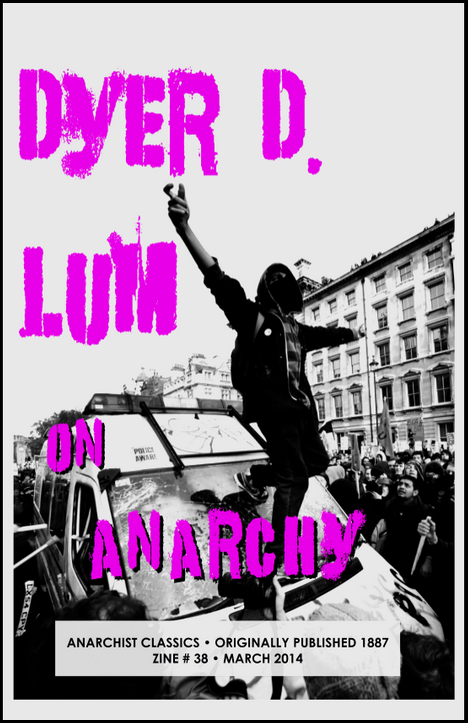
Support C4SS with Dyer D. Lum’s “On Anarchy”

C4SS has teamed up with the Distro of the Libertarian Left. The Distro produces and distribute zines and booklets on anarchism, market anarchist theory, counter-economics, and other movements for liberation. For every copy of Dyer D. Lum’s “On Anarchy” that you purchase through the Distro, C4SS will receive a percentage. Support C4SS with Dyer D. Lum’s “On Anarchy“.

LumAnarchy

$1.50 for the first copy. $0.75 for every additional copy.

This plea for Anarchism by Dyer D. Lum was published as articles in the Chicago revolutionary paper, The Alarm, and then reprinted, in 1887, as part of Albert R. Parson’s anthology, Anarchism: Its Philosophy & Scientific Basis, prepared by Parsons during his imprisonment, and published by his wife, Lucy Parsons, in 1887.

“Modern society, monarchical, parliamentary, and re­pub­lican alike, cries with one voice: Law and order first and foremost, liberty and progress secondary and resul­tant. Anarchy says: Not so; law must not deny liberty, order must not precede progress; they are causes, not results. It proclaims progress first, to which order must adapt itself; liberty at all times, over which law has no control. . . . .”

“Anarchy is freedom from artificial regulation and re­strict­ion; and in freedom, the farmer, as well as the art­isan and all the classes into which society is now div­i­d­ed, will find that wider scope to activity will bring in­creas­ed com­fort; and in freedom to use of land and to org­an­ize credit, rent, interest, and profits will disappear to­gether like bats be­fore the dawning light; and in co-operation find full sec­ur­ity for wealth attained and opportunity for its applicat­ion. . . .”

“In anarchy labor and capital would be merged into one for capital would be without prerogatives and depen­dent upon labor, and owned by it. The laborer would find that to produce was to enjoy and the nightmare of desti­tution ban­ish­ed. The artisan would find in co-operation that nature alone remained to be exploited. . . .”

Dyer D. Lum (1839-1893) was a revolutionary market anarchist, a labor organizer, and a pioneer of mutualist economics. He became involved in the labor movement through his trade as a bookbinder, and came into contact with Anarchists such as Albert Parsons and August Spies in Chicago. He was closely involved with support for the Haymarket martyrs during the 1880s – he took up the editorship of Albert Parson’s newspaper, The Alarm, after Parson’s death, and it was Lum who smuggled a dynamite cap to Louis Lingg in prison (which Lingg used to commit suicide ahead of the noose). A collaborator and lover of Voltairine de Cleyre’s, and a prolific writer of both books and articles for Anarchist papers such as Twentieth CenturyLiberty, and The Alarm, Lum’s Anarchism combined the radical individualism and anti-capitalist market anarchism of the Boston Anarchists, with an emphasis on worker ownership, radical solidarity, and the militant labor organizing of his Chicago revolutionary milieu.

Life, Love And Liberty, Stigmergy - C4SS Blog
Response to Al Carroll on Libertarianism: Part Two

This is the second part of my series on Al Carroll’s critique of libertarianism and small government conservatism. Let’s continue the critique.

He writes:

And yet, in a nation that prides itself on democracy and equality, one finds many defenders of elitism and inequality among some conservatives, most libertarians, and especially objectivists. In a capitalist nation, one that often worships economic success above morality, one can find religious defenses of amorality going back pretty far.

Not all libertarians defend elitism. There are indeed some who do so, but the notion of elites is not intrinsic to libertarianism. Those of us who are left-libertarian market anarchists certainly reject elitism. We’re also not amoral nor do we worship economic success. Our morality of non-aggression is adhered to pretty strongly.

The overturning or limiting of anti poverty, banking, public health, environmental, labor, and safety laws since the 1980s and the blocking of gun control, done for conservative ideological reasons or to benefit large corporations, resulted in huge losses of American lives. Those presidents partly responsible include not only Reagan, Bush Sr., and GW Bush, but also Clinton.

It’s doubtful whether libertarians had anything to do with that. The author also ignores all the deaths caused by government. R.J. Rummel estimates that governments have killed 262,000,000 people in major democides. It should be noted that his statistics have been questioned by a Facebook person I ran into, so the estimate should be viewed with caution. We do know that the Nazis killed millions and so did Stalin though.

The body count from anti government dogma far exceeds all wars in American history:

Up to 875,000 preventable deaths per year, or over one third of all deaths in the US.

At least 26,000 preventable deaths from poor healthcare or lack of healthcare each year.

The author is not clear on what causes these 875,000 preventable deaths per year, nor does he provide a source for his statistic. He also ignores the fact that we don’t have a freed market in healthcare. There is a statist system that has become even more so with the advent of the Affordable Care Act.

A heavily disputed number of preventable deaths from lack of effective gun control includes both murders and a far higher number of gun suicides. The number of deaths prevented by guns is much smaller, and exaggerated by industry lobbyists by as much as a hundredfold. Part of the reason for disputes about how many lives may be saved by gun control is the NRA successfully blocks government health research on firearms deaths.

He assumes these deaths would not have occurred with gun control. Something he doesn’t go on to prove. There is also no recognition of the cultural aspects of gun violence. It may be that a less violent culture would produce far fewer gun deaths. As for the blocking of government research, it’s possible that said research could be conducted by non-governmental organizations.

A further thought of his is:

An unknown number of earlier deaths from increased poverty because of financial deregulation, causing the Great Recession of 2007-2012, the dot.com collapse of the 1990s, the savings and loan scandal of the 1980s, and the housing market collapse, the banking and mortgage crisis, the insurance industry crisis, and the Worldcom and Enron scandals in the 2000s.

For the third time; libertarians are not in charge. A truly freed market would drastically reduce poverty, because there would be no state intervention to prop up the wealth/power of the established rich. One wonders whether an established rich would exist at all. As for the allegation of financial deregulation causing crisis; I recommend Roderick Long’s piece titled Regulation: The Cause, Not the Cure, of the financial crisis.

The country’s turn to the right is often blamed, but this is too broad a claim. There are many cases of conservative support for government regulation of personal freedom. Some conservatives favor regulation of everything people do below the waist, except with the money in their wallet.

We agree on the lack of consistent anti-government sentiment among conservatives. This is implied in his statement about the regulation of personal freedom they desire.

Corporations pushing for deregulation for their own profit or from ideological blindness that imagine regulation costs profits is often blamed. But the US is almost unique in this mindset among business elites. Most nations have corporate elites that accept government roles, often working with them as partners. In every other nation except for Britain, modern industry was developed by the government. It’s worth noting, most of the more successful economies today are mixed.

He interestingly seems to embrace corporatism or the corporate state here. When business elites and government elites work together; the result is more concentrated wealth and inequality. This is due to the fact that they can obtain subsidies and regulatory protection. The fact that modern industry was developed by government doesn’t prove it can’t be created without the state. The resources would still exist and could be used for industrial purposes. The final point to be made is that no standard of success is offered. That’s all for now. I will write the rest of the series after taking a break.

Portuguese, Stateless Embassies
Morre a propriedade intelectual, assassinada pelos videogames e pela música nordestina

Gabe Newell — diretor executivo da Valve, desenvolvedora de jogos como Half-Life e Portal e gerente da loja virtual de games Steam — notoriamente afirmou, algum tempo atrás, que a pirataria é um problema de serviço, não de preço:

“Nós achamos que a pirataria é mal compreendida. A pirataria quase sempre é um problema de serviço e não um problema de preços. Por exemplo, se um pirata oferece um produto em qualquer lugar do mundo, 24 horas por dia, 7 dias por semana, podendo ser adquirido convenientemente em seu computador, enquanto o fornecedor legal diz que o produto tem restrições de região, só deve chegar 3 meses após o lançamento nos Estados Unidos e só pode ser comprado numa loja física, então o serviço do pirata é melhor.

“A maioria das soluções de gestão de direitos digitais (DRM) diminuem o valor do produto através da restrição do que o consumidor pode fazer com ele ou criando incertezas.”

Obviamente, Newell está certo. As tentativas de gestão de direitos digitais em jogos fracassaram retumbantemente, não só do ponto de vista de sua eficácia (não existe qualquer mecanismo antipirataria que não tenha sido quebrado), mas também por terem efetivamente diminuído as vendas e piorado a experiência dos jogadores.

A narrativa de Newell, embora verdadeira, é também conveniente, já que a própria Valve administra um sistema de DRM. Sua loja virtual, Steam, também é um sistema antipirataria, mas é um que, ao menos, tenta compensar aos jogadores a perda de seus direitos de compartilhamento de jogos com serviços como matchmaking, ferramentas de mod e preços baixos.

O Steam é uma tentativa de conciliar uma cultura de gamers que passou a reagir contra os avanços contra seus direitos com as sensibilidades das grandes corporações na defesa de suas “propriedades intelectuais”. E os grandes publishers de jogos já perceberam que estão perdendo a batalha e estão na defensiva. Recentemente, o popular site de games Rock, Paper, Shotgun publicou um editorial em que condenava a demora dos videogames para entrarem no domínio público. Ao longo de seu argumento, John Walker não conseguiu evitar extrapolar as consequências lógicas do seu raciocínio e denunciou a “propriedade intelectual” de forma radical:

“[Por] que uma pessoa não deve poder lucrar com sua ideia durante toda a sua vida? (…)

[Minha] resposta a essa pergunta é: Por que ela deveria? (…)

“Por que uma pessoa deve poder lucrar com algo que fez 50 anos atrás? Em que outra área da vida nós aceitaríamos esse fato como normal? Se um policial exigisse continuar a ser pago por ter preso um criminoso 35 anos atrás, pediriam para ele se retirar da sala e parar de dizer asneiras. ‘Mas o prisioneiro ainda está na penitenciária!’, diria ele ao sair da delegacia com os bolsos virados para fora, sem ter feito qualquer outro trabalho durante 35 anos e se perguntando por que não vive num castelo.

“E quanto ao eletricista que instalou as fiações da sua casa? Ele pode exigir uma taxa toda vez que você ligar as luzes. É assim que as coisas são. Você tem que pagar, porque tudo sempre funcionou assim, desde que você se lembra. Como poderíamos esperar que ele vivesse com a instalação elétrica em outras casas? E quanto aos royalties do cirurgião pela operação no coração que ele fez — esse é o sistema. Por que ele não deveria ser pago toda vez que você o usar?”

E é por causa de reações assim contra o monopólio intelectual que empreitadas como o Humble Indie Bundle ganharam tração, onde os consumidores pagam o valor que quiser por excelentes jogos, sem DRM e disponíveis em Windows e Linux. O HIB também serviu de exemplo para o Story Bundle, que reúne livros de autores independentes, entre vários outros.

Claramente, são iniciativas que pretendem direcionar os consumidores e estimulá-los a apoiar os criadores dos bens culturais que consomem. E vêm dando muito certo. Porém, o próprio fato de as pessoas poderem pagar o quanto quiserem pode parecer um ponto fraco. Afinal, os criadores parecem estar eternamente sujeitos às gorjetas que as pessoas quiserem doar, sem poder depender diretamente de seu trabalho. E seria inconcebível que as grandes empresas se rendessem a esse modelo, que derruba totalmente as cercas de conteúdo que elas impõem.

Qual a alternativa, então? O Nordeste brasileiro tem uma das respostas.

Há anos, não só gravadoras, mas também músicos e bandas do Sudeste vêm tentando suprimir a pirataria de CDs e DVDs. Fazem campanhas reiteradas, nos lembram sobre a ilegalidade da cópia dos “seus” discos e ainda pretendem que nós não temos direito a tocar as músicas e vídeos que compramos “em público”. No entanto, o Brasil permanece como um dos países de maior pirataria do mundo. Camelôs continuam a vender CDs e DVDs piratas, e a polícia continua a fazer apreensões enormes e a passar o rolo compressor por cima da mercadoria apreendida (que, agora, tem que ser descartada de forma “ecológica”).

O serviço oferecido continua péssimo. Continua difícil adquirir músicas e vídeos de forma conveniente e a preços competitivos. E continua a perseguição aos pequenos comerciantes.

Mas no Nordeste a coisa mudou, e a mudança foi encabeçada pelas bandas locais, extremamente populares em suas regiões, mas que tocam estilos de música desconhecidos ou pouco populares no Sul e no Sudeste brasileiros. Os camelôs deixaram de ser vistos como ameaças e passaram a ser vistos como aliados. A banda Calypso (que, tecnicamente, é do Norte) inaugurou a tendência de fornecer diretamente seus CDs e DVDs para os vendedores ambulantes. Outras bandas logo seguiram o exemplo e viram que não fazia sentido fechar um canal de comunicação com o seu público. Os camelôs passaram a ser um dos principais meios de disseminação da música no Norte e Nordeste e a perseguição a eles deixou de ser economicamente tão atraente (o que explica por que existem muito mais vendedores nas ruas nordestinas que no resto do Brasil).

No Nordeste, isso foi levado um passo adiante ainda. Bandas que tocam o estilo de forró local conhecido como brega abandonaram a pretensão de fazer músicas estritamente autorais. Agora, várias bandas tocam uma mesma música, cada uma à sua maneira. A cada estação, nós temos várias (às vezes, dezenas) das mesmas músicas tocadas diferentemente por diversas bandas. As bandas não mais se dividem pelo que tocam, mas como tocam, e todas estão um passo à frente das bandas autorais porque tocam exatamente aquilo que o povo quer ouvir naquele momento.

A cara desse novo estilo é Wesley Safadão e seu grupo Garota Safada. Em seus shows, o Garota Safada distribui gratuitamente CDs e DVDs, que também estão disponíveis para download gratuito em seu site. Wesley Safadão não está preocupado com a pirataria, porque é ela que promove seu real produto: shows (que são levados a cada pequena cidade do Nordeste e sempre atraem dezenas de milhares), aparições na TV local, comerciais e — é claro — seu estilo musical, que é o que o define mais do que a autoria das músicas.

Safadão também não está perdendo o sono com o fato de suas músicas serem tocadas também pela Banda Grafith ou pelo Forró da Pegação — e vice-versa. Na verdade, todas essas bandas e artistas se fortalecem pelo fato de que estão promovendo as mesmas músicas.

Que, inclusive, devem ser consideradas kitsch por quem mora no Sudeste. Mas que são comprovadamente muito mais rentáveis e não depende de modelos mortos como a propriedade intelectual.

Como Gabe Newell disse, o problema é o serviço. O Nordeste pobre já percebeu, o Sudeste rico está ocupado passando rolo compressor em CDs.

Spanish, Stateless Embassies
Boko Haram y el imperativo de la autodefensa

En Nigeria, el grupo Islámico Boko Haram ha llevado a cabo una serie de horrorosos ataques, culminando en el reciente secuestro de 234 niñas de un internado en la ciudad de Chibok. El grupo supuestamente pretende vender estas niñas como esclavas. El gobierno Nigeriano se ha comprometido a liberarlas, pero hasta ahora los informes sobre el terreno indican que se ha hecho muy poco mientras el gobierno espera ayuda extranjera.

La provisión de seguridad es la justificación más básica que se da para la existencia del Estado. Se supone que el estado debe proteger a la población de los depredadores, tanto extranjeros como propios. Sin embargo, en Nigeria, el Estado es claramente incapaz de realizar esta función. De hecho existen algunos interrogantes que plantean si realmente quiere o no realizarla; hay informes confirmados por Amnistía Internacional que indican que el ejército Nigeriano supo, con cuatro horas de anticipación, que una columna armada de militantes de Boko Haram se encontraba en camino a Chibok – cuatro horas durante las cuales el ejercito no hizo absolutamente nada.

En vista de que el gobierno Nigeriano no desea o no es capaz de proteger a su población, tal vez los nigerianos deberían recurrir al ejemplo de los mexicanos, que se han armado en defensa propia contra los cárteles y las fuerzas del gobierno. Por supuesto, el gobierno Nigeriano se hace todo lo posible para fomentar los nigerianos dependan de él, prohibiendo la posesión de rifles semi-automáticos o pistolas de cualquier tipo – una prohibición que fue patéticamente incapaz de exigir a Boko Haram, pero que lamentablemente fue obedecida a cabalidad por los guardias de las colegialas de Chibok.

La autodefensa armada contra el terrorismo es algo ya muy visto durante este siglo. El punto de inflexión en la ocupación estadounidense de Iraq no fue, como comúnmente se asume, producto de las tácticas estadounidenses, sino el resultado de los esfuerzos de los grupos armados de autodefensa establecidos por los propios iraquíes, fuera del control e influencia del gobierno respaldado por Estados Unidos. Aunque estos grupos fueron financiados por los militares estadounidsnes, la iniciativa para actuar surgió de los grupos tribales tradicionales de la población Iraquí. Este modelo, al igual que el ejemplo de la gente de la provincia mexicana de Michoacan, puede servir como ejemplo a la población Nigeriana para actuar en defensa propia contra Boko Haram.

¿Qué puede hacerse en occidente para ayudar a la población de Nigeria? La forma más obvia de ayudar es, por supuesto, completamente ilegal – cualquier estadounidense que done armas a la gente de Nigeria o que se vaya a luchar contra Boko Haram en persona terminaría en la cárcel. El caso reciente de Eric Harroun, un veterano de la armada de Estados Unidos que viajó a Siria para luchar contra el gobierno de Assad, ilustra lo absurdo de estas leyes. El Sr. Harroun puede ir a prisión por ayudar a los mismos rebeldes Sirios a los que la administración de Obama intenta ayudar. Tal y como son leyes, hay poco que Occidente pueda hacer dentro del marco de las mismas aparte de donar a obras de caridad nigerianas y ayudar a crear más presión sobre el gobierno Nigeriano.

A la gente de Nigeria: vuestro gobierno no puede protegerlos y no lo hará. La ayuda de los gobiernos occidentales puede puede que solvente esta crisis inmediata y dolorosa, pero no será una solución a largo plazo. En lugar de esperar que los burócratas de Abuja los salven, den los pasos necesarios para protegerse a vosotros mismos y a vuestros niños. Ármense si les es posible. Organicen partidas de vigilancia. Y cuando vuestro gobierno les pida que dejen de hacerlo, pregúntenle donde estaba el 14 de Abril cuando se llevaron a vuestras hijas.

Artículo original publicado por Jonathan Carp el 11 de mayo de 2014.

Traducido del inglés por Gabriel Franco.

Feature Articles
One Cheer for Uber and Lyft

A lot of recent libertarian commentary has treated Uber and Lyft as the greatest thing since Bitcoin and 3D-printed guns. On the other hand, a lot of critics — including not only liberals but anarchists who should know better — have demonized it as a corporate gentrification tool straight out of the fever dreams of Richard Florida. My own position is a lukewarm, half-hearted support for such services — hence the title. Having them around is somewhat better than not. But that’s pretty weak tea.

Why Uber and Lyft Are Better Than Nothing

If the mainstream libertarian endorsements of Uber and Lyft are unwarrantedly enthusiastic, the liberal criticisms are utterly wrong-headed.

The anarchist opposition is somewhat understandable, if still irrational. The most important site of contention between Uber and Lyft and the anarchist community is in Oakland, set against the preexisting background of ideological polarization between the local anarchist community and Silicon Valley — expressed among other things by sabotage of the Google Bus — over gentrification and skyrocketing rents. So it’s only natural that the ride-sharing controversy would be fitted into the Bay Area anti-gentrification narrative.

But no matter how justified the grievances over gentrification, even the genuine Left’s objections to these services are misguided. The arguments from establishment liberals and “Progressives” are much worse.

To begin with, anyone on the genuine Left should be opposed to the medallion cab system on principle. It’s entirely understandable that liberals would reflexively support anything that can be characterized as “regulating business,” because in their goo-goo worldview all economic regulations by definition serve to rein in corporate greed and restrict misbehavior by the “malefactors of great wealth,” all in the name of “working families.” Liberalism sees itself, as quintessential liberal Art Schlesinger Jr. put it, as “the movement on the part of the other sections of society to restrain the power of the business community.” But in reality liberals are the dupes of big business, just as (in the classic “Baptists and Bootleggers” scenario) fundamentalist preachers who lobby to keep counties dry are the useful idiots for those who sell bootleg whiskey. You may have heard the (perhaps apocryphal) anecdote of the whiskey bootlegger who plastered his car with bumper stickers: “Keep _____ County Dry — For the Sake of My Children!”

But anarchists should not be so naive. Anarchists know, or should know, that the state is the executive committee of an economic ruling class. The main thing the state does is enforce entry barriers against competition, enforce artificial scarcities and artificial property rights, and socialize operating costs and risk and privatize profit. Regulations may be passed off as measures to restrain big business avarice for the “common good,” but most of the time they’re actually passed in the interests of the regulated industries themselves, in order to protect them from competition.

And the medallion system is a classic example of this. It’s a lot like the FCC’s licensing system, in which a finite number of licenses were originally granted; as this limited supply of licenses was bought and sold over the ensuring decades, the price of a license soared into the stratosphere, to the point that simply buying a license to broadcast — never mind building the actual broadcast facility — was a huge capital investment limited to the big players. The medallion system works the same way. In a big city like New York, the local government issues a fixed number of licenses, which are subsequently bought and sold by cab companies. The price of a medallion — the price of simply being allowed to compete, mind you, not the actual necessary costs of doing business — is around a million dollars. And as you can imagine, existing cab companies are the loudest and most strident voices against increasing the number of medallions and allowing more competition.

That’s one of the main things licensing regimes do. They don’t just set minimum safety and quality standards, and allow anyone who meets those standards to enter the competitive marketplace (although even then members of the licensed trade or business lobby to make the standards unnecessarily stringent just to restrict the number of practitioners). They actually set a legal limit on the number of licenses that can be issued, based on calculations — set mainly by the influence of the regulated industry — of “what the market will bear.”

Anyone who believes this serves the public welfare, and not the welfare of the taxicab industry, is just plain stupid. We know liberals are just plain stupid. But anarchists and others on the genuine Left should know better.

A central criticism of Uber and Lyft is that they can’t do the poor any good, because they’re available only to those who have credit cards and can afford smart phones. But as a matter of fact, 47% of those with incomes of $30,000 or below own smart phones. That really shouldn’t be surprising, considering it makes economic sense for people with limited incomes to bundle phone service, email and Web browsing into a single service package in lieu of a desktop PC.

In any case, criticizing ride-sharing services on the grounds that they only serve those who have smart phones and credit cards reflects a basic misunderstanding of how competition works. Even if the very poor can’t afford Uber and Lyft, the fact that people who can do so desert the established medallion cab companies puts more competitive pressure on those companies, both to lower their prices and eliminate discriminatory practices.

A reduced pool of customers for the legacy cab companies, relative to the number of cabs in service, will mean increased competition for the customers who remain. Most people have heard anecdotes of, or directly experienced, cabs ignoring would-be fares who are members of racial minorities or otherwise regarded as “undesirable” by cabbies. They do so because the pool of competing fares is large enough for them to pick and choose. Reduce the size of that pool, and they must be less picky and nicer to those who remain.

At the same time, the competition exerts downward pressure on prices, and reduces the monopoly rents accruing to medallion cab companies. The pricing of taxicabs, in which the number of competitors in the markets is artificially restricted by the state, follows the same pattern that Henry George described in regard to land rent. Since there’s a growing number of people with more money bidding up the price of a fixed supply, the suppliers can price their product based not on the cost of providing the service, but on the consumer’s ability to pay. When you have more fares, and a larger percentage of them economically well off, competing for a fixed supply of cabs, they bid the price up. By definition, monopoly rent is an amount of money over and above what would be necessary as an incentive for the seller to bring their good to market. So if you reduce the number of competing customers and the amount of money available for them to spend, the seller must reduce the price to the consumer’s ability to pay — and the cab companies must eat the loss in the form of reduced profit, just as anything that reduces land rent comes out of the landlord’s pocket.

Some liberal criticism of the new ride-sharing firms is based on what amounts to an aesthetic affinity for managerialism and hierarchy, and a nostalgia for the high-overhead mass-production economic model of the mid-20th century. A good example is Rebecca Schuman (“It’s fine if you’re a Technolibertarian, just don’t pretend it’s progressive,” Pan Kisses Kafka, May 7), who is the education editor at Slate. Here we see the essential nature of establishment liberalism — both Hamiltonian and Schumpeterian. Despite all the greenwashed additions to “Progressivism” — the “think locally” and “small is beautiful” stuff — the core of “Progressivism” is still mid-20th century liberalism.

When I say liberalism is Schumpeterian, I mean it views the giant, hierarchical institution — as such — as inherently “progressive.” Joseph Schumpeter himself believed that monopoly capitalism was ideal for technological progress, because the size and market power of a monopoly corporation enabled it to fund large-scale R&D efforts, and pass on the cost to the public through administered cost-plus pricing. John Kenneth Galbraith — perhaps the patron saint of mid-20th century liberalism — saw the giant corporation’s central planning capabilities and immunity from market competition as the work of a “benign providence.” Liberals since have tended to view the large corporation as potentially more progressive than small, local and decentralized alternatives:  They’re large enough to be willing and able to afford regulatory compliance and relatively decent wage and benefit packages, because they can pass all the costs on to the consumer through monopoly pricing.

Hence Michael Moore’s nostalgia for a world where General Motors owned half the economy, but anyone who worked for them had a job for life with decent union wages. And hence the nostalgia — illustrated by Rachel Maddow’s spots filmed in front of the Hoover Dam — for an era in which a gigantic state fostered industrial gigantism by building enormous blockbuster projects like hydroelectric dams and the Interstate Highway System, whose main purpose was to subsidize big business and absorb surplus investment capital and surplus production capacity.

Democratic “Progressives,” in short, are every bit as pro-corporate as Tom Delay and Dick Armey; they just want an economy of liberal corporate giants run by managerial bureaucrats like Alfred Sloane and Bob McNamara, rather than a corporate economy run by cowboy CEOs downsizing their workforces and maximizing their bonuses.

At the same time, they’re Hamiltonian. That means the central focus of their agenda is anti-deflationary. The central feature of Alexander Hamilton’s policy, as Secretary of the Treasury, was to buy up all Continental war bonds at face value, even though their value on the securities market had depreciated in most areas to something like 3% of their initial price. It was a policy to keep the assets of the rentier classes — capitalists — from depreciating in value.

Since the late 19th century, industrial capitalism has been chronically plagued with a crisis of excess production capacity and surplus investment capital. Both parties, from the turn of the 20th century, have pursued policies to combat these tendencies by using the state’s purchasing power to utilize spare production capacity, or funding giant construction projects to soak up surplus investment capital. One of the main purposes of deficit spending, besides increasing aggregate demand to combat the tendency toward overproduction, is to give surplus capital a guaranteed profitable outlet in the form of U.S. bonds. The perpetual warfare state, government-funded blockbuster projects like the Interstate Highways (and the mass suburbanization and car culture that grew out of them) and the industrial model centered on waste and planned obsolescence, all are ways to make sure that the state engages directly in waste production, or encourages waste production, in order to guarantee sufficient demand for capital and labor to keep stock prices and dividends prices and maintain full employment.

Both liberals and conservatives pursue variants of the same Hamiltonian policy. Conservatives disavow Keynesianism with their mouths, while pouring money into military spending and subsidies to the car culture just as much as Democrats (although they’re more concerned about keeping up full demand for capital than for labor). Liberals, on the other hand, enthusiastically embrace Hamiltonianism.

Either way, the idea is to create as much subsidized waste as necessary, in the form of planned obsolescence or protecting inefficient production methods from competition, to keep capital and labor fully employed. This means embracing what amounts to a Rube Goldberg economy of subsidized waste, with everybody running in hamster wheels, or digging holes and filling them back in again, so that everybody has a full-time job and 401ks keep going up.

So the Hamiltonian agenda — doing things as inefficiently as possible in order to fully utilize labor and capital — is fundamentally at odds with technologies of radical abundance. We of the free market Left want to use technologies of abundance to destroy the rent-extracting capabilities of the old corporate dinosaur industries, and do things with the lowest possible material and labor inputs. But we want to eliminate all monopolies, artificial property rights and artificial scarcities, and all the resulting embedded rents in the prices of goods and services, so that competition socializes all the cost savings of increased efficiency instead of letting capitalists enclose them as a source of profit. We want to eliminate the portion of housing cost that comes from absentee titles that hold vacant land out of use and from the way housing codes (written mainly by contractors) criminalize both new cheap modular housing designs and older vernacular methods. We want to eliminate the 95% of medicine cost that comes from drug patents, and the portion of the price of manufactured goods (probably a majority of it) that comes from imbedded “intellectual property” rents rather than the cost of labor and materials. We want to eliminate all the legal barriers to replacing some portion of our wage labor with low-overhead production in our own homes, using the spare capacity of household goods we already own (including our cars).

Let’s get something straight: Criminalizing self-employment isn’t “progressive.” Economic exploitation is what results when the employing class uses the state to close off workers’ access to the means of production and subsistence, so that employers no longer have to compete against the opportunity for self-employment, direct production for use, and comfortable subsistence in the informal sector. That’s the reason capitalist farmers in England pushed for the Enclosure of common pasture, waste, wood and fen — because the peasantry would only work at agricultural wage labor for as long and as cheap as the employers wanted if they were robbed of alternatives.

Schuman’s article illustrates both the Schumpeterian and Hamiltonian tendencies in spades. Consider her comments on Airbnb:

The “middleman” in the hotel world is the government, sure, but it’s also the thousands upon thousands of lower-wage workers who depend upon hotels for survival, from reservation agents to housekeepers. Those “annoying” hotel taxes that you pay go to provide resources for everyone in the city–resources you use while you’re visiting, and resources that are available to everyone, including the poor. The “sharing” economy means “sharing” wealth and resources, but only between “deserving” people. Everyone else gets cut out, and becomes even more forgotten and invisible than before.

So her ideal is to prop up enormously inefficient, bureaucratic corporate dinosaurs because they keep as many wage workers as possible on retainer — to do everything in as high-overhead a way as possible, so that everyone in society can be employed. The average person’s house and car are by far their biggest capital assets — capital assets that are often far from fully utilized. Being able to use one’s car to transport other people outside the taxicab companies’ monopoly, or host someone overnight in an extra bedroom outside the hotels’ regulated monopoly, is a way that ordinary people can use the spare capacity of their own capital assets, in the informal economy, to support themselves directly outside the wage system, and reduce their dependence on wage income, and increase their bargaining power against their bosses, to the extent that they are able to shift a portion of their wage income to self-employment.

Schuman doesn’t want this. Just like the capitalist farmers of England in the 18th century, she wants to force everyone into the cash nexus: everyone working for wages, for a boss, in order to earn the money to buy stuff from companies that pay other people to make and do stuff. No “masterless men” or cottagers living off the waste without a landlord’s permission for her. She is an ideological kinswoman to the pioneers of mass-advertising in the ’20s and ’30s who stigmatized homemade bread and home-grown tomatoes as “old-fashioned,” and the people at Nestle who convinced women in India that infant formula was modern and up-to-date.

Ironically enough, one of her commenters tried to demonstrate their street cred as a “Progressive” (brave, reverent and clean) by mentioning that they made as many of their own clothes as possible. What?! What about all the employees of the apparel industry? What about the employees of the brick-and-mortar clothing retailers? What about the taxes on store-bought clothing that go to fund those resources used by everyone? A real liberal wouldn’t do anything for herself in the informal sector that could be bought on the cash nexus. I’m just shaking my head in disgust at this crime against Schumpeterian and Hamiltonian orthodoxy.

At the same time, this model of enforced middlemen, with high bureaucratic overhead, unnecessary capital outlays and subsidized waste, is the reason that “comfortable subsistence is impossible” (Ivan Illich) and “it costs 300% or 400% times more to make or do anything” (Paul Goodman). You know, Ivan Illich and Paul Goodman — those right-wing Randroid Tea-Partiers, just like Pyotr Kropotkin.

It’s the same ideology that makes liberals like Joe Biden want to use the power of the police state to stamp out file-sharing and enforce the “intellectual property” monopolies that the gatekeeping function of the movie and record industries and the big publishing houses depend on, so they can maintain enormous office buildings full of people getting paid wages to do what anyone can now do at home with a few hundred dollars worth of hardware and software.

On top of all that, she just gets so much wrong because her liberal aesthetics make her tone deaf. She’s typical of managerial-centrist liberals who mistake themselves for the “Left,” and see reflexively dismiss anything horizontal or decentralist as “right-wing.” Much like Thomas Frank, another totally clueless managerial-centrist, she lumps together as “Technolibertarian” currents as disparate as ’90s-style Dotcom capitalism a la Bill Gates and the free culture movement of Richard Stallman, Linus Torvalds and The Pirate Bay — never mind that the two are at odds, and the latter is actually the nucleus of the post-capitalist successor society.

And given her ideological predilection to see anything identified with “government” or “regulation” as ipso facto “Progressive” and “anti-business,” she’s utterly incapable of perceiving the capitalist nature of the regulatory regime. For example:

…what’s got these startup circle-jerks particularly Ayn Randy is that these “sharing” services have cut out the middleman–i.e. the evil government that evilly taxes and regulates what should be left entirely to consumers and the invisible hand of the market.

Um, no. The middleman is the evil taxicab companies that use the government to evilly protect them from competition and evilly price-gouge.

So Schuman’s idea of “Progressivism” is enforcing the monopolies that enable giant corporations to extract rent, protecting the wage system against self-employment, and forcing everyone into the cash nexus.

Because they’ve drunk so much of their own “Democrats Care” and “The Government Is Us” Kool-Aid, liberals like Schuman are absolutely ideal as dupes for capitalist rent extraction. They have been completely socialized into the official ideology of the capitalist state. The central means by which capitalists extract profit from workers and consumers is the artificial property rights, artificial scarcities and entry barriers enforced by the state. And liberals, with their naive acceptance at face value of any regulation purportedly aimed at restricting business misbehavior, are the best shills corporate interests could ever have for promoting their interests.

Liberals like Rebecca Schuman make the best capitalist apologists of all.

Why Uber and Lyft are Nevertheless Evil and Must Be Destroyed

Nevertheless, Uber and Lyft must be supplanted and destroyed. They are commonly viewed as p2p services, but they are in fact capitalist corporations masquerading as peer-to-peer. They are guilty of the very same crimes as the medallion cab companies — only they use “intellectual property” rather than local licensing regulations to extract rents from their drivers and customers. Uber and Lyft are proprietary, walled garden systems. And I suspect that, if someone came up with an open-source app that directly linked drivers and riders without a corporation skimming off the top, local governments would hit it — unlike Uber and Lyft — like a ton of bricks.

So what do we do? Call in the state to regulate Uber and Lyft? Yeah, that worked out so well with the medallion system. Adam Smith wrote that whenever the state undertakes to regulate relations between workmen and their masters, it has the masters for its counselors; and likewise, when it undertakes to regulate business, it has the business owners as its counselors.

No. As Director James Tuttle of Center for a Stateless Society (the outfit that pays me to write this) says, there are three things we need to do: “hack the app, salt the service, fight the competition with better competition.” That is, we create free and open-source, cooperative alternatives to the proprietary walled garden systems, and if necessary take a black market approach to do as much of it as possible outside the state’s surveillance. We salt the corporate ride-sharing services, Wobbly-style, with drivers who will agitate and organize against Uber and Lyft, and fight to reduce the share of their labor-product the corporations skim off the top. We do to Uber and Lyft what Uber and Lyft are doing to the medallion cab companies — but we make what they did to the cab companies look like a kiss by comparison.


Feature Articles
IP Dies, Killed by Video Games and Northeastern Brazil Music

Gabe Newell — Valve‘s CEO, a company that develops games such as Half-Life and Portal, and also manages the virtual video game store Steam — famously noted, a while ago, that piracy is a service problem, rather than a pricing one:

We think there is a fundamental misconception about piracy. Piracy is almost always a service problem and not a pricing problem. If a pirate offers a product anywhere in the world, 24 x 7, purchasable from the convenience of your personal computer, and the legal provider says the product is region-locked, will come to your country 3 months after the US release, and can only be purchased at a brick and mortar store, then the pirate’s service is more valuable.

Most DRM solutions diminish the value of the product by either directly restricting a customer’s use or by creating uncertainty.

Newell is obviously right. The digital rights management (DRM) scheme in games have failed miserably, not only because they are ineffectual (all antipiracy systems have been circumvented), but because they have also lowered sales and made worse the gamer’s experience.

Newell’s story, while true, is convenient, because Valve itself manages a DRM system. Steam, besides being a store, is an antipiracy mechanism as well, but at least it tries to offset the rights the players lose by giving them some nice perks: online matchmaking, mod tools and low prices.

Steam tries to reach a middle ground between gamer culture, which reacts against any attempt to encroach on their rights, and the large corporations’ sensibilities, that are so keen on defending their so-called “intellectual property.” The large video game publishers have noticed they are losing this battle. Recently, popular gaming website Rock, Paper, Shotgun published an editorial that condemned the fact that video games never go into the public domain. In arguing his point, John Walker did not flinch from the logical consequences of his reasoning and radically denounced “intellectual property:”

[W]hy shouldn’t someone be allowed to continue profiting from their idea for as long as they’re alive? . . .

[M]y response to this question is: why should they? . . .

Why should someone get to profit from something they did fifty years ago? In what other walk of life would we willingly accept this as just a given? If a policeman demanded that he continue to be paid for having arrested a particular criminal thirty-five years ago, he’d be told to leave the room and stop being so silly. “But the prisoner is still in prison!” he’d cry, as he left the police station, his pockets out-turned, not having done any other work in the thirty-five years since and bemused as to why he wasn’t living in a castle.

What about the electrician who fitted the lighting in your house. He requires a fee every time you switch the lights on. It’s just the way things are. You have to pay it, because it’s always been that way, since you can remember. How can he be expected to live off just fitting new lights to other houses? And the surgeon’s royalties on that heart operation he did – that’s the system. Why shouldn’t he get paid every time you use it?

Reactions like this to intellectual monopoly paved the way for projects like the Humble Indie Bundle (HIB), where consumers pay whatever amount they want for several excellent games, no DRM, compatible with both Windows and Linux. HIB served as example for the Story Bundle, that gathers books from independent authors — and there are many other examples.

Clearly, they are initiatives that try to steer consumers into supporting creators of cultural goods, and they have been fairly successful. However, the very fact that people are able to pay what they want seems to be a weakness of the model. After all, it seems that creators are perpetually dangling their tip jar, hoping that people will toss them enough quarters to get by, not being able to depend entirely on their work. And it would be inconceivable that large companies would surrender to such a model, since they are still erecting their pointless pay walls.

What is the alternative? The Brazilian Northeast may have one of the answers.

For years, not only record companies but also musicians and bands from the Southeast have tried to suppress CD and DVD piracy. They make incessant campaigns, remind us about the illegality of copying “their” discs, and pretend we don’t have the right to “publicly reproduce” songs and videos that we’ve bought. Nevertheless, Brazil remains one of the world piracy leaders. Street vendors still sell pirated CDs and DVDs, and the police keeps confiscating merchandise — steamrolled shortly afterwards in big public displays (the junk is to be “ecologically discarded” then).

The service they offer offer is terrible. It is hard to get hold of music and movies conveniently at competitive prices.

In the Northeast, though, things have changed. The change was brought about by local bands, extremely popular in their regions, which play little known or unpopular styles in South and Southeast Brazil. Street vendors are not seen as enemies anymore, but as allies. Calypso (a band that is technically from the North) started off the trend of giving their CDs and DVDs directly to street vendors. Other bands soon followed suit and noticed that it made no sense to close off a channel of communication with their audience. Those vendors became one of the main means of diffusion of music in the North and the Northeast, and chasing them off started being an economic nuisance, instead of an imperative (which explains why there are many more street peddlers in the Northeast than in the rest of the country).

The Northeast took it a step further yet. Bands that play a style of forró known as “brega” (literally “kitsch”) abandoned the pretense of making strictly authorial songs. Now, several bands play the same song, each one their way. Every season, we have several (sometimes dozens) of the same songs played differently by many distinct bands. Musicians are not distinguished by what they play, but rather by how they play, and all of them are a step ahead of the authorial bands because they play exactly what the public demands at that season, at that moment.

The face of this new style is Wesley Safadão and his band Garota Safada. In their concerts, Garota Safada gives away for free their CDs and DVDs, and put all the songs up for free download on their website. Wesley Safadão is not overly worried about piracy because it promotes his real product: concerts (taken to every small city in the Northeast, attracting tens of thousands of people), TV appearances, commercials, and of course his own brand and play style — which define him much more than authorship.

Safadão is not losing sleep over the fact that Banda Grafith or Forró da Pegação play the same songs as him. In fact, all of them are all too happy to promote the same music.

Songs that may be considered kitsch by the Southeast, but are verifiably much more profitable and do not depend on dying models such as “IP.”

As Gabe Newell said, the problem was service all along. The poor Northeast has it figured out, the rich Southeast is busy steamrolling CDs.

Distro of the Libertarian Left
Support C4SS with Early English Mutualists’ “Toward Natural Society”

C4SS has teamed up with the Distro of the Libertarian Left. The Distro produces and distribute zines and booklets on anarchism, market anarchist theory, counter-economics, and other movements for liberation. For every copy of Early English Mutualists’ “Toward Natural Society” that you purchase through the Distro, C4SS will receive a percentage. Support C4SS with Early English Mutualists’ “Toward Natural Society“.

naturalsociety

$1.50 for the first copy. $0.75 for every additional copy.

This “Appendix” was printed with The Inherent Evils of All State Govern­ments Demonstrated, a special reprint of the Vindication of Natural Society (ACS # 6) circulated by early English mutualists in 1858.

“The law of progress in human society is identical with the tend­en­c­y to individualize. . . . The doctrine of the sovereignty of the individual, the most ultra-radical doctrine in theory and final purpose ever promulgated in the world, teaches, in principle, the pro­spect­ive dis­rupt­ion of every existing institution, utterly at variance with all that has hitherto been prac­tis­ed in the world. . . . State Govern­ments will never give real freedom to their subjects. When a people know what real liberty is, and what it is worth, they will assume it as their natural inheritance; and will resist any at­tempt to rob them of it, under the pretence of ‘gov­ern­ing’ them, as they would resist a band of robbers.”

“But not until the property-relations of man shall be placed on a foundation of Equity, can the sovereignty of the indivi­du­al be realized; nor can any other of the human relations be just or har­mon­ic. . . . With the full recognition of the equality and reciproc­ity of all rights and duties; with the use of land, and all oth­er nat­ur­al wealth, easi­ly attainable; with a circulating medi­um of exchange, expanding and contracting as wealth, or bona fide credit was created or consumed; and with the moral belief current in society that the prices of all com­mod­ities or services should be regulated by their absolute cost — the vicious system of profitism or profit-mongering, which now prevails, would cease; because those who now are compelled to resort to this nefarious mode of getting a living, would have other and more legitimate sources of live­lihood. . . . Equitable Society de­m­ands nothing impossible of humanity. . . . But words, words alone, will no longer suf­fice. And the remedy is, — homes for the homeless — food for the starving — Equity for all!”

Years after publishing the “Vindication” anonymously, after his author­ship of the essay was discovered, Burke claimed publicly that the anarchistic argument of the “Vindication” was really intended as satire, and a reductio ad absurdum of deistic defenses of “Natural Religion.” However, many early mutualists and anarchists were impressed by the argument and took it seriously; in the “Preface” to their reprint, the anonymous editors, English followers of the American individualist anarchist Josiah Warren, argued that Burke’s argument for philosophical anarchism was both convincing and sincerely made, and his attempts to disown it later should be rejected. While defending the philosophical Anarchism of the “Vindication,” they argued that it was incomplete, con­demn­ing “Arti­fic­ial Society” without offering guidance on how it might be ended, or “Nat­ur­al Society” brought into practical being. They added this “Appendix,” to “briefly [enunciate] the principles through which ‘Natural Society’ may be gradually realized,” draw­ing on the work of the American individualists Josiah Warren and Stephen Pearl Andrews. The result was a fascinating commentary and document of early English mutualism.

Media Appearances
Toward an Anarchy of Production

Kyle Platt sits down with Jason Lee Byas, editor of The New Leveller, to discuss his article, “Toward an Anarchy of Production.” Jason speaks about the potential problems of communism in an anarchical society.

Portuguese, Stateless Embassies
Dark Wallet: novas armas para velhas guerras

Como alguns devem saber, o projeto Dark Wallet foi liberado para o público no dia 1º de maio de 2014. A Dark Wallet é desenvolvida pelo UnSystem, uma organização que inclui, entre outros participantes notórios, Cody Wilson, famoso por desenvolver a primeira arma impressa em 3D no mundo, a Liberator. A Dark Wallet está em estágio alfa de desenvolvimento, então não é recomendável que ela seja usada fora de testes.

A Dark Wallet é um conjunto de ferramentas para armazenar, enviar e receber bitcoins que busca proteger e tornar anônimo o uso da criptomoeda. É uma reação contra aqueles que pretendem tirar o cripto das criptomoedas.

Se desejar testá-la, você pode ir até a página do Unsystem e navegar até o github. Lá está disponível o código fonte para download. Se estiver usando um sistema Windows, baixe o arquivo .zip. Se estiver no OSX, poderá escolher tanto o .zip como o tar.bz. Se estiver utilizando o Linux, você provavelmente precisará saber quais programas de arquivamento estão disponíveis no seu sistema e escolher o arquivo para baixar de acordo com eles. Assim que fizer o download, extraia a pasta para um local conhecido.

Para instalar a extensão ao seu Chrome Browser, vá em Configurações > Extensões, marque a opção Modo do desenvolvedor. Clique em “Carregar extensão expandida” e encontre a pasta que você acabou de extrair e aperte OK.

Você agora terá a Dark Wallet instalada no seu browser.

Ao abri-la pela primeira vez, você é recebido em uma interface limpa, simples e plana. A partir daí, você deve criar uma conta e pode escolher usar a Testnet se quiser. Como se trata aqui de um software alpha, essa é a melhor opção. A Testnet é uma arquitetura paralela usada para o teste e o desenvolvimento de softwares relacionados ao bitcoin. O sistema é desenhado de forma que as moedas dentro dele não tenham valor.

Quando sua conta for criada, você será levado à sua carteira. A partir de lá, você poderá gerenciar e criar “bolsos” (“pockets”), que são endereços adinistráveis dentro da carteira, e verificar seu histórico de transações. Há uma ferramenta de fundos chamada Multisig, que permite a criação de uma carteira que precise ser assinada por várias chaves para começar uma transação. Isso pode ser especialmente útil para empresas e organizações em que a pessoa que administra os bitcoins é seu dono e, devido à irreversibilidade das transações, é necessário algum tipo de transparência.

Na seção de envios estão localizadas as ferramentas básicas para enviar bitcoins para outros endereços, com opções avançadas como “CoinJoin”, que serve para misturar as transações de diferentes usuários, tornando-as difíceis de rastrear através do blockchain. A natureza pública das transações de bitcoin significa que há um risco de a anonimidade ser comprometida se uma parte má intencionada for dedicada o bastante.

Há também uma opção de depósito de fiação (“escrow”), que ainda não está ativa. Presumivelmente, isso permitirá que as transações sejam feitas em um endereço por um árbitro independente e, se houver alguma disputa entre as partes, o árbitro terá a palavra final na direção da transação. Se implementada corretamente, essa ferramenta poderá ser o antídoto descentralizante às ferramentas monolíticas como o Paypal e os bancos no papel de resolução de disputas. E é um padrão extremamente necessário para que o bitcoin ganhe popularidade.

Outras características incluem um sistema de contatos e há uma sala de conversas pública no “lobby”. É uma ótima ferramenta atualmente, uma vez que as conversas vão desde bobagens e absurdos até a resposta a perguntas sobre o programa e ao envio de moedas de teste entre as pessoas, para que as pessoas saibam como a Dark Wallet funciona. Se você não conseguir nenhuma testcoin, várias “torneiras” estão disponíveis para enviar uma quantidade razoável de testcoins para a sua carteira. Esta é uma delas com a qual eu e outras pessoas tivemos sucesso.

Embora a versão alfa do programa tenha alguns problemas, seu design e suas ferramentas têm muito potencial para torná-la a carteira de bitcoin mais popular. Com isso, o bitcoin poderia passar a ser impossível de ser assimilado ao paradigma financeiro atual. Esse é provavelmente o maior potencial das criptomoedas. Esse conceito, junto com um possível Dark Market no futuro pode ser uma alternativa extremamente robusta ao sistema de mercado “branco” atual.

O Dark Market, atualmente, é apenas uma prova de conceito e não está em desenvolvimento ativo, já que o time UnSystem quer focar seus esforços na Dark Wallet. O Dark Market seria, simplesmente, uma plataforma de mercado com o mesmo foco na privacidade e na anonimidade que a Dark Wallet. Seria uma contraeconomia P2P difícil de se enfrentar – nas palavras de Cody Wilson, onde “ninguém teria que ser Dread Pirate Roberts”.

Inicialmente, pode parecer que a Dark Wallet e o conceito do Dark Market sejam mais adequados à venda de contrabando, mas não há motivos por que, enquanto plataforma, ele não possa se tornar um grande bazar – uma nova Amazon ou eBay, livre das restrições centralizadas, com o uso de criptografia e redes peer to peer para facilitar as transações e resolver disputas.

Um mercado cinzento e negro paralelo que seduz o mercado branco.

Atualmente, há uma guerra entre aqueles que veem as criptomoedas como fundamentos sólidos para uma contraeconomia, aqueles que desejam esterilizá-la e recolocá-la dentro do mercado formal do estado e aqueles que simplesmente desejam destruí-la. Isso é imprescindível para algumas pessoas porque somente o mercado branco pode ser efetivamente controlado pelo estado, só no mercado branco é possível extrair impostos sobre a movimentação de bens e serviços e é só nele que é possível impor regulamentações. A Dark Wallet é uma defesa contra tudo isso, não importa se sejamos atores conscientes da contraeconomia ou não. Enquanto anarquistas, não é apenas ético, mas é também parte de nosso objetivo participar da contraeconomia e ajudar a expandi-la – executar trocas voluntárias sem alimentar o estado. A guerra entre esses mercados é antiga e a Dark Wallet é uma das novas armas para as próximas batalhas.

Traduzido do inglês para o português por Erick Vasconcelos.

Anarchy and Democracy
Fighting Fascism
Markets Not Capitalism
The Anatomy of Escape
Organization Theory