Portuguese, Stateless Embassies
Entrevista de Roderick Long para a revista Veja

Recentemente, a revista Veja publicou uma matéria que tratava da ascensão do libertarianismo no cenário político dos Estados Unidos. Um dos entrevistados para a matéria foi o membro sênior do Centro por uma Sociedade Sem Estado (C4SS) Roderick Long.

Infelizmente, a menção de Roderick ao longo da matéria foi mínima, se limitando a uma frase um tanto descontextualizada. Assim, nós decidimos publicar a entrevista completa, que apresenta uma explicação mais equilibrada do papel dos libertários no cenário político americano e insere os libertários de esquerda dentro dessa discussão.

*     *     *

1. O libertarianismo ganha relevância atualmente na cena política. Como você analisa esse fenômeno?

Acredito que a crescente popularidade do libertarianismo e a crescente atenção que recebe se devam em grande parte à ascensão da internet e ao deslocamento de poder causado por ela. A internet tornou possível a comunicação entre pessoas comuns de maneira horizontal, sem a necessidade da aprovação dos gatekeepers tradicionais da mídia convencional.

A campanha presidencial de Ron Paul também apresentou as ideias libertárias a uma nova geração. muitos dos que adentraram o libertarianismo através de Ron Paul já migraram para versões mais radicais e completas do libertarianismo.

2. Qual a importância do libertarianismo no cenário político atual dos Estados Unidos?

Se você se refere especificamente à política eleitoral, eu não acredito que o libertarianismo possua muita influência nesse contexto no presente. A retórica e os slogans libertários são muito populares entre políticos republicanos, mas ao analisar suas políticas em vez de suas palavras, percebemos que não são muito libertárias. Republicanos tendem a defender favores concedidos pelo governo às grandes empresas, não mercados genuinamente livres. Em outras questões — guerras, imigração, aborto, casamento homossexual, entre outras — eles defendem o aumento do uso da força do estado, não a liberdade individual.

Os republicanos posam de defensores do livre mercado para ganhar votos. Fingem proteger as pessoas do estado inchado da mesma forma que os democratas fingem proteger as pessoas das grandes empresas; na verdade, ambos os partidos apoiam a mesma parceria entre o estado e as grandes empresas, embora possam discordar um pouco sobre qual ala da parceria deva ter mais poder.

Porém, se compreendermos a política atual para além da política eleitoral — se falamos sobre argumentos e ideias, então, sim, o libertarianismo está se tornando muito influente. É possível percebê-lo pelo aumento de ataques ao libertarianismo. Por exemplo, há um site de inclinação democrata, o Salon.com, que publica artigos atacando o libertarianismo quase toda semana, de formas incrivelmente ignorantes. O establishment político costumava ignorar os libertários; o fato de que ele agora nos ataca é um sinal de que o libertarianismo está se tornando mais popular e, portanto, uma ameaça maior aos poderes estabelecidos.

Incidentalmente, da mesma forma que no mainstream político aumentam os ataques ao libertarianismo, dentro do movimento libertário aumentam os ataques à versão orientada à esquerda do libertarianismo representada por nosso grupo, o Centro por uma Sociedade Sem Estado (C4SS), pelas mesmas razões.

3. O libertarianismo pode ser uma importante corrente de pensamento na próxima eleição presidencial?

Eu presumo que quem for nomeado pelos republicanos para concorrer a presidente utilizará a retórica libertária para, por exemplo, se opor ao programa de saúde de Obama. Se essa retórica o ajudar a vencer, suponho que isso significaria que o libertarianismo influenciaria a eleição.

Mas, como eu já indiquei acima, duvido que qualquer indivíduo com ideias genuinamente libertarias tenha chances de ser nomeado pelos republicanos. Sobre a saúde, por exemplo, ambos os partidos querem que as decisões médicas sejam contorladas por uma parceria entre o estado e as grandes empresas e não por pacientes; quando os republicanos falam do livre mercado na saúde, o que eles querem dizer é que pretendem deslocar o centro de poder um pouco mais para as grandes empresas, não favorecendo um mercado competitivo.

O movimento Tea Party tem a reputação de ser a ala libertária do Partido Republicano, mas eu acredito que isso seja um exagero. São mais libertários em alguns aspectos, mas menos em outros.

Existe o Partido Libertário, que foi fundado em 1971, mas sua influência nunca foi grane. E, embora o movimento libertário esteja se radicalizando, o Partido Libertário tem se tornado mais conservador.

4. O Senador Rand Paul é apontado como um dos mais importantes defensores do libertarianismo dentro do Partido Republicano. Você concorda? Em que sentido o Senador Paul ou qualquer outro proponente do libertarianismo poderia influenciar a campanha presidencial republicana?

Não considero Rand Paul um libertário. Seu pai, Ron Paul, é um libertário, embora não seja plenamente coerente, na minha opinião. Rand Paul é um conservador com algumas tendências libertárias. Certamente é mais libertário que o republicano médio, tanto que eu acredito que ele teria muita dificuldade para ser nomeado pelo partido, embora ele sem dúvidas tenha uma chance maior do que a que seu pai teve.

5. Você poderia explicar de forma breve as origens do libertarianismo nos Estados Unidos? Com sua defesa forte e intransigente do mercado, o libertarianismo moderno é diferente ou próximo de suas origens?

No século 19, os precursores do movimento libertário americano foram anarquistas individualistas: pensadores como Lysander Spooner, Benjamin Tucker, Josiah Warren, Stehen Pearl Andrews, Ezra Heywood e Voltairine de Cleyre. Era um movimento de esquerda, na vanguarda do ativismo trabalhista, feminista, anti-plutocrata, antirracista e anti-guerras. Muitos se intitulavam “socialistas” para indicar que estavam ao lado dos trbaalhadores em oposição ao capital. Eram contrários ao “capitalismo”, que, para eles, não se tratava da propriedade privada dos meios de produção, mas da dominação pelas grandes empresas e do desempoderamento dos trabalhadores. Esses “socialistas”, porém, eram intransigentes defensores do livre mercado e oponentes do poder estatal; enxergavam o poder da classe capitalista como resultado de privilégios concedidos pelo governo, não da livre competição.

Infelizmente, no século 20 a ascensão do socialismo de estado empurrou os libertários para uma aliança com conservadores contra esse inimigo comum. Nesse período surgiram brilhantes pensadores libertários como Ludwig von Mises e Ayn Rand, que, embora contrários ao poder estatal, eram menos radicais que os anarquistas e mais dispostos a apoiar a guerra fria. Também tendiam a consideram as grandes empresas mais como vítimas do que como beneficiárias do poder do estado.

Durante os anos 1960, o libertarianismo americano começou a recuperar suas raízes anarquistas de mercado. No mesmo período, houve uma tentativa de recuperar suas raízes de esquerda, através de pensadores como Karl Hess, Samuel Edward Konkin III e, por um tempo, Murray Rothbard, que tentaram construir uma aliança entre os libertários e a New Left. Esses esforços chegaram ao fim com a implosão da New Left.

Ao longo dos últimos 30 anos, o movimento libertário tem se tornado tanto mais popular quanto mais radical, com a disseminação de suas posições anarquistas e anti-guerra. Contudo, o movimento manteve sua orientação de direita em outros aspectos, como em sua oposição instintiva a ideias pró-trabalho e pró-feminismo, por exemplo, e uma tendência a defender grandes empresas como se seu sucesso resultasse da livre competição e não de privilégios estatais. Isso, porém, começou a mudar um pouco na última década, com a disseminação de um libertarianismo mais próximo de suas raízes do século 19. Provavelmente o pensador mais influente nesse renascimento libertário de esquerda é Kevin Carson. Contudo, essa ainda é uma posição minoritária.

Traduzido para o português por Erick Vasconcelos.

Stigmergy - C4SS Blog, Weekly Libertarian Leftist Review
The Weekly Libertarian Leftist and Chess Review 40

Musa al-Gharbi discusses Obama’s foreign policy.

Alice Slater discusses how drone assassinations violate the rule of law.

Bert Sacks discusses sectarian violence in Iraq.

Patrick Cockburn discusses the appeal of ISIS.

Shamus Cooke discusses regional war in the Middle East.

Kevin Carson reviews a new book by Rich Lowry.

William Rivers Pitt discusses the long arc of history.

Noam Chomsky discusses America’s real foreign policy.

Patrick Cockburn discusses government paralysis in Iraq.

Justin Raimondo discusses Japan’s constitutional revisionism.

Mahmoud Abu Rahma discusses the Israeli treatment of people in Palestine.

Pepe Escobar discusses ISIS.

Grant Mincy discusses American anarchism.

Uri Avnery discusses the watch on the Jordan.

Serge Halimi discusses when Obama got it right.

Richard Gamble reviews The Great and Holy War: How World War 1 Became a Religious Crusade

Karen Kwiatkowski discusses Lew Rockwell’s new book. I am not an ancap, but it has some good stuff relevant to libertarian leftists.

Thomas Dilorenzo discusses the American religion of violence. I am not in full agreement with it.

Binoy Kampmark discusses writing the imperial script.

Noam Chomsky discusses the sledgehammer worldview.

Lawrence B. Wilkerson discusses Dick Cheney.

Bill Quigley discusses the short shafting of veterans by the government.

Joe Boehem discusses the source and nature of rights.

Ivan Eland discusses World War 1 as key for today’s foreign policy.

Bonnie Kristian discusses how war is just one more big government program.

Sheldon Richman says let the immigrants stay.

Xavier Best discusses the U.S. role in child migration to the country.

Nozomi Hayase discusses Wikileaks and free speech.

Ludek Pachman loses to David Bronstein.

Alexander Petrov defeats F. Alexander Hoffmann.

Commentary
Protesters, Preventive Detentions and the Kafkian Nightmare

Franz Kafka‘s The Trial follows the tribulations of Joseph K., a white-collar bank employee who finds himself amidst an incomprehensible penal system. He cannot figure out what he’s accused of, nor the steps of the trial, and his possibilities of defense are limited. A murky bureaucracy permeates everything and secrets reinforce the uncertainties of Joseph K.’s condition.

Kafka seemed to have Brazil in mind.

At the eve of the FIFA World Cup finals (on July 12), several protesters were arrested and 26 arrest warrants were dispatched. Those arrested were accused of gang formation and the arrests were justified by the supposed imminent violent protests during the finals – hence the preventive detentions.

Since then, there have been several problems with the process and the provisional incarceration.

The very fact that the arrests were made just before the World Cup finals can be interpreted as an intimidation measure. Amnesty International spoke up and stated that the arrests were the “reenactment of a pattern of intimidation that had been identified by the organization before the kick-off of the tournament.”

Giving credence to that conclusion, the protesters and their lawyers didn’t have access to the content of the accusations, making it impossible for them to defend themselves. Worse, even the judge responsible for the habeas corpus pleas filed in favor of the protesters, Siro Darlan, was denied access to documents related to the police investigation.

At least ten activists’ lawyers’ calls were wiretapped by the Civil Police — authorized by the Judiciary — including the landline phone of the Human Rights Defense Institute (IDDH). Coordinator Thiago Melo highlighted the fact that such surveillance violates the Statute of Lawyers, which guarantees phone secrecy to lawyers in exercising their trade:

The IDDH wiretapping is a violation of the guarantee of secrecy lawyers who work at the institute have a right to in their talks between them and their clients. This hurts an organization that fights for human rights and opposes cases of institutional violence, watching out for threatened individuals.

It was also not clear whether the evidence for preventive detention was strong enough, as stated by the accusation. According to the Delegacy of Repression of Information Crimes, the interception of calls and texts sent by activist Elisa Quadros, known as Sininho, revealed that she negotiated the acquisition of fireworks for use in protests. However, when did buying fireworks become a crime?

On July 23, judge Siro Darlan granted an injunction to release 23 protesters (5 of whom were arrested and the others who were “fugitives”), recognizing that there was no basis for their preventive detention:

6) . . . [T]he decision that mandated the preventive custody of the accused did not contextualize, in concrete, individual and identifiable terms in the filings of the trial the necessity of segregation of the accused, bearing in mind the existence of other less onerous restrictions.

7) Thus, the decree of preventive custody did not analyse the inadequacy of alternative preventive measures other than incarceration . . . being it certain that the Magistrate can only decree such an extreme measure when there are no other measures which are less hurtful to the right of freedom of the accused by means of which it should be possible to reach, efficiently, the same goals desired by the preventive detention . . .

The preventive detention of the activists was how the state closed, with a golden key, the sports state of exception it built for the World Cup in Brazil, being the last abuse among so many committed by the state having soccer as the excuse — even though state abuse is but an ongoing reality in Brazil.

As to the use of preventive detention, the data speaks for itself. The prison population in Brazil, one of the largest in the world — over 550,000 people — is made up of a disproportionate number of preventive detainees: some 217,000 people behind bars wait for trial. One of the reasons almost half of the prison population hasn’t even been judged is the slowness of the judicial system, which is the reason preventive detentions get extended indefinitely. In practice, the Brazilian state uses private detention as a means of anticipating punishment.

Moreover, we should also question the number of legal justifications the state is able to use to detain people preventively. The penal code establishes that one of the hypotheses covered by preventive detention is the “guarantee of public order.” What is “public order?”

Criminal analysts have long challenged this supposed “guarantee of public order,” which has been used arbitrarily to imprison people without trial, indication or proof that they were, while free, impeding with the trial or about to commit another crime.

History is important here. The Brazilian penal code was created during Getúlio Vargas’ dictatorship and its penal trials aimed to strengthen the punitive power of the state. Back then, Getulio’s regime went so far as to instate a presumption of guilt in the Decree Law number 88 from 1937 for crimes against national security, where it read, “the accusation is presumed proven, and the accused has to produce evidence to the contrary.”

The Penal Trial Code has been ammended but several of these authoritarian impulses remain, such as the vague “guarantee of public order.” This Brazilian judicial tradition, in actuality, defends the state against the individual, punishment and the Kafkian nightmare instead of liberty.

Guarantees such as due process, presumption of innocence, habeas corpus and the ban on arbitrary detainments exist to protect us from the state. Without them, no one is safe.

Translated from Portuguese by Erick Vasconcelos.

Commentary
IP is a Hurdle to Self-Direction

Perhaps the most rewarding experience of education is self-direction. Here, the individual fully enjoys his or her own labor. Whatever one’s interests are, self-direction is achieved on one’s own terms. Self-directed education promotes initiative, creativity, co-operative/mutual labor and healthy academic competition in one’s field to cultivate a learning network.

This is the very basis of the scientific method. We are encouraged to doubt and question the existing order, to follow self-direction and formulate our own hypotheses to work toward possible conclusions. In fact, an old academic motto notes that learners are not empty vessels waiting to be filled, but instead respond in different ways to the stream of knowledge and its current.

Under self-direction, peer-to-peer learning is incredibly important. Focusing specifically on Higher Education, particularly graduate academics, there is a need and reliance on empirical data. The goal of graduate research is to add to a body of knowledge that seeks understanding of a system or concept. In order to conduct such research, one must not only understand the relevant field, but also be granted access to data, information and the methods used to obtain such data. In today’s academic institutions this is championed, but there do exist barriers to achieving this goal — one of the greatest is perhaps Intellectual Property (IP).

Take the case of Diego Gomez, a 26-year-old Colombian student whose research interest is biodiversity conservation. Throughout his academic career, access to peer reviewed journals on global research databases was extremely limited due to lack of institutional resources. Because of this, Gomez became dependent on the Internet. The web allowed him to research, share documents and talk with colleagues. To further collaboration, when he and others came across relevant papers they shared them together over the net.

One such paper landed him in legal trouble when the author filed a lawsuit over the “violation of [his] economic and related rights.” Under the allegations of this lawsuit, reports EFF, Gomez could be sent to prison for up to eight years and face crippling monetary fines. His crime is violation of “intellectual property” law — patentscopyright and trademarks that restrict human labor and innovation.

This is the curse of IP — excessive restrictions upheld by laws used to protect the “economic rights” of authors. Instead of promoting scientific progress we are instead beholden to copyright. Instead of allowing human innovation to flourish, we are told ideas should be owned. IP reserves itself the monopoly of coercion. It does not exist to ease, facilitate and grant social innovation — it prevents such progress. IP is a hurdle to self-direction and thus the inclined labor of human beings. The solution is to question and dismantle this authority, furthering our progress towards a free society.

Luckily, we are well on our way in the age of network mutualism. Falling communication costs are allowing us to build anew within the shell of the old. The open access movement occurring on the Internet is creating global markets for free association among social networks that educate and inspire — totally void of traditional power structures. The creative, innovative potential for human labor in the Internet age is astounding.

In a free society ideas will not be owned. Ideas are powerful and fundamental to human flourishing — they should not be caged by legal activism. Instead, imagine a different order – one crafted by creative expression, innate interests and the ingenuity of a free society. To achieve greatness we must continue to advance today’s emerging, beautiful anarchic order. Open source content is fundamental to our success.

Portuguese, Stateless Embassies
Gaza: O feitiço de Israel se vira contra o feiticeiro

Algo pouco mencionado no debate sobre os ataques a Gaza é o papel de Israel na ascensão do Hamas.

Exatamente. Vamos ignorar o fato de que os foguetes lançados de Gaza são mecanismos simples que poderiam ser feitos com equipamentos adquiridos em qualquer oficina e que causam menos de um por cento dos danos das represálias Israelenses. Vamos ignorar o fato de que os foguetes — que são repreensíveis enquanto ataques a civis em quaisquer circunstâncias, não importando as provocações de Israel — são disparados por pessoas desesperadas que povoam o Gueto de Varsóvia no Mediterrâneo em Israel, tendo como alvo a nação colonizadora que os expulsou de suas terras. Vamos ignorar também o fato de que lançamentos de foguetes ocorrem com frequência em resposta a violações de cessar-fogo unilateralmente cometidas pelos israelenses.

Ignoremos todos esses pontos. O Hamas — que é pintado pela máquina de propaganda do estado israelense para o público e para o mundo como uma ameaça existencial comparável aos insetos gigantes de Tropas Estelares, levando o povo de Israel ao tipo de frenesi que os faz comemorar o bombardeio de hospitais — foi criado em parte pelo aparato de inteligência do estado que afirma estar lutando uma guerra de vida ou morte contra ele.

Anthony Cordesman, um analista estratégico de questões de segurança do Oriente Médio do Center for Strategic Studies, afirma que Israel apoiou o Hamas nos anos 1970 como contrapeso à OLP. Um ex-agente da CIA anônimo corrobora essa versão de que Israel apoiou secretamente o Hamas como um concorrente religioso à “forte e secular OLP”. O aumento do apoio popular ao Hamas nos anos 1980 — resultante em parte do triunfo da Revolução Islâmica no Irã e em parte da mudança da sede do OLP para Beirute — surpreendeu as lideranças israelenses.

Alguns afirmam que o suporte dos israelenses ao Hamas é ainda mais antigo e que Shin Bet e as autoridades da ocupação militar apoiaram o crescimento da Irmandade Muçulmana e a fundação do Hamas nos anos 1960. Na época, o Hamas era hostil às organizações nacionalistas palestinas e direcionava a maior parte de suas energias ao combate às forças do Fatah, da FPLP e da OLP nos territórios ocupados (as fontes são as seguintes: Richard Sale, Analysis: Hamas history tied to Israel, UPI, June 18, 2002; Robert Dreyfuss, How Israel Backed Hamas, Institute for Public Accuracy, July 22, 2014).

Infelizmente, os gênios do estado policial israelense preferiam que uma organização teocrática assustadora como o Hamas fosse a face principal do inimigo palestino, ao invés de uma organização que buscasse um estado secular palestino em que árabes e judeus pudessem conviver em paz. O Hamas funciona muito melhor como Goldstein nos dois minutos de ódio.

É um padrão perturbador. O Hamas originalmente era uma dissidência da Irmandade Muçulmana em Gaza (que havia sido silenciosamente apoiada pelos EUA nos anos 1950 como oposição ao nasserismo e ao baathismo). A al-Qaeda surgiu das guerrilhas Mujahedin apoiadas pelos Estados Unidos que lutavam contra a ocupação soviética no Afeganistão. O ISIS surgiu a partir de apoios parecidos dos EUA a rebeldes anti-Assad na Síria. E, então, esses movimentos, criados com o orçamento secreto e treinamento da CIA, dos Boinas Verdes ou do Mossad são usados para amedrontar a população local e fazê-la apoiar guerras criminosas no exterior e atrocidades em larga escala contra civis.

Duas lições devem ser aprendidas: primeiro, a narrativa oficial sobre ameaças do exterior provavelmente é uma completa mentira — uma mentira do mesmo quilate de quando a Alemanha infiltrou agentes no exército polonês e depois propagandeou “ataques poloneses a nossos irmãos étnicos alemães em Danzig”. Segundo, há uma boa chance de que todos os problemas no exterior sejam repercussões das ações do próprio estado. Os estados tentam legitimar suas políticas imperiais de domínio de classe através do apelo a um “interesse nacional” compartilhado por todos, de classes altas e baixas. Mas suas políticas, para além da retórica estúpida de patriotismo, serve aos interesses dos ricos que controlam o estado. E eles provavelmente levarão mortes e destruição para seus próprios povos, se necessário, como os americanos aprenderam no 11 de setembro e os israelenses aprendem agora.

Não confie no estado. Essa confiança pode matá-lo — talvez em um campo de guerra no exterior, talvez na sua própria casa.

Traduzido para o português por Erick Vasconcelos.

Feature Articles
Jane Cobden: Carrying on Her Father’s Work

Among libertarians and classical liberals, the name Richard Cobden (1804–1865) evokes admiration and applause. His activities — and successes — on behalf of freedom, free markets, and government retrenchment are legendary. Most famously, he cofounded — with John Bright — the Anti–Corn Law League, which successfully campaigned for repeal of the import tariffs on grain. Those trade restrictions had made food expensive for England’s working class while enriching the landed aristocracy.

But Cobden did not see free trade in a vacuum. He and Bright linked that cause with their campaign against war and empire, arguing that trade among the people of the world was not just beneficial economically but also conducive to world peace. Unlike other liberals of his time (and since), Cobden understood that free trade means trade free of government even when it pursues allegedly pro-trade policies. As he said (in one of my favorite Cobden quotations),

They who propose to influence by force the traffic of the world, forget that affairs of trade, like matters of conscience, change their very nature if touched by the hand of violence; for as faith, if forced, would no longer be religion, but hypocrisy, so commerce becomes robbery if coerced by warlike armaments.

Unfortunately, this brilliant insight has eluded most advocates of international trade, especially in the United States going back to its founding, who looked to government to open foreign markets — by force if necessary.

Cobden’s legacy is much appreciated by libertarians, but one aspect of it is largely unknown. (I only just learned of it, thanks to my alert friend Gary Chartier.) Cobden’s third daughter and fourth child, Emma Jane Catherine Cobden (later Unwin after she married publisher Thomas Fisher Unwin), carried on his work. Born in 1851, she was a liberal activist worthy of her distinguished father.

The Wikipedia article on Jane Cobden, which I draw on here, relies heavily on two sources: Anthony Howe’s entry in The Oxford Dictionary of National Biography and Sarah Richardson’s “‘You Know Your Father’s Heart’: The Cobden Sisterhood and the Legacy of Richard Cobden” in Re-thinking Nineteenth-century Liberalism, edited by Howe and Simon Morgan (2006).

“From her youth Jane Cobden, together with her sisters, sought to protect and develop the legacy of her father,” according to Wikipedia. “She remained committed throughout her life to the ‘Cobdenite’ issues of land reform, peace, and social justice, and was a consistent advocate for Irish independence from Britain.”

The triplet land reform, peace, and social justice has a left-wing sound today, but that’s because the modern classical liberal/libertarian movement from the 1930s onward got sidetracked by an alliance of convenience with the conservative and nationalist American Right, which, like the liberals, also opposed the New Deal and (in those days, but alas no more) militarism. That alliance, which was fortified in the 1950s due to the common opposition to Soviet communism, had the unfortunate effect of cutting libertarians off from their true heritage.

That heritage included a focus on the class conflict and rights violations inherent in mercantilism (protectionism, corporatism), government control of land distribution, and many other state activities. The libertarian abandonment of some of those concerns in the second half of the 20th century in effect bequeathed them to the antimarket Left. Today a growing number of libertarians have reclaimed them.

Jane Cobden was also a prominent voice for extending the vote to women. Wikipedia says: “The battle for women’s suffrage on equal terms with men, to which she made her first commitment in 1875, was her most enduring cause.” Cobden was a member of the Liberal Party” (which was hardly a libertarian party) and she “stayed in the Liberal Party, despite her profound disagreement with its stance on the suffrage issue.” (The Liberals tended to favor the vote for women but had higher priorities.) The libertarians of her day, both in England and the United States, also made women’s legal and social equality a major part of their agenda. (Some, like the American Lysander Spooner, thought no one should have the vote because they opposed government solutions to problems.)

In 1888 Jane Cobden and other Liberal women ran for seats on the new London County Council. This was a controversial move because up till then women could not hold office and not everyone interpreted the Local Government Act of 1888 as permitting it. She and Margaret Sandhurst won seats in 1889. Sandhurst was disqualified under the act after a challenge from her defeated rival, but Cobden was not challenged.

Even so, her position on the council remained precarious, particularly after an attempt in parliament to legalise women’s rights to serve as county councillors gained little support. A provision of the prevailing election law provided that anyone elected, even improperly, could not be challenged after twelve months, so on legal advice Cobden refrained from attending council or committee meetings until February 1890. When the statutory twelve months elapsed without challenge, she resumed her full range of duties.

But her problems were not over. A Conservative member took her to court, arguing she had been illegally elected, that her council votes were therefore illegal, and thus that she should be severely fined. The court agreed, but an appeal cut the fine to a nominal amount. Her allies hoped she would go to jail instead of paying the fine, but she did not take their advice.

After a further parliamentary attempt to resolve the situation failed, she sat out the remaining months of her term as a councillor in silence, neither speaking nor voting, and did not seek re-election in the 1892 county elections.

In 1892 Cobden married Unwin (whose company published Ibsen, Nietzsche, H.G. Wells, and Somerset Maugham), at which point, Wikipedia says,

Jane Cobden extended her range of interests into the international field, in particular advancing the rights of the indigenous populations within colonial territories. As a convinced anti-imperialist she opposed the Boer War of 1899–1902, and after the establishment of the Union of South Africa in 1910 she attacked its introduction of segregationist policies. In the years prior to the First World War she opposed Joseph Chamberlain’s tariff reform crusade on the grounds of her father’s free trade principles, and was prominent in the Liberal Party’s revival of the land reform issue.

Again, she was carrying on her father’s antiwar, anti-imperialist, and free-trade campaign and his concern with social-legal equality. Wikipedia quotes Richard Cobden from 1848:

Almost every crime and outrage in Ireland is connected with the occupation or ownership of land.… If I had the power, I would always make the proprietors of the soil resident, by breaking up the large properties. In other words, I would give Ireland to the Irish.

He also wrote:

Hitherto in Ireland the sole reliance has been on bayonets and patching. The feudal system presses upon that country in a way which, as a rule, only foreigners can understand, for we have an ingrained feudal spirit in our English character. I never spoke to a French or Italian economist who did not at once put his finger on the fact that great masses of landed property were held by the descendants of a conquering race, who were living abroad, and thus in a double manner perpetuating the remembrance of conquest and oppression, while the natives were at the same time precluded from possessing themselves of landed property, and thus becoming interested in the peace of the country.

Here Cobden asserted an idea from John Locke: that the criterion for ownership of a parcel of land is not conquest but labor.

Jane Cobden thus “embraced the cause of Irish home rule — on which she lectured regularly.” She also “was a strong supporter of the Land League,” which strove to “enable tenant farmers to own the land they worked on.”

“After visiting Ireland with the Women’s Mission to Ireland in 1887,” the Wikipedia article continues, “she subsequently used the pages of the English press to expose the mistreatment of evicted tenants.”

Reflecting her interest in land reform, Jane Cobden published The Land Hunger: Life under Monopoly in 1913.

Along with these causes she maintained a keen interest in her father’s passion, free trade.

In 1904, Richard Cobden’s centenary year, she published [and wrote an introduction to] The Hungry Forties [subtitle: Life under the Bread Tax, Descriptive Letters and Other Testimonies from Contemporary Witnesses], described by Anthony Howe in a biographical article as “an evocative and brilliantly successful tract.” It was one of several free trade books and pamphlets issued by the Fisher Unwin press which, together with celebratory centenary events, helped to define free trade as a major progressive cause of the Edwardian era.

With the coming of World War I in 1914,

Cobden became increasingly involved in South African affairs. She supported Solomon Plaatje’s campaign against the segregationist Natives’ Land Act of 1913, a stance that led, in 1917, to her removal from the committee of the Anti-Slavery Society. The Society’s line was to support the Botha government’s land reform policy.… Cobden maintained her commitment to the cause of Irish freedom, and offered personal help to victims of the Black and Tans during the Irish War of Independence, 1919–21.

She spent the late 1920s and ’30s organizing her father’s papers and otherwise carrying on his work.

One final — and telling — story:

In 1920 Cobden gave Dunford House [the Cobden family home in Sussex] to the London School of Economics (LSE), of which she had become a governor. According to Beatrice Webb, co-founder of the School, she soon regretted the gift; Webb wrote in her diary on 2 May 1923: “The poor lady … makes fretful complaints if a single bush is cut down or a stone shifted, whilst she vehemently resents the high spirits of the students … not to mention the opinions of some of the lecturers.” Later in 1923 LSE returned the house to Cobden; in 1928 she donated it to the Cobden Memorial Association. With the help of the writer and journalist Francis Wrigley Hirst and others, the house became a conference and education centre for pursuing the traditional Cobdenite causes of free trade, peace and goodwill. [Emphasis added.]

Beatrice Webb co-founded the LSE with her husband Sidney. Both were leading advocates of state socialism and the reformist welfare-state strategy known as Fabianism. (They were also among the many prominent welfare statists who favored eugenics.) We can imagine which opinions Cobden resented.

Jane Cobden, who died at age 96 in 1947, still has a place in modern culture. She was made a character in the BBC television series Ripper Street, and her portrait hangs in Britain’s National Portrait Gallery.

Commentary
Gaza: Israel’s Chickens Come Home to Roost

One fact that gets little attention in the debate over Israel’s attack on Gaza is Israel’s role in the rise of Hamas.

That’s right. Never mind that the rockets fired out of Gaza are amateurish things that could be crafted from hobby shop supplies, causing barely one percent as many casualties as Israeli reprisals. Never mind that the rockets — reprehensible as attacks on civilians are under any circumstances, regardless of Israel’s provocations — are fired by desperate people from inside Israel’s Warsaw-Ghetto-on-the-Mediterranean, out into the settler nation that drove them out of their homeland. Never mind that rocket firings have often occurred in response to unilateral Israeli violations of ceasefires.

Never mind all this. Hamas — which the Israeli state propaganda apparatus presents to the Israeli public and the world as an existential threat comparable to the Bugs in “Starship Troopers,” whipping the people of Israel into the kind of frenzy where they sit on hillsides cheering the bombing of hospitals — was actually created in part by the intelligence apparatus of the state that claims to be fighting a life-and-death war against it.

Anthony Cordesman, a strategic analyst of Middle Eastern security issues at Center for Strategic Studies, says Israel aided Hamas back in the ’70s as a counterweight to the PLO. An anonymous former CIA official concurs that Israel secretly supported Hamas as a religious challenger to a “strong, secular PLO.” The upsurge in popular support for Hamas in the ’80s — resulting in part from the triumph of the Islamic Revolution in Iran and in part from the PLO moving its headquarters to Beirut — caught the Israeli leadership off-guard.

Some allege that Israeli support for Hamas goes back even further, and that Shin Bet and the military occupation authorities supported the growth of the Muslim Brotherhood and foundation of Hamas in the ’60s. At the time Hamas was hostile to Palestinian nationalist organizations, and directed most of its violent energies against Fatah, PFLP and PLO forces in the Occupied Territories. (Sources: Richard Sale, “Analysis: Hamas history tied to Israel,” UPI, June 18, 2002; Robert Dreyfuss, “How Israel Backed Hamas,” Institute for Public Accuracy, July 22, 2014).

And unfortunately, some geniuses in the Israeli security state just preferred having a scary theocratic outfit like Hamas as the main face of the Palestinian enemy, rather than an organization calling for a secular Palestinian state where Arabs and Jews can live together in peace. Hamas makes a much better Goldstein in the Two-Minute Hate.

This is a disturbing pattern. Hamas was originally an offshoot of the Muslim Brotherhood in Gaza (which had been quietly supported by the US in the 1950s as a religious challenge to Nasserism and Baathism). Al Qaeda emerged from the US-sponsored Mujaheddin guerrillas fighting Soviet occupation in Afghanistan. ISIS originated in similar US aid to anti-Assad rebels in Syria. And then these movements, created with the help of black-budget aid and training by the CIA, Green Berets or Mossad, are in turn used to scare the domestic public into supporting criminal wars abroad with large-scale atrocities against civilian populations.

Two take-home lessons: First of all, the state’s official narrative about “foreign threats” is quite likely to be an outright lie — I mean a lie on the scale of Germany putting operatives in Polish army uniforms and then using “Polish attacks on our ethnic German brothers in Danzig.” And second, there’s a good chance the foreign bugaboo is blowback from the state’s own policies. States try to legitimize their policies of class rule and empire by appealing to a common “national interest” shared by all, high and low. But their actual policies, stripped the patriotic hogwash, are meant to serve the interests of the rich folks who control the state. And they’ll most likely bring death and destruction home to their own people, as Americans learned on 9/11 and Israelis are learning now.

Don’t trust the state. It’ll just get you killed — maybe on a battlefield overseas, maybe in your own home.

Translations for this article:

Life, Love And Liberty, Stigmergy - C4SS Blog
Radical Libertarianism as a Form of Fiscal Liberalism and Mutual Aid Resulting Therefrom

American libertaranism has a reputation for being another species of that genus known as American conservatism. This is influenced by the American Libertarian’s penchant for lower taxation and less government spending. A position often described as fiscal conservatism. Fiscal conservatism must be understood contextually like any other term or issue. To what extent does the American Libertarian’s affinity for the notion of fiscal conservatism reflect a government centric view of politics? To a great extent.

The term can indeed be narrowly viewed within the context of statecraft. In that specific context, the idea of fiscal conservatism denotes a government’s tendency to make intensive and not extensive use of resources garnered from the general populace through the practice of taxation. In a personalized anarchistic context, it would refer to the practice of an individual choosing to conserve rather than expend their wealth. In a systemic context, radical libertarianism is actually a form of fiscal liberalism. The key to understanding this lies in the radical libertarian view of class analysis and class structure dating back to early 18th-19th century level liberals.

In adopting a dialectical methodology described by Chris Sciabarra, we will discover that a shifting of vantage points allows us to understand that the notion of fiscal conservatism usually adopted by less radical libertarians reflects what organizations, considered parasitical, should do with funds. The libertarian radical wishes to return monies to autonomous individuals and has a theory of class structure that can identify double standards in statist fiscally conservative or austere proposals. An exploitative entity or individual tends to propose conservation, self-discipline, and fiscal sacrifice for others, but not for itself. A testimony to this is the existing state of multi-billion dollar bailouts for major financial entities like Goldman Sachs and cutbacks on welfare programs that the less politically connected are more likely to rely on. What we’re ultimately proposing is that the exploited people in the existing social order retain the product of their labor. In that sense, it’s a form of fiscal liberalism in which people are liberally gaining wealth from the end of an exploitative system.

A genuinely liberal institution of mutual aid makes no collective distinctions, but a conservative program of welfare must reflect an attempt to preserve the structural status quo. As such, it must be congruent with the existing class or social structure. This means it must exclude individuals on an aristocratic basis of not conforming to existing social standards. A radical Promethean break from such structures would signify the end of the status quo. The radical Libertarian proposes a new order in which an aggregate of people achieve a higher standard of living. It inspires rebellion and acquisition rather than conservative self-discipline. This said rebellion and acquisition culminating in the return of monies from corporate or state power structures to free individuals and cooperative organizations.


Portuguese, Stateless Embassies
Por que sou uma anarca-feminista: A explicação de um sistema moral

Não sou fã de Noam Chomsky. Contudo, me impressionou sua descrição do anarquismo em uma entrevista recente:

“Trata-se primordialmente de uma tendência de suspeita e ceticismo quanto à autoridade, à dominação e à hierarquia. Ela procura as estruturas de hierarquia e dominação em toda a vida humana, que se estendem desde as famílias patriarcais até, digamos, sistemas imperiais e pergunta se esses sistemas se justificam.”

Primeiramente, sim. Exatamente, brilhante.

Porém, em segundo lugar, “famílias patriarcais” é algo que eu geralmente omitiria. A incisividade da afirmação, além do fato de que eu a reli para saber até que ponto eu a mencionaria, fez com que eu passasse novamente por ela e a percebesse.

A anarquia pergunta se as famílias patriarcais são justificadas.

Após anos de reflexão, que começaram quando eu ainda estava envolvida no cristianismo evangélico até eu passar a me identificar como deísta cristã não-praticante e anarco-capitalista, creio que sejam, às vezes.

Primeiro devemos pensar no que significa “justificado”. Não conheço o sistema moral de Chomsky, mas a julgar pelo fato de que ele é um anarco-sindicalista, eu imaginaria que a maximização da prosperidade humana não é seu objetivo ético principal.

Mas é o meu.

E o que eu decidi, após a observação das evidências, é que famílias patriarcais não conduzem à maximização da prosperidade humana. Por isso, não são justificadas.

Parte das razões por que eu deixei a igreja evangélica é por eu ter perdido a fé em seu sistema moral. Claro que estou fazendo generalizações e exageros aqui, mas, para deixar este ponto muito claro, eu resumiria a filosofia moral evangélica da seguinte forma:

“Pensamos que Jesus ou Paulo afirmaram que esta atividade é certa ou errada, o que a torna certa ou errada.”

A ideia de que é moralmente errado para mulheres ensinarem a homens, ou de que o sexo antes do casamento é errado, se justifica da mesma forma que a ideia de que as mulheres devem cobrir suas cabeças na igreja para estarem de acordo com os mandamentos de Deus. O fato de que elas não cobrem suas cabeças é claramente uma questão prática, mas apontar esse fato deixava meus colegas de igreja extremamente desconfortáveis.

Assim, eu também exagero e generalizo quando descrevo o sistema social do conservadorismo social da seguinte forma:

“Esta atividade é diferente da a atividade com a qual eu estou confortável e que é considerada correta há muito tempo.”

Embora meu conservadorismo social estivesse intimamente ligado ao cristianismo evangélico e tenha sido rejeitado junto com ele, eu também rejeito sua premissa. Aceitar ou rejeitar uma atividade como moral requer mais do que a aprovação de certas pessoas ou um longo histórico de aceitação. As empresas de táxi têm longo histórico. A carona compartilhada da Uber é melhor.

Eu compreendo, intelectualmente, a ideia de que os humanos sejam falíveis e incompletos em seu intelecto e sua compreensão. A ideia é que, uma vez que não somos oniscientes, precisamos de um poder sobrenatural para nos dizer como agir. É interessante que a fé no sobrenatural (mas não ser membro ou comparecer à igreja) tenha correlação negativa com educação formal e inteligência. É quase como se quanto mais fé uma pessoa tenha em seu intelecto e sua compreensão, menos ela se torna capaz de aceitar esse sistema moral em particular.

Porque quando você o analisa, o sistema moral evangélico se opõe ao intelecto, à compreensão e à informação. Deus nos ama, certo? Então certamente ele estabeleceria um sistema moral que servisse a nossos interesses. Certamente ser um cristão devoto nos tornaria mais ricos, felizes, realizados e nos faria viver vidas mais longas e saudáveis. Mas não, o Novo Testamento afirma claramente que seguir Jesus leva à alienação, à perseguição e ao sofrimento.

Eu nem sei. Não tenho certeza se quero isso para mim. Falo sério, eu não sei. Talvez eu devesse estar proclamando o Evangelho, sendo ostracizada e sacrificando minha felicidade terrena em troca da glória eterna. Eu sei, porém, que o código moral que eu pregava quando era evangélica, que rejeitava a homossexualidade, as drogas e defendia a virgindade até o casamento, era errado. E, pior, incrivelmente alienante e doloroso. Desde que eu percebi que seguir esse código moral havia me levado a um lugar de que eu não gosto de me lembrar, que machucava pessoas e tornava suas vidas mais difíceis, eu o abandonei e substituí.

Além disso, intelectualmente eu entendo a ideia socialmente conservadora de que uma vez que instituições como o casamento e a monogamia “funcionam” há milênios, elas devem ser protegidas e defendidas e que o desvio delas ameaça todo o sistema, devendo ser punido. Mas essas instituições funcionam para quem? Sim, o casamento e a monogamia, a modéstia feminina e a pureza sexual de fato ajudaram a estabelecer e manter casas estáveis com dois pais nas quais as crianças conseguiam crescer relativamente ilesas. Mas a que custo às mulheres? Não estamos confundindo causa e efeito aqui? Casamento estáveis, ou qualquer tipo de casamento, efetivamente, sempre estiveram fácil e prontamente disponíveis para os mais ricos, educados, inteligentes e emocionalmente fortes entre nós. É possível que sejam esses os fatores que compõem os bons lares de casados, e não o próprio casamento?

Além disso, é possível que estejamos testemunhando um ciclo vicioso em que nossas ideias sobre o espaço adequado das mulheres ajudam a mantê-las economicamente dependente, fazendo com que a possibilidade de ser mãe solteira seja dificultada pela pobreza e estimulando a ideia de que as mulheres deveriam ser mães dentro do laço matrimonial?

E mesmo além disso, é possível que a ideia do homem como chefe do lar (que é o acredito que Chomsky pretendia dizer ao falar das “famílias patriarcais”) só faça sentido quando as mulheres são pouco educadas? Agora que as mulheres se formam mais em universidades que os homens, por que entregar a tomada de decisões para a parte menos informada?

Outro dado que desafia a justificativa das famílias patriarcais é se faz sentido que os homens são chefes da casa quando suas esposas ganham mais que eles. Uma vez que mulheres solteiras e sem filhos nas cidades ganham mais que os homens, insistir que uma família seja comandada pelo homem só faz com que as mulheres rejeitem completamente o casamento, por falta de parceiros possíveis.

Não, eu vejo os dois sistemas morais como inexoravelmente defeituosos. Isso não significa dizer que eles sejam completamente errados, mas significa dizer que eu rejeito seus fundamentos. Não, não é suficiente para mim aceitar algo como moral porque Jesus ou Paulo afirmaram que era. Eu não cobrirei minha cabeça ao entrar na igreja, muito obrigada. E não, o fato de que as pessoas sempre fizeram isso e funcionava não é razão o bastante para que eu aceite esse ensinamento aqui e agora como algo que vale a pena ser feito. Você pode pegar sua advertência de que eu deveria me submeter a meu marido e enfiá-la onde o sol não brilha.

Meu sistema moral é essencialmente o seguinte: algo é moral se as evidências empíricas indicam que ele torna as pessoas mais felizes, conectadas ou ricas. É um sistema arbitrário? Muito. Eu poderia facilmente dizer que algo é moral quando ele aumenta a igualdade. E eu gosto da igualdade, mas eu a justifico pelas evidências de que a igualdade de oportunidades e a igualdade perante a lei geralmente conduzem à felicidade, retitude e prosperidade.

Basicamente, tudo isso faz parte do motivo por que eu sou uma anarca-feminista.

Traduzido para o português por Erick Vasconcelos.

Stigmergy - C4SS Blog, Supporter Updates, The State of the Center:
Director’s Report: July 2014

July has been a busy month for a lot of our writers: there was the World Cup coverage, AltExpo, Freedom Fest and the Students for Liberty Campus Coordinator’s Retreat all vying for their attention. Yet, even with all that, we were still able to publish twenty-four commentaries and ten original features.

C4SS pays the writers that work with us, we pay our interns and we pay our bloggers. From what I hear, around the blogoshpere, this is on the unique side. But we wouldn’t have it any other way. Our site, also, only features one relevant advertisement, Markets Not Capitalism, which supports the site and our message. In other words we are funded by supporters. Our supporters donate small amounts, the average being $5 to $10 a month, and this is perfect. C4SS wants small donations from lots of people; we want the swarm and all the information is contains. If C4SS, as an organization and an idea, is something you like having around or you would like to see it do more things (like funding more studies, publishing more books, helping with travel expenses for writers to speak at events, updating the youtube graphics, etc), then please donate $5 today.

What will $5 a month get you from C4SS? Well let’s see,

For the month of July, C4SS published:

24 Commentaries,
10 original Features,
Weekly Abolitionists,
Life, Love and Liberty,
Weekly Libertarian Leftist Reviews,
Missing Commas (2 more than June),
Entrepreneurial Anti-Capitalism,
1 original Review, and
12 C4SS Media uploads to the C4SS youtube channel.

Thanks to the dedication of our Media Coordinators, C4SS translated and published:

Italian translations,
2 Spanish translations,
11 Portuguese translations.

Tor Success

For over three years, C4SS has maintained a dedicated Tor relay node. This node operates 24 hours a day. This node is one of the ways that we contribute to the various technologies devoted to identifying the damage of state and routing around it. The state will never relent or be sated with anything less then total awareness for total control. Maintaining your own Tor node is encouraged, but for whatever reason this is not possible for you, you can help us maintain ours.

On that note, we are happy to declare another successful fundraiser for another four months of continuous operation. Thank you to everyone that donated through the site and bitcoin. We haven’t started next quarter’s fundraiser, but, if you would like to start early, feel free to donate today (just leave the note: For Tor), bitcoin is, as always, welcome too: 1N1pF6fLKAGg4nH7XuqYQbKYXNxCnHBWLB


c4ssbiggerTor

Entrepreneurial Anti-capitalism

Entrepreneurial Anti-capitalism has been a C4SS project since November 2013. Its primary goal, to seek out and support the those anarchist projects that desperately need or can make full immediate use of a $200 to $400 donation. One of these projects that we have recently donated to is the Anarchist Black Cross. The prison state and its prison economy are two interlocking threats that Nathan Goodman’s The Weekly Abolitionist is devoted to abolishingNathan Goodman summarizes the situation and our enemy,

Prisons are the antithesis of all we stand for as anarchists. While we seek a society built around peace and bodily autonomy, prisons are violent institutions that trap inmates at gunpoint and make them vulnerable to rape and murder. Where we seek justice through restitution, reconciliation, and self-defense, prisons are based on punitive vengeance. While we seek a society free from oppression based on race, gender, class, national origin, disability, or sexual orientation, prisons systematically brutalize the most marginalized among us.

As anarchists, we admire those who resist oppression.

One of the crucial parts of a prison abolitionist strategy is supporting those that have been captured in its black iron jaws. The Anarchist Black Cross has been doing this for over a hundred years. We implore everyone to find (or start) a local chapter of the Anarchist Black Cross and help out however you can.

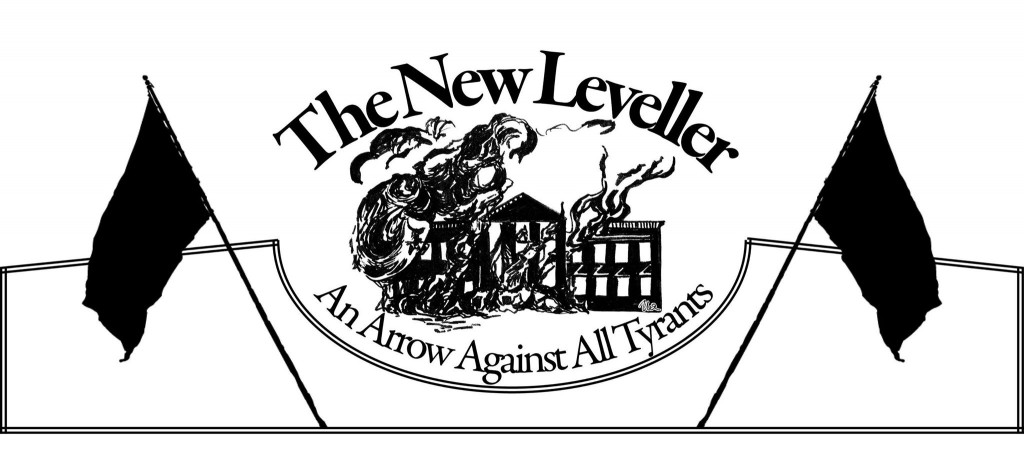
The New Leveller Volume 1, Issue 3 online now!

The New Leveller is the publishing side of the Students for a Stateless Society (S4SS). If you are a student and desire a stateless society, S4SS just might be a perfect fit for you.

newnewnewleveller
“Are you interested in individualist anarchism, or at least so frightened by it that you want to keep an eye on its progress? Are you frustrated by capitalism’s love for central planning and communism’s conservative view of human potential? Do you suspect that abolishing the institution responsible for war, police brutality, and mass incarceration might not be so dangerous after all?

Then The New Leveller is for you!”

The third issue of the Students for a Stateless Society‘s newsletter, The New Leveller is now online.

For a link to a PDF of the entire issue (recommended!), click here.
For links to an HTML version of each individual article, click here.

New Book(s)

C4SS’s first book, a collection of articles discussing the notion, possibility and necessity of common pool resources and “public” property spaces for a flourishing stateless society, The Anatomy of Escape: A Defense of the Commons, is near completion. We have finished the cover, beautifully designed by Benjamin Godwin, for both English and Portuguese. Work on the next book in our collection series, The Iron Fist: Capitalism, the Economy of the State, has already begun. We hope to complete three more books covering the topics: the psychopathology of hierarchy, ecology and environment, and strategy and tactics. After that we will begin the massive task of creating full author collections – Kevin Carson’s will, most likely, need multiple volumes.

New Book Review

Missing Comma‘s Juliana Perciavalle has agreed to review Matt Hern’s Watch Yourself: Why Safer Isn’t Always Better for C4SS.

Karl Hess

Of all the individuals that have contributed to the development and presence of Left Libertarian thought, Karl Hess is easily one of the most important. All are essential, but Karl Hess set the temperament and tone – radical, active, experimental and kind. Hess gave us our conception of the left/right spectrum, helped solidify our appreciation for the weird, gave us an example of heartfelt patience for old friends (that will probably never get us), and reaffirmed our commitment that concentrated economic and cultural power is just as dangerous and worthy of open vigilant opposition as concentrated political power.

Kevin Carson currently holds our first academic position, The Karl Hess Scholar in Social Theory and Markets Not Capitalism is dedicated to the memory of Karl Hess. Gary Chartier and Charles Johnson wrote, in Markets Not Capitalism, about Karl Hess,

We’ve dedicated Markets Not Capitalism to Karl Hess – a gentle, insightful, graceful, articulate, and passionate believer in freedom, decentralization, and peaceful, voluntary cooperation. Karl bridged the gap between the Old Right and the New Left, powerfully indicted the political status quo, and provided a compelling and unsettling model of life outside the state’s clutches. Flawed like everyone else, he was nonetheless good and decent, embodying the commitment to human liberation we seek to foster with this book.

In March, 1969, Karl Hess had an article published with Playboy magazine; that article would be called The Death of Politics. Joel Schlosberg has published a wonderful and detailed review of Hess’ other appearance in Playboy an interview of his life and politics for C4SS. Schlosberg opens with,

At first glance, a no-holds-barred conversation with an anarchist might seem the most inappropriate centerpiece imaginable for a magazine issue marking the bicentennial of the United States of America. But then again, Karl Hess was no ordinary “anarchist.”

Hobby Lobby

The ability or power to opt-out is one of the Thoreauvian aspects crucial to any meaningful theory of liberty. And many commentators lauded just this spirit in the Hobby Lobby ruling. But this power to opt-out, we must never forget, has been granted to billionaires and corporations, it was never considered or expected to trickle down to us –  the individuals. They will not cite it or stand by it when you decide to opt-out. They will zealously stand against opting-out when it comes to the intellectual property provisions of the DMCA or the provisions against secondary solidarity strikes and boycotts in the Wagner Act. The primary interventions are kept firmly and lovingly in place while the rest of us fight each other for corporate and political scraps. As Brain Nicholson summarizes, “with thought, the ‘culture war’ reveals itself as a prison fight — forced by the guards.” And Kevin Carson concludes,

But we’re never going to get Hobby Lobby, and big corporations and wage employers in general, out of control of our lives by using the state as a weapon. They usually work together, and always will. Ultimately, the only way out is what Michael Hardt and Antonio Negri call “exodus” — building our own horizontal institutions outside of both corporation and state, and abandoning the corporate-state nexus to rot.

C4SS has written a lot on this subject for July,

Eric Garner

For those of us that follow and worry about the growing militarization and militancy of the police in the Untied States and around the world, the tragic, needless and unwarranted murder of Eric Garner – live on camera – was not unexpected yet still shocking. There is something strange and terrifying, besides summary executions for loose cigarette entrepreneurship, about the default use of violent arrest when one could just as easily, and with discretion, issue a citation. The question to be asked, “Is this motivated by the desire to set an example for an occupied population or simple bloodlust?” I fear a case can be made for both. Ryan Calhoun‘s “Where’s Eric Garner’s Amargosa?” compares the popular reaction to Garner’s murder with the small Brazilian town of Amargosa,

His crime? Garner was a known holder of contraband, which you might know as loose cigarettes. Despite no evidence that he was selling or even had said contraband on his person, after a brief verbal quarrel between Garner and the police, he was put into a chokehold, held on the ground and pounced on by several more NYPD gang members. His last words, the words of an innocent family man to these “peace officers?” “I can’t breathe. I can’t breathe. I can’t breathe. I can’t breathe.” …

In the city of Amargosa in Brazil, citizens took to the streets after a stray bullet fire by a local police officer struck and killed a one-year-old girl. But they didn’t stay in the streets. They quickly took the police station, freeing prisoners, jacking state-owned weaponry and burning the station and police vehicles to the ground.

Millennials

As twilight sets on the Boomers and GenXers begin to find themselves in positions of civic responsibility (whatever that means), all number-crunching and trend-analysis eyes have turned to the Millennials. What makes them tick? What do they want? What will they do to the status quo? Kevin Carson has penned two pieces on the Millennial question: one suggestive of reforms Millennials should be pushing for and a trend-analysis of the Millennial based upon the historical and cultural novelties that have converged during their development. Carson writes,

So based on all this, it stands to reason this generation would be heavily involved in building all the major components of the successor society that’s emerging from the decaying ruins of the corporate-state nexus. There are 20-somethings in the hackerspace, open hardware and micromanufacturing movements, in Permaculture and community gardens, organizing squats into coherent, cooperative communities, developing encrypted counter-currencies and mutual credit systems, creating scholarly communities around open courseware and academic journals liberated from behind paywalls, and developing open meshworks the state can’t shut down and anonymizing darknets the state can’t penetrate.

I have gathered together the all the articles published with C4SS discussing the Millennial question,

We Haven’t Forgotten

We still have our David Graeber Symposium on the horizon, along with our Carson-Ward-Bookchin edition of Kropotkin’s “Fields, Factories and Workshops Tomorrow”.

Please Support Today!

Needless to say, all of this work is only sustainable through your support. If you think the various political and economic debates around the world are enhanced by the addition of left libertarian market anarchist, freed market anti-capitalist or laissez faire socialist solutions, challenges, provocations or participation, please donate $5, today. Keep C4SS going and growing.

ALL the best!

Feed 44, The Voltairine de Cleyre Collection
The Individualist and The Communist: A Dialgoue on Feed 44

C4SS Feed 44 presents “The Individualist and The Communist: A Dialgoue” from the book Markets Not Capitalism, written by Voltairine de Cleyre, read by Stephanie Murphy and edited by Nick Ford.

COM.: “Well, I admit that much. Certainly the employé cannot compete with his employer.”

INDV.: “Then you admit that there is not free competition in the present state of society. In other words, you admit that the laboring class are not free to compete with the holders of capital, because they have not, and cannot get, the means of production. Now for your ‘what of that?’ It follows that if they had access to land and opportunity to capitalize the product of their labor they would either employ themselves, or, if employed by others, their wages, or remuneration, would rise to the full product of their toil, since no one would work for another for less than he could obtain by working for himself.”

COM.: “But your object is identical with that of Communism! Why all this to convince me that the means of production must be taken from the hands of the few and given to all? Communists believe that; it is precisely what we are fighting for.”

INDV.: “You misunderstand me if you think we wish to take from or give to any one. We have no scheme for regulating distribution. We substitute nothing, make no plans. We trust to the unfailing balance of supply and demand. We say that with equal opportunity to produce, the division of product will necessarily approach equitable distribution, but we have no method of ‘enacting’ such equalization.”

Feed 44:

Bitcoin tips welcome:

  • 1N1pF6fLKAGg4nH7XuqYQbKYXNxCnHBWLB
Commentary
Reading Rainbow Soars Free

The extraordinary success of Reading Rainbow‘s Kickstarter campaign — with a record-breaking hundred thousand donors chipping in over $5 million for distributing Reading Rainbow‘s literacy material as widely as possible to children, particularly those in greatest financial need — demonstrates how crowdfunding may shape up as something more than what The New Republic dubs “the world’s No. 1 solver of First World problems.”

Paying up-front for both the fixed costs of developing Reading Rainbow and programming its software platform for an array of devices, plus the marginal costs of distributing it to schools, many of which would be unable to pay for it otherwise, the campaign is a spectacular example of voluntarism funding a public good.

Literacy education is often held up as the public good that could only be adequately supplied by the very involuntary means of the state. Milton Friedman summed up both the mainstream assumptions and the evidence pointing against them:

“At one time I thought a strong argument could be made for compulsory schooling because of the harm which the failure to school your child does to other people. … But the work which Ed West and others have done on the actual development of schools makes it abundantly clear that in the absence of compulsory schooling there would nonetheless be a very high degree of literacy — that self-interest would be sufficient to yield a degree of schooling which would satisfy the social need for a literate society.”

George Carlin countered the notion that reading is something kids have to be forced to do: “Kids who want to learn to read are gonna learn to read. Much more important: To teach children to question what they read.” Which institutions that depend on unquestioned obedience won’t do, but was the basis of the literacy education in the Ferrer schools whose namesake was put to death by their governmental enemies.

Of course, Reading Rainbow had the enormous advantage of its widely-remembered original public television incarnation. And Seth MacFarlane would not have a cool million dollars to spare for the project (or the clout to get a Cosmos revival back on the air) without his commercial media empire built on the industry’s expertly managed monopoly revenue streams.

But such piggybacking on the existing broadcast media infrastructure, while helpful, is unnecessary in a network age. Just as the public schools’ literacy education is a gutted travesty of Ferrer’s, the PBS/NPR model was always a watered-down imitation of the listener-sponsored model of private stations like KPFA, whose founder Lewis Hill was among its radicals who spent WWII in conscientious objector labor camps.

Alternative media and attempts to make private Ferrer-like education available to poor children — like George Dennison’s First Street School that worked and yet failed to survive (as Herbert Kohl’s New York Times review of Dennison’s account The Lives of Children put it) — have languished in the interstices of a centralized economy whose elites have the power to marginalize them. But if given a chance, their successors will soar higher than a butterfly.

Portuguese, Stateless Embassies
Manifestantes, prisão preventiva e o pesadelo kafkaniano

Em O Processo, Franz Kafka narra a história de Joseph K., um funcionário de alto escalão de um banco, que se vê perdido em meio a um processo penal incompreensível. Não sabe do que está sendo acusado, não conhece quais são as etapas do processo, suas possibilidades de defesa são limitadas. Uma obscura burocracia permeia tudo, e o sigilo reforça a incerteza e a indefinição da situação de Joseph K.

Kafka aí parece falar do Brasil às vezes.

Na véspera da final da Copa do mundo no Brasil (12/07), diversos manifestantes foram presos, com a determinação de 26 mandados de prisão. A acusação era de associação para quadrilha armada e a prisão foi justificada pela eminência de protesto violento marcado para o dia do final da Copa. Daí a prisão preventiva.

Desde então, surgiram vários problemas com o inquérito e a detenção cautelar.

O próprio fato das prisões terem sido efetuadas às vésperas da final da Copa do Mundo pode ser interpretado como uma medida de intimidação aos protestos. A Anistia Internacional se manifestou afirmando que as prisões eram a “repetição de um padrão de intimidação que já havia sido identificado pela organização antes do início do Mundial”.

Reforçando essa conclusão, os manifestantes e seus advogados não tiveram acesso ao conteúdo das acusações, impossibilitando a ampla defesa e o contraditório. Agravando ainda mais a situação, o próprio desembargador responsável pelo julgamento dos habeas corpus impetrados em favor dos manifestantes, Siro Darlan, da 7ª Câmara Criminal do Tribunal de Justiça do Estado do Rio de Janeiro, chegou a ter negado seu acesso aos documentos do inquérito policial.

Pelo menos 10 dos advogados de ativistas foram grampeados pela Polícia Civil, escutas estas autorizadas pela Justiça, incluindo o telefone fixo do Instituto de Defesa dos Direitos Humanos. O coordenador Thiago Melo salientou que referidas escutas violam o Estatuto do Advogado, que garante o sigilo telefônico do advogado no exercício da profissão:

“O grampo do telefone do IDDH se constitui numa violação da prerrogativa dos advogados que trabalham no instituto pelo sigilo necessário nas conversas entre advogado e cliente. Isso é um prejuízo para uma organização que é de direitos humanos e cuida de casos de violência institucional, de pessoas ameaçadas”.

Também não estava claro se as provas que embasaram a prisão preventiva eram fortes, como afirmava a promotoria. Segundo a Delegacia de Repressão aos Crimes de Informática, interceptações telefônicas e de mensagens da ativista Elisa Quadros Pinto Sanzi, a Sininho, revelaram que ela negociou compras de fogos de artifício, para uso em manifestações. Mas quando comprar fogos de artificio se torna ilegal?

Nesta terça (23/07), o desembargador Siro Darlan decidiu pela soltura liminar de vinte e três manifestantes (cinco dos quais presos, e os demais foragidos), reconhecendo que não havia embasamento suficiente para a decretação da prisão preventiva:

“6) (…) a decisão que decretou a custódia preventiva dos pacientes deixou de contextualizar, em dados concretos, individuais e identificáveis nos autos do processo, a necessidade da segregação dos acusados, tendo em vista a existência de outras restrições menos onerosas.

7) Com efeito, o decreto da custodia cautelar não analisou a inadequação das medidas cautelares alternativas diversas da prisão (…) sendo certo que o Magistrado somente poderá decretar a medida extrema da prisão preventiva quando não existirem outras medidas menos gravosas ao direito de liberdade do acusado por meio das quais seja possível alcançar, com igual eficácia, os mesmos fins colimados pela prisão cautelar e, via de consequência, permitir a tutela do meio social naquelas hipóteses em que haja risco de reiteração.”

A prisão preventiva dos ativistas foi o meio pelo qual o estado brasileiro fechou com chave de ouro o “estado de exceção esportivo” instaurado com a Copa do Mundo no Brasil, o último abuso dentre tantos outros cometidos pelo estado sob o pretexto do Mundial — embora todos os abusos cometidos sejam realidade perene no Brasil.

Quanto ao uso da prisão preventiva, os números são claros. A população carcerária do Brasil, uma das maiores do mundo, com mais de 550 mil pessoas na prisão, é composta por uma quantidade desproporcional de presos preventivos: cerca de 217 mil detidos aguardam julgamento. Um dos fatores que acentua este quadro, onde metade dos presos não foi julgada, é a lentidão do Judiciário, em razão da qual as prisões preventivas vão sendo estendidas indefinidamente. Na prática, o estado brasileiro frequentemente usa a prisão preventiva como uma forma de antecipação da punição.

Além disso, devemos questionar também a quantidade de justificativas legais de que o estado dispõe para prisões preventivas. O art. 312 do Código de Processo Penal estabelece que uma das hipóteses para a prisão preventiva é a “garantia da ordem pública”. Mas o que é a “ordem pública”?

Há tempos que criminalistas brasileiros questionam o modo como essa “garantia da ordem pública” tem sido usada arbitrariamente para levar pessoas à prisão sem julgamento, indício ou prova de que elas estivessem, em liberdade, impedindo o andamento do processo ou prestes a cometer um novo crime.

O contexto histórico é importante. O Código de Processo Penal vigente no Brasil foi criado na ditadura de Getúlio Vargas e seu modelo de processo criminal visa fortalecer o poder punitivo do estado. À época, a ditadura getulista foi ao ponto de instaurar explicitamente uma presunção de culpa no Decreto-Lei nº 88/37 para os crimes contra a segurança nacional, onde se lia “presume-se provada a acusação, cabendo ao réu prova em contrário”.

O Código de Processo Penal foi emendado, mas muitos desses elementos autoritários permaneceram, como a vaga hipótese da “garantia da ordem pública”. Essa tradição judicial brasileira defende, na prática, o estado contra o indivíduo, as punições e o pesadelo kafkiano em vez da liberdade.

Garantias como o devido processo legal, a presunção de inocência, o habeas corpus e a proibição das prisões arbitrárias existem para nos proteger do estado. Sem elas, ninguém está seguro.

Missing Comma, Stigmergy - C4SS Blog
Missing Comma: A Question For The Audience

Hi, everyone! I’m back from vacation about two weeks later than I expected, but I’m ready to start writing again. Juliana’s at a FEE seminar this week, but she’s still going to be writing regularly here at Missing Comma.

This week, we’re taking a break from our 24/7 coverage of Anthony Cumia (kidding) to ask a short question: Should C4SS adopt a “safe spaces” comment policy?

For the past several months, we here at the Center have debated the addition of some kind of a “safe spaces” comment policy, but recently, we’ve entered into a deadlock. Some of us are absolutely for such a comment policy, and some of us are for a comment policy that promotes complete freedom of speech, even at the risk of constantly having to fend off hordes of Nazis. We have not decided anything on a concrete level yet; this is all still in the discussion phase.

It’s worth pointing out, of course, that the C4SS comment section has, at least in the two years I’ve written here, been relatively tame in the inflammatory, racist or bigoted comment department, and that’s part of the reason for our deadlock: would the addition of a safe spaces policy be addressing an existing problem, or is it tilting at windmills, so to speak?

It occurred to me recently, during one of the internal discussions regarding this topic, that while we’ve spent months and months debating among ourselves, we’ve never asked what the group of people this is going to effect the most – you – thought about it. Missing Comma is the unofficial-official “ombudsman” blog of C4SS, and as its co-writer, I saw this lack of contact with you, the reader, as a potentially disastrous oversight that needs to be corrected immediately.

So, what do you think? Should the Center for a Stateless Society adopt some form of a “Safe Spaces” policy? If yes, why? If no, why not? What would such a thing look like? What would be the best way to implement it? Leave a comment with your answers below. Alternately, you can tweet your responses to @c4ssdotorg or the Missing Comma Twitter account, @missingcomma; you can also post to the hashtag, #c4sscomments. We’ll talk about some of your best answers next week!

Life, Love And Liberty, Stigmergy - C4SS Blog
Public vs Private Dualities and Contextual Analysis

Among the most enduring and pressing of questions for social scientists has been the nature of the public and private spheres. A great many political battles have been fought over control or delineation of these respective spaces. Some of these battles have been fought by the Civil Rights Movement and labor movement. Both of which sought to make claims of control or access to contested public/private spaces. These conflicts cannot be resolved without a nuanced contextual understanding of the issue. This requires dialectically transcending a strict public-private dualism.

This dualism shows up linguistically when discussing government vs non-government ownership/control. The common usage of the terms private ownership and public ownership are to identify government and non-government ownership. In this parlance, public refers to government ownership while private refers to non-government ownership.

The underlying assumption here is that the government and the public sphere are the same. Dictionary.com defines public as follows:

  1. of, pertaining to, or affecting a population or a community as a whole: public funds; a public nuisance.
  2. done, made, acting, etc., for the community as a whole: public prosecution.
  3. open to all persons: a public meeting.
  4. of, pertaining to, or being in the service of a community or nation, especially as a government officer: a public official.
  5. maintained at the public expense and under public control: a public library; a public road.

It’s certainly possible for a non-government controlled space or institution to meet the criteria above. An example is a privately owned local library called Linda Hall Library that is nonetheless open to the public. This example also shows the problematic nature of the dualism between private and public. You have an entity that is privately owned in the sense of non-government owned and yet accessible to the general public. This shows the importance of contextual analysis in deciphering what is private and public under what definitions. It depends on the context. In one context, public may be a reference to government ownership, but that’s not what it means in the context of anarchy.

Anarchistic public space is an important part of a free society. It would involve a public right of way and accessibility through some kind of cooperative control. A sense of solidarity could ensure access to people not living in the local community or cooperatively controlled area. One way to go about creating anarchistic public space is to homestead government controlled areas and engage in management of the newly created anarchistic commons. I look forward to seeing people try this out!

Spanish, Stateless Embassies
¿Qué es el libertarismo de izquierda?

El libertarismo de izquierda ha generado mucho ruido últimamente en la comunidad libertaria estadounidense. El término “libertario de izquierda” se ha utilizado de muchas maneras en la política estadounidense, y parece que hay cierta confusión dentro de la propia comunidad libertaria acerca de quiénes son en realidad los libertarios de izquierda.

Las ideas básicas del libertarismo de izquierda, tal como las entendemos los que pertenecemos a la Alianza de la Izquierda Libertaria (ALL) y al Centro para una Sociedad sin Estado (C4SS), son más amplias de lo que postulan nuestras organizaciones por sí mismas. La década de los años 90 fueron una especie de era del motor de vapor para la idea general de un libertarismo con orientación de izquierda, y para el uso de las ideas de libre mercado como un arma contra los males del capitalismo corporativo; una serie de pensadores han desarrollado líneas paralelas de análisis de forma independiente el uno del otro, y se han convertido en una tendencia ideológica amplia y unida por vínculos relativamente flexibles. Pero teniendo en cuenta el papel desproporcionado que ALL y C4SS han jugado en la creciente importancia de esta tendencia, parece sensato explicar de dónde venimos y lo que entendemos que es el libertarismo de izquierda.

El uso más antiguo y más amplio del término “libertario de izquierda”, y que tal vez sea el más familiar para aquellos en el movimiento anarquista en general, se remonta a finales del siglo XIX e incluye a prácticamente toda la izquierda no-estatista, horizontalista o decentralista — básicamente a todo el mundo menos a los socialdemócratas y a los leninistas. Originalmente fue utilizado como sinónimo de “socialista libertario” o “anarquista”, y solía incluir a sindicalistas, comunistas consejistas, a los seguidores de Rosa Luxemburgo y Daniel DeLeon, etc. Muchos de nosotros en C4SS nos consideraríamos parte de esta comunidad libertaria de izuqierda más amplia, a pesar de que lo que queremos decir cuando decimos que somos “libertarios de izquierda” es más específico.

Para el público en general de hoy en día, puede que el “libertarismo de izquierda” evoque a una escuela de pensamiento representada durante los últimos veinte años por gente como Hillel Steiner y Peter Vallentyne, entre otros. La mayoría de los seguidores de esta filosofía, combinan la creencia en la soberanía personal y el principio de no agresión con ideas izquierdistas acerca de la limitada medida en que los individuos pueden desasociarse del comunal, y adquirir derechos ilimitados de disposición sobre él con simplemente combinar su trabajo con éste. Se solapa en gran medida con el Georgismo y el Geolibertarismo. Aunque esta versión del libertarismo de izquierda no abarca a lo que promovemos en ALL/C4SS, y algunos de nuestros miembros se opondrían a aspectos de la misma, es fácil imaginar a un adherente de esta filosofía que se sintiese como en casa entre nosotros.

Dentro de la comunidad libertaria anglosajona, y entre los que se describen como “liberales” en el resto del mundo, el término “libertario de izquierda” podría estar asociado con el intento de Murray Rothbard y Karl Hess de forjar una alianza con los anarquistas en la SDS alrededor de 1970, y con los movimientos como el agorismo de Sam Konkin que crecieron a partir del mismo. Aunque el rothbardismo de izquierda y el agorismo de Konkin no son la posición oficial de ALL/C4SS, sería justo decir que tenemos una cierta continuidad organizativa con el Movimiento de la Izquierda Libertaria de Konkin, y una parte significativa de nuestra membresía central más antigua viene de la tradición rothbardiana de izquierda y konkinista. Yo, por ejemplo, no vengo de ninguna de esas dos tendencias. Somos una coalición multi-tendencia que incluye rothbardianos de izquierda, anarquistas individualistas clásicos del siglo XIX, georgistas, y muchas otras tradiciones.

También hay una tendencia entre los libertarios estadounidenses a confundirnos con los “Libertarios idealistas” [Bleeding Heart Libertarians], que en realidad es el nombre de un blog específico. Aunque en ese blog hay unos cuantos artículos buenos y han publicado algunas de nuestras cosas, no somos libertarios idealistas como tales. Los libertarios idealistas son mucho más afines al fusionismo “liberaltario”, con desviaciones que van desde el “paternalismo libertario” de Cass Sunstein a la defensa de los talleres clandestinos y los asentamientos israelíes. Por no hablar de que la mayoría de ellos no son anarquistas y nosostros sí.

Así que ahora que hemos considerado todas las cosas que no somos en ALL/C4SS, y lo que no queremos decir con “libertarismo de izquierda”, ¿qué es lo que realmente representamos? Nosotros nos autodenominamos libertarios de izquierda, en primer lugar, porque queremos rescatar las raíces izquierdistas del libertarismo de libre mercado, y en segundo lugar, porque queremos demostrar la pertinencia y utilidad del pensamiento de libre mercado para abordar las preocupaciones actuales de la izquierda.

El liberalismo clásico y el movimiento socialista clásico de principios del siglo XIX tuvieron raíces comunes muy afines en la Ilustración. El liberalismo de Adam Smith, David Ricardo y otros economistas clásicos, era en gran medida un asalto izquierdista contra los arraigados privilegios económicos de la gran oligarquía terrateniente Whig y el mercantilismo de las clases adineradas.

A medida que los industriales en auge derrotaron a los terratenientes y mercantilistas Whig en el siglo XIX y ganaron una posición predominante en el Estado, el liberalismo clásico fue adquiriendo el carácter de una doctrina apologética en defensa de los intereses arraigados del capital industrial. A pesar de eso, las vetas de izquierda – incluso socialistas – del pensamiento de libre mercado sobrevivieron en los márgenes del liberalismo establecido.

Thomas Hodgskin, un liberal clásico que escribió desde 1820 hasta 1860, era también un socialista que veía la renta, las ganancias y los intereses como rendimientos monopólicos sustentados en privilegios y derechos de propiedad artificiales. Josiah Warren, Benjamin Tucker y otros individualistas estadounidenses también favorecieron una forma de socialismo de libre mercado en el que la libre competencia destruiría la renta, las gangncias e intereses y garantizaría que “el salario natural del trabajo en un mercado libre fuese su producto”. Muchos anarquistas individualistas asociados con el grupo Libertad de Tucker tenían estrechos vínculos con movimientos laborales radicales y grupos socialistas como los Caballeros del Trabajo, la Asociación Internacional de los Trabajadores y la Federación Occidental de Mineros.

Esta rama del libertarismo era también izquierdista desde un punto de vista cultural, estrechamente asociada con los movimientos por la abolición de la esclavitud, por la igualdad racial, el feminismo y la libertad sexual.

A medida que las guerras de clase del siglo XIX se desarrollaban, la retórica de “libre mercado” y de “libre empresa” en la política convencional estadounidense se asoció cada vez más con la defensa militante del capital corporativo frente a los desafíos radicales del movimiento populista laboral y granjero. Al mismo tiempo, la división interna dentro del movimiento anarquista entre los comunistas y los individualistas dejó a los últimos aislados y vulnerables a la colonización por parte de la derecha. En el siglo XX, “el libertarismo de libre mercado” llegó a estar estrechamente asociado con las defensas derechistas del capitalismo esgrimidas por Mises y Rand. La tradición individualista sobreviviente fue despojada de sus antiguas tradiciones culturales izquierdistas, pro-laborales y socialistas, y asumió un carácterde derecha cada vez más apologético.

Sin embargo, incluso entonces algunos remanentes de la tradición de izquierda más antigua sobrevivieron en el libertarismo estadounidense. En particular, georgistas y cuasi-georgistas como Bolton Hall, Albert Nock y Ralph Borsodi siguieron dando vueltas por ahí más allá de la mitad del siglo XX.

Los que pertenecemos a la Izquierda Libertaria consideramos absolutamente perverso que el libertarismo de libre mercado, una doctrina que tuvo sus orígenes como un ataque contra el privilegio económico de los terratenientes y comerciantes, haya sido cooptado en defensa del poder establecido de la plutocracia y las grandes empresas. El uso del “libre mercado” como una ideología legitimadora para el capitalismo corporativo triunfante, y el crecimiento de una comunidad de propagandistas “libertarios”, es una perversión de los principios del libre mercado tanto como la cooptación de los símbolos y la retórica del movimiento socialista histórico por parte de los regímenes estalinistas fue una perversión del movimiento de la clase obrera.

El sistema capitalista industrial que la corriente libertaria convencional ha estado defendiendo desde la mitad del siglo XIX nunca se ha aproximado en lo más mínimo a un régimen de libre mercado. El capitalismo, como sistema histórico que surgió en la época moderna, es en muchos sentidos una consecuencia directa del feudalismo bastardo de la Baja Edad Media. Se fundamentó en la disolución de los campos abiertos, el cercamiento de las tierras comunales y otras expropiaciones masivas de los campesinos. En Gran Bretaña la población rural no sólo fue transformada en un proletariado desposeído y coaccionado hacia el trabajo asalariado, sino que también se criminalizó su libertad de asociación y de circulación con la implementación de un Estado policial draconiano durante las dos primeras décadas del siglo XIX.

A nivel mundial, el capitalismo se expandió como sistema mundial a través de la ocupación colonial, la expropiación y la esclavización de gran parte del Sur global. Decenas y cientos de millones de campesinos fueron despojados de sus tierras por las potencias coloniales, obligándolos a entrar en el mercado de trabajo asalariado, y sus antiguas tenencias fueron consolidadas para la agricultura de cultivos comerciales en una especie de reedición mundial de los Cercamientos de Gran Bretaña. Tanto en tiempos coloniales como post-coloniales, las tierras y los recursos naturales del Tercer Mundo fueron cercados, robados y saqueados por los intereses comerciales occidentales. La actual concentración de la tierra del Tercer Mundo en manos de las élites terratenientes que producen en connivencia con los intereses de la agroindustria occidental, y de los recursos de petróleo y minerales en las manos de las corporaciones occidentales, es una herencia directa de cuatrocientos años de robo colonial y neo-colonial.

Los que nos identificamos con la Izquierda Libertaria tal como la entendemos en C4SS queremos arrancar los principios del libre mercado de las manos de los asalariados de las grandes empresas y la plutocracia y volver a usarlos en función de su propósito original: de un asalto total contra los intereses económicos atrincherados y las clases privilegiadas de nuestro tiempo. Si el liberalismo clásico de Smith y Ricardo fue un ataque contra el poder de los oligarcas terratenientes partidarios del Whig y los intereses adinerados, nuestro libertarismo de izquierda es un ataque a lo que más se parece a eso en nuestro tiempo: el capital financiero global y las corporaciones transnacionales. Repudiamos el papel del libertarismo dominante en la defensa del capitalismo corporativo en el siglo XX y su alianza con el conservadurismo.

En la Izquierda Libertaria queremos demostrar la pertinencia de los principios de libre mercado, de libre asociación y de cooperación voluntaria para abordar las preocupaciones de la izquierda de hoy en día: la injusticia económica, la concentración y la polarización de la riqueza, la explotación del trabajo, la contaminación y los residuos, el poder empresarial, y las formas estructurales de opresión como el racismo, el sexismo, la homofobia y la transfobia.

Dondequiera que se haya perpetrado el robo o la injusticia, tomamos una firme postura a favor de la plena rectificación. Dondequiera que persista la propiedad de la tierra por parte de élites neo-feudales, debe ser tratada como propiedad legítima de aquellos cuyos antepasados la ​​han trabajado y utilizado. Los campesinos expulsados ​​de la tierra para levantar cultivos comerciales para Cargill y ADM deben ser reestablecidos como legítimos propietarios. Las haciendas en América Latina deberían abrirse para que los campesinos sin tierra puedan ocuparlas productivamente. Los títulos de propiedad de la tierra vacante y no mejorada en los Estados Unidos y otras sociedades de colonos que se ha cercado y dejado fuera de uso por propietarios ausentes, deberían ser anulados. En los casos donde la tierra originalmente reclamada en virtud de un título tan ilegítimo esté siendo efectivamente trabajada o habitada por inquilinos o pagadores de hipoteca, la titularidad completa debe ser inmediatamente transferida a ellos. Los títulos de propiedad corporativa de las minas, los bosques y los campos petrolíferos obtenidos mediante robo colonial deberían ser anulados.

La lista mínima de las exigencias del libertarismo de izquierda debe incluir la abolición de todos los derechos de propiedad artificial, la escasez artificial, los monopolios, las barreras de entrada, los carteles reglamentarios y las subvenciones, gracias a los cuales prácticamente la totalidad de las empresas del Fortune 500 generan la mayor parte de sus ganancias. Debe incluir la terminación de todo título de propiedad sobre terrenos baldíos y sin mejoras, todos los monopolios de “propiedad intelectual”, y todas las restricciones a la libre competencia en el tema del dinero y del crédito o a la libre adopción de cualquiera y todos los medios de intercambio elegidos por las partes de una transacción. Por ejemplo, la abolición de las patentes y las marcas comerciales significaría el fin de todas las barreras legales que impiden a los contratistas de Nike en Asia producir inmediatamente imitaciones idénticas de las zapatillas y comercializarlas a la población local a una pequeña fracción del precio sin el recargo que implica el “Swoosh”. Significaría el fin inmediato de todas las restricciones a la producción y venta de versiones competitivas de los medicamentos bajo patente, a menudo por tan poco como el 5% del precio. Queremos que la porción del precio de todos los bienes y servicios conformada por las rentas incorporadas sobre la “propiedad” de ideas o técnicas —a menudo la mayor parte de su precio— desaparezca ante la competencia inmediata.

Nuestro programa debe incluir, además, el fin de todas las barreras artificiales a la actividad por cuenta propia, a la empresa casera, a la vivienda vernácula o autoconstruida y a otros medios de subsistencia de bajo costo — esto incluye las leyes de habilitación y zonificación o códigos de seguridad. Y debe incluir terminar con todas las restricciones legales sobre el derecho de los trabajadores a organizarse y para negarse a prestar sus servicios bajo cualquier circunstancia o a participar en boicots, y el fin de todos los privilegios legales que dan a los establecimientos sindicales certificados el derecho a restringir las huelgas salvajes y otros tipos de acción directa por parte de sus trabajadores de base.

En el caso de la contaminación y el agotamiento de los recursos, la agenda de la izquierda libertaria debe exigir el fin de todo tipo de acceso privilegiado a la tierra por parte de las industrias extractivas (es decir, la colusión de la Oficina de Administración de Tierras de EE.UU. con las compañías petroleras, mineras, madereras y ganaderas), de todos los subsidios a la energía y el consumo de transporte (incluyendo el fin de los subsidios a aeropuertos y autopistas y el uso del dominio eminente para esos fines), el fin de la utilización del dominio eminente para oleoductos y gasoductos, la eliminación de todas las limitaciones regulatorias de la responsabilidad corporativa por derrames de petróleo y otros tipos de contaminación, el fin de la doctrina por la cual las normas mínimas regulatorias impiden normas preexistentes de responsabilidad más estrictas derivadas del derecho consuetudinario, y la restauración completa de la responsabilidad ilimitada (tal como existía en el marco del derecho consuetudinario de agravios original) para actividades contaminantes como el fracking y la remoción de la cima de las montañas. Y debe abolir, obviamente, el rol del Estado guerrerista de EE.UU. en asegurar el acceso estratégico a las cuencas petroleras extranjeras o mantener las rutas marítimas abiertas para los barcos petroleros.

El capitalismo corporativo y la opresión de clase deben su existencia a la intervención del Estado a favor de los privilegiados y poderosos. Los mercados genuinamente libres, la cooperación voluntaria y la libre asociación actuará como dinamita en los cimientos de este sistema de opresión.

Cualquier agenda de izquierda libertaria digna de ese nombre debe incluir también una preocupación por la justicia social y la lucha contra la opresión estructural. Eso significa, obviamente, el fin de toda discriminación impuesta por el Estado en cuanto a raza, género u orientación sexual. Pero significa mucho más que eso.

Es cierto que como libertarios nos oponemos a todas las restricciones legales a la libertad de asociación, incluyendo las leyes contra la discriminación por parte de las empresas privadas. Pero debemos apoyar con entusiasmo la acción directa para combatir la injusticia en el ámbito social. E históricamente, las leyes estatales contra la discriminación solo han servido para codificar, de mala gana y después del hecho, las triunfos obtenidos sobre el terreno a través de la acción directa, como los boicots de autobuses, las sentadas en los despachos de almuerzo y los disturbios de Stonewall. Debemos apoyar el uso de la acción directa, la presión social, los boicots y la solidaridad social para combatir las formas estructurales de opresión como el racismo y la cultura de la violación, y desafiar las normas interiorizadas que perpetúan estos sistemas de coerción.

Al abordar todas las formas de injusticia, debemos adoptar un enfoque interseccional. Eso incluye el repudio a las prácticas de la vieja izquierda de desestimar las preocupaciones de raza y género como “divisivas” o postergables “hasta más tarde” en interés de la unidad de clase. También incluye un repudio de los movimientos de justicia racial y de género dominados por profesionales de clase media alta que solo se preocupan por ver “caras negras o femeninas en las altas esferas del poder”, y “gabinetes/juntas directivas que se parezcan al resto de Estados Unidos”, dejando el poder de esas altas esferas, gabinetes y juntas directivas intacto. El asalto a una forma de privilegio arraigada no debe ser razón para llegar a una solución de compromiso en otras luchas; más bien, todas las luchas son complementarios y se refuerzan mutuamente.

Preocuparnos especialmente por las necesidades interseccionales de los compañeros menos favorecidos en cada movimiento de justicia —mujeres y personas de color en la clase obrera; mujeres pobres y trabajadoras, mujeres de color, mujeres transexuales y trabajadoras sexuales dentro del feminismo; las mujeres, los pobres y los trabajadores en el movimiento por la justicia racial; etc.— no divide estos movimientos. De hecho los fortalece ante los intentos de la clase dominante para dividir y conquistar mediante la explotación de las líneas de fractura interna como fuente de debilidad. Por ejemplo, los grandes terratenientes derrotaron a los sindicatos de granjeros arrendatarios en el sur estadounidense durante la década de 1930 mediante el fomento y la explotación de la discordia racial, logrando que el movimiento se dividiese en sindicatos blancos y negros separados. Cualquier movimiento de clase, justicia racial o sexual que no tenga en cuenta la combinación de múltiples formas de opresión entre sus propios miembros, en lugar de prestar especial atención a las necesidades especiales de los menos privilegiados, queda abierto al mismo tipo de manipulación. En última instancia, este tipo de atención a los problemas interseccionales debe incluir un enfoque de espacios seguros que cree un ambiente receptivo de verdadero debate para todos, sin el efecto amedrentador causado por el acoso deliberado y las difamaciones.

Los libertarios —a menudo por nuestra propia culpa— han sido descartados por muchos como “republicanos que fuman marihuana” que adhieren a una ideología insular principalmente de hombres blancos de clase media que trabajan en startups de Silicon Valley. En demasiadas publicaciones y comunidades en línea libertarias convencionales, la tendencia reflexiva es defender a los grandes negocios contra los ataques de los trabajadores y los consumidores, a los arrendadores contra los arrendatarios, y a Walmart contra la gente común, rechazando a cualquiera que sea crítico en este sentido como enemigo del libre mercado y tratando a las corporaciones como si fuesen portavoces de los principios del libre mercado. Esta tendencia es paralela a otra similar a descartar cualquier preocupación por la justicia racial y sexual como “colectivista”. El resultado es un movimiento que la gente pobre y trabajadora, las mujeres y las personas de color ven como totalmente irrelevantes a sus preocupaciones. Mientras tanto, los varones blancos de 20 y pico de años que trabajan en las industrias de alta tecnología explican la falta de mujeres y minorías en función de su “colectivismo natural”, y con aire taciturno citan mutuamente “El trabajo de Isaías” de Nock.

Los que estamos en la Izquierda Libertaria no queremos ser relegados a las catacumbas, o ser el equivalente moderno de los jacobitas sentados en los cafés recordando a Bonnie Prince Charlie y el ’15. No queremos rezongar sobre cómo la sociedad se va al garete mientras que la mayoría de la gente que lucha para cambiar las cosas para mejor nos ignora. Queremos que nuestras ideas estén en el centro de las luchas por la justicia y una vida mejor en todo el mundo. Y sólo podemos hacer esto abordando las preocupaciones reales de la gente real, repetándolas como se merecen, y mostrándoles cómo nuestras ideas son relevantes. Y eso es lo que pretendemos hacer.

Artículo original publicado por Kevin Carson el 15 de junio de 2014.

Traducido del inglés por Carlos Clemente.

Feature Articles
Market Anarchism for Network Mutualism

Human communication systems offer incredible insight to the creative nature of human beings, spontaneous social order and emerging markets within our societies. For the first time in human history we are sharing ideas from the local to the global in scale. With the advent of the Internet, social media and growing social networks, communication costs are at an all time low. These falling communication costs, as at every time in our collective history, are allowing us to work around traditional power structures that have historically controlled the amount and type of information we receive. As the Internet is a mechanism for global communication, we are now cultivating ideas based on individual and collective interaction with people who hold similar interests.

The described collaborative nature of inclined labor in the freed market has far-reaching political and socioeconomic implications for our societies. Historical evidence suggests that social and cultural development are dependent upon active participation from people in their local communities (Kretzmann & McKnight 1993). Emerging communication technologies and the spread (and ease of access to) information can lead to a transfer of authority from centralized institutions to neighborhood or community organizations (McCook 2000). Human communication systems play a fundamental role in the empowerment of all people and provide a wide range of benefits to communities (Wilcox 1996). Altruism is alive and well in the Internet age.

The collaborative nature of the Internet, the ease of access to information, and the development of local to global markets over the net are of particular interest to market anarchists. After all, what better place to work on a project with peers, or organize a rebellion? The Molinari Institute website defines market anarchism this way:

Market anarchism is the doctrine that the legislative, adjudicative, and protective functions unjustly and inefficiently monopolised by the coercive State should be entirely turned over to the voluntary, consensual forces of market society.

The market anarchist seeks differing and competing modes of social organization. Market anarchism maintains replacing the state with a decentralized society is desirable because of the feasibility of, and the liberating principles innate to, left-wing free market economics. What better example of voluntary social organization exists than the vast networks emerging on the Internet?

Important here is the concept of information ecology. Information ecology is a system of people, practices, values and technologies in a particular environment (Nardi & O’Day 1999) or community. This idea of information ecology helps us better understand human communication systems and how information moves within them – how is information used, who needs certain types of information, who is impacted by access (or lack there of) of information and what does this mean for our communities? As communication continues its decentralized evolution in the age of the Internet more stakeholders will take active roles in community development, empowering people like never before (Mehra 2009).

The online encyclopedia “Wikipedia,” for example, explicitly restricts corporations or governments from uploading information to its online content, instead allowing only individuals to add, remove or change content on the website (Kaplan 2010). Driving this collaborative effort is the idea that the labor of many individuals leads to better availability of information than any single person or actor could individually achieve (Fama 1970). The idea is that collaborative projects lead to more efficient markets. Collaborative projects enable the creation of information by interested users and are incredibly democratic.

A political example of this democratization is occurring right now in China. Guobin Yang (2003) notes that civil society and the Internet are dependent upon each other. The Internet facilitates the activities of a civil society by creating new markets for citizen participation. Civil society facilitates further development of the Internet by creating the social capital (citizens and citizen groups) for communication and interaction (Yang 2003). This co-evolution of the Internet and society has big implications for China’s model of government (even as the Chinese government attempts to control access to social networking sites such as Twitter and Facebook), as Yang explains:

The co-evolution of the Internet and civil society means that political control of the Internet in China will have to take the form of control of civil society as well, and vice versa. Both options are open to the state, but the simultaneous control of the Internet and civil society will add to the difficulty and complexity of control. The co-evolutionary process also means that civil society development will facilitate the democratic uses of the Internet as much as the diffusion of the Internet will shape civil society. This scenario may have long-term consequences for the development of the Internet and civil society in China.

Many more examples of networked decentralization exist across the net.

Human beings are fond of organizing in groups and with new technology we are in the beginning phases of building a global market defined by collaborative social action. The Internet, information technology and falling communication costs provide easy-access to local/regional/global/stigmergic networks. Communication networks are easily coordinated and create ‘‘virtual public spheres’’ (Langman 2005). Virtual public spheres are places in cyberspace where people and information intersect in virtual communities or subcultures (Langman 2005). Communities that are organized and cultivated on the Internet are just as real as the face-to-face interactions humans use on a daily basis. The Internet provides a space where people can acquire and share information as well as interact, debate and negotiate about issues pertaining to society (Langman 2005) – elevating the speech of all individuals, not just those in a position of power, like never before in human history.

The Internet is incredibly empowering – the feedback loop between the Internet and civil society is an engine driving cultural evolution. The rise of global communication, among all tiers of society, will have huge implications for the future of human civilization.

It is important then, for all libertarian theorists, anarchists, and liberty minded individuals to recognize and challenge threats to the Internet. As empowering as network mutualism can be, technology also tends to centralize power – especially as it is the privileged intelligentsia that mainly moves innovation in this field forward. This gives the elite few the power of dominance over the many. Technology is often born in a system of bureaucratic control that champions a social structure based in top-down hierarchies. This is why the democratic nature of the Internet and our virtual public spheres are so unique – they deserve our protection.

Wherever there is human flourishing, rest assured either a state or corporate bureaucrat (often both) discover a system they argue needs taxation, moderation, regulation and/or prohibition. Take Zach Epstein‘s warning  that a new privacy-killing CISPA clone is now a step closer to becoming law. He writes:

We all remember the outrage that swept the Internet and ultimately played a role in defeating CISPA, a proposed law that would have allowed government agencies and tech companies to exchange private information about United States citizens without their knowledge and without a warrant. Well, it’s time to get ready for another round of outrage because CISPA’s controversial successor is now a step closer to becoming law.

He is referring to the Cybersecurity Information Sharing Act of 2014 – approved by the Senate Intelligence Committee in mid-July. The new law (CISA) would allow companies to share private user data with local and federal law enforcement if the claim is made that it relates to any kind of alleged criminal activity. Another piece of legislation allowing the state-corporate apparatus to set-up wiretaps without warrant.

Now take the much more discussed Net-Neutrality debate. The Federal Communications Commission received more than 1 million public comments on the issue of net neutrality during a five-month commenting period for a proposal that would allow cable companies to charge content providers extra fees to deliver faster service. NPR reports it is the biggest public response the FCC has ever gotten on a policy matter in such a short period, and the second most commented-upon FCC issue, period. The overwhelming response from the public was that the internet should remain open in nature to ensure its benefits can be shared by all.

In the same article, however, NPR asks George Washington University law professor Richard Pierce if the record breaking comments will even matter in the long run. Pierce notes that this has been extensively studied by academics and their research shows that rule-making or policymaking tends to be systemically biased to favor the industries that are affected by the regulation. NPR reports:

In a recent example, Pierce points to the work of Kimberly Krawiec. Krawiec read all of the comments that were submitted in the rule-making that led to the Volcker rule — part of the Dodd-Frank Act’s banking reforms. She also reviewed the logs that described the meetings that agency decision makers had with parties who were interested in the outcome of that proceeding. Krawiec found that, while proponents of strict regulation of financial institutions dominated the comment process numerically, their comments were useless to decision makers, because the vast majority of them were identical form letters without data or analysis.

The folks who do comment with the detail, data and analysis that can change minds? Deep-pocketed industries.

The academic conclusion: Research (and history) shows public comments do not affect outcomes – money talks. But, our speech is empowered like never before over the net. The best thing we can do for the Internet is to keep up the trend of decentralization. So far, the national debate has presented us with only two options:

  1. We need the state to protect us from losing the internet to corporate control via regulation and legislative decree, or
  2. We need the state to protect moneyed interests so corporations can practice their rights in the (state) capitalist market.

We must remember there is a third option – maintain common, mutual control over the net.

By the very nature of information ecology, we can keep the Internet innovative and free. All battles against the state and capital are uphill but we are all empowered by the Internet. As the Center for Democracy & Technology (CDT) notes, as long as we continue to build and provide access to new market opportunities and create safe havens for free speech, the Internet will continue to empower and equalize horizontal social organization as opposed to vertical, top down hierarchies around the globe.

We are winning, simply because we talk and are inclined to labor with one another.

Information technologies are allowing for revolutions in markets, thus effecting business, government and global culture. For the first time in human history there is truly global communication. Though it is still a large privilege to have access to the Internet, more and more people, of many different socio-economic statuses, are crossing the digital divide and beginning to talk. As Tim Malone writes in The Future of Work about the coming revolution:

The new revolution promises to lead to a further transformation in our thinking about control. Where does power come from? Who should wield it? Who is responsible? Once again the result will be in a world where people have more freedom. A world in which power and control are spread more widely than our industrial aged ancestors would have ever thought possible…

Dispersed physically but connected by technology, workers are now able, on a scale never before imaginable, to make their own decisions using information gathered from many other people and places.

As Malone points out, emerging orders in society will continue the trend of decentralization. If left in common control the net will continually become democratic, highly organized, structured and efficient – it will be anarchic progress.

There has been a constant push throughout human history to decentralize when the time is optimal. The emergence of democracy, for example, shows off this trait. Now, in an era of low communication costs and emerging technologies, we may see enhanced social evolution, a stronger push to decentralize and the emergence of small social networks that can cause big changes in how we live our everyday lives. Information technology is beginning to impact our neighborhoods, cities, work places and governance. We are connected and, with each blog, tweet, event, post or review, prove we are not neutral, but instead are revolutionaries for network mutualism.

Works Cited:

Fama, E. F. (1970) Efficient Capital Markets: A Review of Theory and Empirical Work. Journal of Finance, vol. 25 no. 2, 383—417.

Kaplan, Andres and Michael Hanlein. (2010) Users of the World Unite! The Challenges and Opportunities of  Social Media. Business Horizons.

Kretzmann, J. P. & L. McKnight. (1993) Building Communities From the Inside Out: A Path Toward Finding and Mobilizing a Communities Assests. Institute for Policy Research.

Langman, Lauren. (2005)From Virtual Public Spheres to Global Justice: A Critical Theory of Internetworked Social Movements. American Sociological Association.

Malone, Thomas W. (2004) The Future of Work. Harvard Business School Press

McCook, K. (2007) A Place at the Table: Participating in Community Building. ALA Editions.

Mehta, Bharat & Ann Peterson Bishop. (2004) The Internet for Empowerment of Minority and Margenalized Users. New Media and Society Vol6 (6):781–802

Mehra, Bharat and Ramesh Srinivasan. (2007) The Library-Community Convergence Framework for Community Action: Libraries as Catalysts of Social Change. Libri, vol. 57,  123–139.

Nardi, B & V. O’Day. (1996) Information Ecologies: Using Information with Heart. MIT Press.

Wilcox D. (1996) Inventing the Future – Communities in the Information Society. NCVO.

Yang, Guobin. (2003) The Co-Evolution of the Internet and Civil Society in China. University of California Press, vol. XLIII, no. 3.

Commentary
Fracking: Poster Child for the Corporate Welfare State

Just about every week another story comes to my attention confirming the complete and total government-dependency of fracking — beloved of so many self-proclaimed “free market” advocates on the libertarian right. Something about eminent domain to build the pipelines, or liability caps for spills, or regulatory approval of unsafe pipelines superseding tort liability for negligence, and ad nauseam. I have another couple of them right here.

First, an article in Monthly Review (Lauren Regan, “Electronic Communications Surveillance,” July/August) describes the revolving door of personnel between federal law enforcement and the oil and gas industry’s private goon squads, and how “the U.S. government has colluded with private corporations and extractive industries to ratchet up their COINTELPRO-esque tactics upon climate justice activists.” The fossil fuel industries like to spin off private “security” and “public relations” firms (often staffed by retired federal and state cops) to spy on perfectly legal activist groups, infiltrate and disrupt them, and give intelligence to PR staff — who then cook up scary “fact sheets” to discredit activists to both media and law enforcement. Extractive corporations like TransCanada also give PowerPoint presentations to various levels of law enforcement advocating surveillance and prosecution of activists as “terrorists” — something the cops are all prepared to eat up, what with the proliferation of “Fusion Centers” looking for stuff to panic over.

The other item: According to a study by Katie Keranen of Cornell University, almost all of the 2,500 small earthquakes in Oklahoma in the past five years have been the result of high pressure wastewater injections related to fracking. The change of stress on existing fault lines from the injection of water can trigger them — with water travelling along fault lines and causing earthquakes up to 22 miles away. And other states — Texas, Arkansas, Kansas, Ohio — have also seen sharp rises in small earthquakes corresponding to the introduction of fracking there. Youngstown, Ohio — which hadn’t previously been bothered by earthquakes — was hit by 109 of them in 2011 following the creation of an injection well.

Somehow I’m guessing even the minor structural damage to homes from thousands of earthquakes in five states, breakage of possessions, and the like, would cumulatively amount to a significant sum of money — enough to have a real impact on the bottom line of an industry that has problems with financial sustainability as it is and is highly reliant on a bubble financing Ponzi scheme. And we haven’t even gotten into the poisoning of groundwater from injection of toxic chemicals into geologically unstable areas.

At every step of the way, the state steps in to subsidize the operating costs of the fossil fuel industry, steal land for it to build pipelines on, and indemnify it against liability through regulatory preemption of tort law or even flat out statutory caps on liability for damage. And yet self-proclaimed libertarians like the Koch Brothers and much of the right-wing libertarian think tank and periodicals establishment loudly proclaim their support for fracking and Keystone in the name of the “free market.”

Sorry, folks. Fracking and pipelines have nothing to do with the free market. They’re creations of the state from beginning to end.

Portuguese, Stateless Embassies
ISIS: Sim, Tony Blair, você causou tudo isso

Mês passado, em um tom que pode ser descrito como insistência improvável, o ex-primeiro ministro britânico Tony Blair garantia ao público que “nós” — a Grã-Bretanha e os Estados Unidos — “temos que nos liberar da noção de que causamos” a desestabilização do Iraque pelos insurgentes do ISIS. Bom, na verdade, causaram.

Retornemos à conferência da paz de Versalhes no final da Primeira Guerra Mundial, quando a Grã-Bretanha — com a anuência de outras potências ocidentais — formou o Iraque a partir de três províncias que pertenciam ao Império Otomano. Essas províncias — de curdos sunitas, árabes sunitas e xiitas árabes dos pântanos — eram uma combinação tão absurda quanto a dos outros países artificiais que as potênciais imperiais da Europa remendaram em todo o mundo e tinham grande potencial de instabilidade desde o início.

Nos anos 1930, os Estados Unidos apoiaram a unificação da península arábica sob a casa de Saud, cuja religião oficial era uma tendência ultra-fundamentalista sunita conhecida como wahhabismo (coincidentemente compartilhada pelos terroristas da al-Qaeda que atacaram os Estados Unidos no 11 de setembro).

Em 1953, os Estados Unidos deram um estímulo poderoso ao fundamentalismo político islâmico ao derrubar o primeiro ministro iraniano Mohammad Mossadeq, um democrata socialista secular, levando novamente o xá ao poder. Isso criou um ambiente em que os clérigos fundamentalistas eram a principal oposição à autocracia do xá, levando eventualmente à derrubada da monarquia e ao estabelecimento de um regime teocrático.

Enquanto isso, o governo Eisenhower silenciosamente apoiava outro movimento fundamentalista, a Irmandade Muçulmana no Egito, como alternativa ao nacionalismo socialista secular de Nasser.

Nos anos 1960, os Estados Unidos apoiaram o golpe militar baath no Iraque, levando ao poder assim o mesmo regime com quem entrariam em conflito duas vezes.

No final dos anos 1970, os Estados Unidos criaram as condições que eventualmente levaram à ascensão da al-Qaeda, deliberadamente desestabilizando um regime satélite soviético estável e secular no Afeganistão ao fornecer auxílio a insurgentes fundamentalistas, provocando uma invasão soviética e 10 anos de uma sangrenta guerra civil. A al-Qaeda surgiu das fileiras dos fundamentalistas islâmicos da guerrilha anti-soviética nos anos 1980, uma insurgência pesadamente armada e treinada pelos Estados Unidos. O governo de Jimmy Carter desestabilizou o Afeganistão; Ronald Reagan jogou gasolina no incêndio, porque dar de presente aos russos o seu Vietnã era uma oportunidade boa demais para ser desperdiçada.

Em 1990, os EUA — talvez ansiosos por uma “pequena guerra esplêndida” para demonstrar a necessidade de grandes investimentos de “defesa” nos establishment pós-Guerra Fria — basicamente instigou a invasão de Saddam Hussein do Kuwait. O embaixador americano April Glaspie garantiu a Saddam que os Estados Unidos tinham pouco interesse em questões como a invasão de um país árabe a outro. Enquanto isso, com o estímulo americano, o Kuwait praticava perfurações direcionais de petróleo na fronteira iraquiana, levando Saddam Hussein a invadir.

Mas apesar da devastação do Iraque por enormes ataques aéreos americanos e uma década de sanções, a ditadura de Saddam permanecia um regime secular em que a maiora das pessoas prestava pouca atenção a diferenças sectárias. Casamentos entre sunitas e xiitas eram tão ordinários quanto casamentos entre batistas e metodistas neste país. A única força no Oriente Médio que rejeitava esse secularismo e essa paz sectária era a al-Qaeda — cria dos americanos. E, ao derrubar Saddam e criar um vácuo de poder, os Estados Unidos fizeram a única coisa que garantia que a al-Qaeda teria uma chance no Iraque. Após derrotar e dissolver o regime baath, a Autoridade Provisória estabeleceu um governo marionete organizado em linhas sectárias, com as várias tendências religiosas em vez de partidos ideologicamente diversos constituindo o eixo principal de divisão política. Perceba que essa estratégia de dividir para governar tornava o Iraque muito fácil de ser vendido para a Halliburton.

E a ISIS? Bem, como a resistência a Assad na Síria se tornou uma guerra civil, os Estados Unidos e os estados satélites americanos como o dos sauditas (o mesmo país cuja aristocracia petroleira wahhabista incluía Osama Bin Laden) armaram os rebeldes anti-Assad — alguns dos quais formaram o ISIS, um grupo fundamentalista sunita tão extremo que até mesmo a al-Qaeda o repudiou.

Então, Tony. Sim, você, Bush e Obama — e todos os outros patifes que usaram o mundo de tabuleiro de xadrez no último século — causaram tudo isso. Todo esse sangue derramado é culpa sua. Assuma.

Traduzido para o português por Erick Vasconcelos.

Spanish, Stateless Embassies
La abdicación del rey Juan Carlos y las falsas dicotomías estatistas

El anuncio de la abdicación del Rey Juan Carlos I de España ha provocado una ráfaga de comentarios comparando la dictadura y la democracia. La mayor parte de la opinión pública ve el poder no honorario de la docena de monarquías que quedan en Europa, sobre todo el de las monarquías diminutas como las de Liechtenstein y la del Vaticano, como vestigios residuales condenados a sucumbir ante la tendencia implacable hacia el Estado nacional-democrático representativo característico del “fin de la historia”. El papel que jugó el estimado monarca al liderar la transición del régimen fascista con “F” mayúscula de Franco a un estado democrático moderno convencional fue una anomalía.

Sin embargo, España es un ejemplo clásico de dos críticas devastadoras a la opinión de consenso llevadas a cabo por el anarquista Karl Hess en una entrevista con la revista Playboy en julio de 1976. Primero, cuando Hess negó “que los monarcas medievales sean muy distintos que nuestros presidentes de hoy en día” fue objetado con el contrargumento de que “Seguramente, incluso siendo anarquista, usted reconocerá que hay algunas diferencias entre los presidentes y los reyes”, pero él insistió: “Los presidentes alcanzan el poder a través de fraudes y apretones de manos, mientras que los reyes optan por la vía mucho menos agotadora del nacimiento. Esa es la única diferencia que puedo discernir”. Segundo, dijo que “La mayoría de los analistas ven el espectro político como un gran círculo, con los gobiernos autoritarios de derecha y de izquierda intersectándose en un punto directamente opuesto a la democracia representativa. Pero mi idea de la política es que sigue una línea recta, con todas las sociedades autoritarias a la derecha y todas las sociedades libertarias a la izquierda”, con “un mundo de barrios en los que toda organización social es voluntaria y las formas de vida están establecidas en grupos pequeños que se asocian por consentimiento mutuo” como lo contrario tanto a la democracia representativa como a la dictadura.

En su introducción a Los Colectivos Anarquistas, Murray Bookchin despreció la interpretación convencional que hizo la socialdemocracia y la vieja izquierda de la Guerra Civil Española como “una lucha entre una república liberal que trató de defender valientemente y con el apoyo popular al estado democrático parlamentario contra los generales autoritarios”. De hecho, la gente común de España “veía a la república casi con tanta animosidad como a los franquistas” y “no les interesaba rescatar a un régimen republicano traicionero, sino reconstruir la sociedad española”. Después de la introducción de Bookchin, se presenta documentación primaria detallada de su éxito cuando lograron contener el poder del Estado lo suficiente como para obtener una oportunidad de luchar.

Lejos de ser lo que la vieja izquierda vio como una quijotesca última resistencia de “rebeldes primitivos” pre-industriales contra la marea de la historia, los anarquistas españoles parecen cada vez más clarividentes en cuanto a la era post-industrial de mañana.

El poder aparentemente imparable del Estado y de sus apéndices plutócratas —los sucesores modernos de los que Bookchin llamó los “enemigos de clase históricos del pueblo español, que van desde los grandes terratenientes y señores clericales heredados del pasado a la creciente burguesía industrial y banqueros de tiempos más recientes”— para desplazar formas alternativas de organización socioeconómica siempre ha dependido totalmente de su capacidad de extraer riqueza involuntariamente: en palabras de Franz Oppenheimer, de los “medios políticos”. Las raíces de los medios políticos se están secando gradualmente a medida que la producción económica se hace cada vez más localizada, menos intensiva en capital, y en consecuencia menos susceptible de ser sometida a la tributación. En el ámbito militar, el poder del ejército permanente está siendo desafiado cada vez con más fuerza por técnicas de guerra de cuarta generación que reviven el espíritu popular de las voluntarias y decididamente anti-estatatistas Brigadas Internacionales.

El futuro cercano nos depara formas organización social a escala humana tan descentralizadas que harán lucir a Monaco como pesadamente burocrático, y que funcionarán sin necesidad de que los individuos renuncien a la soberanía sobre sus vidas personales. Y así es como harán realidad la observación de George Woodcock según la cual “En realidad, el ideal del anarquismo, lejos de la democracia llevada a su extremo lógico, es mucho más parecida a la aristocracia universalizada y purificada”.

Artículo original publicado por Joel Schlosberg el 8 de junio de 2014.

Traducido del inglés por Carlos Clemente.

Anarchy and Democracy
Fighting Fascism
Markets Not Capitalism
The Anatomy of Escape
Organization Theory