Spanish, Stateless Embassies
El rol de los bienes comunales en un mercado libre

El término “anarquismo de mercado” puede causar en algunas personas la impresión equivocada de que los anarquistas de mercado conciben una sociedad organizada principalmente alrededor del nexo del dinero. En parte esto se debe a que una definición del término “mercado” se equipara al mercado como institución: a la esfera del intercambio. Puede reflejar también el hecho de que muchos anarcocapitalistas, que hasta hace poco acapararon la mayor parte de la atención, tienden a enfatizar a las empresas que operan bajo el nexo del dinero como la principal forma de organización social.

Nosotros los anarquistas de mercado tomamos nuestro nombre del hecho de que, a diferencia de comunistas libertarios, anarcosindicalistas y otros anarquistas que expresamente no son de mercado, vemos el intercambio mercantil voluntario como una forma perfectamente válida de organizar la vida económica. Pero esto no significa que el nexo del dinero vaya a ser la forma de organización predominante en una sociedad sin Estado. De hecho, como David Graeber ha mostrado en su libro Deuda, el nexo del dinero se convierte en la forma dominante de organizar la vida económica sólo en sociedades basadas en la conquista militar y la esclavitud.

Como anarquistas concebimos una sociedad en la cual todas las funciones son organizadas, en palabras de Kropotkin, por “acuerdos libres pactados entre los diversos grupos, territoriales y profesionales, constituidos libremente en pro de la producción y el consumo, y también para la satisfacción de la infinita variedad de necesidades y aspiraciones de los seres civilizados”. Esto incluye los mercados. También incluye las economías sociales y las economías del regalo, el trabajo colaborativo y las redes horizontales de todo tipo.

El comunal puede que sea la forma más eficiente de organizar algunas funciones económicas. Esto es puede que sea cierto para los recursos no renovables como los minerales, y para los bienes comunes renovables como bosques, pastos y caladeros, al estudio de los cuales Elinor Ostrom dedicó su carrera. Es desde luego cierto para la información, que es replicable infinitamente a coste marginal cero.

Los mercados son más apropiados para las esferas de la producción y la distribución que involucren bienes que sean replicables, pero sólo al coste del esfuerzo. Pero incluso dentro de esta esfera de bienes producidos por el trabajo humano cuya oferta es elástica, los bienes y servicios que se ajustan mejor a la producción a pequeña escala podrían perfectamente organizarse fuera del nexo del dinero, a través de varias organizaciones sociales primarias: sindicatos locales y mutuas, comunidades familiares o multifamiliares y proyectos de covivienda, asociaciones vecinales, comunidades intencionales, y otras unidades sociales de puesta en común de ingresos, costes y riesgos.

La tasación monetaria probablemente sería la opción más deseable en los casos que impliquen insumos (por ejemplo, microprocesadores) que requieran de instalaciones de producción caras y grandes áreas de mercado, y de otros bienes que sean distribuidos a lo largo de grandes distancias o requieran un relativo anonimato (como las formas de producción que requieran maquinaria más cara y una red de distribución que abarque una ciudad entera).

Incluso en el caso de la producción orientada al nexo del dinero, en una sociedad genuinamente libre sin derechos de propiedad artificiales, escasez artificial, monopolios y otros privilegios protegidos por el Estado, podemos esperar que las formas de producción cooperativas o autogestionarias sean mucho más comunes que hoy en día, y que tengan lugar en una atmósfera en la que la mayoría de los trabajadores tengan la opción de retirarse al comunal por un tiempo y rechazar ofertas de trabajo que no sean de su gusto (como hicieron los campesinos ingleses antes del Cercamientos, los cuales podían elegir entre aceptar el trabajo asalariado o abandonarlo y subsistir en el comunal).

También es importante recordar que el intercambio monetario tendrá lugar en un contexto en el que los bancos ya no tendrán un monopolio garantizado por el Estado en el tema del crédito y los medios de intercambio.

Los anarquistas de mercado, como todos los anarquistas, parten de la premisa de que la gente común y corriente considera a los demás como iguales, y decide sin coerción la mejor forma de trabajar juntos para cubrir sus necesidades mutuas. Esto puede ser mediante el intercambio del producto de su trabajo, produciendo cooperativamente o compartiendo. Lo importante, como ha argumentado el anarquista David Graeber, es que sean cuales sean las formas de organización que emerjan lo harán a través de un proceso indefinido de interacción entre iguales y en el que ninguna de las partes pueda hace uso de la fuerza para obligar a otros a obedecer sus deseos.

Artículo original publicado por Kevin Carson el 25 de agosto de 2014.

Traducido del inglés por Tomás Braña.

Commentary
Brazil: Ferguson is Here

In Ferguson, Missouri, USA Michael Brown was gunned down by a local police officer and a wave of protests rightfully took over the town, demanding justice and an end to police abuse and militarization But what about the Brazilian Fergusons?

In Brazil, police are routinely abusive, especially against poor young people from cities’s peripheries. Their use of extortion, beatings and torture is widespread. Their disproportionate reactions or flat out executions are rarely investigated, let alone punished.

A few months ago, Claudia Silva Ferreira, whose only “crime” was having a cup of coffee in hand, was shot, taken to a police car to be transported to the hospital, then put in the trunk. When the trunk opened, her body hung from the bumper and was dragged for more than 1000 feet. She was then put back inside the car.

It’s not an isolated case: In the state of Sao Paulo, for instance, in 2012, 95% of the wounded in police conflicts died on the way to the hospital. After the prohibition on transporting wounded people and the police being obligated to contact specialized help, there were 39% fewer deaths.

Every Brazilian should be more or less acquainted with such facts. But few know the legal instrument that gives the police a license to kill: The “resistance file.”

According to Juliana Farias, a researcher for human rights NGO Justica Global, “it is important to remember that the denomination [of resistance files] was created during the [military] dictatorship and it is a term that was used then and is used now to cover up police actions that should be filed as homicide.”

The resistance file works as a license to kill because filing a supposed “resistance followed by death” report creates a presumption in favor of the police officer. Any person who involves herself in a confrontation and is then gunned down can just be put in the resistance file, as if the police version were true by default and their actions were justified in face of the “resisting” individual. It’s not a mere presumption of innocence of the police officer, but a presumption of guilt of the person who was put in a resistance file. In the case of Ferreira, the police officers responsible for her death were involved in 62 resistance files and 69 deaths.

The presumption of innocence does not mean that eventual crimes shouldn’t be investigated, but resistance files are used to avoid investigations altogether. The archiving of police investigations involving resistance is recurring.

Deputy Paulo Teixeira adds: “The resistance filings are remains from the dictatorship. In Rio de Janeiro, 12,000 resistance files were analyzed and 60% of them were flat out executions, many with a shot in the nape. We want these people to answer for murder.”

Black and poor people are even more affected by this police privilege. In an conference for the abolition of resistance filings, Vinicius Romao, an actor who stayed in jail for 16 days for being supposedly mistaken for a criminal, stated: “The police officer pointed the gun at me because of my skin color. I didn’t become a ‘resistance file’ only because I never tried to run away. I stayed calm because I have a degree in psychology and I believed that in a few minutes the mistake would be sorted out. But I was taken in flagrante for armed assault. I wasn’t stopped in the street of the occurrence nor did I have any weapon. I was arrested because I had a black power. The media only paid attention when they announced that a soap opera actor had been caught. ‘Soap opera actor’ sells more newspapers than ‘black man.'”

Human rights groups support the replacement of the “resistance” or “resistance followed by death” files with “body injury derived from police intervention” or “homicide derived from police intervention,” with guaranteed follow-up investigation.

The resistance filings denote exactly what the Brazilian state is about. The police forces not only monopolize the prevention and investigation of crimes, but they also possess a legal instrument easily convertible into a license to kill. It’s not by chance that exterminations, extra-judicial executions and “disappearings” are epidemic in Brazilian cities. It’s hard to imagine alternative systems being so easily exploitable.

As Robert Nozick remarked, every individual has a right to a trustworthy and impartial system of law and to resist procedures perceived as untrustworthy or unjust. In Brazil, however, resistance is futile and it doesn’t cause any commotion anymore.

In a scenario in which the rights of the individual are recognized and one’s freedom to choose her own defense mechanisms is upheld, resistance files as they are used by the Brazilian state would be illegal.

In the USA, Michael Brown’s death revolted many and Ferguson’s population demanded justice. If Michael Brown were from Brazil, he would be a statistic in resistance files.

With that, Brazil has legalized police violence. So when you see the Americans protesting their government, remember: Ferguson is here.

Translated into English by Erick Vasconcelos.

Commentary
It’s Not Just About Michael Brown

It’s been interesting to watch information go back and forth on the shooting of Michael Brown, and to watch people’s reactions to that information.

After initial reports that Brown had been shot in the back, early autopsies showed that the bullets actually entered through the front (one shot which grazed the hand may have come from the rear). After claims that Darren Wilson, the officer who shot Brown, had a fractured eye-socket, it was discovered that he just had a swollen face.

Yet no matter what information comes out, most people have stuck firmly to whatever narrative they accepted from the beginning. Discussions about the facts of the case have also been very loud and emotionally charged.

This is because conversations about what happened between Darren Wilson and Michael Brown are not really about what happened between Darren Wilson and Michael Brown. The case is actually serving as a symbol for two other questions, more fundamental and much broader in scope.

The first of which is: “Are the police out of control?”

The way people are talking about this case seems to imply that if Wilson’s use of force was not in necessary self-defense, the police are out of control — and if it was, everything’s fine. No matter how the facts of this particular case turn out, though, the answer to this question is yes.

Even if Darren Wilson turns out to be a near-perfect moral exemplar, the police are out of control. Some estimates say that police kill roughly 400 Americans a year, but the real number is likely much, much higher due to issues with the way that statistic is calculated.

Furthermore, while there is unfortunately no footage of what actually happened that night between Wilson and Brown, Ferguson has since then given us plenty of evidence of lawlessness from the police. Police have used tear gas, rolled through in military vehicles, raided churches, screamed “I’ll f—ing kill you” at crowds, attacked reporters and just generally wreaked chaos on the Missouri town.

The second question that many people are really asking when they ask what happened to Michael Brown is, “is the criminal justice system of the United States still especially skewed against people of color?”

Here, too, we already know the answer is yes. Maybe Darren Wilson is literally incapable of seeing race. Maybe he is the least racist white person in all of Missouri. Even if that ‘s true, it is also true beyond a reasonable doubt that people of color, especially young black men, live under constant attack from the police.

As has been widely reported, blacks in Ferguson are stopped by police at an alarmingly higher rate than whites and are also subject to a disproportionate number of arrests. Ferguson is not unique here. Institutional racism is unfortunately just another part of the American experience.

Despite whites being more likely to use illegal drugs, blacks are four times more likely to be arrested for marijuana possession. Racial disparities in the prosecution of gun crimes are even larger. It’s not for no reason that black families have somber talks with their sons about how to deal with the police.

Because these figures are just numbers to most people, they often fail to inspire change. This leads those living their reality to rally behind a symbol like the fallen flesh and blood of Michael Brown.

Since so much has happened to so many people that has never gotten the news coverage this case has, Brown serves as a stand-in for what’s happened to them or those that they know. They don’t see Darren Wilson, they see the cop who murdered their brothers, framed their cousins or shoved guns in their faces at an early age. They don’t see the Ferguson Police Department, they see the prisons that overflow with people who look like them for “crimes” that hurt no one.

Given Ferguson PD’s failure to be forthcoming with their side of the story, the actions they’ve taken in response to protests and proven lies from nearby departments, it’s probably safer to be skeptical of their claims. Even in the unlikely event that they’re right, though, there’s still more than enough reason for the public to take a strong stance against the police. Not just in Ferguson, but everywhere.

It’s not just Michael Brown getting killed. It’s not just Ferguson where the police are an occupying army. It’s not just Darren Wilson and it’s not just a few bad apples. These problems are structural and have to be addressed at the root.

Portuguese, Stateless Embassies
Os policiais realmente “se encaixam na descrição”

A morte de um jovem negro desarmado em Ferguson, Missouri, e a brutal resposta da polícia local aos protestos fez com que a mídia merecidamente passasse a examinar as práticas dos policiais nos Estados Unidos. Várias entrevistas revelam histórias de perseguição policial constante, mostrando que o tratamento desproporcional dispensado às minorias é generalizado. Trata-se, infelizmente, de uma ocorrência muito comum. Contudo, às vezes casos particulares podem mostrar a injustiça geral ao destacar o absurdo de uma situação.

No dia 22 de agosto, em torno das 5h da tarde, um homem negro que andava em LaCienega Boulevard em Beverly Hills, Califórnia, foi cercado pela polícia, algemado, revistado e preso com uma fiança estipulada em 6 dígitos. Ao contrário dos retratações dos procedimentos policiais na cultura pop (a não ser no seriado da FX The Shield), ele não teve lidos os seus direitos nem pode entrar em contato com um advogado por várias horas. Foi preso por suspeita de assalto à banco na área, cujo suspeito era descrito como “homem negro, alto e careca”.

Para os policias, tinha pouca importância que uma descrição tão vaga pudesse servir tanto para Shaquille O’Neal quanto para o motorista da van dos correios da região. Era um homem alto, negro e careca, muito parecido… até que, ao observarem a câmera de segurança do banco, viram que se tratava do homem errado e o liberaram.

O que fez com que essa história ganhasse notoriedade foi o fato de que esse homem errado era Charles Belk, produtor, diretor e dono de sua própria empresa de marketing. Ao vê-lo discutir sua vida e seu encontro com esses policiais, lembrei da campanha “If They Gunned Me Down” (“Se tivessem atirado em mim”, em português) no Twitter após a morte de Michael Brown e o que ela dizia a respeito da política da respeitabilidade. Se alguém que aparentemente marca todos os pontos múltiplas vezes no teste da sociedade americana que avalia se a pessoa é um Cidadão Respeitável pode ser tratado dessa forma, imagine o que aconteceria se ele não tivesse tais recursos à sua disposição — imagine que fosse um ator com dificuldades financeiras ou um garçom.

O tratamento dispensado às minorias. particularmente nos EUA, não importa se forem um Charles Belk ou João Ninguém, é parte do sistema que vê os não-brancos como uma massa amorfa e indiferenciada. Nas cidades em todo o país, as minorias são desproporcionalmente mais paradas e revistadas em busca de drogas e armas, são tratadas de forma mais dura pela polícia e tendem a “se encaixar na (ridiculamente vaga) descrição”. Dado o histórico de perfilamento racial, brutalidade policial e corrupção, aqueles que carregam o distintivo da polícia de uma ordem injusta são eles próprios suspeitos. As acusações são milhares de assassinatos e milhões de agressões, assaltos à mão armada, sequestro e terrorismo.

Traduzido por Erick Vasconcelos.

Feature Articles
It’s too Difficult to be a Dirtbag Anymore, Unfortunately

I love to backpack, surf, hike and climb. When I’m not able to engage in these pursuits, I sometimes find myself watching video of others adventuring in beautiful, remote locales. It helps me to hold on to some of those joyous and motivating travel feelings. I enjoy footage from decades past, when things were wilder, yet in many ways travel was easier.

I recently enjoyed watching “180° South,” a film about Jeff Johnson’s journey to Patagonia, Chile to climb Corcovado Volcano, surfing along the way and retracing Yvon Chouinard’s and Doug Tompkins’s 1968 trip.

Yvon, in the film, says,

(Jeff’s) just a dirtbag. He could live out of his car, climbing in the Valley … He’s just hustling his way along so he can stay on the road. He reminded me a lot about how I used to be … Life was pretty easy in the ’60s. I mean you could buy an automobile for 15 bucks and live out of your automobile and camp out.

Yvon’s right, and it disappointed me, because life should be much easier now.

Global markets and technology have made us significantly more productive today and has allowed for great wealth creation. We are able to provide for our needs with extraordinarily less effort than in the past. We shouldn’t need to work as hard as we do.

I am not necessarily supporting unproductiveness, although I highly value leisure, adventure and their uplifting benefits, but rather lamenting how much interventionism has impoverished us. I’m disheartened at how much worse off we are and how many people suffer unnecessarily because of governments’ intrusions into human rights and the free, voluntary trade amongst individuals that improves everyone.

The costs of the machinery of coercion are high. Taxes, inflation, debt, war (especially war!), regulations, tariffs, subsidies, bailouts, sanctions, licensing, bureaucracy, liability caps, all dramatically raise the cost of everything. And, most all of this adds nothing to our qualities of life nor betters the greater good.

These policies don’t benefit consumers, laborers or entrepreneurs. They obstruct and burden us while benefiting special interests and larger outfits that can more easily absorb these costs and they are often the ones who collude with legislators and bureaucrats to obtain unfair market leverage to drive out competitors and externalize their costs and risks. It’s been said that no one hates capitalism more than capitalists. In free markets, prices and profits trend towards zero. Despite any good intentions, interventionist policies protect cartels, diminish real wages, increase prices, decrease quality and safety, and cause scarcity.

Raw materials, nourishing ourselves with healthy foods, energy, clothes, homes, hot outdoor showers, educating ourselves and our children, providing for our health care and safety, protecting our environment, aiding others and engaging in the activities in which we delight all cost more due to the weight of interventionism.

It’s not just the pursuit of a simpler life that is harder, but also productiveness and endeavor, caring for our families, running businesses, creating art, science, innovation and discovery. This system discourages ingenuity, risk-taking, and adventure, the ingredients of self-satisfaction, joy, and human progress.

“180° South” also reaffirms how governments dispossess individuals and deliver land and usage rights to others. The film explains how so many Chileans have been stripped of their homesteading and property rights, as land, rivers, coastlines, and water rights are taken from individuals and given to corporations who are protected from recourse despite spoiling others’ land and water and damming up rivers. The film nicely displays Yvon’s, Doug’s, and their wives’ extensive conservation successes in Patagonia through their organization, Conservacion Patagonica.

Coercion isn’t the blueprint for a harmonious society, but rather unbalances us, creating frictions and conflicts. It has a way of turning would be cooperative participants into adversaries and is a terrible waste of human creativity and capital. Cooperation, not conflict, promotes peace, freedom and welfare. Things could be much better, more peaceful, fairer and greener. We could be healthier, more prosperous — happier. We could be both “dirtbags” and endeavor greatly.

Books and Reviews
Noontime Songs of Freedom

The Collected Writings of Renzo Novatore (2012, Ardent Press), edited by Wolfi Landstriecher is split up chronologically and features most of Novatore’s known work at the time. It most notably features his longest and relatively best known work “Towards the Creative Nothing” which takes up a big portion of the book at thirty-five pages. In addition you can find Novatore’s poetry, his short stories, sketches and of course many of his other political essays. Novatore’s style throughout is a unique showing of how one can write very beautifully and poetically by capturing the darkness in ourselves or the world around us. In this way Novatore didn’t illuminate with sunshine and rainbows but his prosaic love of tackling this darkness.

Novatore, however, was just a pen name. Novatore’s real name was Abele Rizieri Ferrari and was born May 12, 1890 in Acrola, Italy to a poor peasant family. He grew up and quickly became disinterested in school, attending only briefly before dropping out. From there he began exploring philosophy and other topics outside the educational system by authors such as Oscar Wilde, Friedrich Nietzsche and many others. He never returned to school and would continue to educate himself on his own terms.

Through his self-education he came to a conclusion about the day and the night and often spoke of finding solace and freedom in the sun. His discussions of the sun and its role for the free spirit are likely the reason the cover of this book depicts an ambiguous passing or beginning of a solar eclipse.

Early on in this collection he explains why free spirits would find solace in the sun:

When the dawn came, with its silvery motes, to find the eyes of the free sleepers, to announce the birth of a new day, they leapt to their feet with an even more fiery flame in their eyes. They sang a hymn to life and focused intensely on the distance. (Intellectual Vagabonds, 14)

The sun represents the start of something new and a fresh way of looking at the world. It gives free spirits a new hope that on this day they will be able to live their life as their own and more fully than the last. The sun gives the free spirit a sense of hope because it reminds them that it is a new day for conquering. And it reminds them that all hope is not gone. The individual has not been completely crushed and our eyes can still see whatever is in front of us. But for Novatore it isn’t just a matter of seeing what’s in front of us but also seeing the obstacles that deny us something better.

For Novatore this new way of thinking was primarily a way to revolt against some specific obstacles such as morality, God, society and so forth. Novatore saw all three of these things as a big part of the war against individuality. This war was done, he summarized, “by Christ in the name of god, [which] was developed by democracy in the name of society and threatens to complete itself in socialism in the name of humanity.” (Towards the Creative Nothing, 27)

This socialism that Novatore was referring to was primarily the socialism of the Russian Revolution for Novatore would die before the USSR was fully formed. To him, it seemed as if the socialism of the Russian Revolution was more interested in “leveling” the individual spirit then seeing it grow. That it would regulate and monitor it and make sure it was never raised above others in the name of “equality”. Interestingly enough we can see that Marx, in his 1844 manuscript “Private Property and Communism”, also didn’t appreciate this sort of communism, which he dubbed “crude communism”.

To oppose society, God and the state Novatore grew to crave a life based on negation. For Novatore this sort of life wasn’t comparable to the one socialism seemed to desire which was one of maybe. He used the example that socialism seemed to not believe in war but then the socialists will argue that maybe if it’s for equality and humanity then it’s okay. Novatore’s nihilism is instead rooted firmly in negation, disruption and discontinuance of the usual.

Nihilism, to Novatore, meant:

Negation of every society, of every cult, of every rule and of every religion. But I don’t yearn for Nirvana, any more than I yearn for Schopenhauer’s desperate and powerless pessimism, which is a worse thing than the violent renunciation of life itself. [My nihilism] is an enthusiastic and Dionysian pessimism, like a flame that sets my vital exuberance ablaze, that mocks at any theoretical, scientific or moral prison. (I am Also a Nihilist, 137)

Although he was a nihilist, Novatore was not a misanthrope or someone who despaired at everything around him. He was not an optimist by any means, but he certainly saw great promise for the individual. He even went as far as to say that all individuals are inherently perfect but merely lack the courage to seize upon this inner perfection.

In Novatore’s life, this courage realizes itself in certain beliefs, practices and tools. It was the negation element of himself that led him to desert the Italian army during the First World War. It was the egoist anarchism that led him to denounce the efforts of other anarchists to merely rebuild another society that would similarly oppress the individual. This oppression, to Novatore, would simply restart the war on the individual.

For anarcho-communists in particular Novatore had his criticisms of another road he saw as a dead end for the individual:

In realizing libertarian communism, the great majority would be the ruling Goddess. But libertarian communism … would have to take extreme measures against those who want to come out, advance rise up to a more ample affirmation of individual life. Libertarian communism would then be forced to repress in order to preserve itself. But its materialistic preservation would be the categorical negation of the very spirit that informs and exhalts it! (The Revolt of the Unique, p. 164)

Novaore’s own solution to the war on individuality was anarchism but of a specific sort. One that expressed itself as a form of individualism and saw that as its goal and not anarchy itself as its goal:

For me, Anarchy is a means for achieving the realization of the individual, and not the other way around. Otherwise, Anarchy would also be a phantom. … Individualism, as I feel, understand and mean it has neither socialism, nor communism, nor humanity for an end. Individualism is its own end. (Noontime Songs, 226 and My Iconoclastic Individualism, 128)

To Novatore then, anarchism is primarily for the benefit of a minority in society that understands their potential and uses their will to reach it. Whether this means resisting society, morality, democracy, the state, capitalism or anything else is of no real concern. What matters is that the lives of individuals remain their own and that their wills can be freely exerted. Being that these groups of people are autocratic or generally superior to the masses around them, the exertion of their will is more likely to be interconnected to a uniqueness that also corresponds and helps create more freedom for themselves.

Throughout all of this I disagree or am unsure of Novatore’s claims many times over. For example his ideas on strategy or on what he thought of the prospects for a society that could benefit the individual are some things I’d argue against. But regardless of my disagreements with him I love his spirit of “no” and his refusal to compromise or silence himself. He wouldn’t ever compromise his positions or quiet himself for “the greater good” whether that be society or for the larger anarchist movement.

For example, in My Iconoclastic Individualism Novatore tells us that his conception of freedom of thought aligns with Persio Falchi when Persio wrote that,

If I were to keep a still unpublished manuscript locked up in my drawer, the manuscript of a most beautiful work that would give the reader thrills of unknown pleasure and would uncover unknown worlds; if I were certain that men would grow pale with fear over these pages, and then slowly wander through deserted pathways with eyes fiercely dilated in the void, and later would cynically seek death when madness didn’t run to meet them with its sinister laughter like the roaring of winds and its grim drumming of invisible fingers on their devastated brains; if I were certain that women would smile obscenely and lie down with skirts lifted on the edge of footpaths, awaiting any male, and that males would suddenly throw themselves upon them lacerating vulva and throat with their teeth; if intoxicated, hungry mobs were to chase down the few elusive men with knives and there was death between being and being perpetuating their deep hatred; if the peace of an hour, tranquility of the spirit, love, loyalty, friendship would have to disappear from the face of the earth, and turbulence, restlessness, hatred, deception, hostility, madness, darkness and death would have to reign in their place forever; if a most beautiful book that I wrote, still unpublished and locked in my drawer, would have to do all this, I would publish that book and have no peace until it was published. (My Iconoclastic Individualism, p. 134)

On the other hand Novatore’s ideas about having a fusion of the Stirnerite “union of egoists” and a Nietzschean aristocratic elite dominating never made sense to me within the context of anarchism. Part of what makes it hard for me to understand this is Novatore’s dark and poetic language which sometimes obscured more than it enlightened. Adding to that, he was usually on the run from authorities, so theoretical clarity likely wasn’t his top concern.

Most of his writings on this topic came from his essay, The Revolt of the Unique, wherein he says that anarchy is the triumph of the “higher ‘type”, the ones who are “noble by nature” who will “stand above the others and dominate them”. I am not sure what sort of freedom it is to exemplify life as “dominating and being dominated” as Novatore saw it. This seems to me to make anarchism an impossible goal.

Then again, I can sympathize with making anarchism an impossible goal, though in a more general sense. After all, anarchism is not my goal; my “goal” (if I could ever say to have some sort of final end to my life and my desires) is for the fullest expression of individuals and their own lives. If this means we must eventually move past anarchism then so be it.

To me, if their fullest expression of who they are is domination then it is good to be clear that we as anarchists should resist such individuals. Novatore may not disagree and instead say that this resistance is up to the individual and their will instead of a collective concern but this strikes me as a non-answer. The bottom line is that those who would use their will to dominate other individuals to their own needs may be expressing who they feel they are but their individual identity is not something that is just de facto acceptable. Especially in this case where the expression of themselves is the sort that smothers the potential for others to express themselves and live their own lives happily.

Despite this disagreement, I am with Novatore on a major part of his thought, the role of fringes in society. That there will always be a part of society that rebels, challenges and tries to usurp the power of the larger society. A segment of society will always challenge, establish new discourse and disrupt whatever new status quo is put in line.

I agree with Novatore that this is necessary now and in an anarchist society.

The new society established, we will return to its margins to live our lives dangerously as noble criminals and audacious sinners! Because the anarchist individualists still means eternal renewal in the field of art, thought and action.

Anarchist individualism still means eternal revolt against eternal sorrow, the eternal search for new springs of life, joy and beauty. And we will still be such in Anarchy. (77)

Overall The Collected Writings of Novatore is a fascinating look into the ideas and actions of a man who lived and died fighting for his ideas. He always spoke as he saw fit and with as much force as possible. His will imposed on the pages in beautiful and breathtaking prose against society, morality and almost anything one may take for granted.

His revolution was his own and it was comprised more often than not by what he wanted than by what society, morality, government or other external authorities dictated. There’s a lot of dismissal in the current anarchist scene about “lifestylism” but when you live the life Novatore did I think you can call your own life a revolution.

This revolution, however, came to an unfortunate end when in 1922 Novatore got caught by Italian military police while he was with his comrade Sante Pollastro in Telgia, Italy. They were visiting a tavern and upon trying to exit the police started shooting at both of them. Novatore was killed but Sante was able to kill the officer who shot Novatore and get away without having to shoot the other. Even in this death though Novatore died as he lived, a resistor of tyranny and oppression and a soldier for the war that he thought individualism needed.

On the whole this collection of writings was fascinating and often times very entertaining. My hope is that others will read this, if for no other reason that they conclude as Novatore did,

You are waiting for the revolution! Very well! My own began a long time ago! When you are ready—God, what an endless wait!—it won’t nauseate me to go along the road awhile with you!

But when you stop, I will continue on my mad and triumphant march towards the great and sublime conquest of Nothing!

Every society you build will have its fringes, and on the fringes of every society, heroic and restless vagabonds will wander, with their wild and virgin thoughts, only able to live by preparing ever new and terrible outbreaks of rebellion!

I shall be among them! (135)

And so shall I.

The Collected Writings of Renzo Novatore by Renzo Novatore, published by Ardent Press.  $13

Portuguese, Stateless Embassies, Stigmergy - C4SS Blog
Relatório da Coordenação de Mídias em Português: Agosto de 2014

Como prometido, aqui estão os números referentes à atuação do C4SS de 25 de junho a 25 de julho de 2014:

  • 14 textos publicados
  • 32 republicações em jornais e veículos da internet

Os textos mais republicados foram:

  1. “‘O governo é aquilo que fazemos juntos’: talvez a coisa mais idiota que já foi dita“, Kevin Carson: 7 republicações
  2. Guerra cibernética: O inimigo é você“, Thomas L. Knapp: 6 republicações
  3. A pergunta é: por que alguém confiaria no governo?“, Kevin Carson: 5 republicações

Como meu relatório anterior veio sem os números acima e a atuação do Centro foi um tanto anêmica, decidi dedicar trabalho redobrado em agosto. Estes são os números de 25 de julho a 25 de agosto de 2014:

  • 28 textos publicados
  • 7 dos 28 originalmente escritos em português (escritos por mim e por Valdenor Júnior)
  • A página do Facebook do C4SS em português saltou de 1219 curtidas para 2056 (aumento de 837)
  • Nosso perfil no Twitter saiu dos 66 seguidores para 82 (aumento de 16)
  • 99 republicações e citações em jornais e veículos de mídia da internet

Os textos mais republicados no mês foram:

  1. Iraque: A cirurgia imperial sem fim“, Brian Nicholson: 9 republicações
  2. Como não combater o 1%“, Kevin Carson: 9 republicações
  3. Agroterroristas acusam banco de sementes de agroterrorismo“, Kevin Carson: 8 republicações
  4. Ciberativismo libertário“, Valdenor Júnior: 7 republicações
  5. A guerra de Israel em Gaza: Não olhe atrás da cortina“, Kevin Carson: 7 republicações e citações
  6. Privacidade 2014: Google como braço da vigilância estatal“, Thomas L. Knapp: 6 republicações
  7. Eduardo Campos morre, mas suas ideias infelizmente sobrevivem“, Erick Vasconcelos: 6 republicações
  8. A Argentina e os fundos abutres“, Carlos Clemente: 5 republicações
  9. O magnata dos ônibus e a coleção de vinis que você comprou para ele“, Erick Vasconcelos: 5 republicações

Dois textos que não foram computados foram os dois últimos a sair no mês (de David S. D’Amato e Valdenor Júnior), que acabaram de ser enviados para diversos editores.

Também acabei de fazer um blog no Tumblr para o C4SS em português. Talvez consigamos estabelecer um diálogo interessante sobre nossas ideias por lá também.

Outro fato digno de nota deste mês foi a publicação de uma reportagem sobre o crescimento das ideias libertárias nos Estados Unidos que citava o diretor do C4SS Roderick Long. Publicamos toda a sua entrevista em português logo a seguir.

De acordo com as estatísticas do Facebook, tem havido grande repercussão de nosso conteúdo em Angola. Sendo brasileiro, naturalmente o conteúdo que produzo e reproduzo tem foco no Brasil, que também é o maior país de língua portuguesa do mundo. Embora seja até certo ponto natural esse foco no público brasileiro, é uma surpresa agradável que nós consigamos chegar à África com as ideias anarquistas de mercado.

Outros projetos da nossa embaixada em português que estão em andamento são:

  • Resenha do livro Hierarquia, de Augusto de Franco (provavelmente saindo na primeira semana de setembro)
  • Resenha de Brasil potência: Entre a integração regional e um novo imperialismo, de Raúl Zibechi (também saindo, provavelmente, na primeira semana de setembro)
  • Tradução para o português de The Iron Fist Behind the Invisible Hand, de Kevin Carson (que deve ser lançado no final de setembro)

Também estamos implementando uma nova página inicial para nosso site em português, para torná-lo ainda mais atraente para os leitores.

Para tudo isso, precisamos da sua contribuição. Por isso, faça a sua doação, porque é isso que mantém as engrenagens da anarquia em funcionamento!

Erick Vasconcelos
Coordenador de Mídias
Centro por uma Sociedade Sem Estado (C4SS)

Portuguese Media Coordinator Update: August 2014

As promised, here are the Portuguese C4SS embassy’s numbers from June 25 to July 25:

  • 14 published articles
  • 32 newspaper and internet pickups

Most picked up articles were:

  1. ‘Government Is The Things We Do Together’: Perhaps the Stupidest Thing Ever Said“, Kevin Carson: 7 republicações
  2. Cyber War: The Enemy is You“, Thomas L. Knapp: 6 republicações
  3. The Question is, Why Would ANYONE Trust the Government?“, Kevin Carson: 5 republicações

Since my July report didn’t have the previous numbers and the Center’s action was rather anemic, I decided to go full steam and work double in August. These are the numbers from July 25 to August 25, 2014:

  • 28 published articles
  • 7 articles from those 28 originally written in Portuguese (by myself and Valdenor Júnior)
  • Our Portuguese Facebook page jumped from 1219 to 2056 likes (+837)
  • Our Twitter has now got 82 followers, from the previous month’s 66 (+16)
  • 99 pickups from newspapers and other websites

August’s most picked up articles were:

  1. Iraq: Endless Imperial Surgery“, Brian Nicholson: 9 pickups
  2. How Not to Fight the 1%“, Kevin Carson: 9 pickups
  3. Agri-Terrorists Accuse Seed Bank of Agri-Terrorism“, Kevin Carson: 8 pickups
  4. Libertarian Cyberactivism” (unpublished in English), Valdenor Júnior: 7 pickups
  5. Israel’s War in Gaza: Don’t Look Behind the Curtain“, Kevin Carson: 7 pickups and citations
  6. Privacy 2014: Google as an Arm of the Surveillance State“, Thomas L. Knapp: 6 pickups
  7. Brazil: Presidential Candidate Dies, His Ideals Unfortunately Live On“, Erick Vasconcelos: 6 pickups
  8. Vulture Funds vs. Argentina“, Carlos Clemente: 5 pickups
  9. The Bus Magnate and the Vinyl Collection You Bought Him“, Erick Vasconcelos: 5 pickups

Our last two articles in the month (David S. D’Amato’s and Valdenor Júnior’s) should get a few pickups, but they were not counted here, as they have just been sent to several editors.

I have also opened up a Portuguese C4SS blog on Tumblr. Hopefully we’ll be able to establish an interesting conversation on our ideas over there too.

Another interesting fact was the story the largest magazine in Brazil, Veja, published on the rise of libertarian ideas in the United States, which mentioned C4SS’s senior fellow Roderick Long. We published his whole interview for the magazine in Portuguese shortly afterwards.

According to Facebook, there has been great repercussion of our content in Angola. Being Brazilian, and Brazil being the largest Portuguese speaking country in the world, I tend to focus my efforts mostly in Brazil. It’s natural to a certain point that I do so, and that’s why it’s positively surprising that we’re able to communicate market anarchist ideas to Africa as well.

The other projects that we have underway are the following:

  • Augusto de Franco’s Hierarchy review (should probably be ready on the first week of September)
  • Raúl Zibechi’s The New Brazil: Regional Imperialism and the New Democracy review (also probably ready in the first week of September)
  • Kevin Carson’s The Iron Fist Behind the Invisible Hand translation (which should be done by the end of September)

We’re also implementing a new splash page for our Portuguese website, so as to make it more attractive and inviting to our readers.

To do all these things, we need your help. Donate and keep the anarchy gears spinning!

Erick Vasconcelos
Media Coordinator
Center for a Stateless Society

Feed 44
Anarchism Without Hyphens on Feed 44

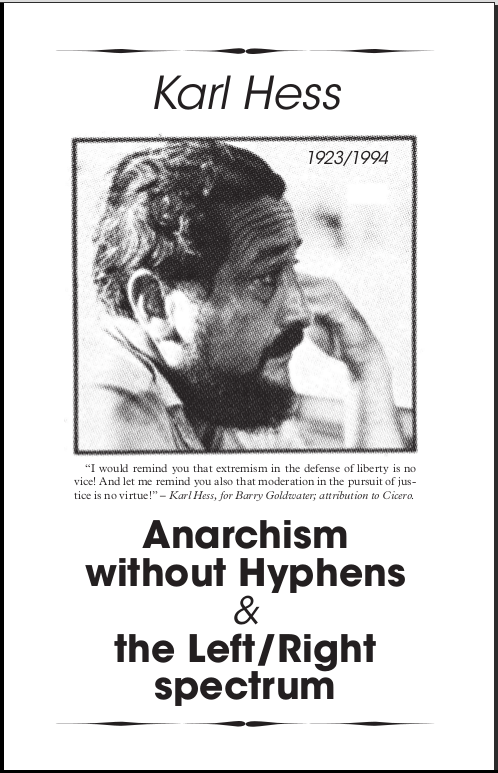
C4SS Feed 44 presents “Anarchism Without Hyphens” from the book Markets Not Capitalism, written by Karl Hess, read by Stephanie Murphy and edited by Nick Ford.

But anarchism is not an ideological movement. It is an ideological statement. It says that all people have the capacity for liberty. It says that all anarchists want liberty. And then it is silent. After the pause of that silence, anarchists then mount the stages of their own communities and history and proclaim their, not anarchism’s ideologies – they say how they, how they as anarchists, will make arrangements, describe events, celebrate life and work.

Anarchism is the hammer-idea, smashing the chains. Liberty is what results and, in liberty, everything else is up to the people and their ideologies. It is not up to THE ideology. Anarchism says, in effect, there is no such upper case, dominating ideology.

It says that people who live in liberty make their own histories and their own deals with and within it.

Feed 44:

Bitcoin tips welcome:

  • 1N1pF6fLKAGg4nH7XuqYQbKYXNxCnHBWLB

Ready to Print PDF

Commentary
Cops Really “Fit the Description”

The killing of an unarmed young black man in Ferguson, Missouri and the brutal response of police forces there to protesters brought down much needed media examination of the practices of police forces in the US. Several interviews reveal stories of constant police harassment, showing the singling out of minorities by law enforcement to be a common thing. It’s a sadly familiar occurrence. Yet, sometimes particular cases shine a magnifying glass on the overall injustice by way of driving home the central absurdity in it.

August 22nd, around 5pm local time, a black man walking down LaCienega Boulevard in Beverly Hills, California, was surrounded by police, cuffed, searched for weapons and detained on a six-figure bail demand. Contrary to pop culture portrayals of police procedure (unless you remember FX’s “The Shield”), he was neither read his rights nor allowed to contact an attorney for several hours. He was held on suspicion in an armed bank robbery in the area, the suspect’s description being “tall, bald black male.”

That such a vague description would cover anyone from Shaquille O’Neal with a fresh shave to the local UPS driver? Unimportant to the cops. He’s tall, black and bald, close enough … until a look at the bank’s security tape proved that they had the wrong guy and they let him go.

What made this stick out like a sore thumb was who this wrong man was: Charles Belk, a producer/director and head of his own marketing company. Seeing him discuss his background and his encounter with these cops, I was reminded of the “If They Gunned Me Down” trend that emerged on Twitter after Mike Brown’s death, and what it said about respectability politics. If someone who seemingly ticks every box on what American society has deemed the Respectable Citizen Survey MULTIPLE times can be treated like this, imagine the outcome if he didn’t have such resources at his disposal — say, if he were a struggling actor or waited tables for a living.

The treatment that minorities get, particularly get in the US, whether they’re Charles Belks or Joe Blows, is part and parcel of a system that sees non-whites as an undifferentiated mass. In cities across the country, minorities are subjected to disproportionate stops and searches for drugs and weapons, typically treated more harshly by police and tend to “fit the (ridiculously vague) description” a lot. Given the history of racial profiling, police brutality and corruption, those carrying the badge of enforcement of an unjust order for the state are themselves suspects. The charges are thousands of counts of murder and millions of counts of assault, armed robbery, kidnapping and terrorism.

Portuguese, Stateless Embassies
Estados Policiais Unidos da América

O Departamento de Polícia de Ferguson liberou seu relatório sobre a morte do adolescente Michael Brown, um documento editado que, segundo o advogado Tony Rothert, da União Americana pelos Direitos Civis (ACLU) viola a lei do Missouri por omitir informações essenciais.

A morte de Brown pelas mãos de um policial provocou demonstrações apaixonadas, debates sobre a brutalidade policial e sobre a própria natrueza da polícia nos Estados Unidos, levando vários observadores a questionarem se os americanos já vivem sob um estado policial.

Mas o que é um “estado policial”? Trata-se de uma expressão que já se tornou comum em debates sobre a violência policial e a militarização, uma forma conveniente para dar forma aos temores sobre a deterioração das liberdades civis. A história da expressão esclarece por que ela é usada no contexto atual e nos dá uma caminho de análise da situação atual dos Estados Unidos e para decidir se já vivemos sob um estado policial.

O historiador e cientista político Mark Neocleous explica que “o termo Polizeistaat, normalmente traduzido como ‘estado policial’, entrou no uso comum da língua inglesa nos anos 1930″, usado cada vez mais naquele momento para descrever governos totalitários como os da Alemanha nazista e da Rússia soviética. Neocleous esclarece que, apesar desse uso comum do século 20, há um “problema histórico” nessa ideia, já que ele sugere uma imagem inadequada dos “estados policiais originais”. Esses estados não eram os regimes brutais e totalitários como o da Alemanha nazista, mas sim os predecessores do moderno estado de bem estar, chamado Wohlfahrtsstaat.

Dadas essas conexões históricas entre o estado de bem estar e o estado policial, podemos revisar nosso entendimento para além da definição do século 20 e ampliar o conceito para incluir não só as extremas e draconianas tiranias do século 20, mas a maioria (ou todos) dos estados “admistrativos” contemporâneos. Assim que começarmos a entender essas conexões e o crescimento e o desenvolvimento do estado durante os séculos 19 e 20, fenômenos como o assassinato de Michael Brown se tornam mais fáceis de compreender. Não importa se o chamamos de estado de bem estar ou estado policial, a realidade é que vivemos em um ambiente completamente dominado pela regimentação — o controle coercitivo e a regulação de quase todos os aspectos de nossas vidas.

Histórica e teóricamente, é impossível desvencilhar os aspectos assistenciais do estado moderno de suas funções policiais. Da mesma forma que o estado progressista administrativo deu origem a uma classe cada vez maior de burocratas profissionais, ele também profissionalizou — e militarizou — as forças policiais. A especialização e a eficiência se tornaram a justificativa do estabelecimento sistemático de forças policiais profissionais, que, ao contrário de formas anteriores de proteção comunitária, são intencionalmente semimilitares — instruídas para ocupar, estudar e controlar as comunidades policiadas, tornando o policiamento uma ciência plenamente desenvolvida com suas próprias técnicas e metodologias.

O anarquismo de mercado é a defesa de uma sociedade mais livre em que o poder seja dividido ao máximo e a provisão de serviços importantes como a defesa não seja monopolizada, mas deixada a cargo das forças pacíficas das trocas voluntárias e da cooperação. Monopólios, isentos da pressão competitiva, se prestam a abusos de poder como o crime desprezível que levou a vida de Michael Brown. O assassinato de Brown não é uma aberração sujeita a consertos com melhor treinamento. É um sintoma previsível da doença subjacente ao estado autoritário presente nos EUA, cujo único tratamento é a eliminação do policiamento profissional como monopólio coercitivo para, dessa forma, acabar com a impunidade de que os oficiais desfrutam atualmente.

Traduzido por Erick Vasconcelos.

Stigmergy - C4SS Blog
Ask an Anarchist Week
1979741_10152305329178690_1466573893_n 1619121_10152305329168690_1083213991_n
1011256_10201645242388949_1268073089_n unnamed

People are drawn to a commotion. In the marketplace of ideas, winners are often simply the loudest and as anarchists we hold ideas inherently more combative and attention grabbing than those regularly seen on a college campus. This is precisely what makes the campus perfect for radical activism, and was the philosophy which guided the Students for a Stateless Society (S4SS) at Texas State when we held our inaugural Ask an Anarchist Week.

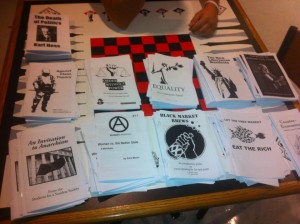
The event intended first to establish S4SS as the primary voice for radical politics and social justice on Texas State campus, and second to communicate to other anarchists on campus that there was an intellectual home for their ideas. Armed with hundreds of pamphlets and a sign which read “Abolish Government Now!”, we set up our tent directly in the middle of campus and invited anyone interested to engage us in dialogue over whatever they wanted. A constant stream of students visited the table, sometimes recognizing the literature and ideas, but more often they were simply interested to hear what the people with the “abolish government” sign had to say. We distributed almost the entirety of our literature, and finished with 40 names on an email list. All metrics point to the event being a great success, but they don’t tell the whole story.

The success of the event was solidified in my mind on the final day of tabling, when I realized almost all of the visitors to the table were repeat visitors coming back to talk about the ideas they had read in the pamphlets we gave them. In our first week of existence, S4SS had not only succeeded in distributing anarchist literature, but managed to create a tiny community where new people explored anarchist ideas and sought deeper understanding of the philosophy.

Ask an Anarchist Week blew through all expectations I had of an anarchist tabling event being held well into the semester, and set a standard for our future activism. I attribute this simply to the commotion we made by being an intellectual group who embraced their radicalism with a touch of flair.

Travis Calhoun is an organizer for S4SS at Texas State University in San Marcos Texas, and a campus coordinator for Students for Liberty.
S4SS at Texas State has a Facebook page and a group.
The group can be contacted through either of the facebook links or email: s4ss.txstate@gmail.com.

Feed 44
“Jobs” as a Red Herring: The Dangers of Make-Work Bias on Feed 44

C4SS Feed 44 presents Nathan Goodman‘s “‘Jobs’ as a Red Herring: The Dangers of Make-Work Bias” read and edited by Nick Ford.

Still, many people measure an economy’s health in terms of employment, a phenomenon economist Bryan Caplan calls “make-work bias, a tendency to underestimate the economic benefits of conserving labor.”

And there are obvious economic benefits to conserving labor. Suppose Kevin Carson is right that 3-D printers will create a homebrew industrial revolution, allowing individuals and small shops to produce modern consumer goods at incredibly low costs and with very little requisite labor. This would likely eliminate plenty of jobs in both manufacturing and sales, as people move to creating goods at low cost in their homes or neighborhoods. But while there would be fewer jobs, people would be much better off. They would have more stuff at lower costs, and likely more freedom to choose what to do with their time.

Feed 44:

Bitcoin tips welcome:

  • 1N1pF6fLKAGg4nH7XuqYQbKYXNxCnHBWLB
Commentary
The Roots of Police Militarization

The police rampage in Ferguson, Missouri has increased public awareness of police militarization and drawn well-deserved attention to writers like Radley Balko who’ve documented the proliferation of military equipment and culture in local police forces over the past decade.

It’s certainly true that the post-9/11 security state and the Global War on Terror have flooded police forces with surplus military equipment, increased the prevalence of military cross-training (including “counter-terrorism” training by Israeli military personnel encouraging American police forces to view their communities in much the same way Israeli security forces view the Palestinians in Gaza).

But the roots of police militarization go back way further than 9/11 —  all the way back to the aftermath of insurrections by the black populations of major American cities in the 1960s and the American political elite’s desire to ensure that nothing like that ever happened again.

US presidents Lyndon Johnson and Richard Nixon began creating an institutional framework to ensure that any such disorder in the future would be dealt with differently. This process culminated in DOD Civil Disturbance Plan 55-2, aka “Garden Plot,” which involved domestic surveillance by the military, contingency plans for military cooperation with local police in suppressing local disorders, plans for mass preventive detention and joint exercises of police and the regular military. Frank Morales wrote in Cover Action Quarterly (“U.S. Military Civil Disturbance Planning: The War at Home,” Spring-Summer 2000):

At first, the Garden Plot exercises focused primarily on racial conflict. But beginning in 1970, the scenarios took a different twist. The joint teams, made up of cops, soldiers and spies, began practicing battle with large groups of protesters. California, under the leadership of Ronald Reagan, was among the most enthusiastic participants in Garden Plot war games. … Garden plot [subsequently] evolved into a series of annual training exercises based on contingency plans to undercut riots and demonstrations, ultimately developed for every major city in the United States. Participants in the exercises included key officials from all law enforcement agencies in the nation, as well as the National Guard, the military, and representatives of the intelligence community.

It was against this background that then-governor Reagan introduced the first SWAT teams in California.

When Reagan became president, he appointed Louis O. Giuffrida, who as head of the California Guard had enthusiastically participated in Garden Plot exercises under Reagan’s govenorship, to head the Federal Emergency Management Agency. In that role Giuffrida worked with Oliver North to draw up plans for martial law in the event of a “national emergency.” They worked together on the Readiness Exercises 1983 and 1984 (Rex-83 and Rex-84), which included mass detention of suspected “terrorist subversives” under the emergency provisions of Garden Plot.

The hypothetical civil disturbance/insurrection scenario these emergency exercises were supposed to be coping with was (ahem) a series of massive antiwar demonstrations in response to a U.S. military invasion of Central America. “North … helped draw up a controversial plan to suspend the Constitution in the event of a national crisis, such as nuclear war, violent and widespread internal dissent or national opposition to a U.S. military invasion abroad (Alfonso Chardy, “Reagan Aides and the ‘Secret’ Government,” Miami Herald, July 5, 1987).

The militarization of local police, and the encouragement of a police culture that viewed local communities (especially people of color in minority neighborhoods) as an occupied enemy populations, got further impetus from the War on Drugs, which was greatly intensified under the Reagan administration. By 1999 — well before the Global War on Terror — the phenomenon had progressed to the point that Diane Cecilia Weber wrote a Cato Institute paper titled “Warrior Cops: The Ominous Growth of Paramilitarism in American Police Departments” (Briefing Paper No. 50).

Since 9/11, the problem has grown beyond Weber’s imagining. After Katrina the (largely black) flooded out portions of New Orleans got a demonstration of the same police hostility and aggression we’re witnessing today in Ferguson. It’s a safe guess that this is now the standard treatment to expect from local police in a community experiencing an “emergency” or (manufactured) “disturbance” of any kind.

Ultimately, what it boils down to is the government views its own people — particularly those of color — as the enemy. The question is how long we will tolerate it.

Portuguese, Stateless Embassies
Ferguson é aqui

Em Ferguson, no estado americano do Missouri, o adolescente desarmado Michael Brown levou seis tiros da polícia local. Uma onda de protestos tomou a cidade, reivindicando justiça e exigindo o fim da militarização e dos abusos policiais.

Mas e a Ferguson brasileira?

No Brasil, a polícia é rotineiramente abusiva, especialmente contra jovens pobres das periferias de grandes cidades. Extorsões policiais de comerciantes e transeuntes são comuns e a tortura é disseminada. Mortes por atuação desproporcional ou execução por parte da polícia não são investigadas nem punidas.

Há alguns meses, Cláudia Silva Ferreira, cujo único “crime” foi o de estar com um copo de café na mão, foi baleada, carregada até a viatura policial para ser levada para o hospital e colocada no porta-malas. Quando o porta-malas abriu, seu corpo ficou preso no para-choque e foi arrastado por cerca de 350 metros pelo asfalto até ser empurrada de volta para dentro do carro.

Não é um caso isolado: no Estado de São Paulo, por exemplo, em 2012, 95% dos feridos em confrontos policiais transportados pela polícia morreram no trajeto até o hospital. Após a proibição desse transporte e a obrigação de contatar socorro especializado, o número de mortes nesses casos diminuiu em 39%.

Todo brasileiro deve estar mais ou menos familiarizado com fatos do tipo. Mas poucos conhecem o instrumento legal que dá aos policiais licença para matar: o auto de resistência.

Segundo Juliana Farias, pesquisadora da ONG de direitos humanos Justiça Global:

“É importante lembrar que esta denominação [auto de resistência] foi criada durante a ditadura [militar], e é um termo que, assim como naquela época, vem sendo utilizado para encobrir ações da policia que deveriam ser registradas como homicídio.”

O auto de resistência funciona como uma licença para matar porque o registro da “resistência seguida de morte” cria uma presunção em favor do policial. Não se trata de uma mera presunção de inocência, mas de um privilégio da polícia de que sua versão é verdadeira. No caso de Cláudia Silva Ferreira, os PMs responsáveis por sua morte já haviam sido envolvidos em 62 autos de resistência e 69 mortes.

A presunção de inocência não significa que possíveis crimes cometidos por um indivíduo não devam ser investigados, mas os autos de resistência são usados exatamente para evitar investigações. O arquivamento de inquéritos policiais envolvendo autos de resistência é recorrente.

O deputado Paulo Teixeira acrescenta:

“Isso é um entulho da ditadura e continua existindo. No Rio de Janeiro foram analisados 12 mil autos de resistência e 60% deles foram execução pura e simples, muitas com tiro na nuca. Queremos que essas pessoas respondam por homicídio.”

Negros e pobres são ainda mais afetados por esse privilégio policial. Em evento pela abolição do auto de resistência, Vinícius Romão, ator que ficou preso por 16 dias supostamente confundido pela vítima de um assalto, relatou:

“O policial apontou a arma para minha cabeça por causa da minha cor de pele. E só não fui mais um ‘auto de resistência’ porque em nenhum momento pensei em correr. Fiquei tranquilo porque sou formado em psicologia e acreditei que em poucos minutos o erro fosse solucionado. Mas fui levado como flagrante e 157 (assalto a mão armada). Eu não fui parado na mesma rua da ocorrência nem estava com arma nenhuma. Fui parado porque tinha o cabelo black power. Só o que chamou a atenção da mídia foi quando anunciaram que um ator de novela havia sido confundido. ‘Ator de novela’ vende mais jornal do que ‘negro’.”

Grupos de direitos humanos defendem a substituição do registro do “auto de resistência” ou “resistência seguida de morte” pelo registro da “lesão corporal decorrente de intervenção policial” ou “homicídio decorrente de intervenção policial”, com investigação dos fatos garantida.

O auto de resistência é emblemático do caráter do estado brasileiro.  A força policial não apenas monopoliza a prevenção e a investigação de crimes, mas também possui um instrumento facilmente conversível em licença para matar. Não à toa os extermínios, execuções extrajudiciais e “desaparecimentos” são epidêmicos nas cidades brasileiras. É difícil imaginar sistemas alternativos que pudessem ser mais facilmente explorados.

Como afirmou Robert Nozick, todo indivíduo tem direito a um sistema confiável e imparcial e tem o direito de resistir a procedimentos percebidos como pouco confiáveis ou injustos. No Brasil, porém, a resistência é fútil e já não causa qualquer comoção.

Em um cenário onde os direitos do indivíduo são reconhecidos e onde a liberdade humana para escolher seu provedor do direito fosse reconhecida, os autos de resistência sancionados pelo estado brasileiro seriam ilegais.

Nos Estados Unidos, a morte de Michael Brown causou revolta e a população de Ferguson exigiu justiça. Se Michael Brown fosse brasileiro, seria estatística de auto de resistência.

Com esse instrumento, o Brasil legalizou a violência policial. Por isso, ao ver os protestos nos EUA, lembre-se: Ferguson é aqui.

Supporter Updates, The State of the Center:
Director’s Report: August 2014

August has been wonderfully productive month for C4SS. We have published more commentaries, features, book reviews, blog posts, and translations, across the board and by a wide margin, than previous months. And we even, finally, published our version of Colin Ward’s edited Fields, Factories and Workshops Tomorrow by Pyotr Kropotkin – complete with an original introduction by Kevin Carson.

All of this output is the result of our love for the ideas and our desire to see them realized, but this level of output can only be attributed to the generosity and support of our donors. We are thankful for every penny and bitcoin decimal. Your enthusiasm and support is our proof that anarchism is not only possible and practical, but humbling and emboldening.

If C4SS, as an organization and an idea, is something you like having around or you would like to see it do more things (like funding more studies, publishing more books, helping with travel expenses for writers to speak at events, updating the youtube graphics, etc), then please donate $5 today.

What will $5 a month get you from C4SS? Well let’s see,

For the month of August, C4SS published:

29 Commentaries (5 more than July)
14 Features (4 more than July),
Weekly Abolitionists (1 more than July),
Life, Love and Liberty (2 more than July),
Weekly Libertarian Leftist Reviews (1 more than July),
Missing Commas,
1 Republished Book: Fields, Factories and Workshops Tomorrow,
3 Book Reviews (2 more than July), and
19 C4SS Media uploads (7 more than July) to the C4SS youtube channel.

And, thanks to the dedication of our Media Coordinators, C4SS translated and published:

Italian translations,
Spanish translations,
26 Portuguese translations!

I would also like to take a moment to point of that Brazil really likes C4SS. Supporters in Brazil visit our site more than supporters any other country, besides the US, and, in only two months since we reported the C4SS Portuguese facebook reaching 1,000 “likes”, it has already surpassed 2,000!

Fields, Factories and Workshops Tomorrow

It took more than a couple of months, but we were finally able to complete the C4SS Edition of Kropotkin’s Fields, Factories and Workshops Tomorrow. This is a special edition that includes an introduction by Kevin Carson, a running extended commentary by Colin Ward and rounded out with Murray Bookchin’s essay Towards a Liberatory Technology.

Pyotr Kropotkin and Colin Ward have long been important figures to the C4SS approach and articulation of a stateless society. Showcasing the ability of individuals to work together in such a way as to provide abundance and autonomy, without the connected nightmares of centralized governance or centralized production, is at the heart of both their work and our very own Kevin Carson. As Carson describes,

I read Kropotkin’s original version, the Ward commentaries, and Bookchin’s essay all around roughly the same time, along with other writings by Ward on neighborhood workshops as a means of communal self-provisioning by the unemployed and underemployed, and similar ideas by Karl Hess in his and Morris’s book Neighborhood Government. Their ideas all clicked together for me and produced the conceptual framework that I expressed first in Chapter 14 of my book Organization Theory, and then grew into a book of its own with the publication of The Homebrew Industrial Revolution.

Autonomy is regarded as possible within all anarchist conversations, but, for some, this possibility is at the expense of technologically produced abundance. Liberals, on the other hand, tend to make the sacrificial concession that reduced autonomy is the price of industrial capacity and capital abundance. Freed Market Anti-capitalists or Laissez-faire Socialists see no necessary conflict between autonomy or abundance; both, in the absence of a state, can be mutually determining, supporting or enhancing. It is this spirit of universal autonomy and abundance that we are proud to offer you Kropotkin’s Fields, Factories and Workshops Tomorrow.

Please Welcome Our Newest Intern

We are four months into our test of a paid internship program. Cory Massimino has been doing amazing things with C4SS and we look forward to helping his career along. Since we began talking about an intern program for C4SS we have received notes from interested supporters curious about how they might apply. We are still figuring out what such a program requires, how best to support and prepare our interns for the curious world of writing about anarchism for a general audience. To help us answer these questions we have included Daniel Pryor to our roster of interns. Pryor’s internship officially begins September 1, but he has already begun writing for C4SS. His “The Culture of Anarchism” gives a taste of what we can expect form his work,

The anarchist culture of scepticism towards power structures is key to human flourishing. On an individual level, this manifests in critically examining our everyday habits. Samuel Beckett reminds us that “the pernicious devotion of habit paralyses our attention, drugs those handmaidens of perception whose co-operation is not absolutely essential”. Our unwavering collective devotion to entrenched power structures paralyses society, and blinds us to the evils that plague it. Embrace change and the possibility it provides.

It is our hope that we will have the bugs worked out and the rubrics in place to make our internship program supportive, challenging and fruitful. We are currently limited by funding, but we feel confident that we can sustain, at current donation levels, two interns a year. We hope to begin deciding on our next intern December 1, 2014. But you don’t have to wait, you can always start writing for C4SS now. If you are interested in participating in this program, please contact us:

  • General inquiries: admin@c4ss.org
  • Media inquiries: media@c4ss.org

Book Reviews

August was a great month for books; we were able to publish three original reviews:

1. Joel Schlosberg reviewed Stan Lee and the Rise and Fall of the American Comic Book just in time for Guardians of the Galaxy. Schlosberg has a slow-burn writing style like a fuse attached to a powder keg. It takes its time, bringing all the background details into focus, before concluding with lines like,

The shift of power back towards artists paralleled the shift towards viable post-mass-market economic alternatives. When in the 1980s the main point of sale of comics moved from newsstands to specialty stores, the decreasing capital-intensiveness of distribution opened the field for creator-controlled independents, many formed by Marvel walkouts who took their experience with them.

and,

The reverberations from Lee’s quickly-forgotten Comix Book, a fleeting effort treating underground comix just like any other fad to be co-opted, shows the disruptive power of alternatives. The contributing underground artists demanded and got rights to their work as a condition of their participation, leading artists at Marvel to agitate for creator rights as well.

2. Cory Massimino, C4SS’s first intern, offered a review of Markets Not Capitalism. Massimino’s review uses selections with themes that challenge libertarian preconceptions about what is or is not possible with a freed market critique of political economy.

For example:

  • Massimino begins with Pierre-Joseph Proudhon’s “General Idea of the Revolution in the Nineteenth Century” and his discussion of the liberatory effects of universal competition.
  • Next is Gary Chartier’s “Advocates of Freed Markets Should Oppose Capitalism”. Chartier disentangles the three dominate referents of the term “Capitalism” and offers a case for why advocates of freed markets are, or ought to be, thorough anti-capitalists.
  • Roderick Long’s “A Plea for Public Property” considers the validity and necessity of public property for the defense of individual autonomy and community development.
  • Kevin Carson’s classic “Economic Calculation in the Corporate Commonwealth” applies the classic Austrian calculation argument, with withering effect, against the “corporate commonwealth”.
  • Murray Rothbard’s challenging “Confiscation and the Homestead Principle” asks the question, “what is to be done with all this stolen property known as state complex industry and compromised education?” Rothbard answers, in the absence of clear and identifiable beneficiaries, “it belongs to the workers and the students – the first or discernible homesteaders of the property.”
  • Jeremy Weiland’s radical “Let the Free Market Eat the Rich: Economic Entropy as Revolutionary Redistribution” thesis is that mass accumulation of wealth can be described as a byproduct of centralized monopoly authority which subsidizes its maintenance, liability and protection against the centrifugal tendencies of freed markets or the spontaneous institutional arrangements possible in a stateless society.
  • Charles Johnson’s “Scratching By” calls into question the state-based progressive plans designed to ameliorate poverty while maintaining the very barriers to subsistence and raised access to capital that created the poverty in the first place.
  • Massimino concludes with Roderick Long’s “Platonic Productivity”. Long challenges some of the accepted notions within certain circles of Austrian economic theory regarding “marginal revenue product” and the power of social change given a passive social context.

Massimino’s parthian shot is a quote by Long,

Once we see why the productivity theory of wages, though correct as far as it goes, goes less far than its proponents often suppose, it does not seem implausible to suppose that this sexism plays some role in explaining the wage gap, and such sexism needs to be combated… But that’s no reason to gripe about “market failure.” Such failure is merely our failure. Instead, we need to fight the power – peacefully, but not quietly.

3. Kevin Carson, while doing research for his latest book The Desktop Regulatory State, received a review copy of New Forms of Worker Organization from PM Press. New Forms… begins by detailing the historical and radical differences between domesticated “Wagner-style business unions” and the horizontal direct action union “descendants of the socialist and anarchist labor formations of the late nineteenth and early twentieth centuries.” Carson comments,

Since then, employers have decided the New Deal labor accord no longer serves their interests. They have instead shifted to a labor model based on union-busting, offshoring and precarious labor (part-timers and temporary workers). Outside of a handful of dying industries, the New Deal model is increasingly irrelevant to today’s workers.

But the pre-Wagner model is becoming quite relevant. It includes such things as minority unionism (in which a minority of workers acts as a union without certification, as the Jimmy Johns workers did), which former IWW Secretary-Treasurer Alexis Buss wrote extensively about in her “Minority Report” columns. It includes the forms of on-the-job direct action described in the pamphlet “How to Fire Your Boss [PDF]” (all of which are prohibited during the duration of union contracts under the Wagner model): slowdowns, sick-ins, random unannounced one-day wildcat strikes, working to rule, “good work” strikes and (perhaps most relevant) “open mouth sabotage,” which is simply public whistleblowing about internal working conditions and the kinds of shoddy goods and services that result from management policy.

Krugman on Libertarianism?

Paul Krugman, rightly, regards the various strands of libertarianism as a challenge worthy of comment. Unfortunately his ready response is dismissal; libertarianism is fanciful or utopian. Joel Schlosberg and David D’Amato both responded to Krugman for C4SS.

Schlosberg points out Krugman’s unfamiliarity not only of libertarian literature on various subjects like pollution, but of allied corporate reformers as well:

Krugman waves a single word at libertarian economics like a vampire hunter’s crucifix: “phosphorous”. (Not “phlogiston“?) The chemical’s contamination of Lake Erie is treated as a prime example of a problem which self-evidently can be fixed only by the regulatory apparatus of a benevolent government. … No mention is made of the decades of substantial libertarian literature dealing with pollution, much of it specifically about water pollution. … Krugman’s entire rejoinder to Milton Friedman’s proposal that tort law could effectively replace the regulatory state as a check on corporate power (only one of enough such examples to fill a book) — and his only actual attempt at addressing free-market proposals at all — is: “Really?” Really. Never mind that exactly that approach has been championed by no less of a foe of corporate power than Ralph Nader, much to the chagrin of more statist leftists like Doug Henwood, who chides Nader that tort “[l]itigation is an individualized solution to broad economic and social conflicts whose proper arena is politics, not the courtroom.”

D’Amato focuses on Krugman’s unbalanced suspicion of business yet resilient faith in bureaucrats. Suspicion, perhaps even uncharitable suspicion, is appropriate towards all with access to power:

Paul Krugman, unconsciously I’m sure, makes an interesting move whenever he articulates his view of what it is that drives the acts of government agents as opposed to market actors. When he’s talking about the latter group, he assumes, perhaps quite rightly, that they are motivated by unalloyed self-interest, by greed and the bottom line, regardless of who gets trampled on, whether it means polluting cherished, shared natural resources or hawking unsafe products to consumers. Well, all right, so when we’re considering the motivations of DC bureaucrats, the same assumptions ought to hold, right? Not exactly. You see, in the Krugman worldview, there is just no reason to fear that the public choice scholars actually made a meaningful contribution to our understanding of political machinations, that we should look at politics “without romance” and consider the motivations of the powerful in government just as we do the powerful in business. Never mind the work of people like Butler Shaffer, who has shown that big business has long agitated for regulation as a way “to obtain benefits it has been unable to secure by its own efforts.” For a firm or any other market actor, lack of flexibility and responsiveness to changing conditions means entropy.

Ferguson: The Tactics of Occupation

As a participant in the Occupy movement, I was able to experience, up close and personal, the default positions of the American Police State: deference and zero-discretion. This is what Kevin Carson refers to as “the Prussianization of American Culture,”

One of the peculiarities of the increasingly militarized culture of Prussia/Germany under Bismarck’s reich was that civilians became second-class citizens. It was common practice for citizens to step off the sidewalk and into the gutter to make way for anyone in uniform. We’re seeing the same tendency in the United States, as the respective rights of officials and ordinary citizens becomes increasingly a matter of status or caste rather than universal law.

In Tulsa, OK, November 2, 2011, the Tulsa PD pepper-sprayed and arrested 10 Occupiers after 1. being made aware that this measured and strategic act of disobedience was civil, 2. making the Occupiers, attendant Media and on-lookers aware that the Officers had two options available to them: citation or arrest, and 3. deploying over 50 Officers to make it abundantly clear what the rules of the game were. Where did they get all of these Officers to accomplish such a task? The training academy. They looked upon that event as a training opportunity in how to deal with a disaffected population.

This was my experience, but it doesn’t even register when compared to Ferguson. Needless to say, we at C4SS have a lot to say on the situation specifically and in general:

Grant Mincy offer a good summation of the situation,

No more can we look to vertical power structures. We need a polycentric approach. How liberating it will be to embrace the idea that we can manage ourselves! Is this not the very essence of the “hands up, don’t shoot!” movement? Is it not the idea that social power is the answer to police violence, racism within the justice system and class warfare? I think it is, we are looking at systems of power, noting how they are all related and seeking our individual and collective liberation. As we walk into this period of revolution, once we really start talking to one another, we will scale these problems up to all institutions — damn right a change is going to come!

Left Wing Individualism

David D’Amato wrote a wonderful feature detailing the historical tradition he calls Left Wing Individualism and its importance to us now,

The individualist anarchists were sticklers about consistency; if labor was made to come under the law of competition, of supply and demand, then so too should capital. As Schuster points out, the “scientific anarchism” of people like Benjamin Tucker thus “did not appeal to the Capitalist because it demanded not ‘rugged individualism’ but universal individualism” (emphasis added). Because the individualists regarded them as the proximate results of coercive privilege, rent, interest, and profit — the “trinity of usury” — were treated as akin to taxes, allowing the owners of capital the stolen difference between prices under a regime of privilege and prices as they would be under true, open competition.

Agri-terrorism

Kevin Carson’s “Agri-Terrorists Accuse Seed Bank of Agri-Terrorism” has done very well at calling attention to yet another method of the state for the defense of privileged Big Agibusiness,

Since their beginnings, the USDA and state departments of agriculture have heavily subsidized, and acted as the enforcement arm of, the corporate agribusiness crime syndicate, terrorizing people who presume to feed themselves without paying tribute to their corporate crime lords. If, as the late Maj. Gen. Smedley Butler said, the US Marines were the overseas strongarm operation for the big US banks, then the USDA and Pennsylvania DA are strongarm operations for Monsanto, Cargill and ADM.

Carson followed up his op-ed with a feature, “Seed Libraries: Treat Law as Damage, Route Around It,” where he discusses what can be done to route around this damage now that it has been identified,

Lobbying against draconian copyright laws like the IP chapter of the Trans-Pacific Partnership and ACTA has done a lot of good, but encryption, proxies and improvements in file-sharing technology have done far more. Before ACTA had even come to a vote, several Firefox extensions became available that can simply bypass domain names seized by the federal government and go straight to their numeric IP address. That’s how people access Wikileaks’ various national sites and mirrors around the world.

In other words, to paraphrase a famous quote, treat the law as damage and route around it.

We Haven’t Forgotten

We still have our David Graeber Symposium on Debt: the first 5,000 years. There is only one article to be finished; it should be ready soon. Thank you for your patience.

Please Support Today!

All of this work is only sustainable through your support. If you think the various political and economic debates around the world are enhanced by the addition of left libertarian market anarchist, freed market anti-capitalist or laissez faire socialist solutions, challenges, provocations or participation, please donate $5, today. Keep C4SS going and growing.

ALL the best!

Stigmergy - C4SS Blog, The Weekly Abolitionist
The Weekly Abolitionist: Pitfalls and Possibilities

The protests, police violence, and repression in Ferguson have sparked nationwide conversations about police militarization and misconduct. There’s some incredibly promising potential here, as more and more people become aware of the brutality of the modern criminal justice system. However, there are also some potential pitfalls that deserve cautious examination.

First, the good. Popular commentators have been offering insightful analysis of police militarization. Perhaps the most notable is John Oliver, whose bit on Ferguson and police militarization was informative, incisive, and darkly hilarious. Thanks to this sort of commentary, plenty of people who hadn’t even heard of police militarization until recently are now aware of why it’s a problem.

Anarchist commentators have offered particularly insightful analysis in the wake of Ferguson. Here at the Center for a Stateless Society Grant Mincy has linked the protests in Ferguson to a broader trend of revolutionary movements, Cory Massimino has called for the abolition of the police, David D’Amato has analyzed what makes the US a police state, and Ryan Calhoun has called on Ferguson to “embrace community chaos over police order.” Over at AntiWar.com, Dan Sanchez has also called for the abolition of police, correctly identifying them as occupying forces that undermine peace and security rather than upholding them.

But it’s important to remember that this isn’t primarily about a national conversation. It’s about people’s lives. The people of Ferguson are facing arrests, police involved shootings, raids, tear gas, and a warlike environment that prevents the peaceful social cooperation that supports human life. To mitigate this tragedy, it’s important for people within and outside Ferguson to cooperate to support those being harmed by state violence. One way to do this is supporting the legal defense fund for those arrested in the course of the protests. Another is supporting the Amnesty International team that is on the ground observing and documenting abuse. Directly supporting those acting on the ground is one example of the vibrant voluntary cooperation human beings engage in from the bottom up, even when the top down violence of the state tries to thwart these actions.

While we should support these sorts of direct and bottom up actions, we must be skeptical of top down reform proposals, no matter how well-intentioned. The danger of public awareness and conversation surrounding serious issues is that politicians will seize on it to pass reforms, and these top-down reforms may make the problem worse rather than better. To understand why reform can be dangerous, just examine the history of criminal justice reform. In a review [PDF] of prison abolitionist Dean Spade’s book Normal Life, Jennifer Levi and Giovanni Shay note various examples of criminal justice reforms that unintentionally resulted in expanded state power and violence:

It is not only prison abolitionists who share Spade’s concern about the unintended consequences of prison reform. The sociologist Heather Schoenfeld writes that prison-conditions litigation in Florida contributed to a prison building boom there. Other commentators–including James Jacobs, Malcolm Feeley, and Van Swearingen–argue that prisoners’ rights litigation contributed to the “bureaucratization” of prisons, consolidating administrators’ power even as it asserted prisoners’ rights.

Examples of double-edged US criminal punishment reforms extend well beyond prison conditions. As described by Kate Stith and Steve Y. Koh (in “The Politics of Sentencing Reform: The Legislative History of the Federal Sentencing Guidelines,” Wake Forest Law Review, 1993), some of the initial proponents of federal sentencing guidelines were liberal academics and judges, who wanted to rationalize sentencing to make it fairer and more consistent. Unfortunately, as innumerable commentators have recounted, the implementation of the guidelines produced draconian sentences, ultimately contributing to the growth of US prisons.

That second point about liberal intentions motivating the establishment of federal sentencing guidelines is particularly important, given how these one-size fits all sentencing policies have driven the dramatic growth of the American prison state. A recent report from the National Research Council on the growth of incarceration in the US identifies the replacement of indeterminate sentencing with top down sentencing guidelines as a key policy that contributed to increased incarceration. The authors note multiple criticisms of indeterminate sentencing from the left that helped contribute to this change, writing:

Criticisms of indeterminate sentencing grew. Judge Marvin Frankel’s (1973) Criminal Sentences—Law without Order referred to American sentencing as “lawless” because of the absence of standards for sentencing decisions and of opportunities for appeals. Researchers argued that the system did not and could not keep its rehabilitative promises (Martinson, 1974). Unwarranted disparities were said to be common and risks of racial bias and arbitrariness to be high (e.g., American Friends Service Committee, 1971). Critics accused the system of lacking procedural fairness, transparency, and predictability (Davis, 1969; Dershowitz, 1976). Others asserted that parole release procedures were unfair and decisions inconsistent (Morris, 1974; von Hirsch and Hanrahan, 1979).

So leftist critique of an unfair criminal justice system inadvertently helped make it more harsh and punitive. These and other examples of reforms gone wrong are vitally important to understand, because the current national attention focused on mass incarceration, police brutality, and police militarization produces opportunities for reforms. And these reforms have a high risk of making the problems of punitive state violence even worse.

One particularly troubling trend in the wake of Ferguson is the trend of liberals calling for increased gun control in order to reduce the supposed need for police militarization. Commentators including UCLA law professor Adam Winkler have claimed that the prevalence of guns in America helps motivate police militarization and gun control may be a solution. But as Daniel Bier points out, police militarization has risen over a period of time when gun ownership has declined, crime has declined, and violent attacks on police have declined. In addition to being at odds with the facts, Winkler’s proposal risks promoting laws that increase the punitive power of America’s criminal justice system. As I’ve written previously, gun control laws have fueled the disproportionate incarceration of people of color in this country.

It’s good that more people are paying attention and talking about police militarization. But we must remember that police militarization is impacting real individuals and we should start by directly supporting the individuals and communities impacted, not attempting top-down political solutions. We must always be careful of the pitfalls and unintended consequences that come with politically enacted reforms. Direct action should be preferred to political action, and our analysis and prescriptions should be both radical and cautious. Radical in critiquing the root causes and institutions that contribute to these problems, and cautious in always being wary of unintended consequences and never allowing good intentions to make us support destructive top-down plans.

Spanish, Stateless Embassies
Por qué el Papa está menos equivocado que Keith Farrell

Las declaraciones del Papa Francisco sobre la pobreza, la desigualdad y el capitalismo — las más recientes hechas durante su misa al aire libre en Seúl — no fueron muy bien recibidas por conservadores y libertarios con tendencias derechistas. Los comentarios del Papa incluyen críticas a la creciente desigualdad económica y un llamado a “escuchar la voz de los pobres”.

Entre los que discrepan con las declaraciones del Papa está Keith Farrell, un coordinador de campus de los Estudiantes por la Libertad en la Universidad de Connecticut (“Por qué el Papa está equivocado respecto a la desigualdad“, City AM, 21 de agosto). Acusa al Papa de “convertir a los ricos en chivos expiatorios de la pobreza” y atribuye a Marx el haber concebido la idea “de que el éxito de algunos perjudica a otros económicamente y que los ricos sólo se han hecho ricos a expensas de los pobres”. Farrell cita a un surcoreano: “Si alguien ha hecho una fortuna por sí mismo, en buena lid, y tiene un montón de dinero, no creo que eso sea algo que deba ser condenado”.

Es una hipótesis interesante, pero, ¿exactamente cuánto de la creciente concentración de la riqueza de la élite económica en realidad se hizo “en buena lid?” A lo largo de su artículo de opinión, Farrell iguala implícitamente el sistema en que vivimos ahora con la “libertad económica” y “la libre empresa”. Pero eso es un ejemplo de lo que yo llamo “libertarismo vulgar“: defender el capitalismo corporativo existente como si se tratara de un mercado libre, y el uso de retórica de “libre empresa” para defender la riqueza y el poder económico que los capitalistas corporativos han en realidad acumulado a través de un sistema de poder abrumadoramente estatista.

Es difícil creer en la idea de que Marx haya sido el primero en darse cuenta de que en una sociedad de clases, gobernada por un Estado de clase, los ricos se hacen ricos a costa de los pobres. Probablemente se le haya ocurrido algún campesino chino o sumerio mientras se rompía el lomo con una azada tratando de producir lo suficiente como para sobrevivir después de pagar las rentas del sacerdocio del templo. Y un montón de pensadores radicales de libre mercado —Thomas Hodgskin, Benjamin Tucker, Franz Oppenheimer— llegaron a la misma conclusión en tiempos más recientes. El sistema capitalista en el que vivimos hoy es el heredero lineal de los sistemas de clase impuestos por el Estado de miles de años atrás.

“Los mercados libres”, lejos de definir estructuralmente al capitalismo, se les permite operar en sus márgenes en la medida en que son compatibles con los intereses de los propietarios que controlan el Estado. Incluso durante el supuesto “laissez-faire” del siglo XIX, la “libre empresa” fue una superestructura erigida sobre cimientos creados por siglos de robo masivo —el cercamiento de la tierra y la desposesión del campesinado, primero en el occidente incipientemente industrial y luego en el mundo colonial, restricciones masivas a la libre circulación y asociación de los trabajadores en la Gran Bretaña industrial, el trabajo esclavo y la confiscación de la riqueza minera global. Hoy en día muchos de los frutos de ese robo, como los títulos absentistas sobre terrenos baldíos y la propiedad corporativa de los recursos naturales del Tercer Mundo, y el monopolio de la oferta de crédito y el medio de intercambio por parte de los dueños de la riqueza robada, todavía gozan de legitimidad legal.

Hoy en día el capitalismo corporativo depende aún más del estatismo —”propiedad intelectual”, cárteles regulatorios y otras barreras a la entrada, y enormes sistemas de subsidio directo como los son el Complejo Militar-Industrial y el sistema interestatal de autopistas y de aviación civil.

Es cierto, como dice Farrell, que los niveles de vida han aumentado en términos absolutos a pesar del aumento de la desigualdad — cierto hasta donde cabe. Pero el hecho es que las ventajas de los avances tecnológicos se rigen por el mismo mecanismo de discriminación de precios que rige a todos los monopolios: Las grandes corporaciones utilizan patentes monopólicas para acaparar el progreso tecnológico, permitiendo que gotee sobre las clases trabajadoras apenas lo suficiente de los beneficios de la mayor productividad como para que les valga la pena seguir comprando, apropiándose del resto en forma de rentas monopólicas.

La declaración de Farrell según la cual “el capitalismo ha traído la libertad y la abundancia” a Corea del Sur amerita un análisis similar. El capitalismo de Corea del Sur fue construido sobre los cimientos de la ocupación militar estadounidense y un régimen militar instalado por la autoridad de ocupación, que posteriormente liquidó la sociedad cuasi-anarquista de comunidades rurales autogobernadas y fábricas autogestionadas que había surgido después de la retirada japonesa en 1945. Este régimen echó a anarquistas e izquierdistas de todo tipo a las fosas comunes, y durante sus décadas en el poder no era exactamente amable a la “libertad económica” de —por ejemplo— los trabajadores coreanos que querían sindicalizarse.

Curiosamente, Farrell comparte una suposición errónea con el Papa Francisco: que la reducción de la desigualdad requiere que el gobierno “redistribuya la riqueza”. Ambos están equivocados. Lo que tenemos ahora equivale a una redistribución hacia arriba de la riqueza, con “impuestos” sobre las clases productoras en forma de las rentas monopólicas impuestas por el Estado que pagamos a los terratenientes y capitalistas. No necesitamos la intervención del Estado para redistribuir la riqueza hacia abajo. Necesitamos una revolución que impida que el estado siga redistribuyendo la riqueza hacia arriba.

Es hora de que los partidarios del libre mercado dejen de actuar como boxeadores contratados por el actual sistema de poder y empiecen a usar las ideas de libre mercado para defender la verdadera justicia económica.

Artículo original publicado por Kevin Carson el 23 de agosto de 2014.

Traducido del inglés por Carlos Clemente.

Feature Articles
The Role of Commons in a Free Market

The term “market anarchism” may give some people the mistaken impression that market anarchists envision a society organized primarily around the cash nexus. In part this is because one definition of the term “market” itself equates to the market as an institution: The sphere of exchange. It may also reflect the fact that many anarcho-capitalists, who until recently got most of the attention, tend to emphasize business firms operating in the cash nexus as the primary form of social organization.

We market anarchists get our name from the fact that, unlike libertarian communists, syndicalists and other explicitly non-market anarchists, we see voluntary market exchange as one perfectly valid way of organizing economic life. But that doesn’t mean that the cash nexus will be the predominant form of organization in a stateless society. Indeed, as David Graeber has shown in Debt, the cash nexus becomes the dominant way of organizing economic life only in societies based on military conquest and slavery.

As anarchists we envision as society in which all functions are organized, in Kropotkin’s words, by “free agreements concluded between the various groups, territorial and professional, freely constituted for the sake of production and consumption, as also for the satisfaction of the infinite variety of needs and aspirations of a civilized being.” This includes markets. It also includes social and gift economies, peer production and horizontal networks of all kinds.

The commons may be the most efficient way of organizing some economic functions. This is probably true of non-renewable resources like minerals, and the kinds of renewable common pool resources like forest, pasture and fisheries that Elinor Ostrom devoted her career to studying. It is certainly true of information, which is infinitely replicable at zero marginal cost.

Markets are best suited to the sphere of production and distribution involving goods which are replicable, but only at a cost in effort. But even within this sphere of goods produced by human labor which are in elastic supply, goods and services which are most suited to small-scale production might very well be organized outside the cash nexus, through various primary social organizations: Lodges and friendly societies, extended family or multi-family compounds and cohousing projects, neighborhood associations, intentional communities, and other social units for pooling income, costs and risks.

Money pricing is most likely to be the preferable option in cases involving production inputs (for example micro-processors) which require expensive production facilities and large market areas, and other goods that are distributed over long distances or involve comparative anonymity (like forms of production that require more expensive machinery and a distribution network covering an entire town).

Even in the case of production for the cash nexus, in a genuinely free society without artificial property rights, artificial scarcities, monopolies and other privileges enforced by the state, we can expect cooperative and self-managed forms of production to be much more common than at present, and to take place in an atmosphere where most workers have the option to retire on the commons for some time and refuse work offers not to their liking (as did English peasants before Enclosure, who could take agricultural wage labor or leave it and subsist on the commons).

Also, it’s important to remember that money exchange will take place in a context where banks no longer have a state-granted monopoly on the issue of credit and the medium of exchange.

Market anarchists, like all anarchists, start from the assumption of ordinary people encountering each other as equals, and deciding without coercion how best to work together to meet their mutual needs. This may be by exchanging the products of their labor, by producing cooperatively or by sharing. The main thing, as anarchist David Graeber has argued, is that whatever forms of organization emerge will do so through an open-ended process of interaction among equals, in which no party can call on armed force to compel others to obey their will.

Commentary
Police State Prompts Pointless Paperwork

In response to the chaos in Ferguson, MO, US president Barack Obama has ordered a review of federal programs and funding that allow state and local law enforcement to acquire military equipment. Whoopty doo.

It’s no surprise to those who understand the kind of perverse incentives inherent in government that it took until now for “something to be done.” And it shouldn’t be a surprise that that “something” is merely an attempt to appease the growing distrust and skepticism of police power rather than actually do anything about it.

This war against civilians by the police has been going on for a long time, though. A Radley Balko, author of Rise of the Warrior Cop,  writes, “There are two trends which began in the late 1960s and early 1970s that help explain how we got here: the rise of the SWAT team and the escalation of the War on Drugs.”

Militarized police forces are nothing new. They go back nearly 50 years, and only just now is the federal government saying something. To be clear, that’s all they are doing. Why would we expect anything to come of this review?

“The election of Ronald Reagan brought new funding, equipment, and a more active drug-policing role for the paramilitary SWAT units popping up across the country,” Balko continues. “Over the next decade, with prodding from the White House, Congress paved the way to widespread military style policing by carving out exceptions to the Posse Comitatus Act.”

We can thank small government conservative Ronald Reagan for much of the militarization of local police in the past 30 years. I suppose he wasn’t that conservative on arming thugs and terrorizing harmless drug users.

The increasingly military-like local police forces have faced nearly no political resistance. It’s been a steady increase of military tactics and weapons. From 1980 to 2000, the number of SWAT teams increased by 1,400 percent. More than 80 percent of small town law enforcement agencies have SWAT teams; almost 90 percent in larger areas have them. Just in 2011, “50 states, 17,000+ federal, state and local agencies have accepted more than $2.6 billion in donated military equipment so far this year.”

Kurt Eichenwald writes, “Research by Professor Peter Kraska at Eastern Kentucky University shows that 80 percent of the paramilitary deployments by police departments were for ‘proactive’ applications — in other words, instances of police-initiated violence rather than in response to an unusual threat. The majority of these involved ‘no-knock’ and ‘quick-knock’ raids on private homes, searching for contraband like drugs, guns or cash.”

And what does all this ramped-up policing do? It creates more terror, more violence, and more death. Shocking, I know. In fact, you’re eight times more likely to be killed by a police officer than by a terrorist. Yet I don’t see a “war on cops.”

The neoconservatives have one thing right; terrorism is a threat to America. They just don’t know who the real terrorists are. The real terrorists are in our neighborhoods — walking around in dark outfits wearing badges and toting military equipment.

And what do we get after nearly 50 years of police abuse and terror that has likely killed thousands of innocent people and ruined the lives of thousands more prompt? A review.

A review that’s probably just going to lower the amount of increase in spending on militarization and do nothing to address the real problem or save lives. White House staff and relevant U.S. agencies — including the departments of Defense and Homeland Security, will reportedly lead this review.

Yes, the very same Department of Defense that provides local law enforcement with surplus military equipment will be reviewing the militarization of police. Yes, the very same Homeland Security that has transformed the United States into a police state with the PATRIOT act and the NDAA, is going to be reviewing the militarization of police.

Superman comic books are more believable than this. But that is government for you.

Rather than providing local police forces with surplus equipment, the weapons should be used to destroy the other weapons. And then we should blow up those weapons. We should do this until the police (and the military) have no more weapons.

Perhaps my solution isn’t that likely to occur. But it’s more likely to solve the problem of police militarization than a government-conducted review.

Commentary
Barack Obama, Murderer

In early August, US president Barack Obama authorized airstrikes targeted at artillery used by the Islamic State extremist group against Kurdish forces defending Irbil, Iraq’s Kurdish regional capital. The Pentagon explained this decision by claiming the artillery was “near US personnel.”

Fast forward nearly two weeks and kidnapped American journalist, James Foley, is gruesomely beheaded by an ISIS militant on video that has made its way through the Internet for everyone to see.

This barbaric and tragic execution isn’t left unexplained, though. The killer explicitly explains why he took the actions he did. And no, it isn’t because he hates our freedom. It’s not because American women run around wearing bikinis. It isn’t because the US has access to computers, phones, TVs and other miracles of modern technology. It isn’t because the majority of Americans are Christian. The reason for Foley’s death can be explained in one word: Blowback.

In the video, the militant said that other American journalists will also die if the U.S. doesn’t cease its airstrikes in Iraq. In fact, at the end of the video, a militant shows a second man, identified as Steven Sotloff, another American journalist, warning that he could be the next captive killed.

Here it is, in plain view and even re-watchable — the consequences of interventionism. An innocent human being murdered in cold blood directly in response to American airstrikes that the president authorized. And more human beings are in known mortal danger if the president doesn’t alter his interventionist foreign policy.

Never before has the phrase “thanks, Obama” been more accurate.

So what does our Nobel Peace Prize winning, progressive commander-in-chief do? Immediately following the tragic execution of Foley, Obama told the press that the United States would be “relentless” against Islamic State militants … and ordered 14 more airstrikes!

Yes, you read that right. A terrorist murdered an American because of airstrikes, threatened to do it again if the airstrikes don’t stop, and the United States military said, “whatever, let’s just bomb them some more,” with an A-OK from the president.

You can’t make American foreign policy up. It’s almost like a dream sequence where the people in positions of authority become increasingly stupid and evil. But that’s actually just real life.

Of course this blowback comes as no surprise to the anti-war movement — and I mean the real anti-war movement, not the partisan hacks and fools who were against invading Iraq under Bush but are now cheering on “humanitarian intervention” (aka bombing with enough media support) under Obama.

The anti-war crowd, unlike the people actually in charge of foreign policy, understands and has predicted the effects of intervention. Overseas meddling never works out. And for central planners in Washington to think they can manipulate and coordinate other country’s affairs from millions of miles away, one has to question either their intelligence or their character.

The airstrikes ought to be ended as quickly as possible and whatever US personnel are near the Kurdish regional capital need to be immediately removed from the region. There is no good reason for them to be there in the first place. It not only puts lives in danger, it serves as an excuse for further bombing and even more meddling.

Even more ideally, the US military would be abolished all together. Then the platform from which psychopathic Nobel Prize winners gain power and murder people with no accountability will be gone.

How many more James Foleys before the United States realizes it can’t continue its interventionism? How many more dead human beings until Obama’s bloodlust is satisfied?

Anarchy and Democracy
Fighting Fascism
Markets Not Capitalism
The Anatomy of Escape
Organization Theory