Stigmergy - C4SS Blog, Supporter Updates, The State of the Center:
Director’s Report: October 2014

October marks another productive month for C4SS. Maybe not as productive in quantity, but certainly in quality. C4SS is a media center and think tank: we focus on crafting editorials for mass media reproduction (over 2000 reprints, and counting, documented) and academic level studies.

Each month we invest more and more into book reviews and studies. We are honored by the opportunity to publish Dr. Mark Hyde’s study critiquing Chile’s “privatized” pension system and we have four more studies on the way covering such topics as: Property and Power, Famous Anarchists, Libertarian Environmentalism, and Bitcoin Crypto-equity.

October is the month we began publishing the reviews of David Graeber’s Debt: The First 5000 Years that we have collected. If you haven’t yet, check out William GillisDebt: The Possibilities Ignored.

We also found time for another volley against Paul Krugman‘s mythology regarding economic history, state power and presidential beneficence. And we have successfully funded our Tor node just in time to begin raising funds to send C4SS Fellows to Libertopia and ISFLC.

Building viable and disruptive institutional alternatives, with their attendant and supportive ecosystems, require, among other things, enthusiasm, participation and resources. Each factor contains important information required to make course, budget and growth decisions. C4SS is an organization that operates predominately on your support. Our growth and influence, since 2006, has been slow and steady, but we would love to do more. We want to do more, but we need your help.

If C4SS, as an organization and an idea, is something you like having around or would like to see do more things (like funding more studies, publishing more books, helping with travel expenses for writers to speak at events, updating the youtube graphics, etc), then, please, donate $5 today.

What will $5 a month get you from C4SS? Well let’s see,

For the month of October, C4SS published:

20 Commentaries,
Features,
Weekly Abolitionists,
Weekly Libertarian Leftist Reviews,
2 Blog posts,
Reviews, and
20 C4SS Media uploads to the C4SS youtube channel.

And, thanks to the dedication of our Media Coordinators and translators, C4SS translated and published:

1 Dutch Translation,
Italian translations,
Spanish translations (1 more than September),
Portuguese translations

We Need Your Help to Meet You in Person

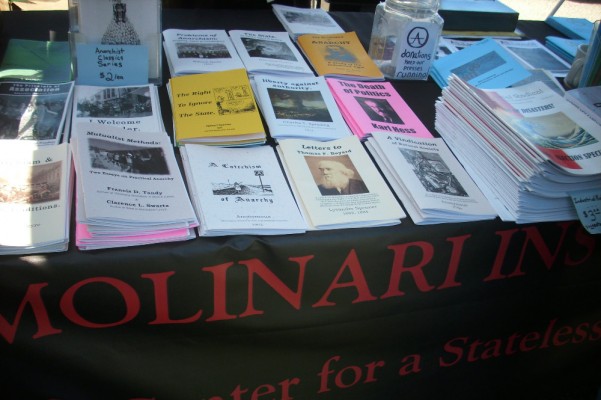
The libertarian world is full of meet and greet opportunities from book fairs to conferences. At the moment there are two events that we are currently raising money for in order to secure a C4SS presence: Libertopia and ISFLC 2015.
2422029_1414041905.5166

Libertopia is a prominent annual conference/festival exploring radical libertarian theory and practice.  This year’s meeting will be in San Diego, Nov. 13-16.

$400 will get us a booth at the upcoming Libertopia meeting to promote our literature and to engage conference attendees in conversation about left-libertarian ideas.

Please help the fund the Revolution!

The International Students For Liberty Conference is the year’s premier gathering of libertarian minds from all over the world – and C4SS is a mere $500 away from getting a table at this event. This is a wonderful oppertunity to further imbue radical left anarchist ideas into the mainstream libertarian project.

Every penny counts and the Center appreciates any and all help you are willing to give. Let’s get C4SS to ISFLC 2015!

Please help out both fundraisers today with a $5 donation!

C4SS and Tor

We are happy to inform everyone, especially the Tor community, that we have secured the donations needed to maintain our Tor node for another quarter. We want to thank everyone that contributed towards making this happen.

Debt: The Possibilities Ignored

We have decided against waiting and will begin publishing what articles we have reviewing David Graeber’s Debt:The First 5000 Years. Our first article is by William Gillis: Debt: The Possibilities Ignored.

It’s no secret that economists and libertarians have developed a bad habit of assuming things about history and other societies on first principle without actually checking archaeological or anthropological findings. On occasion the divide can be quite stark. David Graeber’s Debt: The First 5000 Years gets a lot of momentum by attacking a widely circulated economic fable purporting to explain the origin of currency wherein coinage precedes credit. It shouldn’t be a surprise that the “I need a blanket and all I have to barter with are five chickens but everyone in my village likes cowry shells” dilemma at the start of elementary economics textbooks has no clear historical basis; there’s little evidence small tribes or villages needed to invent physical currency to facilitate market exchange internally because reputation and credit are far more natural and flexible.

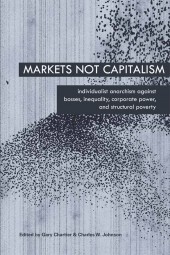
To say this is sympathetic territory for me would be an understatement. In my longest essay in Markets Not Capitalism I emphasized the role reputation and goodwill play in relationships as more fundamental and foundational than property titles and critiqued the recurring assumption that property titles are inherent to all societies. Even though my conclusion was a full-throated defense of property titles, albeit repositioned as a looser, less absolute, second order derivation from goodwill and reputation, you might be forgiven for expecting a strictly positive review of Graeber’s breakout book. Certainly many of my colleagues did. And there is a lot to be found of value in Debt for libertarians and anarchists of all stripes. It is a refreshingly audacious work hearkening towards the kind of grand theory building radicals used to do and I’ve found myself handing it out to young activists hungry for something of more audacity and scope than Gelderloos or Bonanno. It’s been far too long since a work of anarchist theory topped bestseller lists. And anything that so flusters and discombobulates liberals, marxists, and vulgar libertarians alike is surely of value.

However Debt is not without its flaws, some of them quite vexing. …

In early November we will publish Kevin Carson’s contribution to our understanding of Graeber’s Debt.

New Wine in Old Bottles

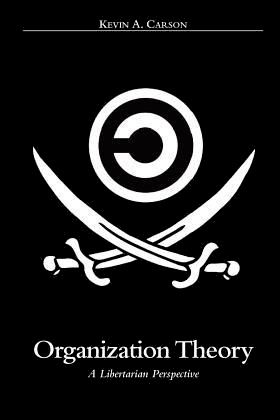
Daniel Pryor, C4SS’s second intern, has published a review, New Wine in Old Bottles, of Kevin Carson’s first study written for C4SS: Industrial Policy: New Wine In Old Bottles.

… There is a world of possibility in disruptive technology, with ideas for decentralisation waiting in the minds of an increasingly anti-state, tech-savvy generation.

This modularization is not confined to the digital realm. In fact, physical manufacturing is the main focus of Carson’s work. Citing the unsustainability of the Sloanist industrial model – which fetishizes “enormous market areas and costly, product-specific machinery” – he demonstrates the superiority of localised production. Emilia-Romanga (a prosperous region of Italy) is used as a case-study for community-based supply chains, small-scale general purpose machinery and a style of manufacturing that is far more responsive to local demand. The advantages of local production, especially in an anarchist society, are made clear. Less intermediary steps in the chain of production give regions more resilience to economic downturns, whilst workers’ bargaining power is improved as wage labour becomes an optional supplement to the income of self-sufficient households. …

The Anarchist as Lover

The most popular feature published in September is Ryan Calhoun‘s The Anarchist as Lover.

… Love is not solidarity. Solidarity is nothing more than loyalty to the cause of a group. It isn’t love. I am told often why I should have solidarity with this group or that despite any personal connection with those involved, despite my judgment on the rightness of their actions. It is not love because love isn’t loyal. Love is infatuated, it is dedicated, it will not merely speak a word of agreement and obedience with The Cause. Lovers do not require obedience. What would you not do for those you love? Do you have to be put in line and told what to love? No, we do not need that kind of dedication to our fellows. We need angered, impassioned, unstoppable individuals guided by their connection with those around them, with those who have shown us they are worth us fighting for and along side. …

Wildness as Praxis

Grant Mincy is C4SS’s resident expert on ecology and environmental activism. He has a fantastic new study on how property rights, political power, the anthropocene and ecology relate to each other within an left market anarchist context. His feature article, Wildness as Praxis gives us a hint of what to expect in this upcoming study.

… The question then becomes, what will follow? The answer is something both beautiful and complex, while liberating and dynamic. Perhaps it is time to revisit our classical naturalists — of which there are plenty. However, one thing that John Muir (or your favorite historical eco-advocate) and his ilk had was a connection to the natural world and a desire for conservation. They did not much care to talk about what governments ought to do, but rather what they ought not do. Environmental achievement was obtained by pronouncing the splendid beauty of natural ecosystems, the challenges facing nature, and the innate need to protect wild spaces — even for our own well-being. Muir and other environmental advocates also practiced their ideals as they labored for the great outdoors.

In order to meet the demands of a changing Earth we will have to adapt. We will be required to constantly change, just like our mountains and rivers. Anarchist and Deep-Ecologist Gary Snyder, in his essay, The Etiquette of Freedom, describes, in great detail, the need to reclaim the words nature, wilderness and wildness — and it is in wildness that we will discover anarchism. …

Classical Liberalism and Conservatism

Speaking of studies, C4SS is honored to publish a detailed critique of Chile’s “private” pension system written by Dr. Mark Hyde. In Dr. Hyde’s Classical Liberalism and Conservatism: How is Chile’s Pension System Best Conceptualised?, yet another privatization scheme is exposed as a conservative defense of a corporate status quo,

… In view of this evidence of policy design and outcomes then, the assertion that the architects of Chile’s multi-pillar retirement system created a “private” pension arrangement that was compatible with the core principles of classical liberalism is looking highly questionable. In reality, there are many stark points of contrast between its design and these tenets, particularly the classical liberal emphasis on the primacy of liberty. But if Chile’s “private” pension arrangement during our period of analysis cannot be regarded as a particular instantiation of classical liberal principles, how is it best described?

According to one authoritative historian of economic affairs, the deployment of state power to augment the wealth, power, and authority of corporate elites is not characteristic of laissez faire, neither did it emerge during the “neoliberal” era of the late 20 th century. Rather, the growing prominence of conservative economic policy and regulation on behalf of corporate elites can be traced back to the very early 20th century when large business enterprises were confronted by smaller and more efficient firms in intensely competitive markets. Characteristically, corporate elites responded to this challenge not by rationalising productive effort in order become more competitive, but by seeking preferential treatment from the state in the form of market privileges and subsidies. These early statutory measures laid the foundations for the institutionalisation of a very distinctive but prevalent form of capitalism, as acknowledged by scholars at different points across the ideological spectrum. …

The conservative commitment to the market is also very distinctive, endorsing individualism and competition to the extent that both can be a source of the wealth, power and authority of corporate elites; and thus subordinating the market to the goal of sustaining a hierarchical social order. This means ultimately that conservatism adopts a “pragmatic attitude towards the economy, realising that compromise and concession may have to be made to maintain social order” …

Poor Paul Krugman

September was our month against vulgar libertarians with Reason Magazine; October is our month against the vulgar liberalism of Paul Krugman.

Paul Krugman: “Leave Obama Alone”
Paul Krugman Stops Worrying About Income Inequality
To Paul Krugman: Thou Art the Man

First Trevor Hultner, in his Paul Krugman: “Leave Obama Alone”, goes after his Rolling Stone love letter to Obama’s presidency:

In his recent Rolling Stone cover story (“In Defense of Obama,” October 8), Nobel Prize-winning economist, peak liberal and New York Times commentator Paul Krugman lays out what he believes is a qualified defense of Barack Obama’s presidency: A sycophantic love letter from a man who surely must know better, but either has chosen to ignore six years of war, economic pain and social tension, or simply doesn’t care. …

Then Joel Schlosberg and Thomas Knapp go after his powers of threat assessment and solution recommendation:

… Contra Krugman’s beloved historical myth that “the robber baron era ended when we as a nation decided that some business tactics were out of line,” any potential robber-baron power Amazon wields depends on the very same uniform, artificially large-scale federal transportation and postal shipping infrastructure that locked in the profits of the Gilded Age business cartels. Dismantling those subsidies, not propping up publishing’s Hachettes, would be the real way to keep Amazon honest.

And Kevin Carson, with his To Paul Krugman: Thou Art the Man, had the honor of the coup de grâce, taking aim at his mythology regarding a defeated and state antagonistic era of the Robber Baron,

… To repeat, the Robber Baron Era never ended. And far from being the Robber Barons’ enemy, the US government has been their chief tool for survival to this day. And perhaps the single most important function of the US government in upholding corporate power is enforcing “intellectual property,” so central to the business models of the proprietary content industries in the Democratic coalition. The most profitable industries in the global economy — entertainment, software, biotech, pharma, electronics — all depend on “intellectual property.” “Intellectual property” is central to the dominant industrial model by which Western corporations outsource all actual production to independent shops working on contract, but use patents or trademarks to retain monopoly rights over disposal of the product. …

The Robber Barons are with us just as much as ever, their power depends entirely on the capitalist state, and “progressives” like Paul Krugman — wittingly or unwittingly — are their shills.

Please Support Today!

All of this work is only sustainable through your support. If you think the various political and economic debates around the world are enhanced by the addition of left libertarian market anarchist, freed market anti-capitalist or laissez faire socialist solutions, challenges, provocations or participation, please, donate $5 today. Keep C4SS going and growing.

ALL the best!
Feature Articles, The Sheldon Richman Collection
The State is No Friend of the Worker

The election season is upon us, and we’re hearing the usual political promises about raising wages. Democrats pledge to raise the minimum wage and assure equal pay for equal work for men and women. Republicans usually oppose those things, but their explanations are typically lame. (“The burden on small business would be increased too much.”) Some Republicans endorse raising the minimum wage because they think opposition will cost them elections. There’s a principled stand.

In addressing this issue, we who believe in freeing the market from privilege as well as from regulation and taxes should be careful not to imply that we have free markets today. When we declare our opposition to minimum-wage or equal-pay-for-equal-work legislation, we must at the same time emphasize that the reigning corporate state compromises the market process in fundamental ways, usually to the detriment of workers. Therefore, not only should no new interference with the market be approved, but all existing interference should be repealed forthwith. If you omit that second part, you’ll sound like an apologist for the corporatist status quo. Why would you want to do that?

The fact is that no politician, bureaucrat, economist, or pundit can say what anyone’s labor is worth. That can only be fairly determined through the unadulterated competitive market process. Perhaps ironically (considering libertarians’ individualism), it’s a determination we make collectively and continuously as we enter the market and demonstrate our preferences for various kinds of services through our buying and abstaining.

If the market is free of competition-inhibiting government privileges and restrictions, we may assume that wages will roughly approximate worth according to the market participants’ subjective valuations. This process isn’t perfect; for one thing, preferences change and wage and price adjustments take time. Moreover, racial, ethnic, and sexual prejudice could result, for a time, in wage discrimination. (See Roderick Long’s excellent discussion of the wage gap, “Platonic Productivity.”)

The surest way to eliminate wage discrimination is to keep government from impeding the competitive process with such devices as occupational licensing, permits, minimum product standards, so-called intellectual property, zoning, and other land-use restrictions. All government barriers to self-employment — and these can take implicit forms, such as patents and raising the cost of living through inflation, or burdening entrepreneurs with protectionist regulation — make workers vulnerable to exploitation. Being able to tell a boss, “Take this job and shove it,” because alternatives, including self-employment, are available, is an effective way to establish the true market value of one’s labor in the marketplace. With the collapsing price of what Kevin Carson calls the “technologies of abundance” (think of information technology and digital machine tools), sophisticated small-scale enterprise — and the independence it represents — is more feasible than ever.

One thinker who understood how the worth of labor is determined in the market was the radical libertarian English writer Thomas Hodgskin (1787–1869). Hodgskin is often misunderstood. Wikipedia calls him a “socialist writer on political economy, critic of capitalism and defender of free trade and early trade unions.” To the modern ear that will sound odd: a socialist critic of capitalism who defended free trade and unions.

Hodgskin is usually labeled a Ricardian socialist, but Hodgskin criticized David Ricardo while lauding Adam Smith. Moreover, socialism didn’t always mean what it means today. In earlier times, socialist was an umbrella term identifying those who thought workers were denied their full just reward under the prevailing political economy. The remedy for this injustice varied with particular socialists. Some advocated state control of the means of production; others wanted collective control without the state; and still others — Benjamin R. Tucker most prominently — favored private ownership and free competition under laissez-faire.

What these self-styled socialists had in common was their conviction that capitalism, which was understood as a political economy of privilege for employers, cheated workers of their proper reward. By this definition, even an adherent of subjectivist and marginalist Austrian economics could have qualified as a socialist. (See my article “Austrian Exploitation Theory.”)

By the way, Hodgskin used the word capitalist disparagingly before Karl Marx ever wrote about capitalism. As George H. Smith notes, Marx called the laissez-faireist Hodgskin “one of the most important modern English economists.” It was not the first time the author of Capital complimented radical pro-market liberals. He credited class theory to French liberal historians. (Marx then proceeded to mangle their libertarian theory.)

As a libertarian champion of labor against state-privileged capital, Hodgskin had much to say about how just wages should be determined. In his 1825 book, Labor Defended Against the Claims of Capital, he first noted that many goods are the product of joint efforts, which would seem to make it difficult to reward individual workers properly. He wrote,

Though the defective nature of the claims of capital may now be satisfactorily proved, the question as to the wages of labour is by no means decided. Political economists, indeed, who have insisted very strongly on the necessity of giving security to property, and have ably demonstrated how much that security promotes general happiness, will not hesitate to agree with me when I say that whatever labour produces ought to belong to it. They have always embraced the maxim of permitting those to “reap who sow,” and they have maintained that the labour of a man’s body and the work of his hands are to be considered as exclusively his own. I take it for granted, therefore, that they will henceforth maintain that the whole produce of labour ought to belong to the labourer. But though this, as a general proposition, is quite evident, and quite true, there is a difficulty, in its practical application, which no individual can surmount. There is no principle or rule, as far as I know, for dividing the produce of joint labour among the different individuals who concur in production, but the judgment of the individuals themselves; that judgment depending on the value men may set on different species of labour can never be known, nor can any rule be given for its application by any single person. As well might a man say what others shall hate or what they shall like.

Whatever division of labour exists, and the further it is carried the more evident does this truth become, scarcely any individual completes of himself any species of produce. Almost any product of art and skill is the result of joint and combined labour. So dependent is man on man, and so much does this dependence increase as society advances, that hardly any labour of any single individual, however much it may contribute to the whole produce of society, is of the least value but as forming a part of the great social task. In the manufacture of a piece of cloth, the spinner, the weaver, the bleacher and the dyer are all different persons. All of them except the first is dependent for his supply of materials on him, and of what use would his thread be unless the others took it from him, and each performed that part of the task which is necessary to complete the cloth? Wherever the spinner purchases the cotton or wool, the price which he can obtain for his thread, over and above what he paid for the raw material, is the reward of his labour. But it is quite plain that the sum the weaver will be disposed to give for the thread will depend on his view of its utility. Wherever the division of labour is introduced, therefore, the judgment of other men intervenes before the labourer can realise his earnings, and there is no longer any thing which we can call the natural reward of individual labour. Each labourer produces only some part of a whole, and each part having no value or utility of itself, there is nothing on which the labourer can seize, and say: “This is my product, this will I keep to myself.” Between the commencement of any joint operation, such as that of making cloth, and the division of its product among the different persons whose combined exertions have produced it, the judgment of men must intervene several times, and the question is, how much of this joint product should go to each of the individuals whose united labourers produce it?

Observe Hodgskin’s Austrian-style subjectivism: How much someone is willing to pay for a product “will depend on his view of its utility.” (The way this fits with his labor theory of value is an interesting matter that we cannot take up today.)

How then does he propose that the wage problem be solved? Here’s how:

I know no way of deciding this but by leaving it to be settled by the unfettered judgments of the labourers themselves. If all kinds of labour were perfectly free, if no unfounded prejudice invested some parts, and perhaps the least useful, of the social task with great honour, while other parts are very improperly branded with disgrace, there would be no difficulty on this point, and the wages of individual labour would be justly settled by what Dr Smith calls the “higgling of the market.”

Thus free competition among industrious individuals, who ultimately are trying to serve consumers, is the only way to reveal the worth of labor services and products. This is both just and efficient. There is no way for a legislator or bureaucrat to divine the correct minimum wage or to decide if “equal work” is being paid equally. Only the free market process can discover this information.

“Unfortunately,” Hodgskin added, “labour is not, in general, free.” What keeps it from being free? The state, which serves special interests.

Hodgskin emphasized that labor includes “mental exertion”:

Far be it, therefore, from the manual labourer, while he claims the reward due to his own productive powers, to deny its appropriate reward to any other species of labour, whether it be of the head or the hands. The labour and skill of the contriver, or of the man who arranges and adapts a whole, are as necessary as the labour and skill of him who executes only a part, and they must be paid accordingly.

Perhaps Marx should have read his Hodgskin more closely, and those who would legislate the level of wages today should read him for the first time. (I’ve also written about Hodgskin here and here.) So-called progressives who look to the state to set wages do a disservice to those who fare worst in the corporate state, because while progressives work on behalf of measures that must price marginal workers out of the market, truly radical reforms are overlooked.

Rather than empowering our rulers further, let’s empower individuals by freeing the market.

Feed 44
Anarchists United on Feed 44

C4SS Feed 44 presents Uriel Alexis’ “Anarchists United” from the Students for a Stateless Society‘s Volume 1, Issue 3 of THE NEW LEVELLER read by Dylan Delikta and edited by Nick Ford.

With the growth of the producer’s network and the mutual trust relations promoted by the mutual bank, a truly revolutionary potential is unleashed. Increasingly more complex production processes can be organized through cooperatives, P2P projects, and other kinds of collaboration. This makes the network more and more independent from the state-dominated formal economy we live under today. As this network gets stronger and more resilient, more goods may be created inside of it, such as schools, aid to people in hardship, medical treatment and collective transportation.

Once a certain workplace had completely come under worker’s direct self-management, its products can be exchanged inside the network of independent producers on a mutual basis. This would greatly add to the stability and to the welfare of all inside the network, since a large quantity of people are now connected. We can see now that mutualist and anarcho-syndicalists can work together against the state and capitalism, achieving not only the goals they share, but also their more specific aims.

In the economic sense, the anarcho-communist societies would be outside the network of independent producers, since there would be no exchanges even in crypto-currencies. But certainly they would be connected by ties of trust and mutual aid. For example, the network could supply products and services for free through those members that so wished.

Feed 44:

Bitcoin tips welcome:

  • 1N1pF6fLKAGg4nH7XuqYQbKYXNxCnHBWLB
Feed 44
Hobby Lobby — A Question of Agency on Feed 44

C4SS Feed 44 presents Kevin Carson‘s “Hobby Lobby — A Question of Agency” read James Tuttle and edited by Nick Ford.

To repeat, there were a lot of people whose agency was at stake here besides the Green family’s — in particular, the 70% majority of Hobby Lobby’s workers who are women. who may have been having a hard time finding work and accepted employment at Hobby Lobby because they really needed a job, who were glad to get health coverage — and who may someday desperately need “morning after” contraception. I felt sick about these people in a way after Monday’s ruling that I never would have about the Green family.

And questions of free association aside, an economic system in which a small wealthy family can wind up in the one-sided position of exercising their own agency at the expense of 13,000 others is a system that’s broken, sick and rotten.

The system we live in, in legal theory, is based on freedom of contract, and the idea that tenants and landlords, software users and sellers, and workers and employers are equal parties to a contract. But we all know that’s nonsense. We feel it in our bones.

Feed 44:

Bitcoin tips welcome:

  • 1N1pF6fLKAGg4nH7XuqYQbKYXNxCnHBWLB
Feed 44
A Matter of Life and Death on Feed 44

C4SS Feed 44 presents Jason Lee Byas‘ “A Matter of Life and Death” from the Students for a Stateless Society‘s Volume 1, Issue 3 of THE NEW LEVELLER read by Trevor Hultner and edited by Nick Ford.

Even more fundamentally, both aggression and domination beat back the thing that makes us distinct from the dead. In so far as we are living, breathing human beings, we act according to our own will. Our choices are our own, and what we create are products of our own minds.

By falling under the control of someone else, that breath of life leaves us. We become instruments no more alive than the tools we ourselves work with.

Of course, because only life can create life, and only to the extent that people are free can any growth occur, we are never fully under the control of others. Nor could we be. Our Schrödinger society is a patchwork of periods where we live, die, and live again.

We spend our truly waking days in gardens among graveyards. Gardens that have either grown for the future harvests of our masters, or (more often) in everyday resistance to their demands.

Feed 44:

Bitcoin tips welcome:

  • 1N1pF6fLKAGg4nH7XuqYQbKYXNxCnHBWLB
Commentary
To Paul Krugman: Thou Art the Man

Paul Krugman, in denouncing the excessive market power of Amazon (“Amazon’s Monopsony is Not OK,” New York Times, October 19), proclaims that the Robber Baron Era ended when “we as a nation” put an end to it.

There’s a powerful story in the book of 2 Samuel about the prophet Nathan confronting King David after he arranged the death of Uriah the Hittite and took his wife Bathsheba for himself. Nathan told David of a rich man, with enormous herds, who had a guest to feed. The man, to spare himself killing one of his own many livestock, instead stole and slaughtered the pet lamb of the poor man next door (which, the Bible says, he fed from his own plate and loved like a daughter). Upon hearing this David became outraged and swore “As the LORD liveth, the man who hath done this thing shall surely die.” And Nathan replied: “Thou art the man.”

Not only did the rule of Robber Barons in fact never end, but in denouncing them Krugman reveals himself as one of their foremost apologists.

Far from bringing Robber Baron rule to an end, the Progressive Era stabilized it in a web of government protections and subsidies. For example, the FTC’s treatment of below-cost dumping as a “unfair trade” practice, by outlawing price wars, made stable oligopoly markets possible for the first time.

Let me state up front that, while Amazon doesn’t actually qualify as a monopsonist (that is, a market actor with monopoly buying power that can unilaterally set terms for sellers) it is at least an oligopsonist (in this case the largest of a relatively small number of major buyers/distributors). As an anarchist who viscerally hates large corporations, and hates perhaps even more all kinds of proprietary, walled garden platforms, I’d much prefer to see an open-source or cooperatively owned platform taking over Amazon’s current role.

But that being said, if Krugman wants to fight Amazon, he’s picked a mighty peculiar hill to die on. Specifically, he objects to Amazon’s use of its market power as a buyer to force down the prices of traditional publishers like Hachette. But those prices are themselves enormously bloated to begin with, because of the monopoly premiums attendant on copyright. Amazon’s use of its purchasing power to shave off that monopoly premium is analogous to, say, Medicare D using its market power as a large-scale purchaser to negotiate down the price of prescription drugs under patent. (Of course we know Medicare doesn’t actually do this, or hardly does it, because of the drug companies’ lobbying power.)

Support for draconian “intellectual property” laws, like the WIPO Copyright Treaty, the Uruguay Round TRIPS accord, the Digital Millennium Copyright Act, and the “intellectual property” components of all the so-called “Free Trade Agreements” proposed over the past decade or so, are strongly supported by both Republicans and Democrats. But the Democrats have an especially close relationship with proprietary content industries — the RIAA, MPAA and Microsoft are at the core of the Democratic coalition.

To repeat, the Robber Baron Era never ended. And far from being the Robber Barons’ enemy, the US government has been their chief tool for survival to this day. And perhaps the single most important function of the US government in upholding corporate power is enforcing “intellectual property,” so central to the business models of the proprietary content industries in the Democratic coalition. The most profitable industries in the global economy — entertainment, software, biotech, pharma, electronics — all depend on “intellectual property.” “Intellectual property” is central to the dominant industrial model by which Western corporations outsource all actual production to independent shops working on contract, but use patents or trademarks to retain monopoly rights over disposal of the product.

And perhaps more importantly “intellectual property” is at the heart of the business model of the new “green capitalism” or “progressive capitalism” personified by “patriotic billionaires” like Bill Gates, Warren Buffett and their ilk. Their business model depends on using “intellectual property” to enclose new, green technologies as a source of monopoly rents, or — as in Buffett’s case — using heavily subsidized “smart grid” infrastructure to make his wind farms profitable.

The Robber Barons are with us just as much as ever, their power depends entirely on the capitalist state, and “progressives” like Paul Krugman — wittingly or unwittingly — are their shills.

Feed 44
A Plea for Public Property on Feed 44

C4SS Feed 44 presents “A Plea for Public Property” from the book Markets Not Capitalism, written by Roderick T. Long, read by Stephanie Murphy and edited by Nick Ford.

For many libertarians, the most important argument for private property is what Garret Hardin has labeled “the tragedy of the commons” (though the basic idea goes back to Aristotle). Most resources are rivalrous—that is to say, the use of the resource by one person diminishes the amount, or the value, of that resource for others. If a rivalrous resource is also public property, meaning that no member of the public may be excluded from its use, there will be no incentive to conserve or improve the resource (why bother to sow what others may freely reap?); on the contrary, the resource will be overused and swiftly exhausted, since the inability to exclude other users makes it risky to defer consumption (why bother to save what others may freely spend?). Hence private property is needed in order to prevent depletion of resources.

It might be argued that this the-more-the-merrier effect occurs only with goods that are wholly or largely nonphysical, but could never apply to more concrete resources like land. As Carol Rose and David Schmidtz have shown, [4] however, although any physical resource is finite and so inevitably has some tragedy-of-the-commons aspects, many resources have “comedy-of-the-commons” aspects as well, and in some cases the latter may outweigh the former, thus making public property more efficient than private property.

For instance (to adapt one of Carol Rose’s examples), suppose that a public fair is a comedy-of-the-commons good; the more people who participate, the better (within certain limits, at any rate). Imagine two such fairs, one held on private property and the other on public. The private owner has an incentive to exclude all participants who do not pay him a certain fee; thus the fair is deprived of all the participants who cannot afford the fee. (I am assuming that the purpose of the fair is primarily social rather than commercial, so that impecunious participants would bring as much value to the fair as wealthy ones.) The fair held on public property will thus be more successful than the one held on private property.

Yet, it may be objected, so long as a comedy-of-the-commons good still has some rivalrous, tragedy-of-the-commons aspects, it will be depleted, and thus the comedy-of-the-commons benefits will be lost anyway. But this assumes that privatization is the only way to prevent overuse. In fact, however, most societies throughout history have had common areas whose users were successfully restrained by social mores, peer pressure, and the like.

Feed 44:

Bitcoin tips welcome:

  • 1N1pF6fLKAGg4nH7XuqYQbKYXNxCnHBWLB
Feed 44
Elections and the Technocratic Ideology on Feed 44

C4SS Feed 44 presents Erick Vasconcelos‘ “Elections and the Technocratic Ideology” read by Christopher King and edited by Nick Ford.

It’s not about being governed or not, it’s about who is going to do the governing. Who would we want to sit on the Iron Throne if not a “specialist?” Someone who wouldn’t be driven by politico-ideological passions, but by the “industrial values” Veblen cherished. Someone to oil up the gears of this great machinery that is society.

That is all hogwash, of course, because when we talk about politics, we talk about ideology — about prioritizing, about choosing one collective goal as preferable to another. However, there are no macro social ends, at least not apart from a sum of individual goals or as a mere metaphor. Which is also the reason why it isn’t possible to put public management under the control of experts, because the very definition of what constitutes “public management” is an ideological question subject to political negotiation and resistance.

Feed 44:

Bitcoin tips welcome:

  • 1N1pF6fLKAGg4nH7XuqYQbKYXNxCnHBWLB
Stigmergy - C4SS Blog, The Weekly Abolitionist
The Weekly Abolitionist: Prisons Without Punishment?

For libertarian prison abolitionists, Randy Barnett’s The Structure of Liberty: Justice and the Rule of Law is an indispensable book. Not only does Barnett offer a persuasive series of arguments for a stateless legal order, he further argues against the legitimacy of punishment altogether.

However, even as crucial as Barnett’s work is for libertarian prison abolitionists, it is not a prison abolitionist book. Despite opposing punishment, Barnett does still defend hypothetical prisons on two grounds: incapacitation and restitution. In this post, I’ll try to explain why even Barnett’s very limited defense of prisons still fails.

What is a prison?

Before doing so, it’s important to remember what exactly we mean by “prison” when we say that we are “prison abolitionists.” By prisons, I refer to large compounds where people are involuntarily confined (typically with many other criminals) in response to their having committed a crime, without the right to voluntarily transfer to another location if that other location would confine them just as well, and where the administration has almost total control over those confined. A given prison might not clearly and precisely fit all of these conditions exactly, but this at least gives us a general idea of what we’re talking about. As will be important in what follows, it also shows that one can hypothetically be forcibly confined without the location of their confinement being a prison.

Incapacitation

Barnett holds[1] that one non-punitive purpose for prison and prison sentences can be incapacitation. In other words, he believes that a prison sentence can be legitimate as a means of extended self-defense. If it is legitimate to use force in direct self-defense, then it is clearly legitimate to prevent someone from (for example) leaving a room if you know they would immediately aggress against someone if they did. If this is this the case, and if we accept that certain kinds of actions can communicate intentions toward future actions, then forcibly confining someone based on crimes they’ve committed in the past can also be potentially legitimate.

So far, Barnett’s argument is sound as far as it goes. However, the next step that Barnett takes is where he goes too far. Namely, he contends that this leads to the re-emergence of the crime-tort distinction[2], and consequently, prisons.

While it may be legitimate to forcibly confine people who pose ongoing threats, this is only going to be a very small subset of criminals. Even for violent crimes like murder, the fact that someone has aggressed against another person is not good enough of a reason to believe they will do so again. The average crime is a product of things like passion or circumstance, not of the psychotic nature of someone who genuinely poses an ongoing threat. Furthermore, most people who are ongoing threats are typically ongoing threats to particular people, not the general public, and can often be handled with a restraining order. Those who are ongoing threats to the general public are also not necessarily especially serious ongoing threats, and could potentially be handled in some way other than simply confining them.

When dealing with those remaining serious ongoing threats to the general public, forced confinement can be legitimate. However, it is not legitimate to confine them to a particular location when another location might do just as well. Nor is it legitimate to place them there automatically as a result of the particular crime they committed – Barnett is right to suggest that actions can communicate future actions, but this must be as part of a larger, highly contextual interpretation of those actions.

It is also not legitimate to place them there in such a way that puts them under the near total control of the administration. In fairness to Barnett, he seems to agree there, saying that prisoners “would be entitled to take legal action to ensure that their rights are respected”. It seems difficult, though, to see how that entitlement could be actualized without also allowing even a limited right of exit to another location (provided that the alternative location would work just as well.)

Finally, why this issue gives us the re-emergence of the crime-tort distinction is left unexplained. Surely, tort law is able to handle self-defense just as well as criminal law, and it’s unclear what necessary thing that bringing back the crime-tort distinction actually does in this instance.

Working off Restitution Debts

Barnett’s second, much more far-reaching and problematic justification for prisons involves cases where an aggressor is not immediately able to pay restitution, or might be expected to try avoiding payment[3]. In such cases, Barnett proposes that criminals could be sentenced to prison, where those debts could be worked off. Importantly, Barnett believes[4] that “they would be released only when full restitution had been made or when it was adjudged that reparations could more quickly be made by unconfined employment.”

The main problem with this approach, and especially with Barnett’s use of it, is that it clashes with inalienability. Without a sturdier justification for bringing back the crime-tort justification than the one he gives, restitution debts become legally indistinct from any other debt. Thus, unless Barnett is willing to sanction debt slavery for a debt generated by hitting someone’s car, or even failure to repay a loan, he cannot justify debt slavery for a debt generated by actions we currently think of as crimes. Wages can be garnished, and all sorts of other, more normal methods of debt collection can be used, but you cannot imprison someone and force them to work.

Notice, by the way, that even if you accept Barnett’s limited re-emergence of the crime-tort distinction, this does not justify imprisoning someone simply to collect their restitution debt. This is because Barnett’s justification is only argued for on the basis of incapacitation, and at no time does he provide a reason for also allowing restitution debt as an independent justification for incarceration. If the only reason a particular criminal in Barnett’s hypothetical is still in prison is because they have not yet paid off their restitution debt, then they are there for a reason that Barnett has not argued for.

Inalienable & Nonforfeitable Rights

Barnett might also resist the claim that his defense of inalienability is inconsistent with his defense of restitution-based imprisonment is by drawing a distinction between alienating and forfeiting one’s rights. As he states earlier[5] in the book:

“A claim that a right is inalienable must be distinguished from a claim that it is nonforfeitable. ‘A person who has forfeited a right has lost the right because of some offence or wrongdroing.’ One who wishes to extinguish or convey an inalienable right may do so by committing the appropriate wrongful act and thereby forfeiting it. But notwithstanding the consensual nature of such an action, it is the wrongfulness or injustice of the right-holder’s act, and not the right-holder’s consent, that justifies the conclusion that an inalienable right has been forfeited.”

All this may be enough to justify a distinction between the way we define the concepts of inalienable and nonforfeitable rights, but it does not justify a difference in the way we judge them. Virtually every argument for inalienability will also be an argument for nonforfeitability. Barnett’s own argument[6], that you are indeed physically unable to give up control of yourself, whereas you can easily physically give up control of alienable goods, is one such example. Committing a crime no more makes you able to give up control of your body than saying “I hereby give up control of my body.”

A defender of the claim that criminals can forfeit their rights by committing crimes might say that we need forfeitability in order to account for the justice of self-defense. If I’m coming at you with a clenched fist, clearly with the intent to swing it at your face, I forfeit my right to run in your general direction, and to swing my fists. Without forfeitability, someone might say, we cannot make that judgment, and are reduced to total pacifism.

Where this defense goes wrong is that it mistakes what’s morally going on in this situation. Someone who physically prevents me from attacking you is not acting against a right that I’ve forfeited, but one that I never had in the first place. If I never raised my fist or even had the thought of hitting you, I would still not have the right to use my fists in that way. If I did hit you, I would still retain all the rights that I had previously had to my fists – for instance, you couldn’t retributively cut them off – that I had before doing so. At no point does the concept of forfeitability need to be appealed to in order to explain self-defense.

For these reasons, Barnett’s defense of prisons without punishment does not succeed. Even still, because these reasons do not have to appeal to the concept of punishment, I take them to be the strongest reasons given for prisons. Thus, it is important to take the time to specifically address them independently of more standard justifications.

[1] pp. 187-191.

[2] pp. 190-191

[3] 177-181.

[4] 178.

[5] 78.

[6] 78-79.

Spanish, Stateless Embassies
Dejemos que el mercado contenga el Ébola

Los intentos de los políticos estadounidenses para crear pánico sobre un posible brote de Ébola en los Estados Unidos parecen haber fracasado. La familia y otros contactos del “paciente cero” estadounidense Thomas Eric Duncan completaron una cuarentena de 21 días sin que surgiesen nuevos casos en el grupo. Dos enfermeras que trataron a Duncan ahora tienen síntomas, pero esto parece ser una cuestión de falla temprana de protocolo (en cualquier nueva situación de atención médica se necesita un tiempo para descifrar cómo hacer bien las cosas). Estoy razonablemente seguro en la predicción de que no vamos a ver un brote de Ébola a gran escala en los EE.UU.

Por supuesto, esto no ha disuadido a los políticos de usar este episodio como una excusa para incrementar el control del gobierno: “revisiones” en los aeropuertos llevadas a cabo por personal de Aduanas y Protección de Fronteras, propuestas de prohibir viajes provenientes de países africanos con brotes de Ébola, la formación de un equipo militar de “respuesta rápida”, etc.

Me sorprende que en este caso no se haya machacado a los libertarios con más propaganda del tipo “¿ven lo mucho que necesitamos al gobierno?” de lo habitual. Pero pensándolo bien, puedo ver por qué. No es que la respuesta gubernamental inspire mucha confianza, y hay maneras obvias en las que incluso el actual no tan libre mercado podría responder con mucha más eficacia. Dos puntos potenciales de pánico revelados en el último par de semanas proporcionan muy buenos ejemplos:

Amber Vinson, una enfermera que contrajo el virus del Ébola de Duncan, voló ida y vuelta de Dallas a Cleveland antes de su diagnóstico con la aprobación de los Centros de Control de Enfermedades a pesar de que tenía una fiebre baja todo el tiempo.

Otro trabajador sanitario no identificado (un supervisor de laboratorio que había manipulado las muestras de sangre de Duncan) y su marido se sometieron voluntariamente a una cuarentena a bordo de un barco de crucero, pero resultaron estar libres de la infección.

Si se les dejase hacer las cosas por sí mismas, es posible que las líneas aéreas y de cruceros manejarían el potencial problema con facilidad. Pero desafortunadamente hay un recurso con el que no contarían si tuviesen que encargarse del asunto por sus propios medios: Una prueba de punción en el dedo para el Ébola que está “en fase de desarrollo”.

Lo que en realidad significa “fase de desarrollo” es “ya en uso por los militares, pero atascado en el proceso de aprobación de la Agencia de Alimentos y Medicamentos de los Estados Unidos para todos los demás”.

Enviar sangre a un laboratorio para el análisis de Ébola toma varios días. La prueba de la punción del dedo lleva unos minutos, y si bien aun no está perfeccionada es probablemente mucho más fiable que el procedimiento actual de “revisión” del gobierno consistente en tomar la temperatura de los pasajeros.

Supongamos que usted maneja una empresa 35 millardos de dólares como Carnival Cruise Lines, o incluso una empresa 150 millones de dólares como Frontier Airlines. ¿Cree que estaría dispuesto a pagar durante un brote por una prueba rápida y fácil para proteger a sus pasajeros del Ébola (y a usted mismo de las demandas por negligencia si un pasajero infectase a otros)? Mi conjetura es que usted estaría muy dispuesto a hacerlo. De hecho, estoy seguro que las líneas de cruceros estarían encantadas de que hubiera una prueba de pre-embarque igualmente rápida, barata y fiable para el norovirus, también conocido como “gripe estomacal”, ya que en este momento la única opción que tienen para hacer frente a los brotes (han habido unos cuantos) es poner en cuarentena a los pasajeros sintomáticos y ofrecer reembolsos y descuentos a aquellos cuyos viajes se vean afectados.

Un mercado verdaderamente liberado, en el que estén completamente ausentes los juegos de poder del estado, probablemente luciría muy distinto del sistema actual. No tenemos ninguna manera de saber cómo y a donde viajaría la gente en una sociedad libre (¡o en un mundo libre!), pero es sensato predecir que si incluso el mercado distorsionado actual ofrece mejores soluciones para los brotes que el gobierno, un mercado liberado lo haría mejor todavía.

Artículo original publicado por Thomas L. Knapp el 20 de octubre de 2014.

Traducido del inglés por Carlos Clemente.

Commentary
Paul Krugman Stops Worrying About Income Inequality

Paul Krugman’s titling of his case against Amazon.com (“Amazon’s Monopsony Is Not OK,” New York Times, October 19) immediately rings alarm bells.

The Nobel laureate economist surely understands that monopsony entails a sole buyer, not merely “a dominant buyer with the power to push prices down” in a particular market. Whatever its other faults, Amazon is no sole buyer, nor even part of an ogliopsony (a small cartel of buyers.)

Publishers can sell books through any number of retailers: Barnes & Noble. Apple. Google. Powell’s. Kobo. Countless independent eBook and print-on-demand shops. Authors can even publish on their own websites, selling directly to readers. Amazon is an immensely popular and lucrative option for authors and publishers, but by no means the ONLY option.

Krugman’s pretext contra Amazon is its current feud with major publisher Hachette, which denied Amazon an increased cut of the action on its titles. He senses an ominous power play in Amazon’s retaliation by “delaying their delivery, raising their prices, and/or steering customers to other publishers”.

It ain’t pretty, but brick and mortar businesses do the equivalent every day: Shelving the most profitable items at eye level while less lucrative items get bottom-shelf space if they get any at all.

“It’s not just about the money,” writes Krugman, always a sign that it is just about the money. Although Hachette is not Krugman’s publisher, if it surrenders in the price war, other big boys like Krugman’s publisher, W.W. Norton, won’t bother to fight. So yes, Krugman’s own bottom line is at stake.

But Krugman’s ultimate reason for picking Hachette’s dog in the fight between two sectors of big business — and his real beef with Amazon — seems to be, of all things, that Amazon reduces the very income inequality Krugman famously specializes in condemning.

Amazon’s existence lowers book prices for readers in multifarious ways, from selection competition to electronic editions to its online marketplace for used copies. Yet Amazon has simultaneously diminished the cost for anyone to publish and sell books and earn money. By offering an alternative to the genuine near-monopoly of capital-intensive big publishers, Amazon distributes those lower prices and that new revenue more evenly among readers and authors.

Hachette and Krugman know they can’t turn back the clock that produced Amazon’s burgeoning marketplaces, preferring to benefit from them, but are convinced Amazon owes them a walled garden, sparing them price competition with the rabble. They want Amazon to preserve their income inequality at the expense of its customers.

Contra Krugman’s beloved historical myth that “the robber baron era ended when we as a nation decided that some business tactics were out of line,” any potential robber-baron power Amazon wields depends on the very same uniform, artificially large-scale federal transportation and postal shipping infrastructure that locked in the profits of the Gilded Age business cartels. Dismantling those subsidies, not propping up publishing’s Hachettes, would be the real way to keep Amazon honest.

Feed 44
ISIS and Ukraine: They’ll Say Anything on Feed 44

C4SS Feed 44 presents Thomas L. Knapp‘s “ISIS and Ukraine: They’ll Say Anything” read by Christopher King and edited by Nick Ford.

We all remember how Vietnam ended. After two lost ground wars in Asia in the last 12 years, after recourse to the history book accounts of the post-WWII era, you might expect Obama to have learned a lesson by now. And you’d be right.

Unfortunately the lesson he’s learned isn’t the obvious one (mind your own business, America!). Rather it’s that modern American wars aren’t meant to be “won.” The measure of success since 1945 is not military victory over a defined enemy, but dollars fed into the maw of “defense” contractors – the more and the longer the better.

Feed 44:

Bitcoin tips welcome:

  • 1N1pF6fLKAGg4nH7XuqYQbKYXNxCnHBWLB
Spanish, Stateless Embassies
El partidismo servil de los socialistas brasileños

Con el comienzo de la segunda ronda de la campaña de las elecciones presidenciales de Brasil entre la actual presidenta y candidata del Partido de los Trabajadores (PT), Dilma Rousseff, y el candidato del Partido de la Socialdemocracia Brasileña (PSDB), Aécio Neves, una gran parte del electorado y los políticos vinculados a los partidos de izquierda han decidido tomar postura.

Por ejemplo, el Partido Libertad y Socialismo (PSOL) redactó una nota que indica una neutralidad no neutral: no apoyan a ninguno de los candidatos, pero recomiendan que nadie vote por Aécio Neves. Los políticos del partido, incluyendo los muy conocidos diputados Marcelo Freixo y Jean Wyllys, han declarado su apoyo a Dilma, aunque afirman que están tomando una posición “crítica” y no respaldan todas sus políticas.

Esto deja a los electores en una posición curiosa: En las redes sociales los simpatizantes y militantes del PSOL dicen que están votando por el “mal menor”, que en su opinión se supone que es Dilma. La situación es tan ridícula que incluso afirman que “su derrota sería nuestra derrota, una derrota de los movimientos sociales y la izquierda”. Es una situación de disonancia cognitiva en la que supuestamente se ve la victoria de Dilma con disgusto, pero que favorece efectivamente al proyecto del PT para mantenerse en el poder.

Una derrota aun más grande para los movimientos sociales es que Dilma Rousseff no sufrirá las consecuencias de sus acciones, y que seguirá siendo considerada como la representante de los intereses de la izquierda, en contraste con el elitismo del PSDB, que es idéntico al del PT. No importa que Rousseff y el PT sean aliados estratégicos de los grandes conglomerados empresariales subvencionados por el Banco de desarrollo de Brasil (BNDES). No importa que el PT haya hecho campaña por la expropiación violenta de cientos de miles de familias y haya creado zonas de monopolio para la Copa del Mundo que excluyeron a los trabajadores brasileños. No importa que se violen continuamente los derechos de las poblaciones indígenas y ribereñas de la Amazonia. Ni siquiera importa que las políticas del PT contribuyan a ampliar el déficit habitacional en Brasil y a expulsar a los pobres de los centros urbanos. Lo que importa es que los izquierdistas señalen su oposición a una élite: una élite a la que pertenecen los principales líderes del PT.

Durante la Copa del Mundo, Luciana Genro, la candidata presidencial del PSOL, declaró que no era un momento adecuado para las protestas. La conveniencia política de Genro y la izquierda universitaria brasileña no tiene en cuenta las consideraciones de las personas comunes. Es por eso que en C4SS apoyamos la desobediencia civil durante la Copa del Mundo, y la sustitución del comercio autorizado por la FIFA con vendedores callejeros libres, bazares y empresas no alineadas.

Todos estos factores muestran el peor rasgo de la izquierda brasileña: Su fe servil en el estado. Hay, en la izquierda, una noción muy mesiánica y leninista de lo que es un partido político: el Partido de los Trabajadores, a pesar de toda la injusticia y el sufrimiento que promueve con sus políticas, simboliza el cambio social y se debe mantener en el poder a toda costa.

Por eso es que el libertario socialista brasileño Mario Ferreira dos Santos solía decir que “la política, como método político de los socialistas, no es más que un medio para un fin”, pero esos medios “acaban convirtiéndose en más importantes que los fines y los reemplazan”. Mario se dio cuenta de que los partidos políticos son un “falso proceso de emancipación social” que sustituye a fines con medios y a través del cual “nunca somos capaces de alcanzar los fines deseados; cuando logramos algo, siempre es a pesar de la política”.

La izquierda partidista pro-Rousseff, en la actualidad, pone sus medios políticos en un pedestal y desprecia sus supuestos fines, deificando el papel del PT en la historia de Brasil como una vanguardia revolucionaria. Al hacerlo, relativiza las absurdas injusticias cometidas por su gobierno.

Tal vez estos militantes crean que están cumpliendo algún tipo de misión histórica y eso alivie su conciencia, pero sin duda esto no devuelve la dignidad y los hogares a los desalojados y los afectados por la Copa del Mundo, ni devuelve al pueblo brasileño los miles de millones que los capitalistas se embolsaron en cooperación con el gobierno.

El gobierno es el enemigo de los pobres y las minorías. Ninguna supuesta vanguardia progresista puede negar este hecho.

Artículo original publicado por Valdenor Júnior el 14 de octubre de 2014.

Traducido al español por Carlos Clemente a partir de la traducción al inglés de Erick Vasconcelos.

Feed 44
Political Governance and Natural Boundaries on Feed 44

C4SS Feed 44 presents Grant Mincy‘s “Political Governance and Natural Boundaries” read by Christopher King and edited by Nick Ford.

What is imperiling the desert is human domination of the landscape.

Planning, zoning and development ultimately seek economic growth. There are of course guidelines and restrictions, town hall meetings and financial statements, but at the end of the day centralized economic regimes will develop a landscape if there’s a profit to be made.

Landscapes have been divided, not based on the sciences of resource management, geology or ecology, but rather to serve political and economic ambitions. States draw fictional lines in the sand for the sole purpose of claiming landscapes as property to enclose, develop and regulate. The political boundary is a marker of centralized economic planning — an institution that sprouts cities, municipalities, lush green golf courses and dam construction in arid lands.

Feed 44:

Bitcoin tips welcome:

  • 1N1pF6fLKAGg4nH7XuqYQbKYXNxCnHBWLB
Commentary
Let the Market Contain Ebola

American politicians’ attempts to create panic over a potential Ebola outbreak in the United States seem to have failed. Family and other contacts of US “patient zero” Thomas Eric Duncan completed a 21-day quarantine with no new cases appearing in that pool. Two nurses who treated Duncan are now symptomatic, but this seems to be a matter of early protocol failure (in any new health care situation it takes awhile to get things right). I’m reasonably confident in predicting that we won’t see any large-scale Ebola outbreak in the US.

That’s not stopping the politicians from using all this as an excuse for more government control, of course — airport “screenings” by Customs and Border Protection personnel, proposed travel bans from African countries with Ebola outbreaks, formation of a “rapid response” military team, etc.

I’m surprised that libertarians haven’t been smeared with more “see how much we need government?” propaganda than usual over this. But thinking about it, I can see why. It’s not like the governmental response inspires much confidence, and there are obvious ways in which even the current not-very-free market could respond far more effectively. Two potential panic points revealed over the last couple of weeks provide great examples:

Amber Vinson, a nurse who contracted the Ebola virus from Duncan, flew from Dallas to Cleveland and back before her diagnosis, with the approval of the Centers for Disease Control even though she was running a low-grade fever the whole time.

Another unidentified healthcare worker (a lab supervisor who had handled Duncan’s blood samples) and her husband voluntarily quarantined themselves on board a cruise ship, but turned out to be free of the infection.

Left to their own devices, airlines and cruise ship lines would likely handle the potential problem with ease. Unfortunately, they’re literally NOT left to one specific device: A stick test for Ebola that’s “under development.”

The fine print on “under development” is “already in use by the military but hung up in the US Food and Drug Administration’s approval process for everyone else.”

Shipping blood to a lab for Ebola analysis takes several days. The stick test takes minutes and while not yet perfected is probably much more reliable than the current government “screening” procedure of taking passengers’ temperatures.

Suppose you ran a $35 billion company like Carnival Cruise Lines or even a $150 million company like Frontier Airlines. Do you think you’d be willing to fork over during an outbreak for a quick and easy test to protect your passengers from Ebola (and yourself from negligence lawsuits should one passenger infect others)? My guess is that you’d be very willing to do that. In fact, I’m sure the cruise lines wish there was a similarly quick, inexpensive and reliable pre-boarding test for norovirus, aka “stomach flu,” as right now the only way they can respond to outbreaks (there have been a couple) is to quarantine symptomatic passengers and offer those whose trips are affected refunds and discounts.

A truly freed market, completely absent state power plays, would likely look a lot different than the current system. We don’t have any way of knowing how people would travel and to where in a free society (or free world!) but it’s safe to predict that if even the current hobbled market offers better solutions for outbreaks than political government does, a freed market would be better yet.

Translations for this article:

Stigmergy - C4SS Blog, Weekly Libertarian Leftist Review
The Weekly Libertarian Leftist and Chess Review 52

Patrick Cockburn discusses the march of ISIS.

Howard Lisnoff discusses what the truth about the Vietnam War is.

George H. Smith’s 10th part of his series on social laws.

Gene Healy discusses Obama’s war powers.

Andrew Syrios discusses the left and the warfare state.

Bryan Caplan discusses conservative relativism.

Abigail Hall discusses radioactive fallout in Fallujah.

William N. Grigg discusses the demonizing of Muslims.

Robert Fisk discusses the internet and ISIS.

Ron Paul discusses Ebola and limiting government.

Roy Eidelson and Trudy Bond discuss new evidence linking the CIA to the APA’s “War on Terror” ethics.

James Bovard discusses how Obama wants to fight extremism with extremism.

Winslow Myers discusses the insanity of endless war.

Dr. Binoy Kampmark discusses the folly of arming governments.

Jason Byas discusses why student libertarians shouldn’t hide their anarchism.

Yigit Guany discuses the half-truth about ISIS and imperialist violence.

Richard M. Ebeling discuses radicalism and free market thinking.

Michael Holtzman discusses Obama’s new war in the Middle East.

Alyssa Rohricht discusses force feeding and detainees held by the U.S. government.

Kevin Edmonds and Ajamu Nangwaya discusses the occupation of Haiti by U.N. troops.

Justin Raimondo discusses the insanity of U.S. foreign policy.

Walter Olson discusses the recent spate of gay marriage rulings in the U.S.

Sheldon Richman discusses the fearmongering surrounding ISIS.

Walter Block discusses libertarianism.

Gregory Elich discusses Western support for the Khmer Rouge.

Trevor Hultner discusses Krugman on Obama.

David Swanson discusses faulty arguments for war.

Lucy Steigerwald discusses the failure of CIA arming of rebel groups.

Garry Kasparov beats Jan Timman.

Garry Kasparov beats Lajos Portisch.

Feed 44
Socialist Ends, Market Means on Feed 44

C4SS Feed 44 presents “Socialist Ends, Market Means” from the book Markets Not Capitalism, written by Gary Chartier, read by Stephanie Murphy and edited by Nick Ford.

Left libertarianism represents a particularly radical development of generally acknowledged libertarian moral judgments and an elaboration of the implications of moral principles that can be seen to provide plausible grounds for rejecting statism. It can provide bases for challenging and means for reducing or ending exclusion, subordination, and deprivation that are authentically consistent with market anarchism. Thus, it can outline identifiably libertarian means to identifiably leftist ends, and it can persuasively redescribe those ends and means as both genuinely libertarian and genuinely leftist.

Feed 44:

Bitcoin tips welcome:

  • 1N1pF6fLKAGg4nH7XuqYQbKYXNxCnHBWLB
Commentary
Obama to GOP: Our Billionaires are Better Than Yours!

Speaking at a $10,000-a-plate fundraiser hosted by Democratic billionaire Rich Richman, President Obama denounced the GOP as — wait for it — the “party of billionaires” (Douglas Barclay, “Obama blasts Republican billionaires at home of Democratic billionaire,” Rare, Oct. 9). “If Republicans win, we know who they’ll be fighting for. Once again, the interests of billionaires will come before the needs of the middle class.” I always figured Obama had a fairly keen sense of irony, but maybe being in power burns that part of your brain out after a while.

Let’s get something straight: America has no major political party that’s NOT a party of billionaires. No party that takes a principled stance on anything, that doesn’t serve the interest of some faction of billionaires, has a snowball’s chance in hell of ever winning the White House or a congressional majority.

That’s not to say that the plutocratic constituencies of the two parties are identical, or that life might not be more tolerable for working people under one party’s agenda than the other’s. But the difference between the two parties is which particular corporate and plutocratic interests their agendas serve, not whether they serve such interests. And the extent to which life is more or less unpleasant for workers under one party or the other is a side-effect of promoting the interests of its corporate masters.

Thomas Ferguson, in Golden Rule, argues that the Democratic and Republican parties represent two rival, broad coalitions of corporate capital. From the New Deal onward, the Democrats have been the party of large-scale, capital-intensive, exported industry and finance capital. The Republicans have been the party of medium-sized corporations and labor-intensive or extractive industries (the old National Association of Manufacturers coalition), and the Sun Belt country club  elites who mostly derive their wealth from such sources. The latter include mining, logging, oil, cotton belt plantation agribusiness and New South real estate. Until recently the Democratic coalition was for globalism and reduced tariffs, and the GOP was comparatively protectionist (reflecting the interests of the domestic textile industry represented by figures like George Wallace and Strom Thurmond); but that mostly went away when the last textile mills moved offshore.

The New Deal liberal coalition was comparatively friendly to a modest welfare state, middle class entitlements, and a labor accord with domesticated, bureaucratic unions on the AFL-CIO model, because it served the interests of the industries it represented. Being capital-intensive, it was most vulnerable to crises of excess industrial capacity resulting from chronic underconsumption, and therefore favorable to at least modest levels of Keynesian aggregate demand management. And being capital-intensive, they regarded labor costs as a comparatively minor part of their total unit costs, and had a long-term planning process highly vulnerable to unpredictability and disruption from worker direct action on the shop floor. This meant they were willing to trade modest, productivity-based wage increases, job security and a grievance process in return for the long-term stability that came from domesticated unions enforcing contracts against wildcats by their own rank and file, and agreeing to “let management manage.”

Don’t get me wrong. I consider the Democratic and Republican models of corporate capitalism equally statist — that’s no exaggeration — and I find the New Deal/Social Democrat model of capitalism a lot less horrible to live under than the Tom Delay/Dick Armey banana republic model. But that’s entirely a side-effect of the Democratic corporate coalition’s own self-interest.

The Republican model of corporate capitalism is an extractive, slash-and-burn model. The Democratic model is geared more toward maximizing the long-term sustainable rate of exploitation. To that extent, the Democratic billionaires are slightly smarter — and even nicer — because they think they’ll come out ahead taking decent care of their livestock, whereas the Republicans think they’re better off working them to death and replacing them.

But both models are based on massive levels of monopoly and rent extraction, and even the “Party of Working People” just gives us back just enough of our labor product from those extracted rents to keep us working. What they give back in “redistribution” is nowhere near what they helped their capitalist masters steal from us in the first place. The only real justice will come, not from electing farmers who are kinder to us “livestock,” but from tearing down the fence.

Italian, Stateless Embassies
Azione sul Clima: Sulle Ceneri del Potere

In un suo recente intervento al vertice sul clima delle Nazioni Unite, Barack Obama ha spronato le nazioni della terra a collaborare per affrontare il problema dei cambiamenti climatici antropogenici. Obama ha rassicurato i politici presenti che gli “Stati Uniti d’America si stanno dando una mossa” e che noi (collettivamente) “ci assumiamo la responsabilità” di combattere i cambiamenti climatici. È curioso notare che, mentre il premio nobel per la pace parlava, cadevano bombe con l’insegna USA in Afganistan, Iraq, Siria, Yemen, Pakistan e Somalia.

La guerra non è compatibile con la sostenibilità. Per affrontare seriamente il cambiamento antropogenico occorre la pace.

Gli Stati Uniti sono in uno stato di guerra permanente. Il nuovo attacco dell’amministrazione Obama contro Isis ne è una prova ulteriore. Nessuna novità. Appena un anno fa alti rappresentanti dell’amministrazione dicevano al senato che esiste un “ampio consenso” sulla necessità di estendere le operazioni militari in Medio Oriente. Un altro decennio di guerra, forse due, in “forma illimitata”. E a quel punto gli Stati Uniti sarebbero a metà strada nella guerra al terrore globale. Così si diceva prima che l’Isis diventasse argomento da salotto.

Questo stato di guerra è responsabile del massacro di innocenti, dell’inasprimento del terrore e della distruzione; e tutto mentre si propaganda l’azione sul clima. Una cosa è certa: sul clima lo stato non sta andando a “battere un colpo”.

Il dipartimento americano della difesa è da solo il più grande consumatore nazionale di combustibili fossili. Dalla produzione di armi alle grandi macchine da guerra, le forze armate emettono più gas serra di ogni altra istituzione. Aggiungeteci la distruzione dell’ecosistema naturale portata dalla guerra. Gli attuali interventi hanno danneggiato il patrimonio forestale e lagunare in tutto il Medio Oriente. Secondo CostOfWar.org, l’Afganistan ha perso il 38% delle aree boschive a causa del taglio illegale. Questa deforestazione è legata ai signori della guerra che salgono al potere sulle ceneri delle campagne militari che continuano a destabilizzare la regione. Questo saccheggio elimina quei benefici che l’ecosistema dà alle popolazioni del luogo, generando scarsità di risorse che a sua volta fa nascere ulteriori conflitti e violenze. La riduzione della superficie boschiva, inoltre, restringe l’habitat di un gran numero di specie, compresi i volatili che attualmente subiscono un forte declino; un precedente pericoloso nel mezzo della sesta estinzione di massa.

Chi sta al potere esalta continuamente lo stato come unico sistema in grado di organizzare legittimamente la società. Ci dicono che solo lo stato può assicurare pace e sostenibilità in un mondo sempre più complesso e fragile. Dato il ruolo dello stato nazione come forza economica e militare, è ormai tempo di riconoscere la sua natura di minaccia mondiale alla pace, la sicurezza, la libertà e l’ambiente.

Lo stato non è in grado di agire sul clima. Lo stato nazione funziona come un essere razionale, mira al proprio interesse. Cerca di espandere il proprio potere, per lo più sfruttando le risorse naturali. Esiste un conflitto di interessi all’interno di uno stato: quello che ha più territorio è anche quello che ha più risorse disponibili al consumo. Ecco perché la guerra (che sia militare o economica) rappresenta il benessere dello stato: perché garantisce il monopolio su un territorio, e dunque sulle sue risorse.

Tutto questo mentre da 300 a 400 mila persone marciavano davanti alle Nazioni Unite e in tutto il mondo per chiedere protezione per l’ambiente. Il progresso inizia per strada, ma un vero cambiamento si può avere solo con con un’attività ambientalista quotidiana a livello di vicinato. Questo potere sociale può rendere inservibile lo stato con tutta la sua autorità illegittima. Non limitatevi a darvi una mossa. Marciate sulle ceneri del potere.

Traduzione di Enrico Sanna.

Studies
Classical Liberalism and Conservatism

Classical Liberalism and Conservatism: How is Chile’s “private” Pension System Best Conceptualised?

Download a PDF copy of Dr. Mark Hyde’s study Classical Liberalism and Conservatism: How is Chile’s “private” Pension System Best Conceptualised?

Introduction

At the start of the 1980s, the Chilean state replaced a long-standing publicly-administered pension arrangement with a multi-pillar retirement system. Centrally, this new arrangement provided for a second pillar of privately-administered, defined contribution (DC) individual accounts. According to a wide spectrum of scholarly opinion, the new “private” pension arrangement was and continues to be the institutional embodiment of the classical liberal blueprint for the reform of retirement income protection. On the left of the ideological spectrum, the kinds of measures deployed by pension reform were integral to the “neoliberal” counter-revolution that (allegedly) dismantled the social democratic welfare state, violently in Chile’s case (Harvey, 2005; Crouch, 2011). Crucially for this article, classical liberal scholars of retirement have defended Chile’s “private” pension pillar on the grounds that its design corresponded in important ways to their core values and principles (Tanner, 2004; Shapiro, 2010). For much of the classical liberal mainstream, Chile’s “private” pension pillar plays a vital role in providing a practical illustration of the measures that are necessary to reform retirement income protection in other national jurisdictions.

We reject this characterisation of Chile’s “private” pension pillar, arguing that any resemblance between its design and the core principles of classical liberalism is superficial. When evaluated in detail against relevant criteria, it is clear that Chile’s “private” pension pillar falls far short of the classical liberal ideal of liberty. This argument is developed in two specific ways. First, we provide a brief contextual overview of the scholarly pensions literature which has maintained that Chile’s experiment in pensions privatisation has exemplified the classical liberal reform model. Second, we evaluate the Chilean second pillar pension arrangement against the requirements of pension design principles that would be suggested by the classical liberal corpus, focussing on the pension fund management industry—the state-licensed agents who have been responsible for running the “private” system. In particular, we appraise their role in managing worker’s savings in terms of classical liberal principles regarding price and performance during the period 1981 and 2008.

Our findings lead us to argue that Chile’s experiment in pensions “privatisation” during this period of analysis did not correspond substantially to any of the core principles of classical liberalism, contrary to what many believe. In characterising the “private” pension arrangement as conservative, we concur with classical liberal critics of state capitalism who regard today’s corporate economy as a state-organised system of market privilege rent-seeking that is systematically biased in favour of big business. Instead of pursuing a policy of laissez faire with regard to retirement income protection, the Chilean state has rigged the “private” pensions pillar in order give preferential treatment to the financial services industry incumbents who manage it. This has meant that rather than striving to satisfy the preferences of sovereign consumers, Chile’s pension fund managers have been insulated from market competition, and have thus been able to impose excessive charges for sub-optimal performance. …

Download a PDF copy of Dr. Mark Hyde’s study Classical Liberalism and Conservatism: How is Chile’s “private” Pension System Best Conceptualised?

Anarchy and Democracy
Fighting Fascism
Markets Not Capitalism
The Anatomy of Escape
Organization Theory