Stigmergy - C4SS Blog
An Open Letter To The Peace Movement: Reply To A Friend’s Criticisms

A recent emailing of Roderick Long’s, “An Open Letter to the Peace Movement,” precipitated some criticisms from a non-libertarian and non-anarchist friend. This post will be a response to those criticisms. The author’s name will be withheld. If he so chooses, he can reveal himself in the comments section. The original text of the piece is in italics, and my friend’s criticisms are in bold.

“Dear Peace Activists:

All honour to you. In your opposition to the United States’ impending war on Iraq, you represent a welcome voice for sanity and civilisation, lifted up against the incessant baying of the dogs of war.

But I want to urge you to follow the logic of your position just a bit further.

Much has been said, and eloquently so, about the need, in dealings between nation and nation, to choose persuasion over violence whenever possible. Hear, hear!

But why this qualification: between nation and nation?

If persuasion is preferable to violence between nations, must it not also be preferable to violence within nations?

Here comes the shift from macro-level (nation) to micro-level (persons). Is it really useful to extend this metaphor? Hard to tell. Nations can cause a lot more damage than individuals when they get roused to action, mainly from the collective ability to dish out pain wholesale.

True enough, but the underlying principle of violence over persuasion remains. Nations or other macro collectivities may do more damage, but that doesn’t change the basic principle involved.

Suppose my neighbour runs a business out of his home, and I’d rather he didn’t. If I call the zoning board and ask them to shut his business down by force, am I acting like a peace activist? Or am I acting like George Bush?

So if someone wants to open a pig farm next door or an opium den, I just have to sit by in a non-mobile “investment” or house that now has diminished value. So someone with property can impose expenses on others by using his property with no regard for others (this is why people think of libertarians as selfish assholes, if you didn’t figure that by now.)

You’re more concerned with property values than human freedom. What’s truly destructively selfish is your willingness to use initiatory force to uphold your property values. Freedom matters more.

That’s all for now, but I will address the rest in a future blog post.

Spanish, Stateless Embassies
Privacidad 2014: ¿Scroogled?

Los aficionados de la tecnología y defensores de la privacidad observaron atentamente el ataque que Microsoft lanzó a finales de 2013 contra el sistema operativo Chrome de Google.

Por un lado, es inusual que una empresa gaste los dólares de su presupuesto publicitario atacando a sus competidores en lugar de promover sus propios productos. Por otro, la posición de Microsoft en la cima del mercado de los sistemas operativos es tal que si sus ejecutivos sienten la necesidad de pasar a la ofensiva, es obvio que temen que su cuota de mercado está realmente amenazada (como fue el caso alrededor del 2002, cuando finalmente se dignó a tomar nota públicamente de la existencia de Linux).

A medida que el año llegaba a su fin, se confirmaron las peores pesadillas de Redmond. En octubre, Google afirmó que el 22% de todas las escuelas públicas de Estados Unidos han adoptado el Chromebook (estrechamente correlacionado con la declaración de fin de año de que el 21% de los ordenadores portátiles vendidos entre enero y noviembre fueron Chromebooks). En diciembre, dos de los tres ordenadores portátiles más vendidos de Amazon.com fueron Chromebooks.

Así que parece que Microsoft se encuentra en una coyuntura crítica y está reaccionando – no sólo con la propaganda «Scroogled», sino con la consideración de proveer gratuitamente algunas versiones del sistema operativo Windows a los fabricantes de ordenadores para combatir el otro sistema operativo gratuito de Google, Android.

La era de desembolsar dinero por los sistemas operativos (y por la mayoría de las aplicaciones) ha terminado. La era de los sistemas operativos libres – y la informática en red / basada en la nube – ya está aquí. Y puesto que no hay tal cosa como un almuerzo gratis, la pregunta obvia para el resto de nosotros es: ¿A qué renunciamos en la transacción?.

Renunciamos a nuestra privacidad. Google hace su dinero comerciando con la información que (a menudo inconscientemente) le proveemos a medida que navegamos por la red, enviamos y recibimos correo electrónico, participamos en el comercio en línea, etc. Lo mismo ocurrirá con otros y futuros proveedores de equipo informático y potencia computacional.

Por razones obvias, esto molesta a algunos usuarios – sobre todo a mis amigos cripto-anarquistas que valoran la privacidad como tal y han estado trabajando duro desde hace décadas para que la privacidad en línea sea posible y conveniente.

No creo que los cripto-anarquistas estén exagerando per sé. La amenaza a la privacidad es ciertamente real. Pero al igual que Microsoft, se encuentran en una coyuntura crítica. La nueva forma de hacer las cosas obviamente se está imponiendo. La mayoría de la gente (yo incluido – mis dos ordenadores principales son un Chromebox y un Chromebook) se siente cómoda renunciando a la privacidad a cambio de mayor conveniencia y comodidad.

Obviamente, se necesita una nueva generación de herramientas de privacidad para esta nueva era. Y como con la anterior generación de herramientas, el obstáculo más difícil de superar será hacer esas herramientas fáciles de adquirir, instalar y usar.

Al igual que el viejo de «El Graduado», tengo una sola palabra para nuestros aspirantes a protectores: Esteganografía. La mejor manera de proteger un secreto es que los chicos malos – gobiernos y criminales (aunque me repito) – no sospechen de la existencia del secreto. Dado que el intercambio de imágenes de lindos gatitos y demás parece haberse convertido en un hábito perdurable en Internet, lo que se necesita es un sistema de cifrado de clave pública fuerte (¡pero fácil de usar!) para ocultar mensajes en este tipo de archivos comunes, corrientes y no sospechosos, preferiblemente sólo fácilmente detectables, y por supuesto legibles, usando la mitad secreta del par de claves.

Pero esto es sólo una sugerencia. Puede haber una mejor manera que yo, al no ser el geek que solía ser, no haya pensado. Mi objetivo principal en esta ocasión no es sugerir una solución particular, sino más bien hacer hincapié en que tenemos un nuevo paradigma ante nosotros. La privacidad todavía puede ser posible, pero sólo si se adapta a la nueva forma de hacer las cosas.

Artículo original publicado por Thomas L. Knapp el 5 de enero de 2013.

Traducido del inglés por Carlos Clemente.

Commentary
Two Tales Of Two Cities

Bill de Blasio’s mayoralty of New York City is shaping up as a textbook example of Roderick T. Long’s account of how electoral politics works in practice:

“… via a façade of opposition between a purportedly progressive statocracy and a purportedly pro-market plutocracy. The con operates by co-opting potential opponents of the establishment; those who recognise that something’s amiss with the statocratic wing are lured into supporting the plutocratic wing, and vice versa. Whenever the voters grow weary of the plutocracy, they’re offered the alleged alternative of an FDR or JFK; whenever they grow weary of the statocracy, they’re offered the alleged alternative of a Reagan or Thatcher. Perhaps the balance of power shifts slightly toward one side or the other; but the system remains essentially unchanged.”

Sure enough, de Blasio’s victory seems at first glance an embodiment of New Yorkers finally getting sick and tired of the overt pro-rich, authoritarian records of Giuliani and Bloomberg. His campaign featured some of the farthest-left rhetoric by a winning New York candidate since the New Deal. His inauguration speech promised to “take dead aim at” wealth inequality and decried “trickle-down economics” and “rugged individualism.” Red-baiters have plenty of fodder in de Blasio’s Sandinista support and Cuba honeymoon. Repeals of some of the most egregious anti-civil liberties and economically regressive policies are likely.

But the smart money is on de Blasio’s term panning out as a far cry from the sea change promised. The New York Times notes that

“The fierce liberal who electrified voters in the Democratic primary has so far produced a cabinet that any of his more centrist rivals might have appointed: Mr. de Blasio has surrounded himself with alumni of Goldman Sachs and the administrations of former Mayors Rudolph W. Giuliani and Michael R. Bloomberg, his bête noire on the campaign trail.”

(Thus bearing out power elite theory.) Doug Henwood sums up de Blasio’s track record as the career of “a real-estate friendly guy out of the medical-industrial complex.”

Expect de Blasio’s “progressive” attempts at making New York City affordable to resemble his endorsement of the Atlantic Yards subsidy, a perfect embodiment of corporate welfare, as long as some affordable housing was also in the deal. Corporatism gets spurred while some of its symptoms get mitigated (Henry George’s 1886 New York City mayoral run, which outpolled Theodore Roosevelt’s, proposed abolishing land speculation altogether). As for civil liberties, the inaugural promised a mere “reform” of the despised stop-and-frisk policy.

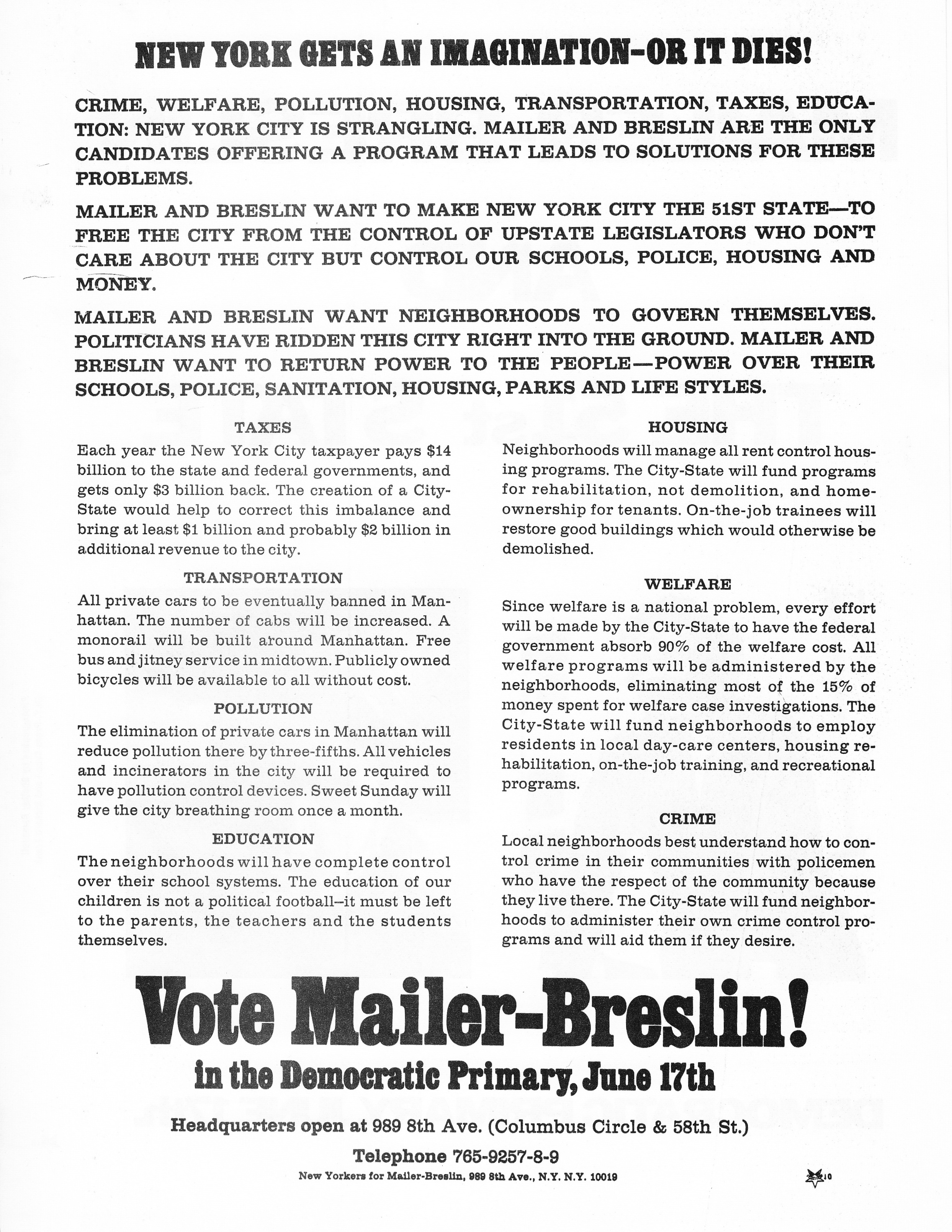
A successful populist movement, in or out of New York City, would focus on building voluntary alternatives. Economic centers of power would be made obsolete and pressured from below, not reined in by political power. Any echoes of New York City electoral history would not be of the paternalistic New Dealers invoked by de Blasio. They might be of George’s labor-backed campaign to address “the shocking contrast between monstrous wealth and debasing want” via laissez-faire. Or Norman Mailer’s 1968 mayoral campaign program of decentralization to neighborhood-level control of political power and social services. For instance, schools would not be expanded cradle-to-adulthood, but broken up into Paul Goodman’s autonomous “mini-schools” [PDF]. The final line of the inegalitarian Tale of Two Cities invoked by de Blasio just might be a quote of a Mailer campaign button: “POWER TO THE NEIGHBORHOOD.”

Stigmergy - C4SS Blog, Weekly Libertarian Leftist Review
The Weekly Libertarian Leftist and Chess Review 11

Enjoy review 11!

Sam Kierstead discusses Hamid Karzai’s role in determing the future of Afghanistan.

Charlie Hinton discusses the ten steps to dictatorship in Haiti.

Pepe Escobar discusses a provocative incident related to China.

Tanya Golash-Boza discusses Obama’s deportation record.

Julie Mastrine discusses why libertarians shouldn’t slut shame.

Sheldon Richman discusses the Pope’s take on the free market and capitalism.

Dave Lindorff discusses the outing of three CIA Pakistani chiefs.

Jonathan Cook discusses the planned Gazaification of the West Bank.

Tom McNarma discusses the terror of bombing and saying no to war crimes.

John Laforge discusses the treatment of Gitmo detainees.

Tom Engelhardt discusses the bombing of wedding parties.

Mitchell Plitnick discusses Max Blumenthal’s book, Goliath: Life and Loathing in Greater Israel.

Aaron Rubin reviews the new film, My Afghanistan: Life in the Forbidden Zone.

Semuas Milne discusses the war in Afghanistan.

Shamus Cooke discusses the potential for peace in Syria.

Norman Solomon discusses Moveon.org’s indifference to the atrioticies of Obama.

Lynn Fitz-Hugh discusses police estatism.

Jonathan Carp discusses Christmas.

Peter Beinart discusses the absence of an anti-war left on Iran.

Josh Marsfeder discusses Miley Cyrus and socail entropy.

Ryan Calhoun discusses libertarians and thre 60’s counterculture.

Noam Chomsky and Stefan Molyneux discuss a range of issues.

Conor Friederdorf discusses why secret operations and self-government don’t mix.

Robert Taylor discusses 10 most libertarian moments of 2013.

Sheldon Richman discusses the Federal Reserve.

Nathan Goodman discusses thick libertarianism.

Dr. Cesar Chelala discusses the application of the Nuremberg precedent to the Iraq War.

Laurence M. Vance reviews, The Moral Case for a Free Economy.

Review of the new algrebaic editon of Winning Chess. Both Irving Chernev and Fred Reinfield wrote this book. Two very prolific chess writers. This is a book on tactics. As the master level player, Teichmann, put it: “Chess is 99 percent tactics”. I own the descriptive notation edition of this book, and can attest to its usefulness.

John Watson reviews Eplus #107 and an e-book version of Chess Praxis. The latter is by the famous Russian player, Aron Nimzowitsch. He was famous for writing My System. Chess Praxis was the follow up game collection to the aforementioned theoretical work.

Italian, Stateless Embassies
Scarsità e Abbondanza Artificiale: Un Uno-Due Micidiale

Scrivo spesso della scarsità artificiale come sorgente di rendita per le classi possidenti, e sul ruolo che ha lo stato nell’imporla. Ma l’altra faccia della moneta è il ruolo che ha lo stato nel rendere artificialmente abbondante, per le classi privilegiate, ciò che è scarso in natura. Un esempio lo vediamo dalle notizie che parlano della politica che circonda gli oleodotti e i gasdotti nel Nordamerica.

All’inizio dello scorso mese di dicembre, il presidente americano Barack Obama ha approvato il progetto di un gasdotto che porterà gas liquefatto o petrolio ultra leggero dall’Illinois fino ad Alberta, sul confine canadese, dove verrà utilizzato per sciogliere le sabbie bituminose da cui estrarre il petrolio, che a sua volta sarà pompato nuovamente a sud verso gli Stati Uniti attraverso l’oleodotto Keystone XL. Due settimane più tardi, alcuni membri di un gruppo contrario all’oleodotto, Great Plains Tar Sands Resistance, sono stati arrestati con la finta accusa di “terrorismo” (pare che alcuni brillantini caduti dagli striscioni rappresentassero una “minaccia biochimica”). I componenti del gruppo si erano incatenati alla sede centrale della Devon Corporation per protestare contro i suoi legami con la TransCanada e l’industria delle sabbie bituminose di Alberta.

Se c’è qualcosa che illustra il principio dell’abbondanza artificiale, questo è il petrolio ricavato dalle sabbie bituminose di Alberta, nonché la mole degli interventi statali necessari a renderlo proficuo. È una classica bolla economica: prima si investono grossi capitali per mettere in funzione i pozzi, e poi la produttività va in caduta rapida (meno 38% solo il primo anno). È una bolla che non sarebbe mai nata se lo stato non avrebbe fatto pendere l’ago della bilancia da una parte con il suo peso. Gli oleodotti sono costruiti su terreni rubati con gli espropri (la maggior parte da popolazioni amerindie in violazione dei trattati, a volte addirittura profanando cimiteri sacri). Gli oleodotti non hanno l’obbligo di contribuire al Fondo Comune Contro i Versamenti di Petrolio (anche se, come abbiamo visto altre volte, in caso di grossi versamenti anche le petroliere e le piattaforme petrolifere hanno una responsabilità limitata ad una piccola frazione del danno probabile). Gli standard sull’inquinamento dell’Agenzia per la Protezione dell’Ambiente, basati come sono su decisioni politiche e su un minimo denominatore comune, non riconoscono la responsabilità civile per gli illeciti commessi contro le comunità confinanti con l’inquinamento dell’aria e dell’acqua. E poi ci sono le leggi “anti-terrorismo”, usate come pretesto per contrastare le tattiche tradizionali di disobbedienza civile degli ambientalisti con pene molto forti.

Nell’economia globale, gli interessi della grande industria dipendono tanto dall’abbondanza artificiale quanto dalla scarsità artificiale. L’economia americana del ventesimo secolo aveva come modello un crescita estesa, basata su risorse rese artificialmente abbondanti e a buon prezzo più che su un uso più efficiente delle risorse esistenti. Il risultato è un’industria agricola che massimizza la produzione per ora di lavoro piuttosto che per ettaro, con un’efficienza nello sfruttamento della terra che è molto più bassa delle tradizionali forme di coltura intensiva, come l’orticoltura pensile. Ci sono anche “agricoltori” capitalisti che ricevono soldi dallo stato per tenere incolti grossi tratti di territorio (quando si dice un buon investimento fondiario), più o meno come succede nell’America latina, dove le haciendas e le latifundias tengono incolta la maggior parte dei terreni mentre gli altri, poveri di terre coltivabili, si vendono come braccianti stagionali.

La nostra economia, dall’industria al dettaglio, si basa su una tecnologia produttiva inefficiente e fortemente capitalizzata, un sistema di trasporti di lungo raggio basato su un uso eccessivo di autostrade pagate dai contribuenti, comunità motorizzate, una crescita estensiva delle città e la monocultura dei sobborghi.

Nel terzo mondo, l’industria agricola esporta i raccolti prodotti in terre rubate ai contadini indigeni, mentre le risorse naturali sono controllate dalle stesse società che le rubarono durante l’epoca coloniale, come la Shell in Indonesia e Nigeria, l’industria mineraria in Sudafrica, l’industria del rame nelle Ande, eccetera.

Questa abbondanza artificiale, come la scarsità artificiale, è assolutamente necessaria ad impedire il calo dei profitti sotto il capitalismo clientelare. Come nota James O’Connor in The Fiscal Crisis of the State (La Crisi Fiscale dello Stato), una fetta sempre più grande dei costi operativi della grande industria viene scaricata sulla società tramite le tasse.

Ma così come lo stato impone un tetto massimo ai costi di produzione, con la scarsità artificiale mette anche un limite minimo ai loro introiti. I regolamenti che impongono l’investimento di grossi capitali per la produzione tagliano fuori efficacemente il pericolo rappresentato dalla concorrenza delle piccole cooperative e dei singoli, le cui tecnologie produttive, effimere ed a basso costo, consentono di avere una produzione più efficiente di quella dei dinosauri di Wall Street. La forma principale di scarsità artificiale è la “proprietà intellettuale”, che con le sue rendite grava sui costi affrontati da altri produttori più dei costi di produzione veri e propri.

La buona notizia è che sia la scarsità che l’abbondanza artificiali non sono sostenibili. Il monopolio della “proprietà intellettuale” da cui dipende la scarsità artificiale sta diventando inapplicabile, come testimonia l’industria discografica. E come ha notato lo stesso O’Connor, gli incentivi pubblici ai costi di produzione inducono la grande industria a chiedere di più, fino a superare le capacità dello stato, che va in fallimento nel tentativo di soddisfare le richieste. Saranno queste due crisi parallele a distruggere il nesso tra lo stato e la grande industria.

Traduzione di Enrico Sanna.

Commentary
Privacy 2014: Scroogled?

Tech aficionados and privacy advocates took notice in late 2013 when Microsoft rolled out an attack on Google’s Chrome OS computers.

For one thing, it’s unusual for any company to spend its advertising dollars attacking its competitors rather than promoting its own products. For another, Microsoft’s position atop the computer operating systems market is such that if its execs feel a need to go on the offensive, they obviously fear their market share is genuinely threatened (as was the case in 2002 or so when they finally deigned to take public notice of Linux).

As the year drew to a close, Redmond’s worst nightmares were confirmed. In October, Google claimed that 22% of all US public schools have adopted the Chromebook (closely correlating to the end-of-year claim that 21% of notebook computers sold between January and November were Chromebooks). In December, two of Amazon.com’s three best-selling laptops were Chromebooks.

So yes, Microsoft finds itself at a critical juncture and is reacting — not just with the “Scroogled” propaganda, but with consideration of making some versions of the Windows operating system free to device manufacturers to combat Google’s other free OS, Android.

The era of paying cash for operating systems (and most applications) is over. The era of free operating systems — and networked/cloud-based computing — is here. And since there’s no such thing as a free lunch, the obvious question for the rest of us is: What’s the trade-off?

The trade-off is privacy. Google makes its money by trading in the information we (often unwittingly) convey as we surf the web, send and receive email, engage in online commerce, etc. So will other and future providers of computer gear and computing power.

For obvious reasons, this upsets some users — particularly my crypto-anarchist friends who value privacy as such and have been working hard for decades now to make online privacy possible and convenient.

I don’t think the crypto-anarchists are over-reacting per se. The threat to privacy is certainly real. But, like Microsoft, they find themselves at a critical juncture. The new way of doing things is obviously catching on. Most people (myself included — my two main computers are a Chromebox and a Chromebook) are comfortable sacrificing privacy for convenience.

A new generation of privacy tools will obviously be required for this new era. And as with the previous generation of tools, the hardest bar to get over will be making those tools easy to acquire, install and use.

Like the old guy in The Graduate, I have one word for our would-be protectors: Steganography. The best way to protect a secret is for the bad guys — governments and criminals (but I repeat myself) — to not suspect the existence of the secret. Since trading pictures of cute kittens and so forth seems to have become an enduring Internet habit, what’s called for is a strong (but easy to use!) public key crypto-system for hiding messages in these kinds of ordinary, non-suspicious files, preferably only easily detectable, let alone readable, using the secret half of the key pair.

But that’s just a suggestion. There may be a better way that I, not being the geek I used to be, haven’t thought of. My main point here is not to point to any particular solution, but rather to emphasize that we have a whole new paradigm on our hands. Privacy may still be possible, but only if it accommodates the new way of doing things.

Translations for this article:

Stigmergy - C4SS Blog
2013 In Review: The Year In Left-Liberty

This was quite the year for left-liberty. Others have already examined the year from different ideological perspectives. This has ranged from Lew Rockwell’s Ron Paul filled piece to Medea Benjamin’s take. It’s time for a retrospective that addresses 2013 from a left-libertarian perspective. There are 4 things worth focusing on.

1) The Canadian Supreme Court’s striking down of the anti-prostitution laws. This was an important step in the direction of sex worker liberation. Not the only step that needs to be taken, but a meaingful one nonetheless.

2) Chelsea Manning’s continued heroic stand against the warfare state. It landed her in jail, but she has many supporters on the outside. Those of us who oppose American warfare statism have much to thank her for.

3) Radley Balko’s book on police militarization earns a spot in this piece, because those police powers are often used against the marginalized and oppressed. The War on Drugs is a notable example, because it predominantly targets African-Americans.

4) Edward Snowden’s revelations about the surveillance state. Glenn Greenwald has been instrumental in helping us find out about the spyng of the NSA. He deserves accolades for this principled behavior. It goes to show that he is one of the more reasonable left-liberals or centre-leftists out there.

Italian, Stateless Embassies
La Tregua di Natale del 1914

Il ventiquattro dicembre di novantanove anni fa ci fu la cosiddetta Tregua di Natale del 1914, una tregua spontanea invocata dai soldati che si trovavano sul fronte occidentale francese e che in alcuni punti continuò anche dopo il giorno di Natale.

I soldati francesi, britannici e tedeschi, attratti dal suono dei canti di Natale che venivano dalle trincee nemiche, cominciarono timidamente a smettere di spararsi tra loro. Dalle trincee tedesche fu lanciato uno stivale, che poi risultò pieno di dolci e salumi. Man mano che acquistarono fiducia, i soldati cominciarono ad avventurarsi nella terra di nessuno tra le trincee, fino ad entrare nelle trincee stesse sul lato opposto per scambiare piccoli regali ricevuti da casa come caffè, sigarette, alcolici e giornali. Celebrarono il Natale giocando a calcio nella terra di nessuno. Soldati di entrambe le parti condivisero le loro razioni, cantarono assieme canti di Natale e posarono per le fotografie di gruppo.

Già prima di Natale le forze alleate e le potenze centrali avevano invocato alcune tregue per seppellire i morti, ma solo con l’approvazione dei rispettivi comandi supremi. Questa tregua di Natale, invece, non era stata autorizzata da nessuna delle parti, una violazione della disciplina a tutti gli effetti (fraternizzare con il nemico significava la corte marziale, tanto per intenderci). Ovviamente i capi delle forze tedesche e alleate erano profondamente sconvolti all’idea di ciò che questo fatto implicava; più sconvolti di quando, dopo l’armistizio del 1918, una unità francese in attesa impaziente della smobilitazione organizzò un soviet. Rimuginarono alla ricerca di un sistema per costringere gli uomini, con le minacce o con l’imbroglio, a tornare nelle trincee e uccidersi l’uno con l’altro.

Ma i soldati non ne volevano sapere. Il 26 dicembre, all’ordine di riprendere il fuoco, risposero sparando negligentemente in aria invece che in direzione del nemico. Tutto finì quando i comandi supremi mandarono al fronte truppe fresche che non avevano conosciuto la tregua. A Natale del 1915 e degli anni seguenti fu ordinato un fuoco di sbarramento continuo. Quando un ufficiale appena accennava ad una tregua veniva trattato in maniera esemplare. Un capitano britannico che autorizzò una tregua per seppellire i morti, seguita da un’ora di fraternizzazione, fu deferito alla corte marziale.

I governi e i comandi militari di Gran Bretagna, Francia e Germania erano giustamente spaventati dagli sviluppi. Era facilissimo per la propaganda ufficiale demonizzare il nemico agli occhi della popolazione civile a casa, come dimostrano le storie diffuse dalla stampa britannica sui soldati tedeschi che uccidevano i bambini belgi a baionettate. Ma i soldati che entravano in contatto con il “nemico” al fronte capivano subito che si trattava di persone normali come loro, con un lavoro e una famiglia a casa, persone che erano state abbastanza stupide da credere alle bugie raccontate dai politici.

Oggi i governanti hanno molte più ragioni per essere spaventati. Da quando si è diffuso internet e la connessione è praticamente diventata ubiqua in gran parte del mondo, ed i social-media hanno cominciato la loro rapida diffusione, è cresciuto esponenzialmente il numero di americani che comunica, da persona a persona, con cittadini delle nazioni “nemiche” contro cui gli Stati Uniti fanno le guerre. Non solo abbiamo accesso a canali d’informazione come Al Jazeera, che mostra i cadaveri carbonizzati e smembrati dagli attacchi americani, ma con il cellulare chiunque può caricare immagini o video sui social-media.

Novantanove anni fa i soldati dovettero camminare fino alle trincee opposte per capire che le truppe “nemiche” erano esattamente come loro, e che i loro veri nemici li avevano a casa, a Londra, Parigi, Berlino. Oggi sempre più civili lo capiscono prima ancora di sparare un singolo colpo.

Traduzione di Enrico Sanna.

Commentary
The Resurgent Market

The Washington Post‘s E.J. Dionne Jr., predicts that the reemergence of the Democratic left will be a major political story in 2014 (“The Resurgent Progressives,” January 1). He argues that the American right has been unwilling to compromise on policy matters with moderate Democrats. As a result the populace has been dragged ever farther to the right — even with Democrat Barack Obama in the White House. This rightward shift of the nation, Dionne writes, is responsible for a rising “militancy” on the Democratic left. The left Democrats and the right Republicans are really going to have an ideological showdown this year. This is good for American citizens — it will foster better policy from Washington. In his final analysis he notes:

When politicians can ignore the questions posed by the left and are pushed to focus almost exclusively on the right’s concerns about ‘big government’ and its unquestioning faith in deregulated markets, the result is immoderate and ultimately impractical policy. To create a real center, you need a real left.

Leaving the mis-characterization of left and right aside, the biggest flaw in his thinking is assuming that government institutions can foster good policy for the populace. The resurgent left, the resurgent right, the resurgent center — none of these will actually help people. Sure, some policy decisions may be a wee bit better than others, but long-term viability will not come from the halls of power. That experiment has failed for thousands of years.

True change will have to come from the populace. Change in the United States will function the way it does everywhere else — by sit-ins and creative labor, not  by legislative decree. Government institutions are often hurdles to democracy, progress and policy that represents the will of individuals. The power structure, contrary to what individual Americans may believe, will continue to govern with force. A centralized bureaucracy will not represent the wishes of free people. Liberty and the state will be ever at odds.

The answer lies in the free(d) market.

Markets, as they currently exist, are not free. Today state-sanctioned economic privilege exists. The market anarchist realizes this and works toward the realization of the true beauty of the market. The free market, by its very definition, must resist domination, violence and privilege because these societal attributes are violations of liberty and human dignity. Free markets, then, based on the spontaneous order of human ingenuity, are a fundamental aspect of a free, liberated society.

In 2013 we witnessed the rise of dissent. Whistleblowers became heroesa war-weary public halted a new military conflict in the Middle Eastcivic sector institutions and social movements demanded protection for the environmentalternative currencies developed, new technology started to change the way we think about educationwe protested police brutalitywe fought for the commons and so much more. Even more, we witnessed this collective action across the globe. The market is back!

Rights do not come from governments. Throughout our collective history, liberation has been achieved by people either working around power structures or directly engaging them, forcing change. Liberation is not the product of legislation, but the sum of human action. When we turn our backs on the political and economic elite we empower free human beings to craft a liberated market. When realized, our federations, institutions and places of exchange will be the story of generations.

The real story of 2014 will be the resurgent market.

Italian, Stateless Embassies
Nazismo Nicotinico

Il grande H. L. Mencken definì il puritanesimo “la paura oppressiva che qualcuno da qualche parte si stia divertendo.” Io non vado nella New York di Michael Bloomberg da più di un decennio, ma se dovessi mai atterrare domani all’aeroporto LaGuardia non mi sorprenderei se ad accogliermi ci fossero poliziotti usciti dal quadro di Tompkins Harrison Matteson, “Il Processo per Stregoneria a George Jacobs di Salem”.

Quando non sono impegnati a bandire il tabacco stanno bandendo i grassi transgenici. Quando non bandiscono i grassi transgenici lo fanno con le bibite in formato maxi. E se bocciano il bando delle bibite, il loro prossimo obiettivo sono le sigarette elettroniche. “Per la salute pubblica!” è la forma moderna di “Ho visto Sarah Good con il demonio! Ho visto Good Osburn con il demonio! Ho visto Bridget Bishop con il demonio!”

Se non credete a me, credete ai politici che hanno votato l’estensione del bando del fumo fino a farlo diventare “non fuma, ma sembra che fumi se sei proprio, proprio, proprio stupido”.

Il portavoce del consiglio cittadino Christine Quinn non cita preoccupazioni vere e proprie per la salute quando spiega il suo supporto al bando delle sigarette elettroniche. Semplicemente asserisce, invece, che sarà più difficile applicare il divieto di fumare se non è al tempo stesso illegale fare qualcosa che un poliziotto cieco, sordo e mentalmente ritardato, che in quel momento è fatto di crack, potrebbe scambiare per fumo.

Poiché questa giustificazione è chiaramente abborracciata, svela la ragione vera: “Pochissime persone si sentono a disagio quando dici che non possono fumare in pubblico. Noi su questo non vogliamo indietreggiare.” In altre parole, se non mettono al bando le sigarette elettroniche i newyorchesi potrebbero ricredersi sulla possibilità che Christine Quinn gestisca la loro vita. Attenzione, Will Robinson! Attenzione!

Il consigliere James Gennaro e il membro della “commissione salute” Thomas A. Farley parlano dell’assenza di un bando delle esalazioni di vapore contenente un quinto del potenziale tossico del “fumo di seconda mano” come di una scappatoia. “Vediamo che queste sigarette (sic) stanno cominciando a diffondersi, e questo è inaccettabile,” dice Gennaro. Mi dicono di persone che fumano queste sigarette (sic – non sono sigarette, e non vengono ‘fumate’, quello che vuole dire davvero è ‘Mi dicono di persone che vivono la loro vita senza consultarmi e genuflettersi davanti a me’) nelle biblioteche pubbliche. Di sicuro si stanno diffondendo nei ristoranti e nei bar.”

Ovviamente non è giusto attribuire tutto ciò unicamente ai complessi di onnipotenza di sociopatici come Quinn, Gennaro e Farley. Di mezzo ci sono anche i soldi. Molti soldi: 1,50 dollari in tasse per ogni pacchetto di sigarette “vere” vendute legalmente (circa il 60% delle sigarette sono contrabbandate per schivare i più che entusiasti passatori della città: i politici), più tutto quello che lo stato riesce a convogliare dai 4,35 dollari a pacchetto verso le tasche di Quinn, Gennaro e compagni.

È una questione di controllo. È una questione di soldi. Quel che è più che certo è che non ha niente a che vedere con la “salute pubblica”.

Questo non significa che le sigarette elettroniche sono senza rischi. È probabile di no: i pochi studi fatti finora suggeriscono che potrebbero esserci rischi minori (un intero ordine di grandezza meno severi di quelli associati alle sigarette “reali”).

Ma è fuori da ogni ragionevole dubbio che le sigarette elettroniche siano più sicure del tabacco. Così come non c’è dubbio che le sigarette elettroniche siano tra gli strumenti più efficaci per uscire dal vizio. Questo è un colpo duro ai fondi neri di Quinn e Gennaro: 1,50 dollari in meno per ogni pacchetto non fumato. Significa che il guinzaglio che Quinn e Gennaro e Co. hanno faticato tanto a mettere al collo dei newyorchesi si allenterà un po’, almeno fino al prossimo bando.

I newyorchesi hanno tutto da perdere dalla messa al bando delle sigarette elettroniche. E tutto da guadagnare dalla scomparsa dei “loro” amministratori cittadini.

Traduzione di Enrico Sanna.

Commentary
Privacy 2014: The Fable of the Hoarder

In recent years, “hoarders” — people who collect lots and lots of stuff, until it overpowers them — have become a hot topic in the news and on “reality television.” The mainstream consensus seems to be that “hoarders” are mentally ill, or at least socially abnormal, and need to be “helped,” or at least stopped from amassing huge piles of stuff. I personally disagree with the idea of using force to combat “hoarding,” but I think there’s something useful as allegory in the phenomenon.

I knew a guy once who answered to the general description of “hoarder.” He collected … well, everything. Over the years I knew him, his house filled up with “antiques” (read: Any piece of furniture more than a few years old), “classic computers” (read: Obsolete electronics) and stacks and stacks of old newspapers and magazines.

My friend didn’t suffer from any lack of will to organize his life. He also collected organizing stuff — storage totes, shelves with little cubby holes for categorizing small objects, books on “taking control” of disorganized households. Unfortunately, all he did with that stuff was … well, collect it. It stacked up on top of those old newspapers, which stacked up on top of those obsolete electronics, which stacked up on top of that old furniture. Oh, and he collected cats, too. Lots and lots of cats. Which meant that all those stacks of stuff were covered with cat hair, cat hairballs, and other cat leavings. He had a lot of stuff. Most of it was probably worthless, ruined by his collecting habit if it had ever been worth anything at all.

He never did get organized, and when he died I’m sure his adult children (they had grown up and moved out before he developed his disorder, if indeed it was a disorder) had a heck of a time cleaning out his house and saving anything of value.

I was reminded of my old friend when I ran across a news story on the The NSA’s problems in doing anything useful with all the data it collects through its unconstitutional surveillance operations (“NSA Can’t Make Sense of Masses of Culled Data,” Antiwar.com, December 26, 2013).

I think a lot of us — yes, me included — may have been looking at all this illegal NSA spy stuff, revealed over the last several months by whistleblower Edward Snowden, from the wrong perspective. We’ve seen it in Orwellian terms: An omniscient state tightening its grip on the populace by tracking our every move, our every purchase, our every electronic statement.

Now I’m beginning to think that what we’re seeing may actually be the equivalent of my hoarder friend’s obsession.

To the extent that hoarding may be symptomatic of mental problems, I suspect that its genesis lies in a perception of loss of control of one’s life. The acquisition of lots and lots of stuff is an attempt to re-assert that control — to act, to take charge.

It seems to me that NSA data hoarding reveals the same set of fears. It’s not an all-powerful state asserting its power and control. Rather it is a failing, quaking, fearful state attempting desperately to re-assume its lost powers.

Like the hoarder who doesn’t understand that his stuff is controlling him rather than him controlling it, NSA can’t come to grips with the fact that the emerging anarchic world order — decentralized, voluntary networks of equally empowered peers — will determine the future of centralized, hierarchical governments, not vice versa.

That’s not to say that government and its spies aren’t still dangerous, but they’re getting more and more dangerous to themselves and less and less dangerous to the rest of us. Their stacks of newspapers are just dripping dust and cat urine through their obsolete electronics and rotting the substructure of old furniture underneath. The whole thing will eventually come down on top of them.

Translations for this article:

Feature Articles
Building Creative Commons: The Five Pillars Of Open Source Finance

Building Creative Commons: The Five Pillars of Open Source Finance” was written by Brett Scott and published on his blog The Heretic’s Guide to Global Finance: Hacking the Future of Money. We are honored to have Brett Scott‘s permission to feature his article on C4SS. Feel free to connect with Scott through twitter: @Suitpossum.

AHOY, THERE BE A CLOSED SYSTEM THAT NEEDS OPENING!
This is an article about Open Source Finance. It’s an idea I first sketched out at a talk I gave at the Open Data Institute in London. By ‘Open Source Finance’, I don’t just mean open source software programmes. Rather, I’m referring to something much deeper and broader. It’s a way of framing an overall change we might want to see in the financial system. To illustrate this, I set up an analogy between computer systems and economic systems, and I then explore what financial ‘code’ might be. I then sketch out the five pillars that could underpin an open finance movement.

Computer systems as economies

Computer systems are great metaphors for economic systems. That’s because, in a sense, a computer is a microcosm of our economy, albeit one that is a lot more predictable and controllable. Economies, at some basic level, are based upon people using energy to extract useful stuff from the earth, using tools, procedures, systems of rules and labour to activate the earth’s productive potential. Likewise, computer systems rely on taking inputs of energy (the computer plugged into the electricity grid) and combining it with software code (a kind of abstraction of human organisation), in order to activate the assemblage of physical hardware (signifying a latent productive potential) towards productive tasks, when willed to do so by a user of the computer.

We constantly interact with computers, but most people in the world do not perceive themselves as programmers of computers. They mostly perceive themselves as users of computers that others have programmed. And even if they wanted to dig deeper, they’d find that much of the software they use is proprietary, locked up in secretive, opaque, even obfuscated formations. Windows looks like a friendly interface, but you cannot see what it does, or how it does it. It’s a useful intermediary interface between you and the inner workings of your computer, but it’s also a hard-shelled barrier.

The Financial Status Quo: Power concentrated in intermediaries

Software code is the organising rule system that steers energy into activating hardware towards particular ends. So, extending this as an analogy, what might financial ‘code’ look like? A financial system, in a basic sense, is supposed to arrange for surplus resources (extracted from the earth), to be redistributed (in the form of money) via financial instruments (often created by financial intermediaries like banks and funds), into new economic production activities (‘investments’), in exchange for a return over time.

Here, for example, is a rough financial circuit: A person manages to earn a surplus of money (a symbolic claim on real things in the world), which they deposit into a pension fund, which in turns invests in shares and bonds (which are conduits to the real world assets of a corporation), which in turn return dividends and interest over time back to the pension fund, and finally back to the person.

Shares and bonds are extractive financial conduits that plug into a corporate structure, but if you look for how they are coded, you’d discover they are built from legal documents that are informed by regulations, acts of parliament, and social norms. They are supported by IT systems and all manner of payments systems and auxiliary services.

But it takes more than clearly-worded documentation to be able to create financial instruments. The core means of financial production, by which we mean the things that allow people to produce financial services (or build financial instruments), includes having access to networks of investors and companies, having access to specialist knowledge of financial techniques, and having access to information. It’s these elements that banks and other financial intermediaries really compete over: They battle to monopolise relationships, monopolise information, and to monopolise specialist knowledge of financial techniques.

And indeed, that’s why production of financial services mostly occurs within the towering concrete skycrapers of the ‘financial sector’, spinners of the webs of the code that is mostly unknown to most people. We have very little direct access to the means of financial production ourselves, very little say in how financial institutions choose to steer money in society, and very little ability to monitor them.

We have, in essence, a situation of concentration of power in financial intermediaries, who in turn reinforce and seek to preserve that power structure. And while I may be happy to accept a concentration of power in small specialist industries like Swiss watchmaking, a concentration of power in the system responsible for redistributing human society’s collective resources into new investments is not a good thing. It’s systematically breaking our planetary hardware by steering money into destructive activities, whilst helping to fuel a culture of bland individualistic materialism in increasingly atomised communities.

Opening access, reconnecting emotion, liberating creativity

The Open Source movement started with software – and in particular with the concept of copyleft and free licensing – but the principles extend far past software. At core, Open Source is a philosophy of access: access to the underlying code of a system, access to the means of producing that code, access to usage rights of the resultant products that might be created with such code, and (in keeping with the viral quality of copyleft) access to using those products as the means to produce new things. Perhaps the ethos is best illustrated with the example of Wikipedia. Wikipedia has:

  1. production process that encourages participation and a sense of common ownership: We can contribute to Wikipedia. In other words, it explicitly gives us access to the means of production
  2. distribution process that encourages widespread access to usage rights, rather than limited access: If you have an internet connection you can access the articles. We might call this a commons
  3. An accountability model that offers the ability to monitor and contest changes: An open production process is also one that is more transparent. You can change articles, but people can monitor and contest your changes
  4. community built around it that maintains the ethic of collaboration and continued commitment to open access. It’s more than just isolated individuals, it’s a culture with a (roughly) common sense of purpose
  5. Open source code that can be accessed and altered if the current incarnation of Wikipedia doesn’t suit all your needs. Look, for example, at RationalWiki and SikhiWiki

You can thus take on five conceptually separate, but mutualistic roles: Producer, consumer, validator, community member, or (competitive or complementary) breakaway. And these same five elements can underpin a future system of Open Source Finance. I’m framing this as an overall change we might want to see in the financial system, but perhaps we are already seeing it happening. So let’s look briefly at each pillar in turn.

Pillar 1: Access to the means of financial production

Very few of us perceive ourselves as offering financial services when we deposit our money in banks. Mostly we perceive ourselves as passive recipients of services. Put another way, we frequently don’t imagine we have the capability to produce financial services, even though the entire financial system is foundationally constructed from the actions of small-scale players depositing money into banks and funds, buying the products of companies that receive loans, and culturally validating the money system that the banks uphold. Let’s look though, at a few examples of prototypes that are breaking this down:

  1. Peer-to-peer finance models: If you decide to lend money to your friend, you directly perceive yourself as offering them a service. P2P finance platforms extend that concept far beyond your circle of close contacts, so that you can directly offer a financial service to someone who needs it. In essence, such platforms offer you access to an active, direct role in producing financial services, rather than an indirect, passive one.
  2. There are many interesting examples of actual open source financial software aimed at helping to fulfil the overall mission of an open source financial system. Check out Mifos and Cyclos, and Hamlets (developed by Community Forge’s Matthew Slater and others), all of which are designed to help people set up their own financial institutions
  3. Alternative currencies: There’s a reason why the broader public are suddenly interested in understanding Bitcoin. It’s a currency that people have produced themselves. As a member of the Bitcoin community, I am much more aware of my role in upholding – or producing – the system, than I am when using normal money, which I had no conscious role in producing. The scope toinvent your own currency goes far beyond crypto-currencies though: local currencies, time-banks, and mutual credit systems are emerging all over
  4. The Open Bank Project is trying to open up banks to third party apps that would allow a depositor to have much greater customisability of their bank account. It’s not aimed at bypassing banks in the way that P2P is, but it’s seeking to create an environment where an ecosystem of alternative systems can plug into the underlying infrastructure provided by banks

Pillar 2: Widespread distribution

Financial intermediaries like banks and funds serve as powerful gatekeepers to access to financing. To some extent this is a valid role – much like a publisher or music label will attempt to only publish books or music that they believe are high quality enough – but on the other hand, this leads to excessive power vested in the intermediaries, and systematic bias in what gets to survive. When combined with a lack of democratic accountability on the part of the intermediaries, you can have whole societies held hostage to the (arbitrary) whims, prejudices and interests of such intermediaries. Expanding access to financial services is thus a big front in the battle for financial democratisation. In addition to more traditional means to buildingfinancial inclusion – such as credit unions and microfinance – here are two areas to look at:

  • Crowdfunding: In the dominant financial system, you have to suck up to a single set of gatekeepers to get financing, hoping they won’t exclude you. Crowdfunding though, has expanded access to receiving financial services to a whole host of people who previously wouldn’t have access, such as artists, small-scale filmmakers, activists, and entrepreneurs with no track record. Crowdfunding can serve as a micro redistribution system in society, offering people a direct way to transfer wealth to areas that traditional welfare systems might neglect
  • Mobile banking: This is a big area, with important implications for international development and ICT4D. Check out innovations like M-Pesain Kenya, a technology to use mobile phones as proto-bank accounts. This in itself doesn’t necessarily guarantee inclusion, but it expands potential access to the system to people that most banks ignore

Pillar 3: The ability to monitor

Do you know where the money in the big banks goes? No, of course not. They don’t publish it, under the guise of commercial secrecy and confidentiality. It’s like they want to have their cake and eat it: “We’ll act as intermediaries on your behalf, but don’t ever ask for any accountability”. And what about the money in your pension fund? Also very little accountability. The intermediary system is incredibly opaque, but attempts to make it more transparent are emerging. Here are some examples:

  • Triodos Bank and Charity Bank are examples of banks that publish exactly what projects they lend to. This gives you the ability to hold them to account in a way that no other bank will allow you to do
  • Corporations are vehicles for extracting value out of assets and then distributing that value via financial instruments to shareholders and creditors. Corporate structures though, including those used by banks themselves, have reached a level of complexity approaching pure obsfucation. There can be no democratic accountability when you can’t even see who owns what, and how the money flows. Groups likeOpenCorporates and Open Oil though, are offering new open data tools to shine a light on the shadowy world of tax havens, ownership structures and contracts
  • Embedded in peer-to-peer models is a new model of accountability too. When people are treated as mere account numbers with credit scores by banks, the people in return feel little accountability towards the banks. On the other hand, if an individual has directly placed trust in me, I feel much more compelled to respect that

Pillar 4: An ethos of non-prescriptive DIY collaboration

At the heart of open source movements is a deep DIY ethos. This is in part about the sheer joy of producing things, but also about asserting individual power over institutionalised arrangements and pre-established officialdom. Alongside this, and deeply tied to the DIY ethos, is the search to remove individual alienation: You are not a cog in a wheel, producing stuff you don’t have a stake in, in order to consume stuff that you don’t know the origins of. Unalienated labour includes the right to produce where you feel most capable or excited.

This ethos of individual responsibility and creativity stands in contrast to the traditional passive frame of finance that is frequently found on both the Right and Left of the political spectrum. Indeed, the debates around ‘socially useful finance’ are seldom about reducing the alienation of people from their financial lives. They’re mostly about turning the existing financial sector into a slightly more benign dictatorship. The essence of DIY though, is to band together, not via the enforced hierarchy of the corporation or bureaucracy, but as part of a likeminded community of individuals creatively offering services to each other. So let’s take a look at a few examples of this

  1. BrewDog’s ‘Equity for Punks‘ share offering is probably only going to attract beer-lovers, but that’s the point – you get together as a group who has a mutual appreciation for a project, and you finance it, and then when you’re drinking the beer you’ll know you helped make it happen in a small way
  2. Community shares offer local groups the ability to finance projects that are meaningful to them in a local area. Here’s one for a solar co-operative, a pub, and a ferry boat service in Bristol
  3. We’ve already discussed how crowdfunding platforms open access to finance to people excluded from it, but they do this by offering would-be crowdfunders the chance to support things that excite them. I don’t have much cash, so I’m not in a position to actively finance people, but in my Indiegogo profile you can see I make an effort helping to publicise campaigns that I want to receive financing

Pillar 5: The right to fork

The right to dissent is a crucial component of a democratic society. But for dissent to be effective, it has to be informed and constructive, rather than reactive and regressive. There is much dissent towards the current financial system, but while people are free to voice their displeasure, they find it very difficult to actually act on their displeasure. We may loathe the smug banking oligopoly, but we’re frequently compelled to use them.

Furthermore, much dissent doesn’t have a clear vision of what alternative is sought. This is partially due to the fact that access to financial ‘source code’ is so limited. It’s hard to articulate ideas about what’s wrong when one cannot articulate how the current system operates. Most financial knowledge is held in proprietary formulations and obscure jargon-laden language within the financial sector, and this needs to change. It’s for this reason that I’m building the London School of Financial Activism, so ordinary people can explore the layers of financial code, from the deepest layer – the money itself – and then on to the institutions, instruments and networks that move it around.

Beyond access to this source code though, we need the ability to act on it. A core principle of OpenSource movements is the Right to Fork. This is the ability to take preexisting code, and to modify it or use it as the basis for your own. The Right to Fork is both a check on power, but also a force for diversity and creativity.

In the mainstream financial system though, there are extensive blocks on the right to fork, many of them actively enforced by financial regulators. They won’t allow new banks to start, and apply inappropriate regulation to small, new financial technologies. The battle for the right to fork therefore, is one that has to also be fought at the regulatory level. That’s why we need initiatives like the Disruptive Finance Policy program.

The Right to Fork needs to be instilled into the design of any alternatives to mainstream finance too though. I don’t want to replace a world where I’m forced to use national fiat currencies with one in which I’m forced to use Bitcoin. The point is to create meaningful options for people. (To the credit of the original designers of Bitcoin, the right to fork has indeed been built in, and there has been significant use of the original Bitcoin sourcecode to create other cryptocurrencies, albeit it takes more to create a currency than merely deploying new code).

Ahoy! We set sail for the Open seas

EXPLORE THE DEEP

We may be in the early phase of a slow-moving revolution, which will only be perceptible in hindsight. As projects within these five pillars emerge, the infrastructure, norms and cultural acceptance for more connected, creative, open financial system may begin to emerge and coalesce into reality.

I hope this article has been of use to you, whether you’re looking to design actual open source finance platforms, programs and free software, or pioneer a new element of open access and open data, or whether you’re just keen to help beta-test new ideas as they get released. The financial sector is a big heavy conglomerate that is a perfect challenge for the adventurous pirate-meets-hacker-meets-activist-meets-entrepreneur. Please do tell me about anything you’re up to, and, in the spirit of Open Source, please do leave suggested amendments to this article in the comments section. I’ll try patch them into the next version of this.


Italian, Stateless Embassies
Pietre dagli Agenti del Bene, Polemiche dal Pubblico

Glenn Broadnax, di Brooklyn, New York, soffriva di ansia e depressione. Secondo i documenti recentemente resi pubblici dal tribunale, il pomeriggio del 14 settembre stava “parlando con i suoi parenti morti che erano nella sua testa”, una cosa che lo spingeva a “buttarsi davanti alle auto per uccidersi”. Poiché intralciava il traffico, arrivò la polizia. Broadnax infilò la mano in tasca, tirò fuori nulla, e finse di sparare la polizia. La polizia sparò tre proiettili veri in direzione dell’uomo disarmato. I proiettili mancarono Broadnax ma colpirono due donne che passavano dietro. Broadnax fu fermato con una scarica elettrica e accusato di minacce, possesso di droga e resistenza a pubblico ufficiale, tutti illeciti di lieve entità. Fu anche accusato del reato di aggressione nei confronti delle due passanti ferite. Il procuratore distrettuale arguì che, poiché Broadnax aveva dato origine alla situazione, era criminalmente responsabile del comportamento sconsiderato dei due agenti del governo.

Questo è solo uno dei tanti esempi della crescente brutalità della polizia. Secondo USA Today, il comportamento della polizia è diventato sempre più violento dall’undici settembre, presumibilmente per colpa dell’abbassamento degli standard nelle scuole di polizia e di un addestramento insufficiente. Forse questo è parte del problema. Io però penso che la colpa sia della crescente mentalità da stato di polizia che si è diffusa da quando è iniziata l’infinita “guerra al terrorismo”. Considerata la militarizzazione crescente della polizia di questi ultimi dieci anni, non c’è da stupirsi se la violenza aumenta.

Ma perché cresce l’interesse del pubblico?

Anche molto prima dell’undici settembre la polizia era brutale e forniva grandi titoli ai giornali, ma non così spesso come oggi. L’interesse sempre maggiore da parte del pubblico si basa sul fatto che la violenza è in aumento? Correlazione non significa causa. Le nuove tecnologie, i media indipendenti e la vecchia buona capacità di comunicare degli uomini sono alle origini della questione. Noi siamo connessi, noi parliamo, noi controlliamo la piazza e noi diffondiamo le storie sul web. Di fronte al crescere della violenza la gente ricorre ai social media per diffondere la conoscenza e fronteggiare il potere dello stato.

Per stare in argomento: Sahar Khoshakhlagh, una delle donne sparate dalla polizia che tentava di sparare Broadnax, non beve la storia dell’uomo mentalmente instabile responsabile delle sue ferite. Secondo il suo avvocato, Mariann Wang, l’accusa dovrebbe essere spostata sugli agenti che hanno aperto il fuoco. “È un incredibilmente sfortunato uso della discrezione dell’accusa il fatto che venga accusato un uomo che non ha inferto alcuna ferita al mio cliente,” ha detto Wang. “È stata la polizia a ferire il mio cliente.”

Sono passati i tempi in cui le persone arroganti prese di mira dalla polizia erano persone che semplicemente se lo meritavano. “Si vede che ha combinato qualcosa,” è il vecchio mantra della maggioranza. Oggi noi sappiamo che gli agenti del governo sono dalla parte del torto e non esitiamo a sollevare polemiche riguardo il fatto. La tastiera è più potente degli editti di stato.

L’informatica ha connesso la popolazione come non era mai accaduto prima, ma non è la semplice esistenza della tecnologia che fa salire il dissenso di fronte agli abusi della polizia: è l’attività del pubblico e la volontà di contrastare il potere dello stato. È incredibile vedere queste piccole fiamme di libertà che spuntano non solo negli Stati Uniti, ma in tutto il mondo. Il pubblico sta mettendo in dubbio chi ha il potere e le sue ragioni. Gli individui (e la collettività) stanno acquisendo più potere che mai. Questo ha un grosso effetto sui sistemi politici; e sulla “giustizia”. Quando si arriverà ad un mondo basato sulla libertà anarchica la giustizia non sarà misurata con il metro del castigo, della forza e della violenza; si baserà invece sulla capacità di ristabilire l’ordine e sulla possibilità di disarmare chi opprime.

E allora: via le pietre degli “agenti del bene”, ben vengano le polemiche del pubblico.

Traduzione di Enrico Sanna.

Commentary
Ani DiFranco, Slavery And The Subsidy of History

Singer-songwriter Ani DiFranco recently cancelled her “Righteous Retreat in the Big Easy,” a song-writing retreat hosted at the Nottoway Plantation and Resort, a former slave plantation in Louisiana. The venue choice provoked well-deserved outrage, prompting DiFranco to cancel. DiFranco issued what Callie Beusman at Jezebel called “a remarkably unapologetic ‘apology,'” defending her actions more than apologizing for them.

The Nottoway Plantation and Resort doesn’t illuminate the brutal history of slavery; it whitewashes and glorifies slavery. The resort’s website claims that “Randolph [Nottoway] knew that in order to maintain a willing workforce, it was necessary to provide not only for his slaves’ basic needs for housing, food and medicine, but to also offer additional compensation and rewards when their work was especially productive.”  Rather than highlighting the rights violations inherent in enslaving human beings, the resort euphemistically calls slaves a “willing workforce” and advertises the supposed benefits slaves received.

The site also brags that “A dramatic, multi-million-dollar renovation has restored this historic plantation to her days of glory.” I wouldn’t call days of slavery, abuse, and exploitation “days of glory.”

The problem here goes beyond sanitizing the history of slavery. We should ask ourselves why this plantation still exists at all. We should ask why wealthy white people still own it. The slaves mixed their labor with the soil, developing it. They, not the slave-owning criminals who retained title after the Civil War, worked and toiled on the land. As libertarian economist Murray Rothbard wrote,

“elementary libertarian justice required not only the immediate freeing of the slaves, but also the immediate turning over to the slaves, again without compensation to the masters, of the plantation lands on which they had worked and sweated.”

But this justice was denied. Black freedmen did not own their own land, and were instead forced to work for those who had unjustly monopolized the land. Slavery gave way to sharecropping, exploitative wage labor, unemployment, and other forms of exploitation of structural poverty. The ongoing structural poverty that plagues communities of color can largely be traced to slavery and the related land monopoly. This is a good example of what Kevin Carson calls “the subsidy of history,” in which historical violence and plunder plays a critical role in the modern economic order.

The plantation lands remained in the hands of slave owners, eventually passing into the hands of wealthy capitalists. Currently, the Nottoway Plantation is owned by the Paul Ramsay Group investment firm. The firm’s owner, Paul Ramsay, is one of the largest political donors in Australia, donating handsome sums to the right-wing, homophobic, misogynistic politicians of Australia’s Liberal Party.

This ongoing legacy of slavery isn’t just apparent in land monopolization and the ruling class’s profit from “plantation resorts.” The 13th Amendment prohibits slavery “except as a punishment for crime.” So after slavery’s formal abolition, Southern states passed Black Codes, effectively criminalizing black people. This enabled Southerners to continue enslaving blacks, using the so-called the “convict lease system.” Some plantations were converted to prisons. The Louisiana State Penitentiary, better known as Angola, is a converted slave plantation where blacks are still exploited for their agricultural labor. The racism of slavery persists; 60% of prisoners are people of color.

From criminal punishment to economic order, our society is pervasively shaped by slavery. This is upheld through an ideology and structure of racism. Kylie Brooks, an activist who organized against holding the retreat at the plantation, put it well:

The Ani DiFranco debacle is one in a pattern of many, many daily experiences of anti-blackness — a global phenomenon — that Black folks have to struggle through daily. Anti-blackness in particular refers back to the ancestral experiences of enslavement and ongoing current experiences of the prison system, both as genocidal phenomenons.

Resisting anti-black racism means standing against the land monopoly, the prison system and all other systems of oppression.

Translations for this article:

Feed 44
The Libertarian Road to Egalitarianism on Feed 44

C4SS Feed 44 presents David S. D’Amato‘s “The Libertarian Road to Egalitarianism” read by James Tuttle and edited by Nick Ford.

But we needn’t regard inequality as a weak point in our arguments for economic freedom, or as an issue on which we simply cannot win. Existing economic relations are not the product of freedom of exchange or legitimate private property. Libertarians actually hold the high ground on the inequality issue. Liberty and equality in fact complement and reinforce one another, the former naturally resulting in the latter.

Individualist anarchists like Lysander Spooner held that “extremes in both wealth and poverty” resulted from “positive legislation,” substituting arbitrary laws for natural laws and “establish[ing] monopolies and privileges.” In capitalism, Spooner argued, the owners of capital receive special power in the economy — power having nothing to do with simple freedom of production, exchange, and competition. Considered holistically, state intervention redounds to the benefit of the rich and politically connected, economic elites with special access to those who write and implement the rules we are all forced to live by.

Feed 44:

Bitcoin tips welcome:

  • 1N1pF6fLKAGg4nH7XuqYQbKYXNxCnHBWLB
Stigmergy - C4SS Blog
End of Year Media Coordinator’s Update

I spent a couple of hours this morning scouring the search engines for C4SS “mainstream media pickups” in December.

The good news: Usually December is a month that kind of trails off for us in terms of pickups — newspapers tend to run cheery holiday stuff instead of anarchist polemic at this time of year. But THIS December was an exception! I’ve identified 35 pickups of C4SS material in “mainstream media” — well above our normal expectation of 20 or so.

The better news: All our authors had successes this month, but two standouts are Jonathan Carp, whose “So This is Christmas and What Have We Done?” broke us into Pakistani media for the first time ever and Trevor Hultner, who had pieces published from coast to coast in the US and abroad as well.

The not quite so good news: I had really hoped to break 1,000 total pickups in 2013. We fell short of that — as of today, the count stands at 976. But if January is as good a month as December was, we’ll hit 1,000 this month. Thanks, as always, for your continuing support!

Best regards,
Tom Knapp
Media Coordinator
Center for a Stateless Society

Anarchy and Democracy
Fighting Fascism
Markets Not Capitalism
The Anatomy of Escape
Organization Theory