
…A Guide For Right-Wing Polemicists and Other Sycophants
In recent months the public outcry against concentrated wealth and inequality, and the growing influence of progressives and democratic socialists with anti-billionaire rhetoric on Democratic politics, has evoked a corresponding alarm from the center, center-right, and right. The counter-cry in defense of billionaires has come from organized billionaire-funded efforts like the March for Billionaires, bedbugs at the NYT Opinion Page and The Atlantic, perennial havers of hot-takes like Matt Yglesias, concern trolling career consultants like James Carville, and center-right Democratic politicians like Tom Suozzi at Promise to America.
In substance, it’s little more than a warmed-over version of rhetoric from Romney’s 2012 campaign and the abortive primary efforts of Michael Bloomberg and Howard Schultz. Even so, it’s generated a great deal of content, which has been promoted in a wide variety of prominent venues.
Since this seems to be go-time for defending billionaires, you might as well jump on the bandwagon, too. I can’t guarantee you’ll get picked up by The Atlantic and appear alongside the Jonathans Rauch, Chait, and Haidt, or Ross Douthat — but it’s worth a shot. That’s why I’ve gone through an enormous body of hand-wringing literature by some of the most irritating people alive, scanned it for the points they share in common, and compiled this list of helpful hints for would-be bootlickers.
1) Say They “Create Value.” This defense takes the form, variously, of arguments that billionaires’ companies create things that people desire, that their investments facilitate such innovation or create jobs, that their capital is necessary for production to take place, etc.
As the March for Billionaires Bluesky account baldly states: “Billionaires get a bad rap. But most of them make our lives much better.”
The March for Billionaires website argues, at greater length, that most billionaires “made their fortunes building companies that employ thousands and solve real problems…. These billionaires didn’t steal from you. They created new products, new services, new possibilities that millions of people freely chose.” Let’s take a look at their list of examples:
Jeff Bezos. Built a store where you can get nearly anything delivered to your doorstep, tomorrow.
Brian Chesky. Created Airbnb, connecting travelers to homeowners with spare rooms.
Taylor Swift. Sold 100 million albums and filled stadiums around the world.
Larry Page & Sergey Brin. Made the world’s information accessible to everyone, for free.
Dustin Moskovitz. Co-founded Facebook, then dedicated billions to saving lives through effective philanthropy.
Noubar Afeyan. Incubated Moderna and dozens more biotech companies.
Hamdi Ulukaya. Popularized Greek yogurt with Chobani.
I won’t comment on Ulukaya, because he seems relatively minor as billionaires go, and I don’t know anything about the back-story of him or Chobani.
But every one of the other examples involves some form of platform capitalism or other industry in which state-enforced entry barriers like intellectual property, or state subsidies, are central to their profit model. In every case, they extract wealth not by actually making or doing anything, but by controlling access to the conditions under which other people are allowed to make and do things. Even Taylor Swift’s music industry, while it does indeed produce music, relies heavily not only on draconian copyright laws but on technical regulations which deliberately break hardware to impede even what’s legally considered fair use. The drug industry, of which Moderna is part, is notorious for its reliance on patent law, and reimportation barriers, to facilitate monopoly prices ten, twenty or more times production cost. Facebook, Amazon, Google, and Airbnb are all Death Star platforms whose monopoly power depends on both intellectual property and laws against “criminal disregard of business model,” which prohibit what Cory Doctorow calls “adversarial interoperability.” Ironically, Facebook got its start through adversarial interoperability, providing a mechanism by which to import all one’s contacts and transfer notifications from MySpace to Facebook without permission; then Mark Zuckerberg turned around and lobbied to outlaw the practice in future. Were this avenue of competition still legal, new platforms could overcome network effects by doing to Facebook, Amazon, Airbnb, etc., the same thing Facebook did to MySpace: creating new modular instances, with their own rules, piggybacking on the old infrastructures but providing superior user interfaces, algorithms and moderation practices.
You might think an outfit called March for Billionaires would be second to none in shameless sycophancy to billionaires, but you would be wrong. Perhaps because their name directly identifies them as billionaires, they feel some need to moderate their rhetoric for the sake of appearances. But right-libertarian periodicals are unencumbered by any such shame. Reason’s Billy Binion, presenting himself as a Galileo standing against the anti-billionaire Inquisition, writes at Bluesky:
I know it’s trendy to hate billionaires, but many didn’t get rich by accident. Jeff Bezos made goods cheaper & quickly accessible. Bill Gates put computers in homes. Sergey Brin gave the world a search engine that works. I could go on. So yes…they should exist.
He writes on the same theme at Reason:
Making a product that others want… does not make someone a bad egg. Amazon, founded by Bezos, allows people to get items much quicker and often for considerably less money. As of December of last year, the company employed 1.58 million people.
In his article “Let’s all practice billionaire positivity,” Matthew Yglesias has an entire subsection titled “Many billionaires are doing great things.” In it he writes that “one of the main ways to become a billionaire is by offering products and services to the public at an appealing price,” citing Amazon and SpaceX as examples. And despite the obnoxious personalities and bad politics of many billionaires, “the act of actually building the wealth tends to involve good things and win-win transactions.”
Amazon, which we’ve already looked at, has over the past decade become the paradigmatic example of “Enshittification,” systematically rendering its search results less usable in the interest of increased profit extraction. It also uses its market power to simultaneously screw vendors and consumers, by flagging competing retailers whose prices undercut Amazon’s and threatening to downgrade them in Amazon search results.
In some internal emails, Amazon employees have flagged low product prices on rival retailers’ sites as threats to Amazon’s own profitability, and informed the products’ suppliers that their sales on Amazon.com have been cut – or might soon be cut – going forward.
Other emails describe Amazon slashing its product prices to match retail rivals like Walmart and Home Depot, then pushing suppliers to compensate it for the revenue lost due to these lower prices….
Over the last decade, Amazon has suppressed the sales of some suppliers’ products or demanded millions of dollars in compensation from them because of the low prices of Amazon’s retail rivals, according to a trove of internal company emails, presentations and notes reviewed by the Guardian, as well as interviews with 15 current or former Amazon supplier representatives, company employees and state and federal law enforcers.
And it is enabled to do these things by the entry barriers already mentioned. Despite right-libertarian claims that billionaires get rich by creating new value, under late-stage capitalism the billionaire owners of monster corporations get rich by destroying value, and are able to get away with it because of legal restrictions on competition.
As for SpaceX, whatever genuinely positive innovations it and Tesla have come up with have been mostly logical and straightforward applications of available technologies, rather than showing any discernable evidence of Elon Musk’s unique genius. In fact, as a recurring rumor has it, engineers at his companies assign “minders” to distract him with made-up problems (“they’re the same picture”) so he won’t derail their work. That’s quite plausible, considering the products which deviate the most from conventional design, in whose development Elon’s idiosyncratic “vision” plausibly played some actual direct role (the clownish Cybertruck, the explosion prone Starship, and the unworkable and idiotic car tunnels) are godawful; at Twitter, which had no preexisting measures for containment and damage control, Elon’s management was a disaster.
Praising billionaire “value creation” frequently takes the form of crediting them with things actually accomplished by other people, based on their “investment” or their “contribution” of capital. As Binion writes:
Steve Jobs effectively put computers in our pockets, facilitating more intimate communication and connection with friends and loved ones near and far. Elon Musk, for all of his controversy, helped pioneer the modern electric vehicle and is investing in technology to help people with neural issues regain function. Why is this never a part of the story?
But the economic ruling class, in any society where class stratification prevails, controls the allocation and investment of resources — that’s not an argument for their indispensability. As Paul Goodman once put it, “a system destroys its competitors by pre-empting the means and channels, and then proves that it is the only conceivable mode of operating.” In an economy where billionaires didn’t exist, institutional arrangements for allocating resources would be different. The right-libertarian argument is comparable to arguing that without feudal landlords, peasants would have no land.
To whatever extent billionaires’ money does all these things, it’s because they’re the ones who currently have the money. But their control over investment capital and credit, in order to finance innovation and production, is precisely the problem. Capitalists do not build plant and equipment themselves, nor do they personally create the food and other subsistence goods workers consume during the production process; they do not construct these things out of bags of money. Every nut and bolt in a machine, every bite of bread consumed by a worker, is the product of human labor acting on free gifts of nature. The money the capitalist “invests” — the “capital” — is nothing but a socially constructed claim on the right to allocate these streams of goods created by human labor acting on nature. And the origin of these paper claims does not bear much looking into — they were acquired mainly through inequalities of power. “Billionaires provide needed investment capital” isn’t a defense of billionaires. It’s an indictment of a system that makes their capital “needed” (I discuss the central reason for this “need” here, and here).
Billionaire sycophants are fond of claiming that unlimited accumulation by rich people is the engine that generates investment and new jobs. As Binion put it, “if you strip billions from someone like Jeff Bezos, he’ll invest less in building things that actually improve people’s lives. Amazon has done more for the average person than the government could dream of.”
Reading this comment, you’d never guess we have an economy where, thanks to increasingly concentrated wealth and reduced mass purchasing power, the super-rich have more money than they can profitably invest in productive activities, and are turning instead to asset stripping and enshittification by vulture capital — including the enshittification of Amazon by Bezos himself.
Billionaire defenders also attempt to deflect criticism by pointing to how much they pay in taxes. March for Billionaires, on Bluesky, notes that “The top 0.1% of California residents pay more than one-sixth of income taxes, and the top 1% pays 40%. California already has the highest income tax brackets in the country — it’s simply not true that the rich don’t pay taxes.” But this is meaningless without further context. Without knowing how much of billionaires’ income is legitimately earned and how much is unearned, we have no way of knowing what significance to attach to that 40%.
The same is true of “charity.” Binion writes that Ken Griffin is “a major philanthropist, having given away billions of dollars. Bezos, meanwhile, recently gave a $100 million donation to a charity funding early childhood education in New York.” Yes, the Medicis were also renowned for their patronage of the arts, public works, and other largesse. But as right-libertarians are fond of saying in regard to the welfare state, billionaires are funding charity with stolen money. And it is owing to the fact that so much of the value produced by society is channeled upward in the form of rent, profit, and interest, that there is so much need for this charity in the first place.
2) Say Their Wealth Is “Positive-Sum.” Yglesias, in a subsection entitled “Billionaires don’t make you poor,” quotes Grace Blakeley’s statement that billionaires are bad because their wealth comes at your expense. For them to be rich, she says, you have to be poor. In response, he writes that
for most of human existence life was, in most cases, basically zero-sum. Hunter-gatherers might obtain more prosperity for themselves by pushing some other group off of promising land. Later, empires rose and great wealth was obtained by ruling classes based on coercive extraction from agricultural laborers. Outright slavery was widespread, lesser conditions of unfree labor, like serfdom, keep popping up, and even ordinary taxation rarely involved the consent of the governed or any concept of the public interest. Into the 19th century, you can read about all these Jane Austen characters who inherited lands from their father and derive income wholly passively from renting it out to tenant farmers.
The modern economy just isn’t like this.
Land rents still exist, but they’re a much smaller part of the economy. The richest people in the world haven’t just appropriated some resource or confiscated income from the public — they are by and large making things that did not previously exist.
…The rich are getting rich by coming up with new stuff to sell to you.
Tim Worstall, at FEE, writes that it “could not be further from the truth” that the rich got that way by taking something.
In a capitalist society with the rule of law where individual rights are secured, wealth or success is not taken, it is voluntarily given through mutually beneficial trade. Innovators create products and provide services that we, the consumers, value more than the dollars in our pockets and enter into voluntary transactions to acquire.
The “non-zero sum” argument involves both conceptual confusion and strawmanning. Claiming that billionaires get rich at our expense does not imply that we receive no benefit from the transaction; and demonstrating that we receive benefits does not acquit billionaires of the exploitation charge. Exploitation and rent extraction are entirely compatible with some benefit to the public. There would be no profit in monopolizing goods if they weren’t desired, and if the consumer weren’t willing to pay for them at the monopoly price. That doesn’t change the fact that the monopoly price is higher than the competitive price, and the consumer is being exploited.
So while it may be true that land rents, strictly defined, are a somewhat smaller part of the economy than in the past, it is also true that land rents are only the paradigmatic example of a much larger category of rents. And while the rich get rich to a considerable extent by coming up with new stuff to sell us, their main source of profit lies in how they sell it to us — specifically who’s allowed to sell it, under what circumstances, and who has access to the prerequisites for making and selling it.
And contra Worstall, the fact that corporations make some things that we “voluntarily” buy because we “value them more than the dollars in our pockets” is irrelevant to the question of whether they’re taking anything from us. If I secure a monopoly on the water supply and get the state to outlaw competing sellers of water, the thirsty person who “voluntarily” buys a glass of water from me may very well value it more than the $100 they pay me for it; nevertheless I have stolen from them.
In short, never accept anything these people say at face value, or take their premises for granted.
3) Engage in Producerism. This talking point, which is closely related to No. 2, is frequently stated using the “makers vs. takers” formula, according to which rich and poor are equally likely to be producers or parasites. It also took the form of the 53 Percenters movement (i.e. the 53% of Americans who pay taxes), formed in 2011 in reaction against Occupy Wall Street.
The March for Billionaires website calls on us to “judge individuals, not classes.”
Of course, not all billionaires are good people. Some extract rather than create wealth. Some use their resources to cause serious political harm. These criticisms have merit, but they apply to individuals, not billionaires as a whole.
We believe most have made tremendous contributions to society, directly through their entrepreneurship and secondarily through taxes and philanthropy. That deserves our respect and admiration.
On Bluesky, the March for Billionaires argues that “Wealth-creating billionaires aren’t the problem. Rent-seekers of all stripes are.” To illustrate, it provides this helpful graphic, worthy of USA Today:
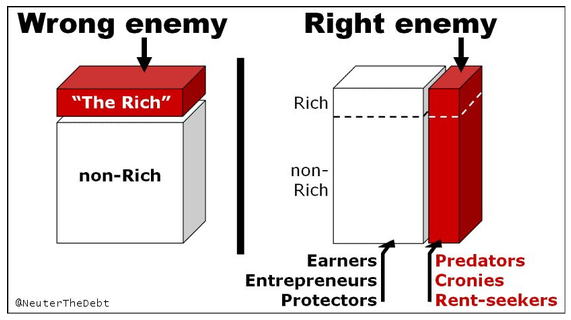
Reason’s Christian Britschgi hauls out the same trope, arguing (as his article’s title puts it) that “you don’t have to be a billionaire to be a leech,” and “there are makers and moochers on every rung of the income ladder.” He starts out by arguing from Robert Nozick’s thought experiment involving Wilt Chamberlain to demonstrate that someone can earn billionaire-level wealth:
To summarize, if you redistributed all wealth equally, Chamberlain would quickly end up having way more money than everyone else because a huge number of people would be willing to buy a ticket to see the basketball player live.
Nozick’s point was that even from a starting point of complete economic equality, some people’s superior skills will enable them to make more money than others and that’s fine. The people who voluntarily pay to see Chamberlain are better off for the experience, even if the money they spent on tickets recreates vast wealth inequality.
First, lets consider all the prior conditions that must be in place for Chamberlain to bring in that kind of income. It’s a fair bet he couldn’t become a billionaire from his share of in-person ticket sales. A super-rich Wilt Chamberlain presupposes a continent-size commercial economy knocked together by massively subsidized railroads, highways, and civil aviation, a national media market piggybacked on top of it, a national mass market with brand advertising which exists mainly because the state promoted mass production at the expense of other industrial models, and intellectual property laws with enforceable broadcast rights.
Second, as we saw above, the fact that people “voluntarily pay for” something and “are better off from the experience” is irrelevant to whether exploitation has taken place. Setting the price just low enough that the consumer receives enough net benefit to make a purchase seem worthwhile, despite it being far higher than the competitive market price, is the first rule of rent extraction through monopoly pricing.
Britschgi ties this digression to his main point by comparing Taylor Swift to Wilt Chamberlain. The same general principle applies: “You can indeed become a billionaire by doing something obviously uncontroversial and non-exploitative like selling concert tickets.”
Nevertheless, he continues, Swift might not be a perfect example because there is “a case that Taylor Swift’s fortune is partially derived from ill-gotten gains…. [Her] wealth depends in part on copyright protections of her music that many libertarians would consider a form of unjust, state-granted privilege.”
The point is that it’s not the amount of money Swift has earned, but her means of acquiring it that determines whether her fortune is deserved. The primary question to ask is whether one earned their money conducting voluntary exchanges in a free market, or through some state transfer or grant of privilege.
To be sure, in our modern, mixed economy, there’s plenty of state transfers going around. Contra AOC, there are makers and moochers on every rung of the income ladder….
The billionaire who lowers consumer prices by creating an online retail giant and distribution network hasn’t inherently exploited anyone. The middle-income tenant living in a rent-stabilized unit in New York is benefiting from an inherently parasitic relationship created by regulation.
Well, not really. The source of billionaire wealth in general doesn’t stand up very well to scrutiny. We’ve already examined the concept of economic rents, which are profits higher than the normal return necessary to bring a good to market, and result from superior power.
Institutional economist Thorstein Veblen showed that the “productive contribution” of the capitalist class depended on a circular definition of “productivity.” Anything that collects an income — including for not using artificial property rights to obstruct production — is a “factor of production,” and it follow that that income is a reward for “productive services.” Veblen’s general term for the ability to extract rents from artificial property rights and artificial scarcity was “capitalized disserviceability.” Essentially, the ability to obstruct production, or to withhold resources from production, is defined by marginalist theory as “productivity.”
By this standard, a feudal landlord who charges tribute for access to productive land is a “maker.” Both-sidesing billionaires, who are comparable to feudal landlords as extractors of unearned wealth, and beneficiaries of rent controlled apartments — or more broadly, creating a “makers” vs. “takers” dichotomy that has nothing to do with wealth or structural power differences — is just plain stupid.
The concept of primary vs. secondary state interventions is relevant here. Primary state interventions are those which serve an architectonic, or foundational function for capitalism. These include the role of the state in creating and enforcing the artificial property rights — e.g. Polanyi’s “fictitious commodities” in land, labor, and money, on which modern capitalism was founded — via which rents are extracted by the ruling classes, and subsidizing many inputs to corporate enterprise like transportation and communications infrastructure, cheap energy, raw materials, and technical education.
But the state, acting as a sort of executive committee on behalf of the capitalist system as a whole, must — in the interest of the overall long-term stability of the system — sometimes make secondary interventions which impair the interests of certain industries, or even the short-term interests of capital as a whole. These secondary interventions limit the rate of extraction to sustainable levels, secure the minimum conditions of subsistence required for reproduction of labor power, and provide sufficient income support and purchasing power to the lower classes to prevent depression or political upheaval. This is not parasitism on the part of the welfare state’s beneficiaries; it is a restraint on the parasitism of the propertied classes, keeping their extraction within sustainable bounds.
4) Accuse Your Targets of “Not Understanding Economics.” Yglesias refers to a Pramila Jayapal tweet in response to Stephen Miller, modifying an anti-immigrant propaganda poster he posted. Miller’s original version had a long list of social problems like housing costs, no jobs, expensive groceries and healthcare, terrible traffic, etc., with “There are tens of millions of illegal immigrants in our country” written below each as the explanation. Jayapal modified the poster, striking out Miller’s comment under each item and replacing it with “It’s the billionaires.” Yglesias comments:
This is really dumb as a policy analysis.
Billionaires are not the reason that traffic is terrible, for example. They just aren’t. A lot of this is that Pramila Jayapal has incorrect ideas about economics, but I can’t even begin to reconstruct what she’s thinking about traffic jams.
Apparently the Economics Understander is unaware of the role of zoning laws and urban design on traffic density, or the role of real estate developers and landlords in making those policies. A large percentage of them may not be “billionaires,” but a lot of them are pretty damn rich. They got that way from unearned income, as property appreciated while they sat on it; and in case Yglesias hasn’t heard, a major factor in municipal policy is causing property values to rise, through no effort on the owners’ part, while they sit on it.
More generally, Cory Doctorow had the number of capitalism defenders like Yglesias, who like to accuse others of Not Understanding Economics. As I commented: “The folks who say ‘You just don’t understand economics’… [have] absorbed the existing paradigm of their discipline, and are quite proficient at regurgitating it, but are completely oblivious to the assumptions behind it and how historically conditioned they are.” What they mean by “economics” is virtually always the marginalist economics which has prevailed from the 20th century on, and perhaps — depending on how right-wing they are — the Austrian or Chicago school version of marginalism. And they’ve adopted its tenets uncritically, so that they’ve acquired “every schoolboy knows” status in their brains. The people most prone to accusing others of “economic illiteracy” are themselves historical illiterates, unaware of how historically and institutionally conditioned not only their “economics,” but capitalism itself, is.
5) Create False Equivalencies Between Billionaire Hatred and Real Forms of Bigotry. One early appearance of this talking point was Mitt Romney’s whining in the 2012 presidential campaign about shaming of the “successful.” Since then, we’ve seen billionaire presidential candidates like Michael Bloomberg and Howard Schultz talking seriously of “anti-billionaire bigotry,” and comparing it to racism.
Noted bedbug Bret Stephens, after repeating some platitudes of the sort we saw under Number 1 about the rich getting that way by producing stuff, wrote this howler: “the idea that people can be judged as individuals based on the economic class to which they belong is one of the foulest in history, matching if not exceeding in its murderous consequences the legacies of racism and colonialism combined.”
Yglesias, in the piece quoted earlier, wrote that Jayapal is “suffering from Billionaire Derangement Syndrome every bit as much as Stephen Miller has gone ’round the bend with hatred of immigrants.” He also clutches his pearls about “moralized condemnations of successful people.”
I don’t see any need to bother critiquing this kind of slop, because come on. But it’s worth including in the list because, stupid or not, it’s a talking point that recurs regularly in their polemics.
6) Pretend Nothing is Systemic or Structural. Our old friend Yglesias frames hatred of billionaires as a matter of their objectionable personalities:
Social media has exposed many of us, often for the first time, to the casual political thinking of extremely high-net-worth individuals. And it’s truly aggravating to watch Bill Ackman or Marc Andreessen sound off in an ignorant way about various issues. Of course there are also lots of non-billionaires sounding off in ignorant ways too. But it’s more annoying when the billionaires do it because you can just imagine them sitting around smugly in their Scrooge McDuck moneypits firing off these bad takes without a care in the world, not even realizing that half the people agreeing with them are just kissing their asses because they are rich.
That being said, how many billionaires are actually out there firing off hot takes?…
How much do you know about them? Are they all obnoxious?
Criticism of billionaires isn’t, or shouldn’t be, about personalities, or about “good billionaires” or “patriotic billionaires,” or how much they give to “charity.” It’s about the structures that enable billionaires to exist. No doubt some billionaires are “nicer” than others, and some do better things with some of their money than others; but that has nothing to do with their avenue to wealth. Capitalism isn’t about personalities, it’s about structure. Nobody cares how much “nicer” one feudal lord was than another. The problem was feudalism as a system.
7) Pretend History Started Last Week. A good example is this howler from the Bluesky March for Billionaires account:
Poverty is a serious issue that we care deeply about. But billionaires aren’t responsible for it. The DRC has no billionaires, yet 75% of its population lives in extreme poverty. We applaud billionaires like Bill Gates and Warren Buffet who have saved millions of lives with their charity.
To add to this: poverty in DRC is due to weak institutions, disease, wars, corruption, and colonial rule.
Just for starters, it’s… really something to interpret the assertion that a poor, former colonial country is poor because of capitalism as a claim that the capitalist extraction was carried out by that country’s own domestic billionaires. I mean, these guys do understand that leftist critics of capitalism see it as a global system that operates across borders, and not 190-odd self-contained national systems of exploitation, right? And we see the “colonial rule,” which they mention themselves, as somewhat connected with the same global capitalist system that created billionaires elsewhere, right? Please, someone tell me they’re just pretending to be this stupid.
Generally speaking, capitalism apologists who frame billionaire wealth in terms like value creation, voluntary exchange, and free contract, don’t just ignore the fact of unequal power and institutional considerations at present. They ignore the fact that these structural power differentials are part of a system that had its origins in the massive use of state force, on behalf of capital, over a period of centuries. Capital’s present superior bargaining power over labor is the legacy effect of a centuries-long process by which the majority of the populations in the Western European heartland of capitalism were robbed of their customary rights in the land and transformed into landless wage laborers, and then subject to totalitarian social controls like vagrancy laws that imposed whippings, mutilations, and forced peonage on anyone who refused to accept wage work on whatever terms were offered, restrictions on free movement (the laws of settlement), and restrictions on free association (combination laws). The process continued in the colonial world not only with similar nullification of customary rights to the land, but the enslavement of tens of millions, and the global looting of mineral wealth. The sheer scale of atrocities conducted by the British in India, King Leopold in the Congo, the British in the Mao Mao wars, and by Belgium and the U.S. in murdering Lumumba and backing Mobutu rivals those committed by Hitler and Stalin (King Leopold’s War, and the overthrow of Lumumba, by the way, are relevant to March for Billionaires’ odd choice of the PRC as an example). Even after colonial independence, the U.S. and its allies responded to any threatened disruption of colonial economic relations by backing coups (the overthrow of Arbenz, Sukarno, Allende, and many others), funding and training death squads, or outright invasion. And the purpose of all these atrocities was to integrate the markets and natural resources of the world into the capitalist economies through which billionaires obtained their wealth. A major function of the post-WWII global economic governance system enshrined in Bretton Woods, and in various Free Trade (sic) Agreements, has been to force the former colonial world into an economic model based on the export of resources, and to limit most of its industrial capacity to contract production for Western capital.
8) Engage in Voluntary-Washing. This is closely related to Number 7. Every defense of the existing distribution of wealth and income — dollar democracy, marginal productivity, time preference, etc. — simply assumes that the bulk of transactions are voluntary. Those who engage in such defenses — the worst are the black-and-gold so-called “Voluntaryist” accounts on social media — simply ignore all background coercion and power inequality in their conception of voluntariness, and consider any transaction “voluntary” in which no gun is immediately present. We’ve already seen this to a considerable extent, with billionaire-defenders’ repeated claims that the super-rich simply got that way by selling things that people “choose” to buy.
One of the most egregious examples of voluntary-washing is the talking point, shared by right-libertarians and neoliberals, that sweatshops represent the “best available alternative” for those who work in them. This “argument,” if one can dignify it with that word, simply takes the existing range of “alternatives” as a fact of nature, and ignores the structural role of the state in enforcing the wage system and facilitating the exploitation of labor, not only through its historical violence in nullifying the popular majority’s rights to the means of production and subsistence and forcing them into wage labor but in continuing to enforce all the artificial property rights on which capitalist control over access to the means of production depends.ll
Conclusion. As stupid as all these “arguments” and talking points are, and as poorly as they stand up to even the least bit of critical analysis, there is no end to all the centrist and right-wing bootlickers — many of them famous or semi-famous — endlessly churning them out for an entire media ecosystem. And so long as there are editors looking for more of this slop, or billionaires willing to pay for it, there’s no sign of market saturation in the foreseeable feature. So why not take a shot at writing your own stupid defense of billionaires?