Many anarchists of various stripes have made the claim that anarcho-capitalists aren’t really anarchists because anarchism entails anti-capitalism. I happen to think this is actually backwards. If they genuinely wish to eliminate the state, they are anarchists, but they aren’t really capitalists, no matter how much they want to claim they are.
People calling themselves “anarcho-capitalists” usually want to define “capitalism” as the same thing as a free market, and “socialism” as state intervention against such. But what then is a free market? If you mean simply all voluntary transactions that occur without state interference, then it’s a circular and redundant definition. In that case, all anarchists are “anarcho-capitalists”, even the most die-hard anarcho-syndicalist.
Defining capitalism as a system of private property is equally problematic, because where would you draw the line between private and public? Under a state, state property is considered “public” but as an anarchist, you know that’s a sham. It’s private property owned by a group that calls themselves the State. Whether something is owned by 10 people or 10 million doesn’t make it more or less “private”.
Going a bit deeper, there may be issues about how property rights are defined, and the nature of ownership between different sorts of anarchists. Obviously, anarcho-capitalists do not want the government to decide who owns what property. So even at their hardest of hard-core propertarianism, they are still effectively anarchists; they just have a different idea of how an anarchist society will organize itself.
But the focus on goals, I think, is very much over-emphasized in anarchist communities, at the expense of looking at means. Goals sometimes lead people toward certain means, but it is the means that determine results, not the goals. And if the anarcho-capitalists follow anarchist means, the results will be anarchy, not some impossible “anarcho-capitalism”.
Anarchy does not mean social utopia, it means a society where there is no privileged authority. There will still be social evils to be dealt with under anarchy. But anarchy is an important step toward fighting those evils without giving birth to all new ones.
My take on the impossibility of anarcho-capitalism is simply as follows:
- Under anarchism, mass accumulation and concentration of capital is impossible.
- Without concentration of capital, wage slavery is impossible.
- Without wage slavery, there’s nothing most people would recognize as “capitalism”.
The first part of this, that mass accumulation and concentration of capital is impossible under anarchism, has several aspects.
One big one is that the cost of protecting property rises dramatically as the amount of property owned increases, without a state. This is something that rarely gets examined by libertarians, but it’s crucial.
One reason for this is that large scale property ownership is never all geographically massed. A billionaire doesn’t have all his property in one small geographic area. In fact, this sort of absentee-ownership is necessary to become a billionaire in the first place. Most super-wealthy own stock in large corporations that have many factories, retail outlets, offices and the like all over the place. Leaving aside whether joint-stock companies are even likely in anarchy for now, this geographical dispersion means that the cost of protecting all of this property is enormous. Not only because of the sheer number of guardians necessary, but because one must pay those guardians enough that they don’t just decide to take over the local outlet. You could hire guardians to watch the guardians, but that in itself becomes a new problem…
But the property needs to be protected not only from domestic trespassers, but from foreign invasion as well. Let us imagine that an anarcho-capitalist society does manage to form, Ancapistan, if we will. Next to Ancapistan is a statist capitalist nation, let us call it Aynrandia. Well, the Aynrandians decide “hmm, Ancapistan lacks a state to protect its citizens. We should take over and give them one, for their own good of course.” At this point the billionaires in Ancapistan must either capitulate, welcome the Aynrandians, and Ancapistan is no more, or they must raise a private army to repel the Aynrandians. Not only will the second option be ridiculously expensive, for the reasons I’ve outlined above, but a lot of property will get destroyed if the Aynrandians decide to engage in modern total warfare. Ahh, but what about all the middle class people in Ancapistan; won’t they form a militia to defend themselves? Well yes, but they won’t form a militia to defend a bunch of billionaires’ property.
The anarcho-capitalists often have a nonsensical rosy picture of the boss-worker relationship that has no basis in reality. Almost no one wakes up and goes in to work thinking “thank the heavens for my wonderful boss, who was kind enough to employ a loser like me”. When external invasion arrives, the middle classes will defend themselves and their own property. But they’re not going to risk their lives for Wal-mart without getting a piece of the action.
So, due to the rising cost of protecting property, there comes a threshold level, where accumulating more capital becomes economically inefficient, simply in terms of guarding the property. Police and military protection is the biggest subsidy that the State gives to the rich. In some sense the Objectivists are correct that capitalism requires a government to protect private property.
Furthermore, without a state-protected banking/financial system, accumulating endless high profits is well nigh impossible. The police/military state helps keep the rich rich, but it is the financial system that helped them get rich in the first place, at everyone else’s expense.
First off, state-chartered banking creates a limited supply of sources from which one can receive banking services. This cartelization allows them to get away with a fairly large amount of fractional-reserve banking, in which more is loaned out than actually exists. By increasing the in-use money supply in a one-sided manner, this creates a situation where the people who take out loans are effectively stealing from everyone else. Companies that finance expansion force their competitors to do so or fail, by bidding up the price of resources. By raising the cost of entry, this limits and reduces the amount of competitors in every industry, driving wages down.
And the current fiat money/central banking regime, by constantly inflating the money supply, destroys the ability of people to save, thus forcing them to borrow in order to start or expand a business, to buy a home or a car. It literally and directly concentrates the supply of capital in the hands of a smaller and smaller group of people, destroying savings and feeding effective purchasing power to those with higher credit ratings. This drives down wages and makes people dependent on those who still have large amounts of capital to hire them.
Under anarchy, anyone could lend money to anyone, there would be no special thing known as a “bank” per se (or to put it a different way, anyone could put up a shingle that said “bank”). Without legal tender and the ability to create large amounts of money out of thin air (the threat of “bank runs” and/or devaluation of bank notes would effectively limit this to a very small level, enough to minimally pay for itself at most), the money supply would no longer be in the hands of a cartel. Borrowing would become rare, and saving would become widespread, distributing capital more and more widely, rather than more and more narrowly, thus diluting the price of capital. Under such a system, any shift in demand would be met by a vast array of competitors, driving profits back down to the average.
Obviously, under anarchism, such a thing as “intellectual property” wouldn’t exist, so any business model that relies on patents and copyrights to make money would not exist either. This would contribute to the dilution I mentioned above.
As the price of capital is diluted, the share of production that goes to the workers increases. What we would eventually see is essentially, a permanent global labor shortage. Companies would compete for workers, rather than the other way around.
What is likely, judging from history, is that something like a private syndicalism would arise, where owners of value-producing property would lease it out to organizations of workers, simply because it would be easier for them than trying to hire people on a semi-permanent basis.
Mining was organized like this for quite a while, for instance, until the advent of bank-financed joint stock mining companies, which bought out most of the prospector/owners in the 1800s.
So we see, even assuming an “anarcho-capitalist” property regime, anything recognizable as “capitalism” to anyone else could not exist. In fact the society would look a lot like what “anarcho-socialists” think of as “socialism”. Not exactly like it, but much closer than anything they’d imagine as capitalism.
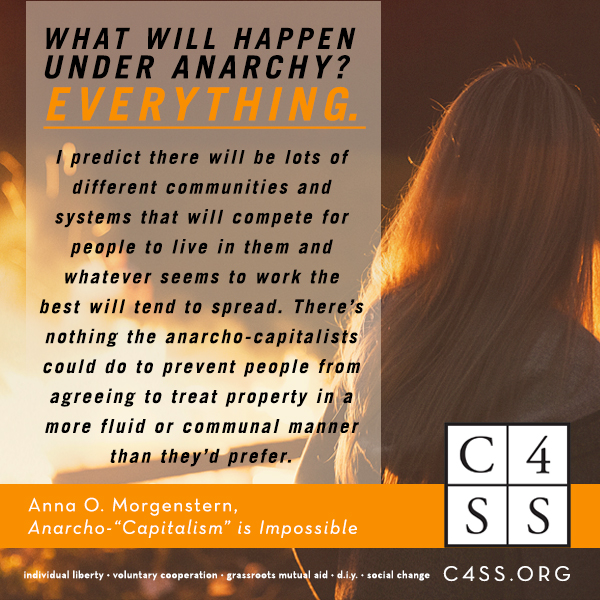
However, under anarchism, even such a strict property regime is not guaranteed. There is no way to impose it on a community that wants to operate a different way. I predict there will be lots of different communities and systems that will compete for people to live in them and whatever seems to work the best will tend to spread. There’s nothing the anarcho-capitalists could do to prevent people from agreeing to treat property in a more fluid or communal manner than they’d prefer. Nor is there anything the anarcho-socialists could do to prevent a community from organizing property in a more rigid or individualistic manner than they’d prefer.
For, just as anarcho-capitalism is impossible, anarcho-socialism is also impossible (depending on how you define things). In reality all of us who are opposed to the state, as that great fiction that some people have a special right to do things that anyone else doesn’t, are anarchists. And what will happen under anarchy? EVERYTHING.
<< Back to the Market Anarchism FAQ page
Citations to this article:
- Anna O. Morgenstern, Anarcho-“Capitalism” is Impossible, Disinformation, Economics, July 15, 2015


Ryan Allen:
“That’s called management, and it isn’t exactly democracy or any sort of cohesive social system. Everyone is free to leave the group of managers, it is voluntary. What makes capitalism work is the free flow of capital. What makes your idealized system work??”
The individual.
“This is nonsense. First you are assuming that the government subsidizes all factories”
Name one factory on in the USA that does not benefit from government.
” I won’t deny that the government subsidizes many businesses and individuals, and such measures are anti-capitalistic in the extreme, but that argument is poor even from a socialist viewpoint. Most socialists accept some variation of a labor theory of value under which the workers are exploited.”
I am not a socialist.
“Hahaha, c’mon. So you make individual determinations of each stranger you encounter whether or not you respect them as an individual?”
Yes.
“Then if you meet someone who you do not respect as an individual (say, the owner of a factory or a large shareholder in a multinational corporation) you attack them?”
Stealing from a government subsidized factory is not attacking a person.
“You are right, even though a body and a factory are both property, one is capable of doing much more work than the other. The operating factory is generally more capitalized, it has more capital.”
Which is why capitalism is bullshit. A factory is NOT more valuable than ANY individual.
“But there are ways of interacting with your fellow humans other than dominating them, such as cooperation. Given that cooperation benefits all parties involved, it is rational (that is, a better choice) to cooperate than it is to dominate.”
But capitalism, with ANY concentration of wealth, inhibits cooperation. Just like having a State subsidized police force inhibits communities from cooperating to sustain their own security.
“First look at #1. Who does we refer to???”
The world. The earth. Concentrated wealth forces scarcity on the earth because it creates scarcity of currency, which is always fiat.
“1*) Human beings are aware of the existence of a minimum amount of resources on the planet. It is a generally accepted fact that at least some amount of resources exists. These resources can be used as factors of production in the creation of products which will be sufficient in quantity that no person on the planet will ever go involuntarily hungry.”
Yes.
“2*) Private property is a widely accepted social institution.”
Which relies on the concentration of wealth. Any anthropologist or sociologist would agree that under abundance the desire for private property evaporates.
“Conclusion*: Private property (as a social institution) is a barrier to feeding the people of the world”
Yes. Thanks.
“Violence action is any use of the property of another in any way other than that to which the other consents.”
If you do not make a distinction between personal (possessions, that which you actively possess, occupy, and mix your labor with) and private property, this debate will go nowhere.
“If you come into my house, even though I left the front door unlocked, give yourself a tour and leave, that is an abuse of force.”
Stop equating your personal house with a house you do not live in or work at that you expect to extract rent profits from. They are not the same.
“Yes, you support using force and you legitimate it with democracy. You consider it legitimate because it is what the group decides.”
There is no legitimate or non-legitimate. That is a false dichotomy.
“This is where we differ. I am always willing to change my mind when a superior argument is presented. I have no allegiance to any ideology, capitalism or otherwise.”
I have allegiance only to myself, my own subjective, conditional values, and my own relative convictions. For this I take full responsibility. I have no desire to tell anyone else what they should value, and I am not trying to convince you not to value corporate held factories and real estate.
I am just saying, without government aid, these things would not exist. Of course, I could be wrong. I am fallible.
I think the best argument against my views is that without private property, innovation would not exist, because concentration of wealth (which thus far has only been enabled by force backed monopoly) may be what prompts high sum investments.
I have argued that without the government, (any monopoly on violence and also monopoly on minds via media and ignorance), concentration of wealth would not exist, because there has been no examples of this occurring in history.
But this is where my steadfast optimism comes in. I know Leonardo Da Vinci and Einstein were not curious because they were profit motivated. I know humans are inherently inquisitive and will always tinker, should they be given the opportunity.
Thus innovation would occur (perhaps faster. remember electric cars were invented alongside gas cars, but oil companies had the lobby) regardless of the lack of profit margins and class stratification.
Capitalist propertarians seem to have no such faith in humanity.
@soahc:
“This is nonsense. First you are assuming that the government subsidizes all factories”
“Name one factory on in the USA that does not benefit from government.”
Name one worker or homeless person in the USA that hasn’t benefitted from government subsidies. If you’ve set foot on a government street, you did.
“Stealing from a government subsidized factory is not attacking a person.”
So stealing from a government subsidized worker isn’t attacking a person either?
“You are right, even though a body and a factory are both property, one is capable of doing much more work than the other. The operating factory is generally more capitalized, it has more capital.”
“Which is why capitalism is bullshit. A factory is NOT more valuable than ANY individual.”
1.He didn’t claim that. He claimed is more capitalized, which it certainly is.
2.How can you say that? Value is completely subjective. Maybe I value factories more than individuals.
So capitalism is bullshit because you don’t listen to what he says and don’t get economics? That is what I thought.
“But capitalism, with ANY concentration of wealth, inhibits cooperation. Just like having a State subsidized police force inhibits communities from cooperating to sustain their own security.”
Exactly the opposite! Cooperation is only done if there are differences. If we all have the same capital and are otherwise the same, there’s no reason to cooperate. Everything you can do, I can do equally well. Everything you can bring to the table in terms of capital, I also have. If capital is concentrated, on the other hand, cooperation is suddenly good for both of us. I can work at a more capitalized level, thus being more productive, and you get to leverage your capital. Both gain.
“Concentrated wealth forces scarcity on the earth because it creates scarcity of currency, which is always fiat.”
Currency isn’t always fiat. Food can be a currency. Cigarettes.
“Which relies on the concentration of wealth. Any anthropologist or sociologist would agree that under abundance the desire for private property evaporates.”
And every sane being would agree that there is no objective abundance possible. Even if every single being on earth was rich and had a yacht, they’d want space ships and their own planet. We always want more than we have – and it’s a good thing. It drives capitalism and thus the rising of the level of wealth of everyone.
There is relative abundance. If you take a starving african child and bring him to Europe, he’d probably think of it as abundant. He’ll get more welfare in a month than his family would’ve earned in a year back home. Food is very cheap. Nobody starves. Relative to his starving home region, it is full of abundance. But after he lives here for a while, he’ll want a car. And a nicer house. And more clothes. Abundance can never be reached.
You also don’t seem to understand where the relative abundance comes from. It’s not like there’s food, shelter and cars lying around, waiting to be split up evenly amongst people. Someone made that stuff. And he owns it. So if you forbid private property, people have no incentive and no capital to create this stuff. You’re right that DaVinci would probably try to invent stuff even without recompensation. But without capital, he can’t. Because he can’t build the tools or get the resources.
“If you do not make a distinction between personal (possessions, that which you actively possess, occupy, and mix your labor with) and private property, this debate will go nowhere.”
It’s completely arbitrary. When does something become “private” and not “personal”? The two words mean the same thing.
“Stop equating your personal house with a house you do not live in or work at that you expect to extract rent profits from. They are not the same.”
Not the same. But they’re both his property. You’re arbitrarily saying it isn’t his because you don’t want him to. You’re the one making the mistake.
“I have argued that without the government, (any monopoly on violence and also monopoly on minds via media and ignorance), concentration of wealth would not exist, because there has been no examples of this occurring in history.”
There’s also no example in history of peace existing without a government. Does this prove peace can’t exist without government? No. It just proves there’s always been government.
And I think you’re wrong. Medieval Iceland. Somalia, e.g. now. There’s no government, but people concentrate capital and wealth.
“Capitalist propertarians seem to have no such faith in humanity.”
Exactly the opposite! They believe humans are awesome and nice for the most part. Which is why they don’t want to keep them in line by stealing their stuff. You, on the other hand, seem to think that everyone who gets capital will use it to hurt others. Therefore you want to force everybody not to own capital. That’s not only evil and will lead to doom, it’s also a very fearful image of human beings you seem to have.
All other anarchists besides An-Caps have very little to no knowledge of any economics. Just look at this 'post-scarcity' Venus Project non-sense. If I wish for a coke in my hand right now, or if I wish or go look to buy 500,000 cokes, and everyone on the Earth did the same, it is impossible. Therefore, there will always be scarcity because resources are not infinite. There is not an infinite mass, and similarly human demand is infinite. It is the great analysis by Rothbard that even in the so-called post-scarcity utopia of Adam and Eve, that there was still scarcity. (It is in his introductory to Austrian Economics part 1 lecture) Without an understanding of economics the rest of your philosophical and ideological thought process is worthless.
Just because you proclaim there is now post-scarcity, doesn't make it so. In fact, it is easy to demonstrate there isn't such a thing. If I steal all the cokes in the world, then it implies that cokes are scarce for everyone else. I suppose you also think oil is infinite? Or that the sun will produce infinite energy? Equally absurd. Besides, that all by-passes the point if you do not have an understanding of how things are actually produced, then you cannot claim to say anything with any certainty.
In any event I hope that all anarchists can agree upon fundamentals of private property. That allows everyone to have their own society of their own choosing. Without this basis understanding us Capitalists will be constantly fighting syndicalists and communists who steal our property. We will let you live in peace if you let us live in peace. Capiche?
"post-scarcity" just means that there are plenty of resources for everyone to have the basics, food, shelter, education, health care, etc. "Scarcity" does not refer to swimming pools full of solid-gold Porsches except to capitalist economists, who don't live in the real world. If you ask 100 people what "scarcity" means, 99 of them will talk about starvation and homelessness, and only the capitalist economist will think "scarcity" means "resources aren't infinite".
Syndicalists and communists will always be trying to take "your" property if you think you have any kind of right to land, buildings, tools, and machines which you don't use, aren't involved in, and possibly have never even seen. Property should be owned by those who use it, and no other people or organizations.
So, there will be no more vacations in the world of the communists and syndicalists? You have to work and never enjoy being away from your domecile for fear it will be stolen from you? What about cruise ships? The workers must live on the ship? The factory workers building the ship own it? How do they even know how to operate it, market it, captain a vessel, etc.?
If property cannot be traded, then you cannot say you own it. If I cannot voluntarily trade my log cabin in the mountains to an investor who wants to market it for vacationers, then how can you say I own it? It's completely absurd. Property rightfully understand comes about through the homesteading of land. Once homesteaded, the homesteader can sell the title to who he or she wishes for whatever purposes they wish. Once the new owner has the title, whether he lives there or not, sees it or not, is the rightful owner of the property. There is no other viable system of property, because it is incoherent. Of course, no one is saying that if you abandon your property that you still own it — no one says that. What I and other capitalists say is that you do not need to be on the same continent, nor do you personally have to use it, etc. to justly own something.
Do the factory workers have to sleep in the factory for fear of squatters? Do the loggers have to live in the forest? What happens if the loggers finish one area, re-plant it, and never go back there for 40 years? Can you honestly tell me the loggers do not own that area because they aren't involved in, or have any use for that area for 40+ years? Any other system of property besides the capitalist one is like I said, incoherent.
Even if there are enough foodstocks and building materials for everyone on the planet, there'll still be scarcity. You have to distribute the stuff. You have to put it together. You have to cook it. You have to clean the dishes. Without a djinni fulfilling everyones wishes, scarcity is impossible.
Now, a high standard of living for most people, that's very possible. And the best way to get there is private property and capitalism, as history and economics have shown.
"So, there will be no more vacations in the world of the communists and syndicalists? You have to work and never enjoy being away from your domecile for fear it will be stolen from you?"
No, for the same reason as when you leave your house now it doesn't immediately become regarded as being abandoned. You're still going to be personally using it in a specific way in the near future.
"What about cruise ships? The workers must live on the ship? The factory workers building the ship own it? How do they even know how to operate it, market it, captain a vessel, etc.?"
I sincerely doubt there would be the most ostentatious luxuries like cruise ships; but just to get to the point, Anarchists are not capitalists; goods and services should be distributed as gifts, not in trade. I suggest you learn at least one thing about Anarchism before you start railing against it.
If you want an incoherent system of property, it's title. Who tracks title? Who enforces title? Most of the US's land is stolen; do you recognize those titles? I agree that homesteading gives a person ownership; but why shouldn't they lose it again if they abandon the property? Title-based property ownership leads to wealth concentration that enriches a few people to the detriment of the vast majority of humanity; if good process leads to bad ends, is it a good system? (is this the part where you blame the victims for not being bootstrappy?)
"Of course, no one is saying that if you abandon your property that you still own it — no one says that."
What does "abandon" mean to a capitalist? Is there an expiration date on titles?
"Can you honestly tell me the loggers do not own that area because they aren’t involved in, or have any use for that area for 40+ years?"
No. There is no time limit to determine abandonment. As long as there is still some way to make sure people know that land is being used, and the rest of the community finds that use to be legitimate (which they will determine fairly in a healthy, functioning community), then it's not abandoned.
"Even if there are enough foodstocks and building materials for everyone on the planet, there’ll still be scarcity."
Assuming there's distribution, which is also easily within our abilities, then having enough for everyone is the definition of post-scarcity.
“Name one worker or homeless person in the USA that hasn’t benefitted from government subsidies. If you’ve set foot on a government street, you did.”
Yeah except only the difference is that wealthy corporate heads are have disposable ‘income’ and freedoms of mobility and scheduling in their life.
“So stealing from a government subsidized worker isn’t attacking a person either?”
Stealing from a corporation is not stealing from an individual. I repeat, a corporation is NOT an individual.
“2.How can you say that? Value is completely subjective. Maybe I value factories more than individuals.”
I agree, value is subjective. And I have no value for absentee ‘ownership’ and corporate personhood. And I am far form alone in these convictions. Without State subsidy, there would be no one to protect your property ‘rights’. You would be forced to do so yourself.
“So capitalism is bullshit because you don’t listen to what he says and don’t get economics? That is what I thought.”
All of the economic theories of ancaps come from a history of fiat currency. Hardly a compelling argument for what the world would look like post-State.
“If we all have the same capital and are otherwise the same, there’s no reason to cooperate.”
Some people actually enjoy cooperating. Thankfully, everyone in the the world is not like you Bleike.
“Everything you can do, I can do equally well.”
I never said this at all. People always find was to compete on some level. If we are not competing economically for mythically ‘scarce’ resources, then we will compete in art and recreation. Instead of want and desperation, we will compete as good sportsmen.
“Everything you can bring to the table in terms of capital, I also have.”
That is not true. Artisans can create beautiful things but not all of us will be as talented.
“If capital is concentrated, on the other hand, cooperation is suddenly good for both of us. I can work at a more capitalized level, thus being more productive, and you get to leverage your capital. Both gain.”
Right, because a football team is competing for capital always, rather than the status of being a winner.
“Currency isn’t always fiat. Food can be a currency. Cigarettes.”
So you are going to base a large economy on food and cigarettes, with multinational corporations and their property ‘rights’? Come on Bleike. You are living the fiat fantasy. Without government standardization of currency, your economic model fails.
“And every sane being would agree that there is no objective abundance possible.”
There is plenty of resources on this planet right now to feed, house everyone, provide clean water, a/c, cell phones and internet access.
“Even if every single being on earth was rich and had a yacht, they’d want space ships and their own planet. We always want more than we have – and it’s a good thing. It drives capitalism and thus the rising of the level of wealth of everyone.”
Good is subjective.
“Abundance can never be reached.”
Wishful thinking.
“So if you forbid private property, people have no incentive and no capital to create this stuff.”
Some people enjoy creation. Da Vinci was not into art for the money, but for the love of creation. Again, not everyone is only motivated by profit like you Bleike. Some people have more aesthetic motivations.
“You’re right that DaVinci would probably try to invent stuff even without recompensation. But without capital, he can’t. Because he can’t build the tools or get the resources.”
I am sure Da Vinci could have done just fine in a world free of absentee ownership. People would still trade goods and services.
“It’s completely arbitrary. When does something become “private” and not “personal”? The two words mean the same thing.”
Okay Bleike, fine. I’ll just revert to ‘possession vs. property.’
“There’s also no example in history of peace existing without a government. Does this prove peace can’t exist without government? No. It just proves there’s always been government.”
Are you kidding? The only peace there ever has been has been without government.
“And I think you’re wrong. Medieval Iceland. Somalia, e.g. now. There’s no government, but people concentrate capital and wealth.”
Until I go to Somalia, I will abstain from commenting on the situation there. I assume you have never been.
“Exactly the opposite! They believe humans are awesome and nice for the most part. Which is why they don’t want to keep them in line by stealing their stuff. You, on the other hand, seem to think that everyone who gets capital will use it to hurt others. Therefore you want to force everybody not to own capital. That’s not only evil and will lead to doom, it’s also a very fearful image of human beings you seem to have.”
Look Bleike, an absentee landlord, or a boss looking to profit off the labor of others, is a lazy ass. Mmmkay? A lazy vampire.
Mass accumulation of wealth only happens if one provides goods and/or services the people want at the best price. It's a democracy where people vote with their wallets. In an anarcho-capitalist world competition would be rife, not suppressed by the state, and so monopolies would be rare and short lived.
And this talk about slave wages is utter garbage. No one would be holding a gun to anyone's head. If people don't like a wage they can carry on as if that employer does not exist
There are numerous other errors in this piece, but really, I think it best to just send people to good Rothbardian websites like Mises.org and LewRockwell.com.
This negative view of capitalism is exactly what the oligarchs want. They know that free enterprise has drastically reduced world poverty and greatly empowered the people as a whole, and they see that as a threat. Hence all this Marxism in state schools, and misguided anarchists like you find here.
"And this talk about slave wages is utter garbage. No one would be holding a gun to anyone's head. If people don't like a wage they can carry on as if that employer does not exist."
Not if the state had been colluding with businessmen to enforce "IP" laws so that no one can make legitimate copies to be sold to support themselves, not if the state had been colluding with businessmen to PREVENT legitimate homesteading, not if capitalists had systematically colluded with state authorities to "privatize" productive means in their hands & left many others with nothing, so they must either starve or work for a boss, who will steal all the surplus they will have made.
Moreover, even if Capitalists, according to ancap's fairytale, earned their property to homesteading, hard work, that doesn't justify taking surplus values. Just read Benjamin Tucker: "Not to abolish wages, but to make every man dependent upon wages and to secure to every man his whole wages is the aim of Anarchistic Socialism. What Anarchistic Socialism aims to abolish is usury. It does not want to deprive labor of its reward; it wants to deprive capital of its reward. It does not hold that labor should not be sold; it holds that capital should not be hired at usury."
Wage slavery is not a feature of capitalism. This article is horrid. I'm sad to see it on C4SS.
Anna, if you define anarcho-capitalism as a society of private property, then there doesn't have to be billionaires before it can be considered capitalist. If the marginal costs of protecting a marginal accumulation of property outweigh the benefits, and we see a "cap" on each individual's wealth acquiring capacity, then the society will still be capitalist. It would still be capitalist even if it becomes difficult or impossible for individuals to do what they can do now under a state, which is accumulate a vast fortune without any additional costs of protection. For they could just incur the additional costs of protection if their revenues from selling goods is sufficient. It would be theoretically possible for billionaires to form as long as they produce more than the costs they incur, including costs of protection. You are hastily dismissing this possibility and imagining some sort of artificial "cap" on individual earning capacity. Yes, each individual is capped in terms of earning potential, but there is nothing like "$10 billion in wealth is the maximum that people can afford to protect." It might make it harder for individuals to accumulate vast fortunes without a state, but that doesn't mean they will never. It might make billionaires start appearing in 2100 AD instead of 1914 AD, or whatever.
Now, even the voluntary, more rigid socialist communities of "communal property" would still be capitalistic, vis a vis the rest of the world. For those individuals NOT in the community, who are NOT entitled to any ownership rights, are still defended against just like they would in the fact of a capitalist community. There is no difference to the individual if a community in which they have no rights of ownership over is owned by one or by a million individuals. It doesn't matter if the community's members are profit sharing, or if the community is a more fluid and dynamic individual-based wage and profit earning community. The individual non-owner still has to ask for permission from "the property owners." Individuals in both types of communities, like you said, cannot exercise property rights over the property that is legitimately owned by the members of the other community.
Otherwise, decent article. Much better that the tripe that typically accompanies critiques of AnCapism.
"Under anarchy, anyone could lend money to anyone, there would be no special thing known as a “bank” per se (or to put it a different way, anyone could put up a shingle that said “bank”). Without legal tender and the ability to create large amounts of money out of thin air (the threat of “bank runs” and/or devaluation of bank notes would effectively limit this to a very small level, enough to minimally pay for itself at most), the money supply would no longer be in the hands of a cartel. Borrowing would become rare, and saving would become widespread, distributing capital more and more widely, rather than more and more narrowly, thus diluting the price of capital. Under such a system, any shift in demand would be met by a vast array of competitors, driving profits back down to the average."
THIS, is what I define as capitalism. A system based on capital as money , and not imaginary number,
Anarcho Capitalism is as impossible as abolitionism!
Just kidding! 😀 We ended slavery because slavery it is immoral and contrary to self ownership.
The government too will end because it is immoral and contrary to self ownership.
Very good article. A lot of others at Mises Institute, for example, and Daily Anarchist, touch on the points you make here, I don't think I've read one that clearly explains things, in practical terms, as this one. Thanks!
Why is Anarcho-Capitalism impossible?
No one would rather sacrifice their individuality to work as a wage-laborer for a boss when they can work for themselves either in private single business or in democratic co-ops.
Because wage-labor is inherently authoritarian (you must obey the boss' every order) & exploitative (all the surpluses you made will be stolen by your boss, as per Lysander Spooner, not necessarily Marx), nobody who values their autonomy & want to keep their labor's fruits, if given the alternatives, would choose it. Bosses need the state to remove all alternatives so that many others must work for boss or starve to death.
Kevin Carson shows that, economically, authoritarian hierarchies are less productive (because the harder the workers work, the richer their bosses become & not themselves, so why bother to work hard?) than autonomous self-owned businesses or democratic co-ops. Hierarchical sweat-shops cannot compete, either psychologically or economically.
We need not to ban wage-labor. Just get rid of the state which enforces wage-labor, then wage-labor will collapse by itself because (1) it cannot compete economically with single private businesses & democratic co-ops, (2) no sane one will want it (bossy sadists & servile masochists don't count but they are too few anyway & we can always ignore the very few wage-labor sweatshops).
great essay! as an anarcho capitalist i find that the only real debate between the anarchisms is the competence of the other.
Markets without capital are meaningless. Such a dichotomy is highly problematic.
I see this as a failure of logic. If you say "Anarchy would not be anything we would recognize as 'capitalism'" and then go forth to list all of the supposed flaws of "capitalism" that are really just machinations of the state, that doesn't disprove the idea of capitalism.
In other words, if I say "socialism theoretically means the abolishment of private property and the principle of collective action towards human progress, but anarchy wouldn't resemble any of the qualities of socialism that we would recognize, including massive civilian murders, starvation, etc" then I haven't disproved the theory of socialism.
This article seems to be a long, overly wordy criticism of the idea of corporate fascism and trying to guilt-by-association capitalism so that people don't try to learn about the ideas of anarcho-capitalism. Doesn't seem very intellectually honest to me.
Anarchist aren't just anti-statists. We oppose all authority. An-archy is the negation of archy, including heir-archy. "Anarcho"-capitalists therefor aren't anarchists. They are anti-statists, sure, but they aren't consistently anti-authoritarian. Just political anti-authoritarians.
So, as a AnCap, I think all your arguments here have already been refuted by other AnCaps. Anything that would be anarchism would essentially have to be Voluntaryist. That would necessarily be Capitalism. Even if ya'll wanted to start a commune and share your stuff, sure, it'd be Voluntaryist. There would be banks, companies, and competing currencies, with private ownership of property in such society, and any invaders would have to fight a well armed non-centralized group of militias and individuals.
Anyway, the State is the opposite of Capitalism, and everything that you're arguing for is Voluntaryist Capitalism, whether you know it or not.
this is one of the better joke articles I’ve read in awhile. Hell yeah! servitude to the collective!!! SLAAAVERYYY!
Capitalism: A system of social organization characterized by private ownership of the means of production – starting with my hands, sweat and ideas which I use to produce my life.
You can’t make a red rose blue by redefining it.
“People calling themselves “anarcho-capitalists” usually want to define “capitalism” as the same thing as a free market, and “socialism” as state intervention against such. But what then is a free market? If you mean simply all voluntary transactions that occur without state interference, then it’s a circular and redundant definition. In that case, all anarchists are “anarcho-capitalists”, even the most die-hard anarcho-syndicalist.”
Yes, for the billionth time yes. That is exactly what anarcho-capitalists say. And it’s what we say over and over and over again. thank you for finally admitting it. This is also how modern english dictionaries define the terms. Some anarchist’s say ancaps have “wierd” definitions. But we use the exact same definitions that dictionaries use. why are dictionary definitions “weird”. Especially considering that the different dictionaries don’t contradict one another and all define “capitalism” as “voluntary transactions that occur without state interference” just as the author describes.
I go back and forth in whether I’ll use the term “ancap” when communicating with people. I’m aware that the correct term would be “free-market individual anarchist; voluntaryist” but that’s exactly what ancaps understand themselves to be and it’s a much shorter phrasing.
However, recognizing that the term is contentious and misunderstood by other anarchists, I’ll use the more specific term, above.
I am aware that worthy American individualist anarchists like Thoreau, Spooner, Tucker etc. associated themselves with the term “socialism” but I also recognize that, much like the term “liberal”, (and to an extent “anarchist”) was claimed by Marxists re-writing history to suit their propaganda agenda.
So, at the end of the day, it’s about your audience and their bias, and communicating in a way that makes sense to them.
Long ago I recognized that people often get in arguments about how they describe or define what they believe, even when they actually agree in principle.
[…] this is a dispute between anarchists, though, that assumption is unfounded. As Jeremy Weiland, Anna Morgenstern, and others have observed, the cost of protecting one’s property naturally increases more and […]
[…] a minha resposta ao artigo de Anna Morganstern no Center for a Stateless Society intitulado “Anarcho-‘Capitalism’ Is Impossible“. […]