
John Della Volpe, Director of Polling at Harvard’s Institute of Politics, recently observed that “[r]ather than being empowered to remain active in politics … young voters are sadly becoming more disillusioned and distrustful of all things Washington.” Volpe cites an Institute of Politics poll which finds millennials’ “trust in almost every institution tested” at lows that are apparently supposed to startle and sadden us.
For Volpe, young people’s distrust of the presidency, Congress and Washington generally is an unfortunate problem, something that politicians must “take heed of,” finding a way to inspire us back into civic-mindedness.
But as a millennial myself I want to suggest that, assuming Volpe’s polling is truly representative, my generation’s cynicism about politics — our distrust of and distaste for politicians and the federal government — is a natural and healthy response to our environment.
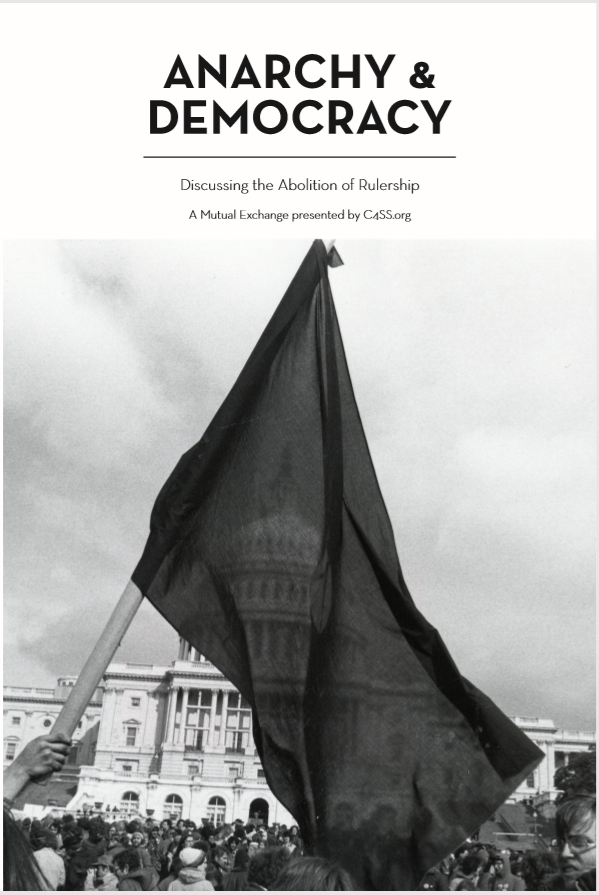
People like Volpe, the sanctimonious priests of the cult of politics, cannot believe that one might be concerned with the wellbeing of her community without caring about whether this term’s winner has an “R” or a “D” next to his name. They can’t accept that some millennials may see politics for what it is, the language of coercive force and the means by which some people lord over others. Contrary to the earnest claims of John Della Volpe and the political faithful, politics is not in fact a good or even legitimate way to confront “the fundamental challenges of our time.”
Politics is simply one group foisting its rules and preferences onto another through the use of physical force. It may appear more or less democratic, more or less liberal, but always and everywhere it is a mere facade covering conquest.
It must be difficult to be a sincere non-anarchist, for presented with any question whatsoever he must be guided by the vagaries of whim and caprice, given to random and arbitrary answers and distinctions. Instead of the principle of individual sovereignty, he must refer to expediency, but then not even truly that, only his chance feelings about it, wherever those happen to lead him.
This seems a less than ideal way of analyzing (but then we really can’t call it analysis) social questions, particularly for the non-anarchists’ neighbors, to whom his inconstant and unscientific standards must apply. Even still, anarchists do not pretend that all social questions can be solved by mere incantatory referral to the sovereignty of the individual, only that it must be our starting point and guiding principle.
Our anarchist principles established, countless questions no doubt remain, with anarchists to be found on all sides of them. For instance, what is authority or aggression? Is private property a freedom from authority or an instantiation of it? Anarchists present nuanced answers to these and other questions.
But our answers differ from those of statists to the extent that, even when we disagree, we are aiming at one target — the maximization of freedom for each individual socially and economically. All of statism is, by contrast, about control, domination, aggression, and exploitation, even in its apparently milder, more liberal forms.
If millennials are indeed shunning the political process, the takeaway may be just the opposite of what John Della Volpe thinks it is. Instead of looking to our overlords in Washington, to venal and unprincipled dead weight burdens who write laws for lobbying special interests, we might look to each other. When we work, cooperate, and trade together, outside of the establishment’s rules and regulations, we are at our most civic-minded.
My generation’s apparent aversion to politics is not apathy, but knowing, active revulsion. I’m happy to continue avoiding politics and the polls, and I welcome my peers to join me in creating something new and better outside of their brittle old system.
Translations for this article: