Handicapped or Above the Law?

Posted by on Aug 4, 2010 in Feature Articles10 comments

Coercive monopolies are bad. I doubt there is anyone on the planet left or right who would dare disagree with this abstract statement who doesn’t directly benefit from monopolistic government policies. Monopolies virtually always fail the consumer as they do not need to be flexible, innovative, efficient, provide good quality of service, or eliminate corruption from their ranks to stay in business. Without the cleansing forces of competition to be just and effective, firms of all kinds operate from within a disgustingly perverse incentive structure.

I ran headlong into the monopolists and their incentive structure this weekend, on the occasion of my speaking at the Drexel University Student Liberty Front’s summer retreat in Philadelphia. In the early afternoon, our friend Michael Gurrieri stepped outside to smoke a rolled tobacco cigarette. He didn’t smoke it all, so he extinguished the flame and pocketed the remains for later. As he did so, the Philadelphia police were crossing the street to accost him and determine if he was smoking the wrong variety of leafy growth.

They demanded that Mike reveal the cigarette, which he refused on privacy grounds. As a result he was assaulted, thrown against the wall, and told to put his hands behind his back or the officer would “break his fucking arms.” Handcuffed, Mike asked to speak to the officer’s superior before proceeding. Two other officers arrived. At this point I was summoned from out of Darian Worden’s presentation on Practical Anarchy to observe the situation. I came out of the building in the presence of Stacy Litz, the event organizer, with my camera at the ready to begin recording. I was immediately approached by an aggressive and plump law enforcement official who bellowed at me that I was interfering with a police investigation and needed to move and put my camera away. I stated that he was a public officer in public who had no reasonable expectation of privacy and inquired if he was making legal order. He asked me if I was willing to bet that what I was doing was legal and removed his handcuffs. He approached me from the side and alerted me that if I didn’t put the camera away he would make it “his personal property” and take me down to the station. I backed up a little bit and pulled my camera up once more, at which point his temper broke and he erupted that he would “[expletive] me up and take me to [expletive] jail” if I didn’t comply with his order.

I later found out that he was bluffing. Pennsylvania does not have prohibitions against recording interactions with police officers. It didn’t matter though. I was then filled with adrenaline and more than a little intimidated. This well-armed man I didn’t know who was ostensibly there to keep the community safe was worried that I might create an accurate record of the actions of all parties. He was so opposed to my recording him and his cohorts that he threatened the brutalize me, abduct me, and then throw me in a cage.

If my friend had thereafter acted wrongly, then my video would have reflected his behavior and vindicated police retaliation, if not morally than at least in the eyes of the public. If the police had performed in an unprofessional or excessive way then the aggressors would be the subject of scrutiny. If they were going to continue in a just manner, wouldn’t they want their conduct a matter of public record to make sure that any subsequent use of force against the ‘perp’ was legitimate in case he later claimed otherwise? Their aversion to being recording clearly indicates their intentions to act maliciously against their victims and remain unaccountable for their transgressions.

Sadly, I didn’t know Philadelphia or Pennsylvania law well enough at that moment, so I wasn’t about to risk a bloodied body, obliterated or confiscated property, and a protracted legal endeavor for what very well might turn into another bogus and expensive wiretapping case for yet another liberty activist. Luckily, the ordeal ended soon, with Mike being released by his captors after a ‘good cop’ detailed him a twenty minute justification of the assault they had just committed.

Supposedly, when they saw Mike put the cigarette in his pocket they didn’t know if he had a gun (smokers are usually armed, apparently) so they needed to make sure that everyone in the community was safe. Well, except for Mike. Consciences of the cops salved, we returned to our conference and collectively decompressed from the absurdity we had just experienced.

This is a clear anecdotal example for minarchists of why having a monopoly on the most crucial services of justice and defense systems should be subject to market forces. The thugs we encountered that day in Philly could never behave so poorly in a world where the people who paid their bills could begin purchasing rights-protection services from other less abusive providers. Even with moral outrage removed from the mind of the consumer and only economic effects taken into account, firms that recklessly aggressed against innocent people would have to charge more due to their increased liability and legal exposure, and would thus continually lose market share until they ceased to exist.

Without coercive monopolistic control of this market sector, police officers may even actively seek to record their own behavior for public record, both to assure their own firm of their continued reliability and professionalism as well as to disprove any false accusations of illegitimate behavior from competitors.

We weren’t done with the monopolists that day just yet, however.

Later that night, when our reflections on the excitement of the day had nearly petered out, we went to the closing social to have a few drinks and bring the event to a conclusion. A group wanted to have a smoke, so some of us followed them outside to keep them company, spotting a few grazing cops on our way out. In front of the restaurant was a handicapped parking space occupied by, you guessed it, a squad car. Seeking some small token of justice from his assault at the hands of the blue shirt gang that morning, Mike took the initiative and told the proprietors of the restaurant that there was someone parked in the handicapped spot who did not have the appropriate credentials. They came and checked it out, then disappeared inside to presumably alert the kindly officers that they needed to follow the laws they were supposed to be enforcing.

The lawbreakers came outside and meandered up to us to inquire as to why we couldn’t have just asked them personally to move it. Mike calmly retorted that he was being righteous and following the law, to which the cop replied that he was actually “being retarded.” As he walked away, we asked him if he was handicapped or above the law. He grumbled, possibly affirming that he was both.
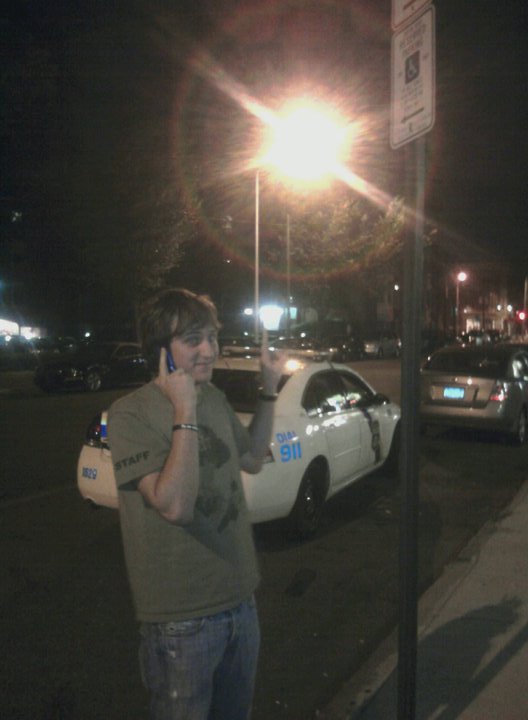
Police abuse of handicapped spot in Philadelphia, Pennsylvania.
Police abuse of handicapped spot in Philadelphia, Pennsylvania.
C4SS Research Assistant Ross Kenyon serves on the Executive Board of Alumni For Liberty, on the Board of Directors of the Association of Libertarian Feminists, and is an essayist with the ALLiance of the Libertarian Left. He is interested in questions of culture, being, language, and community.

Tags: , , , , ,

10 comments

» Comments RSS Feed
  1. Looks like the squad car is about four feet from curb. Parking like that will just about get you a DWI in Kansas City (if you're not a cop).

  2. Unfortunately, it didn't really matter what the law actually was. If you'd stood your ground based on the argument that the cop was a public figure, he really would have just fucked you up and taken you to jail, regardless of what the law said. He might or might not have gotten a reprimand after the fact–and cops would have continued to adopt menacing poses toward people with cameras in the reasonable expectation that they could get a bluff in. For people in uniform, there is no law.

  3. A little background:

    The Drexel Police are new on campus, about a year old, in an attempt to make the campus “seem” safer, especially to parents who are sending their kids to a city school. Our neighbors at UPenn have a police force, so of course Drexel feels like it has to keep up to a near-Ivy League school’s standards.

    Since being around, every day I see the cops pulling over someone on a major street during rush hour. Racking in revenue for the city and stalling traffic are their specialties.

    I have heard that they have not made ANY arrests since being on campus. The Philadelphia police are always around, so the Drexel poilce are unnecessary. Most of what they do is found in parking illegally in no parking zones, in handicap zones and now, I suppose they are starting trouble with innocent people! I cannot even begin to tell you how many photos I have collected of the police parked illegally when they go inside somewhere to eat. Really, they don’t do much but cost a LOT of money for students, raising tuition costs that are already incredibly high and growing every year.

    They have about 10-12 cars, I believe. Plus 2-3 swat vans and 2-3 undercover police cars (normal looking cars that are actually police cars)

    Oh yes, and did I mention that we already have a public safety private security system on campus? While they don’t have guns and night sticks, they keep the peace by INFORMING students if they are doing something wrong rather than arresting them. IE if a student is found drinking publically/smoking/etc, the public safety will say, “Psst, go away! Hide that! Be quiet! Etc.” The cop, on the other hand, has the authority to ARREST students. Ridiculous.

    Other complaints: Police leave cars idling, police do nothing to help students (P.S. at least escort students, look out for peace, found on every corner, etc.). Police often drive recklessly around campus.

    But anyway, their behavior this weekend, the fascist way they presented themselves with NO RESPECT for us, their public swearing/obscenities, and their disregard for the laws that THEY MUST FOLLOW has blown me away. “We’re only protecting the students.” No. No you’re not. I feel more unsafe than ever!

    Rant finished. <3

  4. Stacy Litz: "They have about 10-12 cars, I believe. Plus 2-3 swat vans and 2-3 undercover police cars (normal looking cars that are actually police cars)"

    University police with SWAT trucks? What is this world coming to?

  5. what i don't understand, is why you think that market forces would solve this problem of aggressive authority? i suppose i shouldn't be suprised since you said 'anecdotal evidence for minarchists', instead of 'anarchists'. but it is beyond me why you think that an organization like triple canopy or blackwater (xe) wouldn't act exactly the same. the same people who work in police forces on average have also rotated in and out of jobs with the military and contractor companies. the problem you're experiencing here, is people who believe they have authority over you. who pays them may be a part of the problem, but it is by no means the entire problem. they may be more careful if you specifically write them a check (isn't that bribery anyway?), but what about that homeless person down the street? and what about them roughing you up for dropping their contract?

  6. @Joe:

    Thanks for the question. Its definitely a good one. There is a lot written on this, but I’ll try and give you a really quick answer.

    I’d start by pointing out that Blackwater and Triple Canopy get about 90% of their contracts from the state, so they aren’t really fantastic examples of free market actors. A monopoly just outsources to them, so they’re pretty damn unaccountable too.

    I gave a few reasons in this essay:

    Monopolistic service providers are highly dangerous, have no incentive to please the customer or eliminate corruption/inefficiency, and consumers can’t stop paying them, no matter what.

    I spoke about free market protectors desiring to film themselves to prove to their competitors, (potential) consumers, and the world at large that they are reliable and just. If not, someone else would do it and steal their business. If you could sue the people that acted like cops, they’d be way more careful, because litigation can be expensive, and expensive means you lose the bottom line you need to survive.

    Its just as much bribery as it is to bribe a baker for baked goods. I don’t trust a spirit of altruism with police officers to look out for my best interests. They’re looking out for #1, like most people, and at least the profit incentive can encourage them to be just through competition.

    A free society would be far more wealthy than what we have now, without all of the bureaucratic overhead and constant destruction of wealth through inflation and war, but if you want to see the involuntarily homeless protected and helped, start a mutual aid society or charity to help them. Most people are generally pretty cool and don’t like seeing others hurt, I’m sure we wouldn’t have a problem taking care of a few who fall on hard times.

    If they roughed me up for dropping their contract, it’d be very risky for them. They might regain my one measly contract, but they’d be risking their entire business if I sued them/went public. Its a dumb risk to take, and they’d pay for it.

  7. @joe
    Community militias. The free market collapses in the face of coercion.

  8. [...] between defense attorneys and their clients; recordings of which he sent to prosecutors. Especially when private citizens in Pennsylvania can’t even record the public actions of police officers with…, it is indicative of a troubling double standard in wiretap procedures that a law enforcement [...]

  9. [...] Handicapped or Above the Law? Tags: America, american geographical society, conservative religious beliefs, country, government, Rich, U. S, U. S. As, U. S. Economy, U. S. Government, United States, US Published by admin on Sep 25, 2010 under 1 | Post your comment now Find out more: legallife.info/?p=1169 here. « legal articles [...]

  10. [...] Handicapped or Above the Law? Tags: legal aid society, mashable blog Published by admin on Oct 2, 2010 under 1 | Post your comment now Find out more: legallife.info/?p=1301 here. « legal articles [...]

Leave a comment