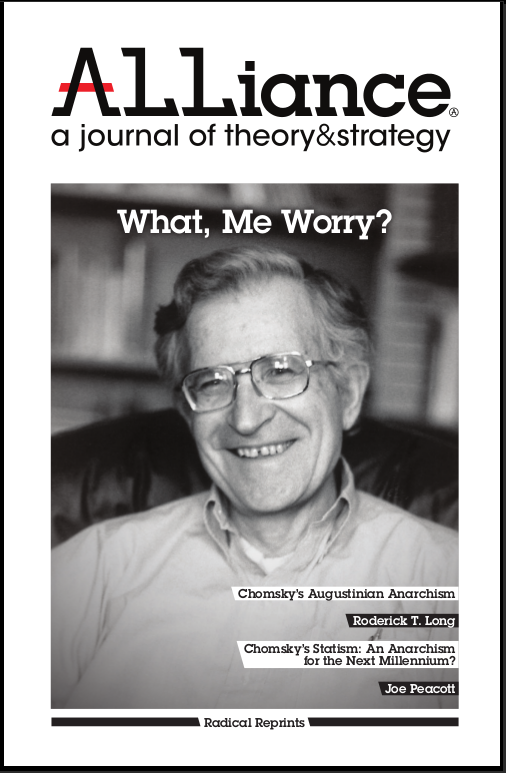
Chomsky’s Augustinian Anarchism
Posted by Roderick Long on Jan 7, 2010 in Feature Articles • 10 comments[ed: The following essay by Molinari Institute President Dr. Roderick Long was originally published on a now defunct blog, The Art of the Possible.]
Noam Chomsky is perhaps the United States’ best-known anarchist. There’s a certain irony to this, however; for just as St. Augustine once prayed, “Grant me chastity and continence, but not yet,” Chomsky’s aim is in effect anarchy, but not yet.
Chomsky’s reason for the “not yet” is that a powerful central government is currently necessary as a bulwark against the power of the corporate elite; thus it will not be safe to abolish or even scale back the state until we first use the state to break the power of the corporate elite:
“In the long term, I think the centralized political power ought to be eliminated and dissolved and turned down ultimately to the local level, finally, with federalism and associations and so on. On the other hand, right now, I’d like to strengthen the federal government. The reason is, we live in this world, not some other world. And in this world there happen to be huge concentrations of private power that are as close to tyranny and as close to totalitarian as anything humans have devised.
There’s only one way of defending rights that have been attained, or of extending their scope in the face of these private powers, and that’s to maintain the one form of illegitimate power that happens to be somewhat responsible to the public and which the public can indeed influence.” — You Say You Want a Devolution
Now Chomsky’s notion of the state as a crucial bulwark against “concentrations of private power” might initially seem puzzling, given that – as Chomsky’s own research has confirmed time and again – the state has historically been the chief enabler of such concentrations. But what Chomsky seems to mean is not so much that it generally acts as a bulwark now, but rather that it can be made to do so; if you’re facing a much stronger opponent (private power) who also has a sword (government power), you’re better off trying to grab the sword and use it against him than you would be simply destroying the sword.
“The government is far from benign – that’s true. On the other hand, it’s at least partially accountable, and it can become as benign as we make it.
What’s not benign (what’s extremely harmful, in fact) is something you didn’t mention – business power, which is highly concentrated and, by now, largely transnational. Business power is very far from benign and it’s completely unaccountable. It’s a totalitarian system that has an enormous effect on our lives. It’s also the main reason why the government isn’t benign.” — On Gun Control
There are two assumptions here with which I want to take issue.
First, Chomsky assumes that the influence of private business on government is “the main reason why the government isn’t benign.” Why on earth does he believe this? Monopoly power tends to invite abuse, whether those who direct that power are mostly within or mostly outside the state apparatus. If Chomsky thinks government would be so harmless without evil capitalists pulling the strings, why does he want to abolish it even in the long run?
Second, Chomsky assumes that state power is “partially accountable” while business power is “completely unaccountable.” Now to begin with, I’m not sure whether the accountability of state power is here being contrasted with that of actually existing, state-enabled business power or instead with the accountability of business power as it would be without governmental support. But if it’s the former, then the contrast, even if correct, would provide no grounds for resisting the state’s abolition; the fact that X + Y is more dangerous than X by itself is not a good reason to defend X. The contrast is relevant to a defense of the state only if business, without state support, would still be less accountable than the state. And here it seems obvious that the state – even a democratic state – is far less accountable than genuinely private business.
After all, a business can get your labour and/or possessions only if you agree to hand them over, while a government can extract these by force. Of course you can try to vote your current representatives out of office, but only at multiple-year intervals, and only if you convince 51 % of your neighbours to do likewise; whereas you can terminate your relationship with a business at any time, and without getting others to go along. Moreover, each candidate offers a package-deal of policies, whereas with private enterprise I can choose, say, Grocery A’s vegetables and Grocery B’s meats.
David Friedman illuminates the contrast:
“When a consumer buys a product on the market, he can compare alternative brands. … When you elect a politician, you buy nothing but promises. … You can compare 1968 Fords, Chryslers, and Volkswagens, but nobody will ever be able to compare the Nixon administration of 1968 with the Humphrey and Wallace administrations of the same year. It is as if we had only Fords from 1920 to 1928, Chryslers from 1928 to 1936, and then had to decide what firm would make a better car for the next four years….
Not only does a consumer have better information than a voter, it is of more use to him. If I investigate alternative brands of cars …. decide which is best for me, and buy it, I get it. If I investigate alternative politicians and vote accordingly, I get what the majority votes for. …
Imagine buying cars the way we buy governments. Ten thousand people would get together and agree to vote, each for the car he preferred. Whichever car won, each of the ten thousand would have to buy it. It would not pay any of us to make any serious effort to find out which car was best; whatever I decide, my car is being picked for me by the other members of the group. … This is how I must buy products on the political marketplace. I not only cannot compare the alternative products, it would not be worth my while to do so even if I could.” — The Machinery of Freedom
The “accountability” provided by democratic government seems laughable by comparison with the accountability provided by the market. The chief function of the ballot, it would seem, is to make the populace more tractable by convincing them they’re somehow in charge.
None of this should be news to Chomsky, who after all has himself pointed out:
“As things now stand, the electoral process is a matter of the population being permitted every once in a while to choose among virtually identical representatives of business power. That’s better than having a dictator, but it’s a very limited form of democracy. Most of the population realizes that and doesn’t even participate. … And of course elections are almost completely purchased. In the last congressional elections, 95 percent of the victors in the election outspent their opponents, and campaigns were overwhelmingly funded by corporations.” — Chomsky’s Other Revolution
Well, yes, exactly. So what is the basis of Chomsky’s faith in the democratic state?
Chomsky might object that my defense of market accountability ignores the fact that such “accountability” involves voting with dollars, so that the wealthy have more votes than the poor – whereas in a democratic state everyone has an equal vote. But even if we leave aside the causal dependence of existing disparities of wealth on systematic state intervention – as well as the fact that government, by controlling the direction of resources it does not own, magnifies the power of the wealthy – it still remains the case that however few dollars one may have, when one votes with those dollars one gets something back, whereas when one votes with ballots one gets back nothing one was aiming for unless one happens to be voting with the majority. Which is less democratic – a system in which the effectiveness of one’s vote varies with one’s resources, or one in which 49% of the population has no effective vote at all?
Chomsky is hardly unaware that what he calls “business power” depends crucially on government intervention – since he has done as much as anyone to document this relationship. As he notes:
“Any form of concentrated power, whatever it is, is not going to want to be subjected to popular democratic control or, for that matter, to market discipline. Powerful sectors, including corporate wealth, are naturally opposed to functioning democracy, just as they’re opposed to functioning markets, for themselves, at least.” — Reflections on Democracy (emphasis added)
So if the corporate elite are so terrified of the free market, why is Chomsky so reluctant to hurl them into it?
Perhaps Chomsky’s view is that although government is needed to create these concentrations of private power, it’s not needed to maintain them, so just suppressing the state at this point in the game would leave business power intact. That’s not a crazy view, but it needs argument. After all, systematic government intervention on behalf of big business isn’t just something that happened back in the Gilded Age or the Progressive Era or the New Deal; it continues, massively and unceasingly. I wouldn’t claim (indeed I’ve denied) that private power depends solely and uniquely on state support; but it’s hard to believe that all that state support is simply superfluous, as it must be if removing such state support wouldn’t appreciably weaken businesss power.
Chomsky has said (in Answers to Eight Questions on Anarchism) that although he finds himself “in substantial agreement with people who consider themselves anarcho-capitalists on a whole range of issues,” and also “admire[s] their commitment to rationality,” he nevertheless regards the free-market version of anarchism as “a doctrinal system which, if ever implemented, would lead to forms of tyranny and oppression that have few counterparts in human history.” Why? Because “the idea of ‘free contract’ between the potentate and his starving subject is a sick joke.”
But this argument is blatantly question-begging. Chomsky is assuming the very point that’s in dispute – namely that without government intervention on behalf of the rich, the economy would be divided into “potentates” and “starving subjects.” Now it’s true that market anarchists (for reasons explained elsewhere, I prefer to avoid the term “anarcho-capitalist”) themselves have sometimes – mistakenly, in my view – described their ideal economy as looking very much like the distribution of wealth and labour roles in our present economy, only minus the state. But why should Chomsky take their word for it? If the state really is intervening massively and systematically on behalf of the “potentate” and against the “starving subject” – as Chomsky must admit that it is, since his research explicitly demonstrates just this – why on earth would he expect that power imbalance to remain unchanged once that intervention ceases?
Not only does Chomsky underestimate the resources of anarchy, but he also appears to overestimate the serviceability of the state. He writes as if, even though the state is doing lots of bad stuff now, this could all be changed if more people would vote correctly. Now it’s true enough that people voting differently can make a difference to just how bad the government is. (If enough Germans had voted differently in 1932, they could have gotten a less awful regime.) Still, at the end of the day, what’s wrong with a coercive monopoly is not that the wrong people are running it, but rather that – leaving aside its inherent injustice – such a monopoly brings with it incentival and informational perversities which there is no way to avoid (except by removing the source of the problem, the monopoly, in which case what you have is no longer a state).


Roderick, I’ve had two parallel trains of thought that lend credence to your second-to-last paragraph. They would overlap in practice, but for the sake of explanation, I’ll break them out.
First, if state power were to recede (or be pushed back), people would instinctively begin to re-skill themselves. Primarily, they would begin to show an interest in helping to grow their own food, but other skills would probably grow, too — health care, construction/maintenance, clothing production, etc. This would gradually re-focus their priorities both as workers and as consumers, and would distribute power away from big business to real people.
Second is the idea that labor creates all value. If workers began to be self-employed or mutually employed, then value stops accumulating in big business, and it begins to collapse under its own weight.
Indeed, I would very much hope that these would both happen. If the state were to disappear without them, frankly, I think Chomsky would be right — there would be a power vacuum, and local warlords would spring up very quickly.
This article, when I read it for the first time about a year ago, is one of the major reasons I became a market anarchist (from a Chomsky-ite pseudo–anarchist). The only other works I can think of that gave me as much of an ‘Aha!’ moment as this are Kevin’s “Iron Fist Behind the Invisible Hand” and some of Brad’s writings on wage slavery as it pertains to free and non-free markets.
Thanks for all your work guys.
So what are the arguments against the belief that ‘without government intervention on behalf of the rich, the economy would be divided into “potentates” and “starving subjects?”‘
Is state subsidy seen as the ONLY reason why there are huge businesses? What about competition between business ending up in only a few big players… who then can leverage economies of scale where smaller competitors cannot?
It’s a genuine question, and I don’t know the answer. Links would be appreciated if it is too far off-topic.
Estebandido, isn’t there a chicken-and-egg issue here?
@PDA — re: “What about competition between business ending up in only a few big players…”
Pretty much the definitive work on this topic is independent Marxist Gabriel Kolko’s “The Triumph of Conservatism”. It was a key piece of New Left revisionist history that Rothbard integrated into free market libertarianism. The topic has been explored since then by various radical libertarian authors.
http://en.wikipedia.org/wiki/Gabriel_Kolko
http://www.amazon.com/Triumph-Conservatism-Gabriel-Kolko/dp/0029166500
Generally, the version of things you describe (the one we’re all taught) is found to be a ruling class myth used to rationalize after the fact the state intervention in the market of the so-called “progressive era”.
In actuality, relatively open competition from small firms was eating alive the big companies that were attempting (but failing) to cartelize/monopolize the market. These big companies then resorted to backing government regulation (under cover of progressive rhetoric) to shore up their position. The same thing continues today, with (for example) the insurance companies everybody already hates being the prime beneficiaries of “health care reform”.
@Alaskan Anarchist — Thank you for your praise and support!
I’ve challenged Chomsky more than once regarding the self-contradictory nature of his statements on the free market. If big business is so massively dependent on subsidies for its day-to-day existence, how is it that government is necessary to prevent the emergence of large concentrations of private power? That’s like saying “We can’t pull the crutch away from him, or he’ll walk all over us.” He’s never yet acknowledged that there was any contradiction, and seemed mildly annoyed at the question.
PDA: Generally, government creates artificial economies of scale where none existed, or shifts them upward. It does this by imposing entry barriers, increasing capitalization requirements, and otherwise raising fixed costs that can only be amortized by large revenue streams; the higher the fixed costs, the higher the pressure to large batch production. Government also conceals a lot of the inefficiencies of large scale by subsidizing the operating costs of large organization and making centralization less costly than it would be with everyone operating on their own nickel. And it tends to cartelize markets so that cost competition isn’t as destructive to the big inefficient dinosaurs as it would otherwise be.
Esteban: It’s likely IMO that the state will be gradually hollowed out, so that civil society will have time to occupy the ground that’s vacated. The sudden collapse of the old USSR left a horribly pathological society because so much voluntary activity had been atrophied by seventy years of authoritarianism. A lot of the stuff that liberals are skeptical about (e.g. welfare states based on mutual aid and voluntary cooperation) reflects their acceptance of a relatively recent phenomenon as “normal.” For most of human history, voluntary communalism was the primary means by which the disabled and old were supported; and it worked pretty well in many cases DESPITE peasants and townsfolk being gouged by taxes and feudal rents. It’s only in the past two or three centuries that the state has ceased to be a distant tribute-collector superimposed on a society of self-governing communities, and has instead put itself forth as the only legitimate embodiment of society and suppressed all competing forms of organization.
Let me perhaps explain Chomsky’s point better. The main point that separates Chomskian left-libertarianism from anarcho-capitalist is the capitalist workplace characterized by the voluntary contract for the renting of people, i.e., the employment contract. Right-libertarians tend to parse the issue solely in terms of consent as in Nozick’s acceptance of a voluntary contract to self oneself, not to mention rent oneself out. In political terms, the employment contract is like a little Hobbesian pactum subjectionis, a contract of subjection, to make oneself a subject rather than a citizen in the workplace. The key difference between a pactum subjectionis and a democratic contract or constitution of governance is not the consent, which is by assumption there in both cases, but the question about whether the contract alienates and transfers the right of self-government to some sovereign or master (the old name of the employment relation was the master-servant relation) who then rules in his own name, and a contract which only sets up a representative or trust relationship so that the government is then in the name of the people being governed (”for the people” in theory). In spite of all the flaws in the democratic state (which I don’t have to dwell on here) it is at least in theory a democratic relationship. In contrast, the employment contract is not even in theory democratic; the employer is not even in theory the representative or trustee of those being managed within the scope of the contract, the employees. That is the root distinction behind Chomsky’s lingering respect or hope for institutions that are at least in theory democratic and his condemnation of the capitalist firm that is not even democratic in theory. In the past the sophisticated defense of slavery and autocracy was by interpreting them as based on implicit voluntary slavery contracts and the political pacts of subjection (both of which were accepted by Nozick and his anarcho-capitalist progeny). The critique of such contracts was developed in the theory of inalienable rights (rights inherently inalienable even with consent) that descends from the Reformation (inalienability of conscience) primarily through the Scottish Enlightenment and was developed in the historical abolitionist and democratic movements. Unfortunately, this history was almost completely lost in the triumph of classical liberalism which parsed the basic issue solely in terms of consent and thus lost the traditional theory of rights inalienable even with consent–all in the service of an economy built on the institution of renting people, the employment contract.
PDA, you wrote “Is state subsidy seen as the ONLY reason why there are huge businesses? What about competition between business ending up in only a few big players… who then can leverage economies of scale where smaller competitors cannot?”
Leaving aside the fact that economies of scale stop at a certain point unless they are artificially boosted by outside intervention, something others have addressed, there is something else. Without corporate structures, “big players” are themselves inherently limited by internal effects. One man couldn’t get that big as he couldn’t be everywhere, and in any case he wouldn’t last for ever. A group working together would amount to a cartel and would have the same pressures tending to split up its members as a cartel.
Kevin Carson, you wrote ‘If big business is so massively dependent on subsidies for its day-to-day existence, how is it that government is necessary to prevent the emergence of large concentrations of private power? That’s like saying “We can’t pull the crutch away from him, or he’ll walk all over us.” [Chomsky has] never yet acknowledged that there was any contradiction…’.
This is omitting a time scale issue that has been used to create a “poison pill” that drives precisely this, so there really is a need to restrain them while they last – only, like the poison pill dynamic, that tends to perpetuate the status quo that favours them (”…always keep a-hold of Nurse/For fear of finding something worse” – Hillaire Belloc). Large concentrations would indeed persist for a material period; they are often not dependent on subsidies day-to-day. If the supporting structure were withdrawn, for a while they would do all sorts of things without even long term incentives to restrain them.
For instance, consider what happened when the Reformation finally ended the already failing supporting structure that held together the Teutonic Knights along the Baltic: “The monastic state in Prussia was secularized in 1525 during the Protestant Reformation and was replaced by the Duchy of Prussia in eastern Prussia. The western part of Teutonic Prussia was separated in 1454/60 into Royal Prussia and became part of Poland.” The corporate structure created by monasticism under catholicism broke up into parts, but as it went it took more and more – and one of the parts grew via the Duchy of Prussia into the Kingdom of Prussia.
Think of the well known danger incurred by shooting someone fatally but not immediately so, without enough stopping power; then recall Machiavelli’s dictum about never doing an enemy a small injury, for it leaves him means and gives him motive to retaliate.
You also wrote “For most of human history, voluntary communalism was the primary means by which the disabled and old were supported; and it worked pretty well in many cases DESPITE peasants and townsfolk being gouged by taxes and feudal rents”.
Ah… I have myself observed the problems this approach produces in developing countries once advances start. Hordes of importunate relatives descend on any family member who starts to do well, dragging everyone back at least as much as any formalised support system with costs spread via taxes. It actually needs a measure of customary restraint as well, so only the temporarily or permanently needy take it up.
PDA: two quick comments on “national defense”–
1. In a stateless society, obviously, there wouldn’t be nations to defend–there would be much smaller voluntary networks and communities. No one could seek to attack everyone in a vast geographic area by attacking a specific city or installation. “Kill the body and the head will die” works only if there is a single head–and, indeed, a single body.
2. The kind of defense-related issues that seem most to trouble people arise precisely because there are nation-states. A state with imperial ambitions provokes attacks by its victims and their allies. In the absence of a state, there’s no entity in the business of pursuing imperial projects, and thus no reason to worry about blow-back from those projects.
Gary Chartier, further to your first point, being decentralised that way opens up the use of other strategies against the decentralised, ones that are themselves decentralised and are usually made less practical by centralised forces. For instance, consider the Spanish Reconquista or the pacification of Ireland from the Middle Ages onwards, between flare ups.
On the second point, consider that there are other motives for aggression, so that while getting rid of one would be an improvement it would not do the whole job.