Copyright Communism?
Posted by Kevin Carson on May 15, 2009 in Commentary • 8 commentsIn a 2005 interview, Bill Gates dismissed the free culture/open source movement as “some new modern-day sort of communists who want to get rid of the incentive for musicians and moviemakers and software makers under various guises.”
Never mind Gates’ own hypocrisy on the subject. Never mind that he developed Microsoft’s BASIC compiler by a classic open source method: “The best way to prepare is to write programs, and to study great programs that other people have written. In my case, I went to the garbage cans at the Computer Science Center and I fished out listings of their operating systems.” Never mind that this enthusiastic dumpster diver had the nerve to write a letter to the Homebrew Computer Club Newsletter in 1976, whining that the widespread infringment of BASIC was taking food out of his mouth (”most of you steal your software”) — despite being a multi-million dollar trust fund baby from birth.
Never mind what Gates practiced. Many a fortune founded in robbery has been sanctified by time.
What matters, rather, is what he preaches: if you don’t believe a return on effort should be guaranteed by the state, you’re a communist.
But as the American individualist anarchist Benjamin Tucker observed more than a century ago, removing privilege and monopoly means that free market competition will cause the benefits of innovation to be “socialized.”
The normal process, in a free market without entry barriers, is for an innovator to derive short-term economic rents from being the first on the market, and for those rents then to decline to nothing as competitors adopt the innovation and drive price down to production cost.
So anyone who believes in genuinely free markets is a “communist.”
As many critics of “intellectual property” have pointed out, the term is inherently self-contradictory. “Intellectual property” is fundamentally at war with the principles of genuine private property. “Intellectual property” can only exist by infringing the rights of genuine, tangible property. Copyrights and patents give the holder a de facto ownership right in other people’s physical property, and prevents prohibits them from using their own property in ways that the copyright or patent holder has been granted a monopoly on.
And the reason for this, if you examine the assumptions behind IP law, is that the “artist” or “innovator” has a right to state-guaranteed returns on his investment or effort.
So if we’re Copyright Communists, then Bill Gates and his good buddies at the RIAA and MPAA are Copyright Nazis.
Fascism is a system in which government guarantees a profit to favored business interests by protecting them — at gunpoint — from market competition.
The Copyright Nazis believe the creator’s right to a profit trumps the right of people to enter the market freely and use their own property as they see fit.
We Copyright Communists believe everyone has the right to do what he wants with his own property, and that nobody is entitled to a profit from the state.
Copyright Nazism, on the other hand, is “socialism” of the perverse kind described by Noam Chomsky: socialized cost and privatized profit. The real and genuine property of the many — their property in the fruits of their own labor, and their right to do with it as they will — is “socialized” for the benefit of the privileged. Bill Gates’ watchword, in short is Adam Smith’s “vile maxim of the masters of mankind,” frequently quoted by Chomsky: “all for ourselves .. and nothing for other people.”
Another Adam Smith quote that’s relevant to the Copyright Nazis: “‘People of the same trade seldom meet together, even for merriment and diversion, but the conversation ends in a conspiracy against the public, or in some contrivance to raise prices.”
I declare myself the enemy of Gates, the MPAA and RIAA, and a friend of Adam Smith.
If this be communism, then make the most of it.
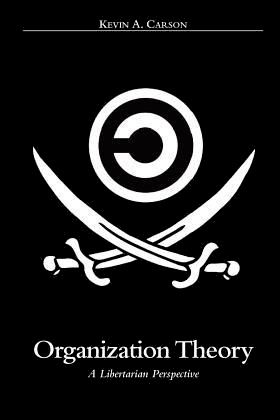
C4SS Research Associate Kevin Carson is a contemporary mutualist author and individualist anarchist whose written work includes Studies in Mutualist Political Economy and Organization Theory: An Individualist Anarchist Perspective, both of which are freely available online. Carson has also written for a variety of internet-based journals and blogs, including Just Things, The Art of the Possible, the P2P Foundation and his own Mutualist Blog.


Wow, I’m a “evil anti-property communist”!
Normally I’d call Godwin’s Law, but there’s an actual, legitimate comparison with the economic policies of the Third Reich intended here. Nevertheless, I think Mussolini’s fascism was closer to the public costs, private profits model, with the Nazis eventually moving to a more typical state-run economy.
So, then you’d be OK with me copying some or all of this post and claiming it as my own, without attribution, on the Distributist board as my own work?
The patent process is actually a way to make sure ideas get out there and are improved upon, since after the patent expires the technology is fair use. Without the technology, anyone who can keep their process secret can control it in perpetuity. Other things might never be developed, like new drugs – as any biochemist can replicate any drug and work out a production process in a short period of time.
There are shades of gray on this issue. Likely some of the current rules go too far toward regulation, especially regarding broadcasting on the Internet. There a several songs I would love to use on my blog talk radio show, however doing so is frowned upon – and the licenses you can buy are not cheap (even though I work for free – which is why I have not done a show in a while).
The way corporations reward creativity is a far bigger problem. It would seem that paying big salaries with small bonuses and owning all output is a great way to control innovation from the board room. If that is the purpose, then we have a very good system. If unlocking creativity is the purpose then salaries should go down and bonuses up, with voting stock part of the equation so that inventor influence outweighs investor influence in really creative companies. The big challenge would then be to make sure that the right people get the credit and the access to tools.
Michael: Everything I write is in the public domain. I’d have a problem if you claimed it as your own, as a matter of simple courtesy rather than one of law, because I consider plagiarism to be unethical.
Regarding the need for patents to promote innovation, I dealt with that in my latest paper for C4SS. A study by F. M. Scherer found some 80% of process and product innovations would have been developed even without patents, for the sake of competitiveness.
OTOH, by the time a process patent expires, the production technology is probably already obsolete, and the successor technology is hedged about with patents. What’s more, corporations protect patented technologies about to expire by developing and patenting all imaginable applications of them. It never ends. See discussion on patenting and R&D strategy by the Edison interests, Westinghouse, GE, etc.
First, did you hear that the ACLU is challenging a patent on a human gene?
http://www.aclu.org/brca/
As for the meat of this article, I disagree that IP is a means to guarantee a return on effort — if the invention is useless, the inventor will still receive no return on his effort. The state is actually creating a structure that aids in the internalization of the benefits coming from his effort. I think that there are plenty of grounds to criticize IP without attempting to portray it as a government guarantee of reward. (my statement assumes that the IP system is in place before the intellectual good is created; if IP is granted/extended after the good is created — as in the Mickey Mouse Protection Act — then it is simply a transfer from the public to favored interests)
“anyone who can keep their process secret can control it in perpetuity. Other things might never be developed, like new drugs – as any biochemist can replicate any drug and work out a production process in a short period of time.”
The above comment reflects conventional wisdom, and the proposed mechanisms are plausible, but I’m not aware of any research indicating that these mechanisms really matter in the real world. Indeed, I am quite sure that the politicians who imagined and implemented the IP system designed their policies without any scientific basis for the expectation that it would serve a public good.
I’ll address these concerns one by one:
First, I doubt that a modern production system could keep a process secret for a substantial period of time. Not only would this require that all of the workers keep their mouths shut, it would also require that no-one re-invent the process. As you suggested, one of the hardest parts of invention is just to understand what is achievable and useful — once the public knows that something can be done and that it will be rewarded, there typically will be an engineer who can figure out how to do it.
Second, the assertion that “other things might never be developed” seems to rest on the idea that the reduction in incentives would be the main change in the equation of innovation. However, if all IP disappeared today, the cost of production would also decrease across the board, and many inventors would have new freedom to build on the work of others.
On top of the costs of rewarding existing IP owners, and the deadweight loss of monopoly production, the IP system itself has substantial costs. The system employes armies of IP lawyers, motivates laws that restrict what tools that we can own, and requires that the US make sacrifices to its trade agenda in order to get IP laws included in trade treaties.
In the end, it is simply a question of whether the benefits outweigh the costs, but there is no way measure costs and benefits using just philosophy. Indeed, I’m skeptical that these quantities can ever be measured — even with the most advanced tools of economics. In such a situation, I support the most parsimonious system.
@Kevin_Carson: As a fence-sitter on this issue, I enjoy thoughtful commentary on it. I liked your latest paper, but I did not like this post. Here’s what I had said before:
http://blog.mises.org/archives/009946.asp#comment-544270
(Bear with me, don’t know how formatting works here, and this form isn’t helpful.)
“What matters, rather, is what he preaches: if you don’t believe a return on effort should be guaranteed by the state, you’re a communist.”
IP does not guarantee any return; for one thing, it only leads to a return if the intellectual work is worth using in the first place. And it’s only backed by the state to the extent that *any* social convention is backed by the state. Yes, today the state enforces it, just like it enforces property rights in owner-occupied houses. That doesn’t mean stateless mechanisms can’t arise to protect it, and it doesn’t mean that advocacy of IP is equivalent to endorsement of the state.
“As many critics of “intellectual property” have pointed out, the term is inherently self-contradictory. “Intellectual property” is fundamentally at war with the principles of genuine private property. “Intellectual property” can only exist by infringing the rights of genuine, tangible property.”
Sure, just like genuine, tangible property can only exist by infringing on the rights of other genuine, tangible property. Fist/nose and all that. The problem of property rights is to prove which side is justifiable. It’s not enough to say that something infringes property rights; you have to justify the infringed property right. Like Stephan_Kinsella, you assume that some act gains you the property right which includes the use asserted by an IP holder. But this is no more obvious than how much of a right you gain to the area above and below the land you claim, and in its EM spectrum rights.
“And the reason for this, if you examine the assumptions behind IP law, is that the “artist” or “innovator” has a right to state-guaranteed returns on his investment or effort.”
Again, IP is no guarantee of returns. Moreover, you are caricaturing the assumptions behind IP law. IP’s supporters advocate right of control of an idea that (in the canonical case) would not otherwise have existed. Yes, this right of control is most commonly *used* to earn a monetary return, but this is just one potential use. Someone may have non-monetary reasons for wanting to see an original idea of theirs used a certain way. Do all people claiming ownership rights in land or capital that they work, do so because it gives them a monetary return?
By the way, take a look at what I did above: I applied the same scrutiny to physical property rights, that you just did to IP rights. What does that tell you?
Mr. Carson writes, “But as the American individualist anarchist Benjamin Tucker observed more than a century ago, removing privilege and monopoly means that free market competition will cause the benefits of innovation to be ’socialized.’”
I find this a very interesting insight. It reminds me of Rothbards rationale for rejecting the free-rider argument. If I recall correctly, Rothbard said that we are all free-riders, riding on the human knowledge built up over thousands of years. Thus I must ask the rhetorical question, should we not bother using algebra out of fear that Mr. Gates will label us all “communists” for using a system of knowledge developed by others?
“Fascism is a system in which government guarantees a profit to favored business interests by protecting them — at gunpoint — from market competition.”
Well, yes, fascism can certainly adopt this economic structure. But more fundamentally, fascism is any system that sees the individual as having no value outside of her use toward the ends of the state. Militarism, hypernationalism, and corporatism are often features of fascism, but the core of the ideology is the rejection of the inherent worth of the individual.
To Mr. Binder, check out the essay “Against Intellectual Property” by N. Stephan Kinsella. It was thanks to Kinsella and a personal friend that I came to reject copyrights around a year ago.
In answer to your question: If I were to write and publish a book, and you were to publish the same exact book but with your name on the by-line rather than mine, you would not be violating my rights at all. You would, however, be defrauding your customers, and they would have every right to sue you so as to recoup their losses. If you, instead, republish my book word-for-word but you leave my name on the by-line, then you have wronged no one.
Respectfully,
Alex Peak