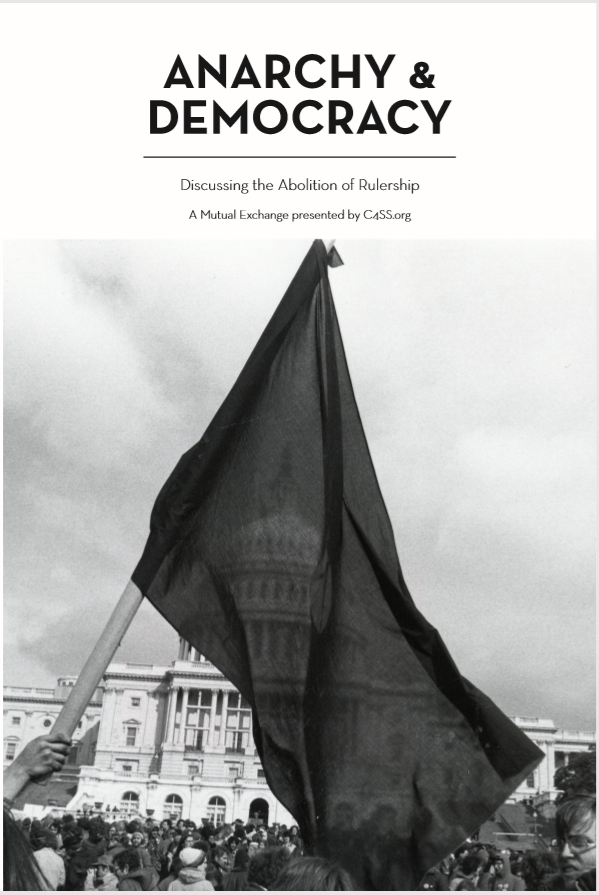
Per official democratic ideology — the ideology inculcated by politicians’ speeches, election day rhetoric, and high school civics classes — the people are sovereign. The government — our “public servants” — is agent of the popular will, and the public is the principal.
But if you look at how people actually view the state’s authority on an emotional level — and how it views us — that doctrine turns out to be 99 and 44/100% buncombe. The attitude that’s actually encouraged among the general public, and that probably prevailed among a majority at least until recently, was described by Paul Goodman in Like a Conquered Province:
“We elect an administration and it, through the intelligence service, secret diplomacy, briefings by the Department of Defense and other agencies, comes into inside information that enables it alone to understand the situation …. [T]here is a permanent group of selfless and wise public servants, experts, and impartial reporters who understand the technology, strategy, and diplomacy that we cannot understand; therefore we must perforce do what they advise.”
We’ve seen this view expressed, on a much more vulgar level, in the public reaction to Bradley Manning’s so-called “treason” in allegedly leaking hundreds of thousands of State Department cables two years ago. This comment reported by Marja Erwin is typical:
“you are so right,americans do have hatred for traitors like you. it only makes sense. to think that the government should have no secrets and everyone have access to all infomation is absurd. your arguments about government is also absurd. dont you ever think about the ramifications of what you write about?”
The perspective of the state’s functionaries is similar. In 2004 former Clinton “National Security” Advisor Sandy Berger warned, regarding waning public support for the Iraq war: “We have too much at stake … to lose the American people.” So regardless of what the civics textbooks say, our “public servants” view the state as having interests in its own right — interests to which the allegedly sovereign public must acquiesce because the state knows better.
That’s essentially the view articulated by Samuel Huntington in The Crisis of Democracy in the early 1970s. During the postwar decades, the United States had been able to act as “hegemonic power in a system of world order” only because of a domestic power structure in which the country “was governed by the president acting with the support and cooperation of key individuals and groups in the Executive office, the federal bureaucracy, Congress, and the more important businesses, banks, law firms, foundations, and media, which constitute the private establishment.”
This should all be enough to disabuse us of the idea that “government by the consent of the governed” is anything but a fairy tale. As Erwin says, “if the government keeps secrets from the public, it cannot have consent, and therefore cannot have legitimacy, and it is incoherent to claim ‘treason’ when someone reveals its secrets to the public.”
Whatever the official ideology of democracy, most people’s emotional framing of their relationship to the state is colored by their childhood socialization in relation to parental authority. Developmental psychologists tell us that children are actually socialized to view government as an extension of parental authority. The President is first viewed as a sort of Mommy or Daddy, with the American people as the family. Gradually actors like Congress, the courts, and so forth enter the picture — at first understood as simply “helpers” to the President, and only later as constitutional checks to presidential authority. But the aura of parental authority persists, on a subliminal level, even then.
According to Alice Miller that general attitude toward authority into which children are first socialized in the family, and which is later extended to the state, is decidedly unhealthy. Miller (Thou Shalt Not Be Aware) refers to this value system, which punishes critical evaluation of authority in terms of one’s own judgment, as “poisonous pedagogy.” Without this authoritarian enculturation,
“… [i]t would be inconceivable … for politicians mouthing empty cliches to attain the highest positions of power by democratic means. But since voters, who as children would normally have been capable of seeing through these cliches with the aid of their feelings, were specifically forbidden to do so in their early years, they lose this ability as adults. …
“Our whole system of raising and educating children provides the power-hungry with a ready-made railway network they can use to reach the destination of their choice. They need only push the buttons that parents and educators have already installed.”
The only framework within which genuine democracy can exist is voluntary association of equals, in which we are all recognized as ends rather than means, and our right to informed consent on matters that affect us is respected. You’ll never find that within the state.
Translations for this article:
Citations to this article:
- Kevin Carson, Consent of the governed?, Deming, New Mexico Headlight, 06/27/12


I expressed similar sentiments on a popular liberal blog (liberalforum.org) the other day. There seem to be about three kinds of responses:
1. If you don't like "our democracy" and all the wonderful benefits it has provided you, you are free to move to Somalia.
2. You're expecting perfection. It's not perfect, but that just means we need more democracy. We just need to get rid of the big money corruption, pass the right laws and elect the right people.
3. Without the state, we'll all just be plundered by unaccountable corporations. Whoever is the richest and has the most hired guns will rule over the rest of us. Now go back to your adolescent Ayn Rand fantasy land!
What do you say to these kinds of people?
There seems to be a grand degree of dishonesty which makes the 'democratic state' more insidious than the explicit dictatorship. Indeed, I prefer the kind of enemy (a Fascist for example) who will look me in the eyes and tell me he is my enemy, rather than the 'democrat' who would pretend to be my friend and garotte me from behind.
I think the following posts on my blog would be of interest to you and your readers:
'The Pointlessness of party Political Plurality': http://entitosovrano.wordpress.com/2012/06/13/the…
and, 'The Cloak of 'Decency'': http://entitosovrano.wordpress.com/2012/06/12/the…
My recent post The Pointlessness of Political Party Plurality
Here's what I'd suggest.
1. Please show me proof that "your" democracy responds to your concerns, as opposed to you conforming to what the govt and infotainment media tell you are in your best interest.
2. If that's true, then give me evidence of the incremental change you suggest. For example, in 2006 the Ds took control over the Congress, but proceeded to give Rs in the Executive everything they requested. The Ds passed laws which further eroded civil liberties, and approved bailouts which crushed the hurting people and gave largesse to the malefactors. Are those the kinds of incremental improvements you suggest are possible?
3. What you blame on "unaccountable corporations" actually is the force of human selfishness and greed, which can exist (have existed, will continue to exist) whether corporations continue to dominate the American landscape. Go on and make corporate forms illegal — the same who plunder now, will plunder under other formats. It's about power disparities in whatever form, not just about corporations. And don't think it's about reversing or vacating Citizens United. If you think that's the key, go read Buckley v Valeo.
"Are political rights under discussion? Is a legislator to be chosen? Oh! then the people possess science by instinct: they are gifted with an admirable tact; their will is always right; the general will cannot err. Suffrage cannot be too universal. Nobody is under any responsibility to society. The will and the capacity to choose well are taken for granted. Can the people be mistaken? Are we not living in an age of enlightenment? What! are the people to be always kept in leading strings? Have they not acquired their rights at the cost of effort and sacrifice? Have they not given sufficient proof of intelligence and wisdom? Are they not arrived at maturity? Are they not in a state to judge for themselves? Do they not know their own interest? Is there a man or a class who would dare to claim the right of putting himself in the place of the people, of deciding and of acting for them? No, no; the people would be free, and they shall be so. They wish to conduct their own affairs, and they shall do so.
But when once the legislator is duly elected, then indeed the style of his speech alters. The nation is sent back into passiveness, inertness, nothingness, and the legislator takes possession of omnipotence. It is for him to invent, for him to direct, for him to impel, for him to organise. Mankind has nothing to do but to submit; the hour of despotism has struck. And we must observe that this is decisive; for the people, just before so enlightened, so moral, so perfect, have no inclinations at all, or, if they have any, they all lead them downwards towards degradation." — Bastiat
"There seems to be a grand degree of dishonesty which makes the 'democratic state' more insidious than the explicit dictatorship. Indeed, I prefer the kind of enemy (a Fascist for example) who will look me in the eyes and tell me he is my enemy, rather than the 'democrat' who would pretend to be my friend and garotte me from behind. "
Absolutely. Lysander Spooner makes this point in his famous highwayman / State passage:
The State versus the Highwayman – Lysander Spooner (3 minute quote): http://www.youtube.com/watch?v=ewtA3qcm3fo
"In short, he [the highwayman] does not, in addition to robbing you, attempt to make you either his dupe or his slave [unlike the State]."
You seem critical of parental authority here. It's hard to see whether you are suggesting that it ought to be thrown out entirely; or if it is OK per se, but corrupted and utilized by the state. No one I have seen who takes this line of argument, ever seems to want to follow it to its conclusions. People say everyone should be treated as equals, but parents and children are not equals. This line only gives rise to more questions. How about a discussion about parental authority – what is it, is it sometimes good, sometimes bad, is it necessary or is it able to be dispensed with, and so forth. Yes, of course, the state co-opts and uses parental authority to their ends. But they do that with everything: rights, internet, guns, you name it, they abuse it. That does not mean these things are inherently bad.
"The twentieth century has witnessed two periods of confusion about authority. The first was the idolization of authority in the interwar years, when authority was defined inadequately and worshipped fanatically, resulting in the rejection of democracy and legality and in the condonation of dictatorship. The second was the postwar era with its New Left movement, which in various ways influenced the whole political spectrum. In the 1960s a remarkable awakening took place in academic and artistic circles, in which all authority was decried as tyranny, even the authority of the experienced over the novice, of parent over child, of teacher over student, of law over whim, of democratic decisions over sectarian goals. In conjunction with other developments, this trend created an aversion to the proper assertion of authority in Western countries and resulted in a tendency toward paralysis of society and government in the face of legal, economic, and moral disorder. Those in authority knew they should act but could not bring themselves to do so.
Both kinds of error are still with us, although the worship of political power has taken new forms. The fashion of regarding all authority as sinister or wrongfully inhibiting, whose history goes back at least to the French Revolution, has become a fixture in the modern worldview of certain leftists and certain libertarians.
If the first error consists of equating social order with coercively imposed order, the second error consists of neglecting the need for a social order or blithely assuming that order will come about solely from individual action. Some Rothbardian libertarians seem to embrace the idea of 'spontaneous order' in that sense. And some Kropotkinian anarchists seem to think that in the absence of centralist government, some spirit will move individuals to coordinate their actions without the need for a hierarchy of leadership. Both are mistaken. Order may come about without central direction in more cases than commonly thought, but no order is spontaneous in the sense that it has no human agent or organizational form. Any extensive social order requires individual initiative—that is, leadership—and hierarchy, which implies authority (although not necessarily political authority) and deference by individuals. All cooperative social order requires individuals to restrain some of their own immediate desires in deference to the injunctions of authority. A concept of freedom that does not acknowledge this necessity must remain a pipe dream. No free society can come into being except by establishing authority and placing restraints on individual action. Political authority is only the most palpable manifestation of this general truth."
–Sigmund Knag, "The Almighty, Impotent State Or, the Crisis of Authority": http://www.independent.org/pdf/tir/tir_01_3_knag….
IMO, while some claimed forms of authority, like that claimed by a national president installed through mass democracy, is artificial and evil, some forms, like parental authority or the authority of a village elder or a wise, benevolent employer, are natural and good.
::facepalm X 3::
1. False dilemma (Love it or leave it) you get this from both sides of the statist spectrum.
2. We are not Utopians. We merely seek a more free and more fair society. Obviously, things have been going in the opposite direction for quite some time. There's no reason to believe that things will get any better under the current "system".
3. We are already being plundered by unaccountable corporations in conjunction with unaccountable politicians. It is, in fact, the politicians that give the unaccountable corporations their power. Rand was, indeed, infatuated with the "successful" members of society, but she despised individuals who used government power to achieve their wealth. Egoism and egotism are two different things.
I usually call liberals on their lack of morality and ethics. They can not assign "rights" to any group which they, themselves, do not have. Watching the explosion from the cognitive dissonance is quite entertaining.
>>>a wise, benevolent employer
I once had a debate with an ultramontain royalist, which was funny since
a) this is the 21st century
b) this was Quebec, but he was channeling France far right thinkers, putting in question the relevance of the argument to the local material conditions
in any case, the royalist in question tried to put forward the argument that the best authority is that of "a wise and benevolent king" (verbatim, though I'll admit, translated from the French). I'm sure we'll find your wise, benevolent employer in the same place as his wise, benevolent king: a fantasy novel.